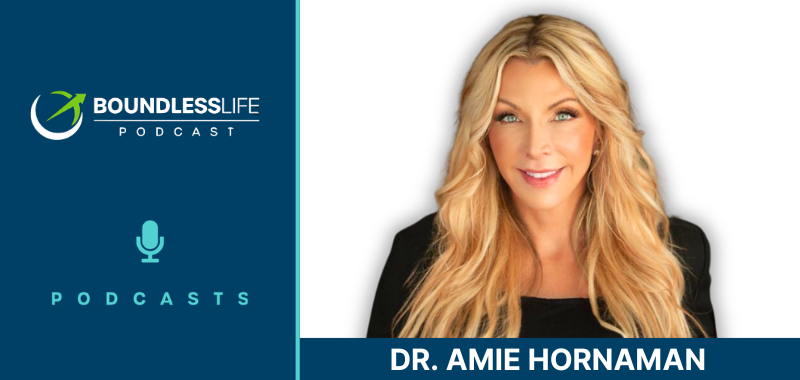
Home » Podcast » How Fixing Your THYROID Improves Fat Loss, Hair, Skin & Energy, With Dr. Amie Hornaman

How Fixing Your THYROID Improves Fat Loss, Hair, Skin & Energy, With Dr. Amie Hornaman

Listen on:

Reading time: 6 minutes

What I Discuss with Dr. Amie Hornaman:

  • How Dr. Amie Hornaman gained 25 pounds while preparing for a fitness contest on a strict diet and twice-daily workouts, while six doctors told her she was perfectly normal…01:57
  • What the seventh doctor finally found by touching her neck, and why five months on levothyroxine (Synthroid®, the inactive T4 hormone) changed nothing…05:32
  • Why testing thyroid-stimulating hormone (TSH), the pituitary signal most doctors test on its own, alone isn’t enough, and the functional range she wants you under…10:43
  • Reverse T3, the bouncer outside your cell door that blocks active thyroid hormone from getting in, and why levels of it spike in critically ill ICU patients…12:21
  • Why Hashimoto’s thyroiditis accounts for 95% of low thyroid, and how over-dieting and over-exercising can flip that autoimmune switch on…14:42
  • Three tools she layers onto Hashimoto’s care: low-dose naltrexone (a tiny, off-label dose of an addiction drug), black cumin seed (use code BEN25 for 25% off), and a gluten-free diet…16:29
  • Why only 2% of hypothyroid patients do well on T4 alone, and when she adds liothyronine (Cytomel®, the active T3 hormone)…17:34
  • Why she believes 3,5-diiodo-L-thyronine (T2, one of the four thyroid hormones) burns fat and spares muscle without shutting down your own gland…19:36
  • The Thyroid Fixxr® I took to Italy, where I ate cake for breakfast and still came home seven pounds lighter…23:00
  • What years of very low carbohydrate eating does to T3 production, and the weekly or every-other-week carb refeed she prefers to a full cheat day…25:29
  • Whether desiccated thyroid glandulars actually work, and why they can backfire for those who struggle to convert T4 to T3…28:56
  • Why she’s firmly in the pro-iodine camp, the iodine she sprays up her nose on planes, and her Brazil nut rule for selenium…31:06
  • Thymosin alpha-1 for the autoimmune attack, growth hormone peptides for hair and skin…35:44
  • Why testosterone is the most abundant hormone in a woman’s body, and why a level of 50 gets flagged high by a standard lab range…39:15

In this episode, I’m re-airing one of the most comprehensive thyroid conversations I’ve ever had, with repeat guest Dr. Amie Hornaman. Six doctors told her she was normal while she gained 25 pounds in contest prep, and the seventh found her goiter. You’ll hear why the test most doctors run misses most of the picture, which thyroid hormones actually matter, and why the standard prescription only replaces the inactive one.

We dig into T2, the thyroid hormone almost nobody talks about, and the bottle I took to Italy. You’ll also hear what years of low-carb eating does to T3, whether animal glandulars help or backfire, where iodine and selenium fit in, and which peptides she uses for Hashimoto’s. We close on testosterone for women, which is Dr. Amie’s second passion after the thyroid. If you’ve been told your thyroid labs are normal but you still feel terrible, this one’s for you.

Dr. Amie Hornaman is a doctor of clinical nutrition and functional medicine practitioner known as The Thyroid Fixer. After six doctors told her nothing was wrong during her own thyroid collapse, she rebuilt her career around the gland that failed her, and now leads a clinical team that can prescribe in all fifty states. She hosts The Thyroid (And Hormone) Fixer Podcast, a top-rated show in medicine and alternative health, and created the Fixxr® supplement line to put the tools she uses with patients, including the Thyroid Fixxr® T2 formula discussed in this episode, within reach of everyone else.

For additional insights, you can check out our previous show together below:

You can find her Fixxr® supplement line here and use code BEN10 for 10% off.

Episode Sponsors

Larine: Larine is a better-for-you chewing gum that uses nano-hydroxyapatite, the same mineral your tooth enamel is naturally made of, to help support stronger, healthier teeth while freshening your breath. It’s an easy daily habit you can use after meals or coffee, or anytime you’re on the go. Visit BuyLarine.com/BEN to get up to 50% off your order today.

TruDiagnostic: TruDiagnostic is an advanced at-home health test that uses epigenetic analysis to measure over a million biomarkers, giving you personalized, data-driven insights into your aging, energy, and overall health so you can stop guessing and start optimizing with a clear plan. Visit TruDiagnostic.com and use code BEN20 for 20% off.

ULTRA: ULTRA is a clean, nicotine-free, and caffeine-free pouch designed to deliver smooth, sustained energy and focus using clinically backed nootropics and adaptogens without the jitters, crashes, or sleep disruption. With flavors like their new Blue Razz, it’s a simple, effective way to stay sharp throughout the day. Visit takeultra.com and use code BENGREENFIELD for 15% off.

Young Goose: To experience the transformative power of Young Goose’s cutting-edge skincare products, visit younggoose.com and use code BGF10 at checkout to enjoy a 10% discount on your order.

Active Skin Repair: If you’re focused on recovery and optimizing your routine, Active Skin Repair uses hypochlorous acid, a molecule your body naturally produces, to support skin repair and defense without harsh chemicals, making it a simple, non-toxic option for everything from post-workout irritation to everyday skin support. Go to ActiveSkinRepair.com and use code BEN for 20% off, or find it on Amazon and at your local CVS.

Our Place: Upgrade to Our Place today and say goodbye to forever chemicals in your kitchen. Go to fromourplace.com/ben and enter my code BEN at checkout to receive 10% off sitewide.

Episode Resources

People

Companies & Products

Podcast Episodes

Studies & Research


Upcoming Events:

Eudēmonia | November 5–8, 2026

I’m speaking at Eudēmonia (November 5–8, 2026, in West Palm Beach, FL), a prevention-focused, science-based health, well-being, and longevity summit designed to add years to your life and life to your years. Across 3 days and 15 venues, you’ll experience 200+ talks from 120+ experts, 300 treatments, and 160+ brands covering everything from biohacking, longevity, and hormonal health to gut health, brain health, peptides, mobility, and more. I’ll be leading a talk and a movement session alongside some of the brightest minds in health today. Use code BGREENFIELD-EUD-100 for 10% off when you register here!

The Manzo x Ben Greenfield Table Private Dinner | Throughout 2026

If you want to taste one of the world’s rarest cuts of beef and experience my North Idaho biohacking compound firsthand, my family and I are hosting The Manzo x Ben Greenfield Table, an intimate, chef-catered VIP dinner on a few limited 2026 dates. The evening includes biodynamic wine, a live cooking demo, a multi-course Piedmontese feast finer than Wagyu, and a night of deep sleep in an EMF-free, fully grounded, circadian-optimized guest room. Anyone who reserves a half or whole Piedmontese bull from Manzo qualifies for a spot, so reserve your allocation and dinner here.

Summit Basecamp | February 4–7, 2027

Join me in Lake Tahoe for four days of world-class programming, outdoor adventure, live music, wellness, and real connection, all part of Summit’s global community of entrepreneurs and world-changing creatives. This is an exclusive, apply-to-join event—apply through my link, and you’ll be fast-tracked with a priority invitation. Apply to join Summit Basecamp here. 

Stay tuned for future updates—and you can always keep up with my LIVE appearances by checking out bengreenfieldlife.com/calendar!

Do you have questions, thoughts, or feedback for Dr. Amie Hornaman or me? Leave your comments below, and one of us will reply!

Ben Greenfield

My name is Ben Greenfield and on this episode of the Boundless Life Podcast

Dr. Amy Hornaman

So if your thyroid isn't working, there's nothing that is working. There's nothing that you can do. And this is what I see. They're doing the most perfect diet, the perfect exercise regimen. They're doing all the supplementation. They're doing peptides. They're doing all the things and they're not seeing the results. They'll say, listen, the scale is not moving down. And in fact, it's moving up. And that is the thyroid's control over your metabolism.

Ben Greenfield

Welcome to the Boundless Life with me, your host, Ben Greenfield. I'm a personal trainer, exercise physiologist, and nutritionist, and I'm passionate about helping you discover unparalleled levels of health, fitness, longevity, and beyond. In this episode of the Boundless Life Podcast, I'm doing a throwback to a conversation that I had with Dr. Amy Hornaman. I'm re-airing this because Amy is one of the world's leading voices in thyroid health. And this is still probably one of the most comprehensive conversations that I've had on the subject. She got misdiagnosed six times before anyone figured out what was wrong with her. And that's what sent her down this thyroid road. So if you've been told that your thyroid labs are normal and you're still feeling terrible, this one's definitely for you. Usual note neither of us is giving medical advice. This is for informational purposes only. So proceed at your own risk or benefit. The show notes are at bengreenfieldlife.com/thyroidhealth. I'm always curious when I when I talk to people who are big experts in a particular field, you know, especially for you being a doctor, you know, how'd you how'd you actually get into specializing in the thyroid? And also related to that, since your approach team's so much different than the In the standard, you know, Synthroid prescription doctor approach, you know, where'd you kind of veer away from, I don't know, standard sane medical advice and all this, you know, woo stuff.

Dr. Amy Hornaman

Into all the thyroid stuff. Well, you know, I'm like most of us in this space, it was a pain-to-purpose journey. So, like you, years ago, years ago, I competed in fitness and figure competitions. I did fitness modeling. So, I mean, you've talked about this on the podcast before. It was the chicken, fish, asparagus, gym twice a day regimen. I mean, you're you're killing yourself.

Ben Greenfield

Right, bricken, chick chicken and brown rice. Yeah.

Dr. Amy Hornaman

Good memories, such great memories, right? So I was doing all the things. I had done multiple shows before. I had done multiple preps for photo shoots before. So I knew what to do with my body. I knew what worked, what didn't work. This one show was a big one, and your listeners that compete will know it's the MPC Pittsburgh. So I was getting ready for a pretty big show at the time and checking in with my coach, you know, doing the weigh-ins, all of that. And I'm getting on the scale week after week and the scale's going up. And we know you know biologically, that doesn't make sense. Wait, whether you believe in calories in, calories out, or not, does not make sense with what I was putting into my body, what I was expending. No, didn't no, unacceptable. So I kept I kept going to my coach. We kept talking. He was trying to troubleshoot. Every week I get on the scale, 10 pounds. Fifteen pounds. Eventually twenty-five pounds heavier. Now I'm frustrated. Right. Twenty

Ben Greenfield

Yeah. And by the way, you were you were in full on competition phase, eating like you said, the chicken and rice and cutting calories, and I would imagine exercising pretty heavily, and you were up like fifteen plus pounds.

Dr. Amy Hornaman

Yeah. Yeah. I stopped weighing after it hit twenty-five plus pounds because I was just depressed. I mean, I fell into a true depression, despair. And you know, I mean, you always think like people at the gym are judging, she's not doing it right. She's eating too much. Look at her. She's just gaining weight. Here's a fitness model, not looking so good. So I did what we all do. I went to my doctor. And at the time I wasn't into functional medicine at all. I just Went to regular conventional allopathic sick medicine, trusting that they would have an answer because I knew my body was rebelling against me. So I figured, well, if I go with all my symptoms right, they're gonna test something, they're gonna tell me what's wrong. I'm gonna get an answer on a pill. So I do that and I'm told, you're normal, everything is fine. Eat less and exercise more. I was like, right, like that is even possible with the regimen that I'm on. So doctor number two. I don't stop, right? I don't accept that. I move on. Doctor number two. Doctor number three. Now we're four, five, six, all of them telling me that I'm normal. And I know, just like I'll tell your audience, you know when your body is off. You absolutely know when your body is rebelling against you and there's something wrong. So I kept plugging away. I kept going. And they all told me it's all in my head, eat less, exercise more, your BMI is fine. Meanwhile, I'm bringing in what I'm eating. I'm bringing in my exercise regimen, saying, This doesn't make sense. No one would give me an answer. Finally, Dr. Number Seven says, you have a thyroid problem. You have a goiter on your thyroid. You have Hashimoto's. We're gonna do an ultrasound and confirm it, but here's a pill. So I left her office pumped. I'm like.

Ben Greenfield

Wait, could I could I ask you something? Yeah. Guys some what's a goiter?

Dr. Amy Hornaman

It's like a little growth on your thyroid. So your thyroid is butterfly-shaped gland in your neck. So she did touch my neck and she actually said swallow. This is the first doctor to actually do the touch test of my thyroid. And she ran a couple other blood labs and said that she wanted to get an ultrasound. So she found a little, she felt some growth on my thyroid gland. So she knew that something wasn't right. And whatever numbers she looked at on paper, she called me. Hypothyroid, which I was totally okay with because I had a name for it finally, and I had a pill. Yeah. Right. So I thought, this is gonna be it. I'm gonna finally lose this weight. I'm gonna feel better. All the things. I gave it five months. Nothing happened. Absolutely nothing. Not one pound lost. I didn't feel better. I was still gaining.

Ben Greenfield

And what was the what was the pill that she gave you?

Dr. Amy Hornaman

Synthroid T four. T four. Levo Synthroid.

Ben Greenfield

And syncentroid is that's just it's just T four, which means that there's, I believe, four different thyroid hormones and the centroid replaces one of them.

Dr. Amy Hornaman

Right. And we'll get into this. We'll we'll we'll get down and dirty with the thyroid hormones. Just for right now, T four is inactive. So that's the thing to remember is that T four is totally inactive. It is standard of care though. That is what you learn in med school. You learn to test one test for the thyroid. And if it is above the standard lab value range, which we know is taken from sick people, if it's above that standard lab value range, then you're given pill and that pill is T four. Now, I mean, we could go down rabbit holes and say the makers of Synthroids sponsor med schools and give funding and all of that, but that is the standard of care. That's what's tough.

Ben Greenfield

No, don't do don't do that. I don't want to lose my pharmaceutical company sponsorship of this podcast episode. So don't go down that rabbit hole, but let's keep going. Right.

Dr. Amy Hornaman

So I was given T4, and I start Googling on my big gateway computer back in the day. What about these thyroid hormones? I'm on T4. It's not working. So I start to see this thing about other thyroid hormones that are really, really important. And I went back to my doctor and I'm like, hey, you know, maybe this regimen, this protocol that you have me on, I know it's not working. Maybe it's not the best for me. How about we try something else? She goes, I don't do that. I go find somebody who does. And that's what led me into functional medicine, where a functional medicine practitioner literally saved my life, did all the tests, changed the thyroid hormone therapy that I was on, implemented a supplement regimen that actually would work for me and work for my body and work for the numbers that he was seeing. And he became my mentor. And that's what totally changed my career. And I just thought, well, wait a minute, here I am 20 something, and I'm dealing with this in a pretty large city. I was in Pittsburgh, Pennsylvania. Pretty large city, huge medical system, right? And I'm getting the shaft. So how many other people are getting the same shaft all across the United States, let alone the world? So that's what landed me here. And I specialize in thyroid and hormones and here I am helping people.

Ben Greenfield

So what kind of doctor are you exactly?

Dr. Amy Hornaman

I'm a doctor of clinical nutrition and a functional medicine practitioner.

Ben Greenfield

Okay, okay, got it. And you took a deep dive and studied all this thyroid stuff. Who is this mentor, by the way? I wonder if I know him, the thyroid guy.

Dr. Amy Hornaman

His name is Dr. Len Bransewitz. He's in his seventies now. he practiced in Pittsburgh PA. He had his own radio show. Yeah, I don't know if he's practiced.

Ben Greenfield

Okay.

Dr. Amy Hornaman

But

Ben Greenfield

Yeah. Yeah. I don't I don't think I know of him. But the back to the back to the thyroid. When you were gaining that weight, because I am super curious about this, is it water weight or do you know when people start to see this increase in the metabolism? And just so you know, the reason I'm asking this is I'm doing some you know math in my head about the whole calories in, calories out equation, and I'm just curious if the added weight is kind of like cortisol related water retention and bloating, if it's an actual, you know, formation of new fat in response to a drop in metabolic rate, or did you ever think about that or dig into it?

Dr. Amy Hornaman

Formation of new fat based on the decrease in metabolism because your thyroid is the master. I mean, that is the start of all metabolic processes, including fat burning. So if your thyroid isn't working, there's nothing that is working. There's nothing that you can do. And this is what I see with the people that I work with. They're doing the most perfect diet, the perfect exercise regimen. They're doing all the supplementation, they're doing peptides, they're doing all the things. And they're not seeing the results. They'll say, listen, the scale is not moving down, and in fact, it's moving up. And that is the thyroid's control over your metabolism.

Ben Greenfield

Okay, got it. I got a lot of questions for you about the thyroid now. So you said earlier that the doctors run this kind of test for the thyroid and they test for certain things. Is that test inadequate?

Dr. Amy Hornaman

No, no. So you go to your doc, you say, listen, I want to get my thyroid tested. If you don't specify the test that you want, you're going to get TSH, thyroid stimulating hormone. And that's a pituitary hormone. It's not a thyroid hormone. And it's an okay test, but again, in functional medicine, we have optimal lab values. Standard conventional medicine has their standard lab value range, right? That we said earlier is taken from a group of sick people. Functional medicine takes people like you, takes the fit, the healthy, and we say, Where are they at? And that's that really narrow optimal range that we want you to fall into. So with TSH, even just that marker alone, in functional medicine, we want that below a two. Standard medicine won't call you hypo until you're above a four point five now. So It's an okay test if it's screaming at us, if someone comes in and it's like, wow, your TSH is a five. Yeah, there's a problem. But there are so many other tests that we have to test.

Ben Greenfield

Okay, so you got T S H and first of all the reference range for that you're saying should be closer to two than like four plus. So if you're looking over your lab values and I don't know, you got an inside tracker or wellness FX or your doctor scores or whatever, you might have to look a little bit more closely if that flags as A OK, because that might actually not be a proper reference range for what you would consider to be true thyroid health.

Dr. Amy Hornaman

Right. Exactly.

Ben Greenfield

Okay. What else do you test?

Dr. Amy Hornaman

Okay, so then we go down the line. We go free T three. That is the active thyroid hormone. So I mentioned I was given T four. That's inactive. We will test the free T four for sure. We'll do a total and a free T four. And that gives us a little bit of information. But where I really like to focus, where what I want to see is the total and the free T three, because that's your active thyroid hormone. And the free form of it tells me how much of that active thyroid hormone is in your body, ready to be taken up by the cell. So if we look at a cell, the receptor site on that cell is for T3. There's no receptor site on your cell for T4. There is for T3. So I want to see how much free active thyroid hormone is in your body. Then I want to look at reverse T3. So reverse T3 is your antithyroid hormone. The analogy that I love to use is a bouncer at a club. That bouncer is just standing outside your cell door, arms crossed, looking at T3, being like, you're not getting in. You're not getting in today. So if there's too much reverse T3 in the body, it's going to block T3's action at the cell level. Where we see elevator reverse T3 is in clinical settings, like the ICU, the ER. When you're injured, when you're in a trauma state, that reverse will go up and it's a survival mechanism. I mean, it's beautifully built into our bodies, but we don't want it elevated when you're walking around trying to live life. That you're not in a hospital bed. We don't want you to have elevated reverse T3. So this also tells me how well you're converting your inactive thyroid hormone T4 over into the active thyroid hormone T3. Beyond that, we test for the Hashimoto antibodies. So that's TPO and TGA. thyroperoxidase, thyroglobulin. That tells me if you have hypothyroidism that is an autoimmune form where your body's attacking your thyroid.

Ben Greenfield

Okay, got it. Would that only be for Hashimoto's that somewhere would have these elevated thyroid antibodies?

Dr. Amy Hornaman

Yeah, those are just Hashimoto antibodies. I mean, we could run like an ANA screen. That's kind of a general autoimmune marker, but the TPO and TGA are just for those autoantibodies attacking the thyroid glands.

Ben Greenfield

Okay, so you got this one subset of people who's maybe not eating enough calories or not eating enough carbohydrates and exercising too much and you're getting a down regulation of thyroid that you could that you could test, but then are you saying there's like another population of people who have an immune condition in which their thyroid is under attack?

Dr. Amy Hornaman

yeah. So 95% of all hypothyroidism is actually Hashimoto's. So we have that small percent of the people, just like you said, Ben, that they're over exercising, they're over dieting, or maybe they did chemo radiation, they're taking a drug that is downregulating their thyroid function. But 95% of hypo, low and slow thyroid patients fall into the Hashimoto category. Now it could be that. The diet and exercise, overdoing it, actually flip that autoimmune switch to the on position too. So the over exercising, over dieting, low calorie definitely will have an effect on the thyroid directly, but it's also a stressor on the body that can flip on the Hashimoto switch.

Ben Greenfield

this sounds a little bit like something like leaky gut syndrome or a food allergy where a stressful incident in life or something that triggers almost like a cell danger response syndrome causes someone to all of a sudden have an autoimmune reaction to certain foods or a permeable gut membrane that they never had to deal with otherwise in life. And there's like a life incident that flips that switch that maybe they weren't born with, but that is now activated from a from a stressful scenario.

Dr. Amy Hornaman

Yeah, exactly. It's that whole three legged stool analogy for all autoimmune conditions. We're definitely having a leaky gut, that's gonna set you up for that autoimmune switch to turn on. And then here comes that stressful event.

Ben Greenfield

Okay, gotcha. And obviously this kinda leads to the question, this is probably gonna rabbit hole a little bit, is what do you do if you find out the values are off? And it sounds like there might be two different approaches depending on which thyroid dysregulation that you're looking at, yeah?

Dr. Amy Hornaman

There is, I mean, here's the thing. Even if you have Hashimoto's, how are we going to treat you differently? Okay, we're probably going to use something like low-dose naltrexome, black human seed oil. We're going to mandate that you go gluten-free because gluten is a molecular mimicker to the thyroid. So that can induce an autoimmune attack. But I'm still going to treat those low thyroid hormones. It's not like, you have Hashimoto's, so you're going to get. T4 monotherapy while everybody else gets T4 and T3. I'm still gonna look at those, those lab values that we just talked about. And I want to get those in an optimal range. And I want to get you in an optimal range, ultimately eradicating your symptoms. So treatment might vary slightly, but at the end of the day, we want you optimized.

Ben Greenfield

Okay, got it. So let's go back to the optimized piece. I assuming that Synthroid, as you've just explained, is not necessarily the answer 'cause it's inactive T four, what would you actually do to restore thyroid function?

Dr. Amy Hornaman

So let's look at those labs, right? So let's say you're coming in with a free T3 that is suboptimal. I won't even say low because it's not necessarily going to be flagged low on that standard lab value range, but it maybe it's low according to my functional standards. Then we have to look at the fact that here's a here's a stat for you only 2% of hypothyroid patients do well on T4 monotherapy. 98% do well. On T4 and T3 or T3 alone. So right there, we have to change the treatment. If someone is on T4 only, it's not gonna work. It's not gonna work. We have to add in some T3. So let's add in some T3. We can use natural desiccated thyroid like armor or NP. I have no problem with this with the synthetics. I have no problem. If someone's on Synthroid and they're doing well and their reverse T3 is okay, it's optimal. I know they're converting their thyroid hormone, but the T3 is low. Okay, well, then let's add in some lyothyrinine. Let's add in some cytomel. Let's add in that T3 to get a better balance. Skip the middle man. Give you some of that active thyroid hormone that your body needs and that your cells require. And now all of a sudden you're feeling better. Now, if there's a reverse T3 issue where the person is having issues converting. Then we might lower the T4 and add in the T3. Maybe we do T3 only. I'm T3 only. I don't convert. I never tested my genetics to see if I have a D101 or D102 SNP, but I don't convert. You give me T4, I get worse. So I'm T3 only. Some of my patients are. It's all about that personalization aspect and finding the right combo that's gonna work for that individual.

Ben Greenfield

What about like T one and T two? Why are we just talking about three and four?

Dr. Amy Hornaman

I love, I love the other thyroid hormones. Love it. So T1 and T2, very important. T one is inactive. We can kind of set that aside, put it in the same category as T4. But T2, this baby. I've been studying T2 now for 15 years. And you know, I joke, Ben, that bodybuilders were really kind of the OGs of biohacking because I mean, you know, when you were doing it, we tried everything on ourselves. I mean, you try everything on yourself now. But we tried everything on ourselves long before it came into mainstream, right? So 15, 20 years ago, and T2 has been studied for 30 years, but about 15, 20 years ago, I started looking into it because as you know, many people, many bodybuilders, competitors, people looking to lose body fat will use T3 in order to lose body fat, whether they have a thyroid problem or not. And the problem that I saw when I was competing were especially among the ladies, a lot of these girls were using it to burn body fat, get show ready. And then they came out the other side and would put on 30, 40 pounds a couple of weeks after the show. And now they have a thyroid problem because they shut down their own thyroid production. They basically created that negative feedback loop. Now they're hypothyroid.

Ben Greenfield

Right. Sounds similar to a guy who gets on a bunch of testosterone, you know, like when they're young and, you know, inhibits fertility and LH and FSH and has this big uphill battle to climb if they ever stop taking it.

Dr. Amy Hornaman

Exactly. I mean, our bodies are smart. If we ever if we're taking something that we don't need. So T Two, not in medication form, in supplemental form. T two will decrease body fat. So it'll actually increase your basal metabolic rate. It will stimulate brown adipose tissue. And I can go into the studies on this. But in a nutshell, it protects your muscle. So where T three will come in, cause a thyroid problem. Burn fat and muscle. So now you get to the show. Now you look flat on the stage because you wasted your muscle. You come out the other side, you're going to gain 40 pounds and have a thyroid problem. T2 will only burn body fat. It will protect muscle and it will not downregulate your own thyroid. So back in the day, the trainers to the pros were using T2. And I actually saw one interview where he's like, Yeah, I don't let my women competitors use T3 at all. I give them T2 because we can get it in supplemental form. We don't have to buy it on the black market. We don't have to get a doctor to prescribe it. And hey, it's only going to burn body fat. It's not going to shut down their thyroid production afterwards. So it's actually, I mean, T2 is amazing. The technical term is 3-5 diet OL thyrinine. And it is in supplemental form. It is not in medication form, although we do see it. in natural desiccated thyroid products, the medication, the armor, the NP, because it is naturally produced by your thyroid gland. It's one of the four thyroid hormones, although it's in it's in a teeny tiny amount in the NDT medication, whereas what we use for the studies is higher.

Ben Greenfield

Yeah. So T two you call it three five diodo L thyrinine?

Dr. Amy Hornaman

Yes.

Ben Greenfield

Okay. So if I have a supplement, and that you're saying this could be like an overcaliber supplement and I want to like, I don't know, enhance brown adipose tissue activation from cold, or I want to lose fat but not lose muscle, I could literally take this as a supplement without having to get like a prescription from a doctor.

Dr. Amy Hornaman

Yes, absolutely. Yeah. I that's that's what I put in one of my formulas thyroid fixer because I've been using it for 15 years. I started using it when I was competing. I started using it with my patients and anecdotally I was just seeing these amazing results, amazing fat burning results, with no effect on their thyroid lab value. So yeah, that's the beauty of it. I mean, until, you know. The FDA clamps down on us and figures out, Hey, this is really good. Let's put it in a pill. I it's it is available in supplemental form.

Ben Greenfield

You made you made this is that this black bottle, thyroid fixer?

Dr. Amy Hornaman

That is? Yep, that's what's in fire effects.

Ben Greenfield

I did not put two and two together. Okay. Cause four bottles of that showed up at my house like two months ago. And I read the label. I wasn't quite sure about the three five Diodo L thirenine. Now it makes sense. if that's the T two, but I took a bottle to Italy and we went to Italy and since Italy I've been telling everybody we're riding all over the hill country like madmen on bicycles. I was eating cake for breakfast and gelato for lunch and pasta for dinner and came back and I'd lost seven pounds. But I now I'm wondering how much that stuff came into play 'cause I was popping three capsules of that every morning.

Dr. Amy Hornaman

Mm-hmm. Yeah. Yeah, no, it'll help.

Ben Greenfield

What's what's the downside? I mean in terms of T two? Are you gonna see any type of negative feedback loop or hormonal down regulation?

Dr. Amy Hornaman

Combed through all the studies, the rodent studies, the human studies. I have combed through them. And I cannot find a negative. There was one study that showed there's a potential down regulation of TSH, meaning your TSH might go low, in which case, okay, if it goes super low, your doctor's gonna say, my gosh, you're hyperthyroid. But that was just one single study done in rodents. All the other studies show no thyromemetic effects. So no effect on the thyroid gland itself, because this thyroid hormone T two works at the mitochondrial level. It doesn't work stimulating the thyroid to pump out more thyroid hormone. It's actually working at the mitochondrial level.

Ben Greenfield

Wanted to get your thoughts on this whole ketosis low carb thing and whether you think there's anything there as far as lack of carbohydrates suppressing thyroid.

Dr. Amy Hornaman

So the studies show that it's only in long term low carbohydrate consumption. So you know, I mean, a lot of my patients end up being insulin resistant because of the thyroid problem. So thyroid master gland controlling sex hormones, controlling all the hormones in our body, including insulin. So we see this glucose dysregulation, insulin resistance in the majority of thyroid patients. Now, what do they do? All of them go on a low carb diet because we see that they're insulin resistant. Maybe they'll throw in some berberine. But if they are low, low, low carb, like under 20 or 30 grams of carbohydrates day after day, month after month, year after year, then we will see a little bit of a down regulation in free T3 production, in the T3 production of the thyroid gland. But it's not significant enough for me to say, that low carbohydrate diet being in ketosis is bad for you because there's so many other positives. You know, whether you're doing carnivore, which okay, it has upsides and downsides, but a lot of people will do carnivore just to reduce that inflammation. And that has a fantastic effect on Hashimato antibodies and the reduction of those. So if it's if it's working for you, if the low carb diet of carnivore of being in ketosis is working and you feel better and your brain's alive and you're keeping a stable weight, then who cares if your free T3 drops a little bit? I mean you can always come out of ketosis once a week or once every two weeks. And that's enough to just kick that back up again.

Ben Greenfield

Okay, this idea of long term carbohydrate deprivation deleteriously affecting thyroid kind of makes me think about something else I wanted to ask you that you see bandied about a lot in the particular nutrition sector. And it is that you should do refeeds. And I've even seen a number thrown out there is four weeks. Like don't go any longer than four weeks without some kind of like a refeed weekend or a binge Saturday or you know a big cheat day or whatever. Because if you do that every four weeks, if you push the reboost button on your thyroid. I've seen other people say, you know, as often as every one week. But is there this is there any science behind or anything that you know about this idea of calorie cycling and having basically like refeeds on particular days of the week to keep the thyroid elevated if you're otherwise restricting calories on other days?

Dr. Amy Hornaman

Yeah, you know, I mean, I haven't seen any hardcore evidence or studies on it, but what I normally tell my patients is, and this will happen naturally because you're just living a normal life, right? Once a week, once every two weeks, go ahead and enjoy. Now I'm not talking about a cheat day where you go all out and it's like, Okay, let's do the pizza, beer, and brownie diet. But just bringing your carbohydrates up. Eat sweet potatoes, have that fruit that you've been craving. Have some dark chocolate, bring your carbohydrates up to like 100, 150, but with good quality carbohydrates. And then that's enough to bring you kind of out of that ketosis. Now, obviously, if you're metabolically efficient, you're gonna snap right back into ketosis than the next day or two, but it's enough to bring you up out, and that's all your thyroid needs. So whether it's maybe it's once a week, base it on your lifestyle, base it on your social schedule and plan it out that way so you can live a life.

Ben Greenfield

Yeah. There's like half the people, I think, who hear that and are gonna put an extra cup of blueberries in their smoothie. And then the other half of people just heard you say have donuts every Saturday. So it's it's gonna it's gonna widely vary. So with the thyroid, you talked about T2, talked about Synthroid and some of these other natural options like say armor. But what about these folks who are just using like desiccated thyroid glandula? Like you talked about the carnivore diet, right? A lot of those people, maybe because The liver king guy Brian Johnson had an ancestral supplements company and would sell these thyroid capsules. I know there's a lot of other companies. I think Heart and Soil does one. I know there's a few others out there, but it's basically just like claims to be T one, T two, T three, and T four because it's just the ground up thyroid gland of an animal. Do you think that's beneficial at all?

Dr. Amy Hornaman

So th this is a story going back about 15, 20 years, maybe 20 years ago. There was another company that had it out. And I swore one day, because I would use this with my patients and I would see lab values change and I would see improvements happen. And I said, you know, one day somebody's gonna figure out that there's T three and T four in here and take away the glandulars. And they still haven't yet. But yes, I mean it So glandulars are supposed to. And if you look on Ancestral, if you look on those companies' websites, it will say, there's no active thyroid hormone in these glandulars. But just like you said, Ben, they're drying the thyroid gland out of a cow. So is there a little guy picking out the T3 and the T four and the T2? No, I mean, those thyroid hormones are going to be dried in that thyroid gland. So yes, I do think that they are beneficial. There's a caveat though, if you are not a converter. So going back to what we talked about before about that T4 to T3 conversion, if you're not a converter, that those glandulars are 80% T4, 20% T3, just like armor thyroid, just like NP thyroid, they are 80% T4. So if someone's a non-converter and they take a glandular, they could actually get worse.

Ben Greenfield

Yeah, I see where you're going. You get you can see an elevation of reverse T3. So your bouncer in front of the cells like would actually go up. Okay, cool. That's good to know. So you'd actually have to do a little bit of pre-testing or look at that genetic SNP that you talked about before you determine if that approach might work for you. What about, you know, coming I know that's not really like a whole foods approach, although some would argue it is. But another thing that comes up a lot is the recommendation for using these seasonings that are like ground up sea vegetables, like kelp and dulci and kambu or nori, you know, eating a diet that's rich in sea vegetables and including a lot of these components in your diet. What do you think about that approach for things like iodine and selenium, for example?

Dr. Amy Hornaman

Right. So that's the iodine, yeah, the iodine selenium piece. So here's my take. And as you know, in this space that we're in, you could find 50% of the people saying Hashimoto hypothyroid patients shouldn't do iodine, and 50% will say that they should. I'm in the camp that iodine is good because if you really look at it, every cell in the body needs iodine. Just like every cell needs thyroid hormone, every cell in the body needs iodine. And when you look at the studies on iodine, iodine will Reduce reverse T3. It will help with T4 to T3 conversion. It helps your hair grow. It helps with fibrocystic breast disease. It's used it for your immune system support. So why not take iodine? We don't have to take it in excess. We don't have to take abnormal amounts that's going to cause a thyroid storm, but we can take enough for support and for conversion help. So I'm a fan of using straight-up iodine just because some of the, like you said, the seek help and the salts. I mean, you're not really getting, number one, you're probably not getting the amount of iodine that you need. And you might even overdo it if you're taking an iodine supplement and you're doing all the sea vegetables. And I mean, listen, I love me some good sushi, but I'm not going to use that as my sole source of iodine. I'm to take a really high quality iodine supplement. And then for the selenium, I see too many. my gosh, these thyroid patients, they will go on every blog, every forum. And they see selenium and then they start popping 200 megs of selenium a day. Now their selenium goes up. Now their reverse T3 goes up. So I tell people, my God, just eat a Brazil nut or two per day to get your selenium. It's cheap and you're not going to overdose on it.

Ben Greenfield

Yeah, fun fact. Keep the Brazil nuts in the freezer. Those things tend to get notoriously moldy. They don't have a good shelf life. So I actually have Brazil nuts and I keep them in the freezer and I pop a couple every now and again for primarily the selenium that you talked about. But I also interviewed a friend of mine, Dr. Leland Stillman. He said the same thing about iodine that you are really championed the idea that it actually is a helpful supplement for a lot of people. He uses it with a lot of his patients. He was taking I don't want to get this wrong. I'm gonna say what I think he said on the podcast, but I'll link to in the show notes. We may have to go back and check. But I think he said he was around somewhere in the range of 50 to 70 micrograms a day, as a little experiment that he was doing and feeling fantastic. And since talking to him and looking at a few of the options for iodine out there, I actually started a couple of times a week to take 150 micrograms of iodine, the life extension formula. And what's interesting is that I fly a lot. And if you look at all these things like bentonite clay and magnesium and chlorella that are all you know talked about as a way to combat the effects of radiation, x-ray radiation, solar radiation, even the type of radiation you might get from a dye injected during, say, like a CT angiography, which I recently got, that iodine is the only supplement that actually has scientific data behind it for helping to combat the effects of radiation exposure. So there's kind of a bonus to having it around you know if you're gonna go on a long haul flight or go get a heart scan or something like that, it appears that iodine's good for too.

Dr. Amy Hornaman

yeah. I squirt it up my nose when I'm on a plane. I keep it in a little spray bottle and dilute it with saline water and put it up my nose because it's so good for the immune system. And then for the thyroid gland, iodine will bind to the halides that are toxic to the thyroid gland. So that it's going to bind to chlorine and bromine and fluoride and all those fluoride treatments that we got as kids, right? I mean, it's going to bind to that in your body and help your body detoxify from those halides. It's only gonna help support your entire body, detoxification processes, and support your thyroid gland too. Actually protect the thyroid from all those toxins that like to attack it.

Ben Greenfield

Yeah, all you have your kids and swim or you're you're a master swimmer in the chlorinated pool all day, make sure you have some sushi or some sea vegetables, use some iodine. I wish I'd known about that when I was doing a lot of triathlon because I was in chlorine almost every day, and that's a notorious halide that affects the thyroid. So something to think about there. And then the other thing that I'm seeing a lot more of, Amy, is this idea of peptides. You know, there's the research out of Russia, Dr. Kavitson has done a lot of that research on longevity and decreased all cause risk of mortality. And improved organ function with these very small peptide bioregulators, which you know, TLDR, you c consume certain bioregulators and they go to support that specific gland that they're named after. And there's one I think it's called I'm not butchering the name, I think it's called thymocin or something like that. But you take it and apparently it helps to support the thyroid as a peptide. And a lot of people are swearing by peptide bioregulators and or peptides for thyroid support. What do you think about peptides?

Dr. Amy Hornaman

Okay, so let's do bioregulators first. Yes, I interviewed Phil Mikins on my podcast too. Fascinating. Fascinating. the thyroid gen is the peptide bioregulator. Okay. What's crazy about it is it will work whether you're hyper or hypo. I mean, it's amazing. These bioregulators come in now. You have to have a thyroid gland. So if you have a thyroidectomy or you had your thyroid radioactive iodine, not gonna work. You have to have a thyroid gland for the bioregulators to work on it. But it will literally, it's almost like an adaptogen, it but so much better. It will literally balance out the thyroid. So if you're making too much thyroid hormone and you're hyper, it's gonna calm that down. If you're making too little, it's gonna help your thyroid gland kind of amp up and produce more, kick out more thyroid hormone. So that's the bioregulator. But peptides, that's where we can get into like thymus and alpha. So we know that's immune regulating. That's going to help people with Hashimoto's because we see with Hashimoto's, like we said, it's your body attacking your thyroid gland. Your little, your little soldiers in there think your thyroid gland's a bad guy. And they're going out and they're beating it up and they're attacking it until your thyroid gland becomes like this weird-looking small, tiny little gland that can't produce T4 and T3 anymore. So when we support the immune system, use thymus and alpha, then we see a Almost like a downregulation of those autoantibodies, they start to calm down. The soldiers stay in their barracks. So peptide-wise, I love thymus and alpha. I love MOT C because we see, like I said earlier, a lot of insulin resistance with hypothyroidism and Hashimoto's. So MOT C is really good. and then just the growth hormone ones, CJC 1295, epimerelin. So many of my patients have the hair loss and they're. They'll they will literally say, I feel like I've aged 10 years in one year. So we bring on the growth hormone peptides, and now they're seeing this more luxurious hair growth and they're seeing improvements in their dry skin from their thyroid condition. And I mean, you know, it's not, it's not like the miracle fat loss drug. We know, and you've talked about this before on your podcast, these growth hormone peptides, they act slow. Like this is like a marathon, not a sprint, right? So you're not gonna see, my God, I dropped ten pounds at a month from using CJC. No. But over the long haul, when you're doing all the things, that's just gonna stack on top of your regimen and help with all of the symptoms that you're seeing.

Ben Greenfield

I just wanted to ask you while I have you on the show, I know we don't have a terribly long amount of time left together, but it's testosterone, particularly for women. Cause because I understand, I think I saw an article on your website where you talked about this, and I'm curious, what's your take on that? Because I'm hearing a lot of talk about sexual function and orgasm quality and things like this for women who use like a topical testosterone or a or a hormone replacement with testosterone. What's your take on that?

Dr. Amy Hornaman

this is this is my second passion next to thyroid is testosterone and the importance of for men and women. So, you know, I mean, really we're hearing it more and more from men these days, TRT, all of that. I mean, it's it's talked about more in mainstream, but I think women get left behind in this testosterone talk because when we talk about women's hormones, we think estrogen. We don't think testosterone. But testosterone is the most abundant hormone in a woman's body. Now, you guys have more of it, but it is our most abundant hormone. And I call it the get shit done hormone. It gives us motivation, it gives us drive, it gives us strength, it helps with body fat, it helps with libido, it helps with hair growth. I mean, it helps with so many things that if you don't have enough of it, you're not gonna wanna do anything. I mean, you're not, you're not gonna wanna have sex, yeah, but you're also not gonna wanna go to the gym. You're not gonna wanna work, you're not gonna wanna Think. You're not going to want to do. So testosterone for women is vital. Now here's the problem. Again, going back to conventional medicine and those standard lab value ranges, a woman will get cut off. And that standard lab value range, most of them end at 48 total. So I'm looking at the total testosterone right now. It'll go like two to 48. So if a woman comes in with a test level of a 50, which in my mind is the best. Bottom number for optimal. I would like my ladies at 50 or above for testosterone, total testosterone. So a woman comes in with a 50, she's getting flagged high. Her doctor is telling her, you have too much testosterone. You must have PCOS or you have an androgen problem. Meanwhile, she's just hitting the bottom of the barrel of optimal. I really think that, I mean, men, you guys get told you're normal too if your testosterone is, you know, 400. And we know that's horrible. But ladies, I love, I mean, when you get that testosterone number up and you give a woman who is low in tea, you give her testosterone replacement therapy, whether it's a cream, I will use injectable with my ladies too. trochies, however, you want to do it. The only thing I stay away from are the pellets because that's where I see female levels go to dude levels. And that's where you'll get the women saying, I lost all my hair. It's like, yeah, well, you converted the DHT because your test was a 900. So That's not a good idea.

Ben Greenfield

I was gonna say, I like I assume that you look at lab values because I would imagine if you're just looking at total T, you could put a woman on testosterone, see some like over aromatization. I don't know if excess estrogen could lead to a risk of breast cancer or something like that. Or you might see that, you know, it's not bioavailable 'cause sex hormone binding globulin is too high 'cause they're under a lot of stress. Like I would imagine similar to a man, you can't just like take testosterone as a woman and assume you're just good to go, right?

Dr. Amy Hornaman

Right. Yeah. No, it's all about the dose, the administration, how she pushes to the five alpha reductase pathway. So how she's going to aromatize her testosterone in the DHT. We look at that. And I mean, we can tweak it. We can personalize it. We can really make it fit her. So if we're using something like a cream, I'll go 10 to 20 megs per day because there's always a crapshoot with the cream with absorption and utilization. With an injectable, I mean, we can do something as simple as like 10 milligrams a week or 10 every two weeks. And that's enough to just bring I mean, it just lights a woman up. And here's the thing with the thyroid, too, tying it back. Low levels of testosterone. And this is one reason why women get hit with Hashimoto's more than men. Because again, you guys have more testosterone for protection. Testosterone protects against autoimmune. So women get hit with Hashimoto's. more often because we have lower levels of testosterone in general. And then you have the group of women that just have low T, period. And when you give that testosterone, male or female, you actually protect against autoimmune. So you can lower the Hashimoto antibodies by bringing those testosterone levels up to optimal.

Ben Greenfield

Wow, interesting. Yeah, I thought about recommending testosterone to my wife, but I thought we should just test blood first just in case. Her levels came back at sixty-eight, so I told her she's good to go. It's probably because she's just outside all day in the sunshine, pushing around wheelbarrows and you know, bringing alfalfa out to the goats and just kind of living a primal lifestyle out there. And I think she's okay on testosterone, but yeah, I think a lot of women don't know about this, and so that's really helpful to hear the reference ranges and your approach on that. You know, we're we're out of time, but Man, I mean your website is a deep dive into a lot more. You get into peptides for women and other lab tests for other hormones and you know constipation, what to do if you're losing your hair, and you know, a lot of really, really helpful advice. So I'm gonna link to your website in the show notes and to everything else that you do, and then to some other podcasts that I mentioned, like the one with Phil Mike Hans, the one with Leland Stillman, etc. So obviously a lot there. I'll take detailed show notes and get them down there for everybody at ben greenfield life.com slash thyroid fixer. And correct me if I'm wrong, Amy, but even though you're based out of Pennsylvania and kinda like the northeast area, you would do like consults or teleconsults and things like that with people.

Dr. Amy Hornaman

Yep. We can actually my team, I built a team that we can now prescribe to all 50 states because I do feel that I don't claim to be able to heal everyone's thyroid naturally or with supplements. I mean, just like we talked about, sometimes thyroid hormone replacement or Bioidentical hormone replacement with testosterone. Sometimes that is required. Oftentimes that's required. So we can prescribe to all 50 states. So absolutely, I do the one on one consults. My team does them. We can prescribe the whole the whole deal for anyone suffering.

Ben Greenfield

To discover even more tips, tricks, hacks, and content to become the most complete, boundless version of you, visit Ben GreenfieldLife.com. In compliance with the FTC guidelines, please assume the following about links and posts on this site. Most of the links going to products are often affiliate links of which I receive a small commission from sales of certain items, but the price is the same for you, and sometimes I even get to share a unique and somewhat significant discount with you. In some cases I might also be an investor in a company I mention. I'm the founder, for example, of Keon, LLC, the makers of Keon branded supplements and products, which I talk about quite a bit. Regardless of the relationship, if I post or talk about an affiliate link to a product, it is indeed something I personally use, support, and with full authenticity and transparency recommend in good conscience. I personally vet each and every product that I talk about. My first priority is providing valuable information and resources to you that help you positively optimize your mind, body, and spirit, and I'll only ever link to products or resources, affiliate or otherwise. That fit within this purpose. So there's your fancy legal disclaimer.

Ben Greenfield

Ben Greenfield is a health consultant, speaker, and New York Times bestselling author of a wide variety of books.

What's Blocking You From Living Boundless?

Thoughts on How Fixing Your THYROID Improves Fat Loss, Hair, Skin & Energy, With Dr. Amie Hornaman

Leave a Reply

Your email address will not be published. Required fields are marked *

Related Podcasts

Best of - Longevity WP

Longevity MASTERCLASS: Biological Age, Mitochondrial Repair & The Superhuman Protocol

Listen on: Reading time: 6 minutes What I Discuss with Gary Brecka, Dr. Anurag Singh & Dave Pascoe: How Gary...

Boundless Life Podcast promotional graphic featuring guest Dr. Tyna Moore, a smiling woman with short gray hair, wearing a black top with layered necklaces, against a white background. A dark blue sidebar on the left displays the podcast logo, a microphone icon, and the word 'PODCASTS,' with 'DR. TYNA MOORE' labeled in a blue banner at the bottom right.

How To Microdose GLP-1s Correctly: Lose The Fat, And KEEP The Muscle – With Dr. Tyna Moore

Listen on: Reading time: 6 minutes What I Discuss with Dr. Tyna Moore: Why I’m re-airing this conversation, where Tyna...

Ben Goertzel

This Man Thinks “AGI” Could Allow Humans To Live Forever, With Dr. Ben Goertzel

Listen on: Reading time: 6 minutes What I Discuss with Dr. Ben Goertzel: The Linus Pauling biography his grandmother started...