
August 9, 2014
Click here for the full written transcript of this podcast episode.
Until today's podcast episode, I didn't realize lasers were so darn cool, and effective for so many issues.
The laser was invented in 1960 and the biological stimulation properties of laser light were discovered shortly after than, in 1967. Even though therapy lasers have been used in Europe much longer than in the United States, in 2002, the FDA cleared therapy lasers for treating injuries and enhancing recovery.
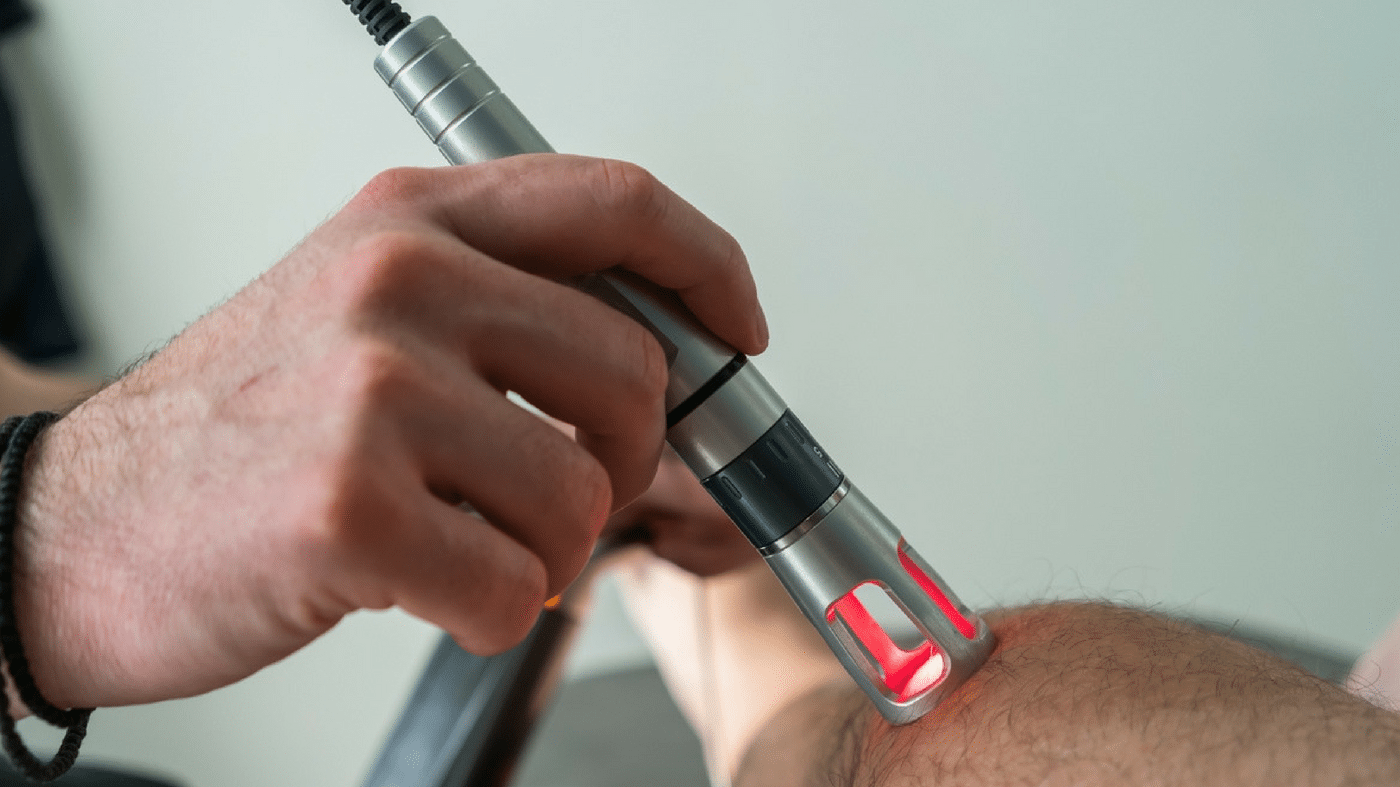
Now, multiple researchers throughout the world are finding enormous therapeutic application of different laser infrared wavelengths like red, green, and blue wavelengths and their effects on tissues. New high-power laser therapy systems penetrate deep into tissue and deliver physiological benefits that no other modality like electrical muscle stimulation or ultrasound can deliver. By stimulating adenosine triphosphate (ATP) production and enhancing cell membrane permeability, lasers can actually helps injuries heal and speed up recovery from workouts, rather than just masking pain.
Today's podcast guest, Dr. Phil Harrington, has over 10 years of clinical experience using lasers for healing, and is a national and international author and lecturer on laser therapy. During our discussion you'll discover:
-How laser treatments work…
-What conditions can benefit from laser treatments…
-Whether those little handheld laser units you can buy online work…
-Which elite athletes are currently using laster treatments….
-What other modalities or treatments can be used with laster…
-Why your body won't just heal itself from injury…
-The difference between laser and other things like ultrasound or electrical muscle stimulation…
–How to find a K-Laser provider in your area…
Do you have questions about how you can use lasers to heal injuries, enhance recovery and increase performance, or questions about the K-Laser? Leave your comments below.
how dose a laser heal the injuries, how dose it repair the tissue.
Which frequency is the best to regenerate damage soft tissue? Red, Green, or Blue?
Red!!
why the red
Curious- am I hearing that the 100 – 500 dollar lasers that you mention in your book are really not worth it? Thanks for the clarification.
Cold laser therapies that you highlight in your book has a five color handheld that looks good at first inspectlion.
We discuss all these concerns in the actual podcast episode…
Around 9:10 you ask the question and then again at 18:20 you mention Nadal’s laser but I still did not come away with clarity on whether the “inexpensive lasers” are worth it. Maybe at 12:20 he gets close in discussing the difference between a therpeutic dose and a lower dose.
Are cheap lasers worth the expense?
Thanks for all your time with this.
J.T.
In my experience at this point, the cheap lasers ARE NOT worth the expense…
A meniscal injury is the most common cause of symptomatic knee pain. Due to the inability of the meniscus to heal, current management of these injuries involves symptomatic management, and surgery as needed. Low-level laser therapy (LLLT) for soft tissue injuries has become increasingly apparent in recent years, with claims of reduction in pain, inflammation, as well as accelerated healing time. It is currently being used for these possible benefits; however, its effectiveness for treating meniscal tears is still unknown.
Hey Ben,
I listened to this podcast again because my son is a professional pitcher and hurt his back lifting. I am curious about your experience for your neck injury. You mentioned you were going to call and go to a local K-laser practitioner. How did it go?
I wound up doing a ton of deep tissue massage and foam roller work on my neck, but I did end up contacting a K-Laser practitioner for my knee after Spartan World Championships and it helped a ton. I think a mash-up of modalities (particularly deep tissue massage, electrostim, laser and in the case of a back, something like the Biomat infrared mat) would be the best mix. Feel free to have your son contact me: [email protected]
Ben – YI'm late in the game in listening to your podcast as i just signed up. In this podcast, you mentioned that you use an infrared laser before you go to bed and that you have an infrared sleep mat as well. Can you tell me which ones you use? I've been looking for an LED infrared device at night before bed to help with sleep and mitochondrial function, but have no idea which one to get. There are so many out there…Curious about your sleep mat as well. Thanks!
Take a look at this article http://biohacksblog.com/red-light-exposure-enhanc…. This is the lamp I use http://www.amazon.com/gp/product/B002MGVPHM/ref=a… and this is the sleep mat I like http://bengreenfieldfitness.biomat.com/
Great Podcast. Shame they're so expensive, I'd love to have one for myself!
regarding this statement – "By stimulating adenosine triphosphate (ATP) production and enhancing cell membrane permeability, lasers can actually helps injuries heal and speed up recovery from workouts, rather than just masking pain." Could I assume that these could not only assist recovery, but performance also?
Maybe using one of these in between sprints could boost performance (due to higher ATP levels). And if so, then the next question is 'could you use one of these DURING a race?'
I haven't seen any evidence for that yet, but I will ask the folks at K-Laser if they know of anything!
Ben,
Hope you don't mind me answering directly….
K-Laser treatments help facilitate healing by increasing blood flow, increasing tissue oxygenation and stimulating mitochondrial enzymes. They do not over-charge the body or make it do anything it could not normally do – just help facilitate natural healing. We do have some evidence that K-Laser treatments help reduce delayed onset muscle soreness. We have several major league pitchers who use it pre- and post-game to help improve performance.
One of our doctors performed a small in-office study measuring fatigue rate for biceps curls – the K-Laser group outperformed the non-K-Laser group, by a large margin.
So…if you are looking to enhance your recovery between sprints, I am confident that K-Laser treatments would decrease your times.
Thanks Phil, I don't mind at all! That's great info.
Great podcast! I was surprised to see that most of the locations with the k laser are veterinarian offices.
Thank you for the feedback! Most Veterinary offices have a larger capital budget than chiropractic offices – so they are able to afford it more easily. We are currently launching a program called "K-Laser On Demand", where chiropractors can use a K-Laser and pay per treatment used. It will get K-Lasers into many more offices and increase K-Laser availability for human patients.