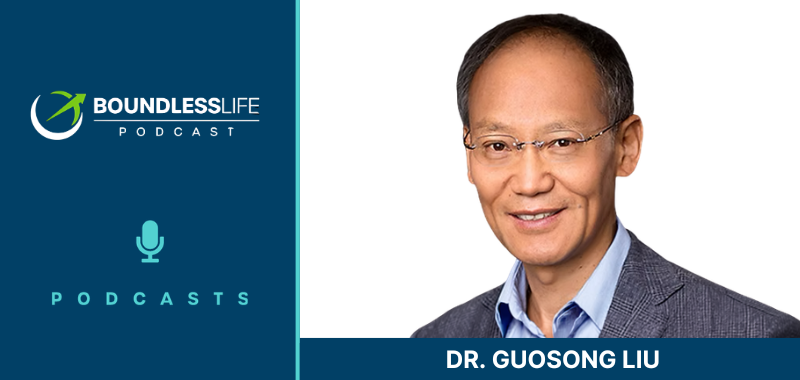
Home » Podcast » Can the RIGHT Form of Magnesium REALLY Boost Brain Performance, Reverse Cognitive Decline & Protect Against Alzheimer’s? with Dr. Guosong Liu

Can the RIGHT Form of Magnesium REALLY Boost Brain Performance, Reverse Cognitive Decline & Protect Against Alzheimer’s? with Dr. Guosong Liu

Listen on:

Reading time: 6 minutes

What I Discuss with Dr. Guosong Liu:

  • How Dr. Liu‘s accidental discovery at MIT's Center for Learning and Memory led to the invention of Magtein (magnesium L-threonate) and his journey into brain magnesium science…01:59
  • The concept of synaptic plasticity, the brain's ability to strengthen or weaken connections between neurons, and why it is the foundation of all learning and memory…03:19
  • Why forming and extinguishing memories must be paired with intentional behavior to be effective, and what this means for PTSD and extinction therapy…05:07
  • What the “L” and “threonate” in magnesium L-threonate actually mean…11:30
  • The surprising link between brain size, intelligence, and brain magnesium levels across species, and what that suggests for human supplementation…13:34
  • Why most magnesium supplements (glycinate, oxide, and chloride) can't cross the blood-brain barrier, and the years-long search for a form that could…15:26
  • How magnesium L-threonate was synthesized, how magnesium ions bind to threonate, and why this structure enables superior absorption, bioavailability, and brain penetration…17:08
  • The first human clinical trial results: reversing nine years of cognitive decline in people with mild cognitive impairment, plus subsequent trials in Australia and China…26:37
  • How soon you feel the effects: mood and stress reduction in as little as three days, with full cognitive benefits emerging around six weeks to three months at 140mg daily…29:36
  • Which areas of cognition respond most to magnesium L-threonate, why the prefrontal cortex shows the greatest improvement, and what that means for focus, planning, and resistance to distraction…31:26
  • Why testing for brain magnesium deficiency is nearly impossible and which symptoms suggest you might benefit from supplementation…34:47
  • How magnesium L-threonate shifts sleep architecture toward more deep sleep and REM, and why many users report vivid, colorful dreams…38:20
  • Slow-release formulations and why they are central to Dr. Liu's current drug development research on preventing Alzheimer's before it starts…42:30

In this episode with neuroscientist Dr. Guosong Liu, you’ll explore his accidental discovery at MIT's Center for Learning and Memory that led him down a two-decade journey into brain magnesium, synaptic plasticity, and cognitive decline. That research ultimately resulted in the invention of Magtein® (magnesium L-threonate), a compound he engineered to cross the blood-brain barrier in a way other magnesium forms cannot, with clinical trials showing a reversal of nine years of cognitive decline, measurable shifts in sleep architecture, stress reduction in as little as three days, and meaningful improvements in prefrontal cortex function at just 140 milligrams per day. Dr. Liu also shares what his current Alzheimer's prevention research looks like.

Dr. Liu is a world-renowned neuroscientist whose pioneering research on brain magnesium has transformed our understanding of cognitive function and synaptic plasticity. With more than 25 years of neuroscience expertise, he previously served on the faculty at MIT's Picower Institute for Learning and Memory, founded the Center for Learning and Memory at Tsinghua University, and earned his Ph.D. in Neurophysiology from UCLA. His translational research has bridged laboratory discovery and human clinical application, resulting in multiple trials demonstrating Magtein's efficacy in supporting cognitive performance.

Magtein is the patented, clinically studied form of magnesium L-threonate designed to cross the blood-brain barrier and support memory, focus, mood, sleep quality, and stress resilience. Featured in more than 400 products across 40-plus countries, it is the global standard in brain-support magnesium nutrition.

Ready to give your brain magnesium it can actually use?

You can discover more about Magtein and find a brand that carries it here.

Episode Sponsors:

Quantum Upgrade: Recent research has revealed that the Quantum Upgrade was able to increase ATP production by a jaw-dropping 20–25% in human cells. Unlock a 15-day free trial with the code BEN15 at quantumupgrade.io.

Troscriptions: Explore Troscriptions' revolutionary buccal troche delivery system that bypasses digestion to deliver pharmaceutical-grade, physician-formulated health optimization compounds directly through your cheek mucosa for faster onset and higher bioavailability than traditional supplements. Discover a completely new way to optimize your health at troscriptions.com/BEN or enter BEN at checkout for 10% off your first order.

Fatty15: Fatty15 is on a mission to optimize your C15:0 levels and help you live healthier, longer. You can get an additional 15% off their 90-day subscription Starter Kit by going to fatty15.com/BEN and using code BEN at checkout.

MTE: MTE is a caffeine-free daily drink mix with adaptogens, nootropics, and superfoods for clean energy, sharp focus, and balanced mood, without the crash. Boost your wellness at a systemic level with MTE's 13 healthy ingredients. Check them out at GetMTE.com/BENG and use code BENG for 20% off your first order.

Episode Resources:

People

Studies

Supplements & Devices


Do you have questions, thoughts, or feedback for Dr. Guosong Liu or me? Leave your comments below, and one of us will reply!

Upcoming Events:

ECO26 | May 14–16, 2026

Healthcare practitioners looking to achieve exponential clinical outcomes through Foundational Medicine: I'm speaking at ECO26 (May 14–16, 2026, in Boise, ID), a three-day event featuring cutting-edge education, powerful networking, and actionable strategies to elevate your practice (with up to 20 CEUs available for some practitioner types). I'll be presenting “The Detox Frontier: Lessons from The Edges of Biohacking to Everyday Vitality” on May 15th alongside some of the top minds in functional and foundational medicine. You can use this link to register and claim a $400 discount!

Ultimate Men Over 40 Health Summit | June 8–14, 2026

If you're a man over 40 looking to improve your strength, energy, health, hormones, recovery, longevity, and performance, I'm speaking at the Ultimate Men Over 40 Health Summit (June 8–14, 2026), a free 7-day virtual event featuring 100+ experts across 7 core pillars. I'll be presenting “Optimizing the Human Machine for 40 and Beyond” alongside some of the best minds in men's health today. You can register for free here now!

Health Optimisation Summit | September 11–13, 2026

I'm speaking at the Health Optimisation Summit in London (September 11–13, 2026) at the Business Design Centre. This isn't your average health conference. HOS unites the best minds in biohacking, longevity, nutrition, fitness, and medicine, with one goal: to actually make people healthier. With 35+ world-class speakers, 120+ cutting-edge brands, and 4,000 like-minded people all under one roof, it's two days that could genuinely change how you approach your health. Get your ticket here and use code BEN to save 10% off registration! 

The Boundless Couples Retreat | November 10–14, 2026

Ready to reconnect and recharge with your partner in paradise? Join the Greenfields at the stunning Prana Maya resort in Belize for the Boundless Couples Retreat, November 10–14, 2026. It's a five-day, all-inclusive escape designed to deepen your relationship, restore your vitality, and create memories that last a lifetime. From relaxation and adventure to intimate relationship coaching with Jessa and me, every detail is crafted to send you home with a stronger bond and a reinvigorated spirit. Spots are limited, so discover more and secure yours here today!

Stay tuned for future updates—and you can always keep up with my LIVE appearances by checking out bengreenfieldlife.com/calendar!

Ben Greenfield [00:00:08]: My name is Ben Greenfield and on this episode of the Boundless Life podcast.

Dr. Guosong Liu [00:00:13]: So then finally we found out, hey, actually magnesium serenade. Among all the magnesium compound tested is only one who can effectively elevate the brain mechanism.

Ben Greenfield [00:00:27]: Welcome to the Boundless Life with me, your host, Ben Greenfield.

Ben Greenfield [00:00:32]: I'm a personal trainer, exercise physiologist and nutritionist.

Ben Greenfield [00:00:35]: And I'm passionate about helping you discover unparalleled levels of health, fitness, longevity and beyond.

Ben Greenfield [00:00:47]: Today's podcast is with Dr. Guosong Liu, I believe is how you pronounce his first name. Dr. Liu is what I'm going to call him. He is a boatload of, or has a boatload of knowledge on magnesium, specifically magnesium L-Threonate a little bit of a deep scientific dive today. I took 140 milligrams of magnesium L-Threonate approximately before this podcast. So you'll see how I perform. Go to BenGreenfieldLife.com MagTein podcast.

Ben Greenfield [00:01:18]: That's M a g t E I n Magtein podcast if you want the show notes. So here we go. My guest on today's show, Dr. Liu, and I'm cracking up because I just gave him a fantastic introduction and I forgot, forgot to press record. So you guys get this again. He's actually a neuroscientist, world renowned neuroscientist who studies magnesium and magnesium specifically in terms of its impact on the brain, on things like cognitive function and synaptic plasticity. He's got over 25 years of experience doing this and studies up on learning, on memory, on neurological function, all related to this mineral. So Dr.

Ben Greenfield [00:02:01]: Liu, welcome to the show.

Dr. Guosong Liu [00:02:02]: Thank you for inviting me. I'd be happy to share with you about our journey.

Ben Greenfield [00:02:07]: Yeah, I'm very interested in what got you started into studying magnesium's impact on the brain because these days it seems like everybody's talking about it as like a relaxing and stress relieving mineral. But that's kind of, that's kind of, I would say 90% of what I hear about magnesium and I don't hear about it as kind of like a, I guess something you would use to enhance cognitive performance or something like that. So what got you started into magnesium in general and then its impact on the brain?

Dr. Guosong Liu [00:02:39]: Yeah, the whole thing is, I have to say it's like a serotivity, like by accident, like about 25 years ago. Well now also faculty at MIT first center for learning and Memory, we were actually a scientist, try to study the synapse, which is a building block of the Entire brain at that time. We're interested to see how do we make more synapse. We have simple idea of at that time. The synaptic plasticity is extremely hot topic. The idea is how do you find some compound which can increase synapsitude?

Ben Greenfield [00:03:26]: Before you keep going, how do you define synaptic plasticity for people who might not be familiar with that term?

Dr. Guosong Liu [00:03:34]: Okay, I think in this case it's interesting if you think about the AI right now, AI is essentially neural network and artificial neural network adjust connection between the node many connection. What the difference about a brain is that each connection actually can be modified. The connection strands are modifiable. So this modification of synaptic strength, connection strength is called synaptic plasticity.

Ben Greenfield [00:04:09]: Okay, got it. So basically, synaptic plasticity is an increase in the connection strength with the connection being between neurons in the brain.

Dr. Guosong Liu [00:04:19]: Right. It may not be increased. It could be decreased too.

Ben Greenfield [00:04:22]: Oh yeah, I guess so. Because plasticity would mean it could go either way.

Dr. Guosong Liu [00:04:27]: Exactly.

Ben Greenfield [00:04:27]: Yeah. Okay, got it.

Dr. Guosong Liu [00:04:29]: So it's always a hard topic. I think our brain can learn, I mean fundamental about a human is, or in fact the animal, right? Is learn to adapt the changing of the environment. The ability to learn is really what is the foundation to be able to learn is actually changing the connection strength between the synapse. So that's why if you are able to modify ability of brain to change its connection strengths, in this case synaptic opacity, you will make a brain a better learning machine.

Ben Greenfield [00:05:08]: Now a quick question about that before we get into how magnesium might influence that. I think increasing the strength of the connection would make sense to people. But would decreasing the connection be something that might be related to decreasing the appearance of a negative pattern or a negative thought or habit? Or what would be a situation in which you would want to decrease the strength between neurons?

Dr. Guosong Liu [00:05:37]: Accident. That's exactly the point. For example, for people who have a ptsd, then that's a strong memory of negative memory and you want to get rid of. Then you need to reduce the strength of connection. A lot of a bad memory and you prefer not thinking about it all the time. Then you talk to the doctor and then they have extinction therapy is try to reduce that negative memory. So it's not everything you're supposed to remember. In fact, many bad stuff you probably prefer to forgot.

Ben Greenfield [00:06:16]: Yeah, yeah. Okay. And I might be putting the cart before the horse here, but you know, when we're talking about something one could take as like a supplement to strengthen or weaken a neural Connection does something like that have to be paired with an actual activity? I'll give you the example of a popular wakefulness drug that many people are using for focus, Modafinil or Provigil. What a lot of people report is that it doesn't work that well unless you take it and then you combine it with a very intense cognitively demanding activity. Or in the case of something like ginkgo biloba for memory, you would actually need to pair that with learning a musical instrument or memorizing a speech or series of words or numbers or something like that. So when you take a supplement, does it automatically strengthen or weaken a neural connection? Or does it need to be paired with some type of activity that actually causes that connection to occur and the supplements just making that activity work better?

Dr. Guosong Liu [00:07:31]: That is another. You should be a scientist. The question asked is really a great question. And that's actually touch upon our research. That is there are two type of sensuous. For example brain have a lot of inhibitor synapse they call gaba.

Ben Greenfield [00:07:53]: Right?

Dr. Guosong Liu [00:07:53]: GABA type of synapse. You could actually bring everything down by stage hammer. Let's say increase the GABA or even taking anesthesia and you can lock people down. That is not a learning dependent. So that's one type of. You just increase the brain inhibition and you can actually bring down the neural activity in the brain. But alternative is exactly what you're talking about. It is whether you have something to lose up.

Dr. Guosong Liu [00:08:26]: In fact, by original classific definition of plasticity is actually enable the synapse to learn. So in that case, it's exactly what you talk about is when you're taking certain compound who promote the plasticity, they just allow you to be able to learn better. So taking one example in fact that's one experiment we have done. If you want to use the extinction therapy, for example for treating ptsd, very bad memory, you go to talk to the psychiatrist, they say calm down, right now you're in a safe environment. That bad thing will not going to happen again. During this section you actually contemporary forgot the negative stuff. Okay. Ideal situations you probably will remember that's not harmful.

Dr. Guosong Liu [00:09:23]: And when you go home, you still that way. But if your synapse is not plastic, it's only transiently that the negative stuff is gone. You go home, then come back again. In fact, the compound we develop magnesium surround in animal study is exactly like that. If you couple with the. Let's call the behavior therapy and with our compound it will enhance the learning in this case, enhance your ability to forgot the negative memory.

Ben Greenfield [00:09:59]: Yeah, yeah, okay, okay, I understand. So in the case of something like magnesium threonate or magnesium L-Threonate, it's simply enhancing the ability of an activity that you engage in when magnesium L-Threonate levels are elevated to allow that activity to, for lack of a better term, work better to modify.

Dr. Guosong Liu [00:10:28]: Right. For example, if your intention is stronger, let's say learning, you want to remember something. In the presence of magnesium L3, your ability to strengthening the synapse during learning is increased. But if your intention is weakening the synapse by trying to forgot some negative stuff like during psychotherapy, this also help you to remove that synapse.

Ben Greenfield [00:10:56]: Yeah, yeah. Okay. Okay. So magnesium L-Threonate. Now for those of you who are are unfamiliar with that term, I know it sounds like the number 3 and the number 8, but I'm not saying magnesium L3 and 8. It's actually T H R E O N A T A or N A T E A Magnesium L-Threonate. So Dr. Liu, when did magnesium L-Threonate enter the picture for you and your research as a form of magnesium? That was of interest.

Ben Greenfield [00:11:32]: And as you're explaining that to me and the audience, also, can you clarify what all the letters and funky words are like? What's the l mean? And what's the 3 and 8 mean after the word magnesium?

Dr. Guosong Liu [00:11:47]: Okay, so this actually getting back to your original question about the journey, right? How we found the magnesium, why we actually study magnesium from beginning. It's interesting in ivory tower, the place like mit, we supposed to do some extremely fancy, nobody know what's going on, kind of high tech. And a magnesium is considered to be too low for a MIT professor to study. So my original interest is a synaptic process, how to make the brain bare. So originally we have experiment system to look these snaps, like study their plasticity. We actually dump a lot of molecules and looking which one molecule we can actually nanomole or increase in absence. So that was 25 years ago. After screening many, many compound, we found something extremely simple.

Dr. Guosong Liu [00:12:50]: That is just the magnesium ion, which is readily available anywhere, is a powerful molecule that can increase the synapse number and also plasticity of each synapse. So that work was finished and published at 2002. So that's almost like 25, 23 years, 24 years ago. So that obviously leading to extremely interesting study. A lot of people get excited about it. I mean for most of the professor game is over. Okay? You publish a nice paper and you show market is important. Everybody people say, well we know the market is important.

Dr. Guosong Liu [00:13:36]: Anyway, here is a problem. The during that period of time I found something very interesting. That is the brain mechanism level in the large animal up to human. The smarter the animal, the higher the brain mechanism. Because for example, take example of rats, the blood mechanism and the brain magnesium is about equal. But when you get a dog, the brain magnetism getting bigger, the brain magnesium

Ben Greenfield [00:14:15]: is getting bigger relative to the body magnesium as the size of the animal increases.

Dr. Guosong Liu [00:14:21]: Yes. And the brain gets bigger the higher their brain magnesium. Okay, so that's a very surprising just observation to me. And in fact our early animal experiment when we found we could increase the synapse number and diplocysity is we actually humanize the concentration of magnesium infrared, which means originally they are for rat low. We actually artificially elevated rats brain magnesium level to human level. Suddenly we found oh my God, there's a lot of more synapse and each synapse are more plastic. So that actually is the initial early trigger for me saying wait a minute, this is exciting, right? At 25 years old, I think that's, you know, although my other colleagues think the magnesium is not exciting for me, I say that must be important. But here is the next step.

Dr. Guosong Liu [00:15:26]: Okay. If you have to elevate the brain magnesium to making this whole thing work, increase the brain function, then you have to basically bring magnesium to the brain. Remember at that time there's a lot of magnesium compound, magnesium chloride, magnesium oxide, magnesium glycinate, many, many magnesium compound already available. But there's nothing for us to do until we realize most of the magnesium compound cannot bring magnesium to the brain. So that's at the time I built a biotech company in a silicon valley. We dedicated our effort to screening the magnesium compound that can increase the brain magnesium.

Ben Greenfield [00:16:19]: Quick question. With the rats that you were amplifying the magnesium levels up to human level magnesium levels in. At that time, were you doing this via oral supplementation or using a different method to get it into the rats brains?

Dr. Guosong Liu [00:16:32]: No, that's a very good question. Because at the time the experiment was done in culture, we basically taking the animal brain. Oh yeah, like culture in the neuron in a dish, we can increase whatever they want to increase.

Ben Greenfield [00:16:44]: When you take a rat, when you take a rat neuron and you put it in a petri dish, obviously you can easily add magnesium to that. But that's nothing like actually getting it across the blood brain barrier in the intact brain in the actual mammal.

Dr. Guosong Liu [00:16:59]: That's exactly the point. So at that time we say, okay, now we have some task. The task is can we fund a new magnesium compound? Right. And that actually can effectively elevate the brain. Magnesium. So we actually looked at the molecular structure of a magnesium compound here. Bring my colleague Fengbao who is one of the top chemists and he actually synthesize a bunch of magnesium compound. So the magnesium L, Serena is one of them.

Dr. Guosong Liu [00:17:38]: So then we start to go to animals, say okay, let's see which one actually works. So then finally we found out, hey, actually magnesium srioli among all the magnesium compound tested is only one who can effectively elevate the brain mechanism. So that's where the journey began. The work was actually published 2:10.

Ben Greenfield [00:18:10]: Okay, so you know the name magnesium L-Threonate. For those of you who may remember a little bit of high school chemistry, you might recall that certain molecules have a left and right handedness. And sometimes terms like L and D or R and S are used to describe which configuration that we're looking at. So with magnesium L-Threonate, what is the L and what is the threonate? How do you explain that to somebody who might not be as familiar with molecular terms?

Dr. Guosong Liu [00:18:47]: So I think the relation, I think that maybe the right angle to think about it is ironically when we discover this molecule, we think we found something new, totally new. Ironically, later on we realized we did not find anything new. Our body actually contain the SRI Lane. So because Sir Lane is a metabolic byproduct of vitamin C. So when the vitamin C is used, it will be converting into sirulate. Okay. So we basically artificially increase the metabolic byproducts of the vitamin C.

Ben Greenfield [00:19:38]: So does that mean that you're getting threonate from a ascorbic acid or vitamin C source and then somehow binding that to magnesium?

Dr. Guosong Liu [00:19:50]: Yes. So that's still mystery right now. Yes. So the, because the, the magnesium is an ion, right? They. They need a negative charge molecule to combine to stabilize them. Right. So that, that's, that's really. You have a magnesium site, you have Air 3 on a.

Dr. Guosong Liu [00:20:08]: And when they combine together, it's become a. It's basically magnesium insulin. A salt.

Ben Greenfield [00:20:17]: Okay, yeah, it's a, it's a 3 and 8 salt that you're binding it to. So when people see something like magnesium citrate or magnesium glycinate or in this case magnesium threonate, it's simply the magnesium ion that's bound to another molecule. And when it's bound, it would have different effects on different areas of the body. And what you guys found was that when binding magnesium to L-Threonate, you were able to actually create a form of magnesium that could cross the blood brain barrier and enhance synaptic plasticity.

Dr. Guosong Liu [00:20:57]: Excellent. So I think I want to add one more point. So this compound also increase the bioavailability to get inside our body too. So the bioavailability not only before they can increase the foreign mechanism, they can also increase the body magnet in terms of absorption rate. They are way higher than ordinary magnesium component. That's probably explain why I mean of course later on we can touch to the dosage. Our recommended dosage right now is like a 2 gram which is only 140 milligrams of magnesium, elemental magnesium, which is way lower than other magnesium compound.

Ben Greenfield [00:21:44]: Did you, did you say 40 milligrams?

Dr. Guosong Liu [00:21:46]: 140 milligrams.

Ben Greenfield [00:21:48]: 140. Okay, got it.

Dr. Guosong Liu [00:21:49]: For example, if you look in the most of the magnesium products sold in the market and they, you know, they are basically 200 milligram, 80 ventomacines and sometimes they 400 milligram. And our is the lowest. Right. I don't want a consumer to feel, you know, bad about it. It's our lowest because our bioavailability, which means let the magnesium get into your body is highest. You don't need take that much. It's not a motivator. But you just take the right amount.

Ben Greenfield [00:22:21]: Yeah. Okay. I was at a health conference last year when I met someone who was with a company called Magteen and he later introduced me to you. And Magtin is M A G T I N and from what I understand, Magtene is a company that like owns the rights to use magnesium L-Threonate in supplements. Is that right?

Dr. Guosong Liu [00:22:51]: Yes. So essentially is the we are the one who invent this compound. So we obviously got the US global patent for use this compound for both developed as a drug and also use cell as a dietary supplement for promoting health. So Magotin is a trademark of magnesium LCl. So magnesium serenase chemical name Magtin is a brand name of this. It's the same thing.

Ben Greenfield [00:23:27]: Okay, can you get magnesium L-Threonate in other brand names or is magteam pretty much like own the global rights to magnesium L-Threonate?

Dr. Guosong Liu [00:23:36]: No, 20% of the distributor use the brand mag, but 80% of them have their own name. For example, Lifestation is one of the early distributor. They are probably also biggest distributor. And they sold the magnet silane under their brand name of Neuromag.

Ben Greenfield [00:24:01]: Okay, got it. Neuromeg. So if there's these different forms of magnesium L-Threonate, are they all pretty similar or is there a difference between something like Meg Tene and Neuromeg in terms of, I don't know, purity or the way that it's created or anything like that?

Dr. Guosong Liu [00:24:18]: They're very similar. Because if you think about from science point of view, and when you develop a molecule in the drug development called API, you have a molecule which is effective. The only modification you can have with that molecule is release profile they call formulation. For example, you can control the speed of that molecule getting into your body. You can put into gummy, you can put a drinking water. So you can improve, modify the rate how fast that molecule get into your mind.

Ben Greenfield [00:25:00]: Okay, okay, got it. So with magnesium L? Threonate in the form of magtene or otherwise, this idea that it increases synaptic plasticity in vitro in a dish is one thing that you established. And then you established that you could achieve high levels of magnesium L-Threonate in the body by binding magnesium to L-Threonate. But then from there. Did you guys do any actual trials, human or otherwise, on what happens in the brain, to the brain or to things like cognitive performance once you take magnesium L? Threonate?

Dr. Guosong Liu [00:25:44]: Absolutely. Actually it's interesting about the, you know, general audience in terms of the. The translation from animal study to human study and whatever benefit you got. Animal study and transfer humans. Like remember every day if you look at news, some scientists found, you know, almost like big effects of some molecule to for certain disease and breakthrough. Actually there's a two area of the research. The translation from animal research to human results is poor. One is a cancer, other one is a neurology.

Dr. Guosong Liu [00:26:29]: That's a neuroscientist. There are many, many molecules works beautifully in animal model. And you go to human, it doesn't work. So it's our duty to show this compound works in human. First human clinical trial was conduct actually two years after we got beautiful animal experiment. We begin the first human trial at 2012 at Miami. We got the patient people who have a mild cochlear impairment. Then we give this compound and we look in their cognitive function, we look their sleep, we look their mood.

Dr. Guosong Liu [00:27:15]: Okay, so that's the first human clinical trial results is positive on the cochlear. So we actually to make that understandable. The cog improvement quantified we ask the self is how much we can rejuvenize your brain. Like if you or brain are decline function decline faster than your biologic age. Are we able to Reverse your age dependent cognitive decline. In that trial we found we can reverse nine years of cognitive decline. That's the first human study published in 2015. Since that we have conduct in the nutraceutical side about three more clinical trials.

Dr. Guosong Liu [00:28:12]: In fact more than three, two more clinical trials focus on cognition. Can we improve your cognitive? We got a trial in Australia, we have another clinical trial in China. Both trial results is positive. To demonstrate when you're giving this as a supplement to the healthy human being, the compound can improve cognitive. So just slightly outside this whole thing, if they have a clear regulation you sold the supplement, then you actually have to test whether compound can improve the function of normal human being.

Ben Greenfield [00:29:01]: Yeah.

Dr. Guosong Liu [00:29:02]: Right now I'm leading a drug we actually are also testing can we use this compound to treat neurologic disorder in this case? Actually my main work is testing whether this compound can be used to prevent reduce the the chance of developing Alzheimer's. That actually is the main work I'm doing today. Yeah, that would be in this case just separate. It's a huge one is the supplement for normal human being. The other side is for prevent the disease. So that prevented disease is drug development.

Ben Greenfield [00:29:42]: Yeah. Some people might be wondering, well is this something that you feel right away when you consume magnesium L? Threonate? I noticed you guys actually did do a study on how effectively different forms of magnesium could cross the blood brain barrier. And magnesium L? Threonate appeared to be the only compound tested that significantly raised the concentration of magnesium in the brain. I think this is the one where you measured magnesium concentration and cerebrospinal fluid and penetrate neural cells better than other forms of magnesium. But there was a number of days of supplementation. I believe in that study it wasn't like right away, was it like number of days, weeks, months. How soon does it really start to take effect based on what you've seen?

Dr. Guosong Liu [00:30:30]: Right. So it depends and for cognitive function we found it takes longer. For cognitive function we found actually you got pretty nice results about six week. The maximum benefit for cognition it need

Ben Greenfield [00:30:48]: about three months was that at 140 milligrams daily.

Dr. Guosong Liu [00:30:53]: Yeah.

Ben Greenfield [00:30:54]: Okay.

Dr. Guosong Liu [00:30:54]: Yes. However, I mean there is an unpublished study, you know, we have not published. When you actually try to change the moon the effects of improving your. In fact you're talking about a stress reduction reduce anxiety. That is a moon direction like emotion control. That's about three days. So you can have a positive fading of a moon improvement in three days but improve your ability to the mass do the work and being full and that takes longer.

Ben Greenfield [00:31:31]: Yeah. Okay, so three days. Yeah, that's pretty quick. When you're talking about cognitive function, I think a lot of people kind of like throw that word around, but just a little rabbit hole here for people. When you hear Dr. Liu and I talking about improving cognitive ability, typically there's kind of like four different areas that are studied. Executive function, working memory, episodic memory and attention. Did I get those, Dr.

Ben Greenfield [00:31:59]: Liu?

Dr. Guosong Liu [00:32:00]: Yes.

Ben Greenfield [00:32:01]: Okay.

Dr. Guosong Liu [00:32:01]: Absolutely. When you definitely have cognitive function is really primarily there are two domains. One is executive function, planning, attention and episodic memory. Those are major domain of cognitive function. So that also is something we tested in human clinical trial.

Ben Greenfield [00:32:21]: Yeah. Okay. So executive function, the ability to plan, focus, remember instructions, juggle tasks and then you have working memory. That's basically how you can, I guess, like I would say retain for example, phone number, right? Yeah, exactly. Retain and manipulate, you know, pieces of information like a phone number over short periods usually. Then episodic memory. Episodic is just a fancy term for long term memory, like what did I eat last Sunday night for dinner? Or you know, where did I go last Friday afternoon? Then attention is exactly what it sounds like. Your ability to remain focused.

Ben Greenfield [00:33:01]: Maybe there were a few times so far in this podcast where you kind of tuned out and then you tuned back in. That would be a disattention and attention. The reason I'm bringing these four areas up is have you seen that magnesium L3 and it kind of works globally across all four or does it seem to target any of those specific four areas more than others?

Dr. Guosong Liu [00:33:25]: That's another great question. I think the so far the biggest improvement is a prefrontal cortex function. So they are more closer to executive function improvement is highest and episode of memory improvement is less. So the biggest improvement is executive function. Like a planning better and a focus better. One of the interesting component is prevent you to be distracted by, you know, a particular like a ramination. Oh, one of them actually why people talk about a brain frog, right? Like you feel, you know, just not clean, like a tranquility. I mean after you're taking this Hong Kong.

Dr. Guosong Liu [00:34:12]: I think that one is pretty clear. It's like you feel cleaner, like almost like have a meditation. Like your just brain is clean.

Ben Greenfield [00:34:20]: Yeah, yeah. A little windshield wiper for the brain. And by the way, I don't regularly take magnesium L-Threonate right now. Sometimes I've kind of. I kind of wait until I do the podcast with somebody to decide if it's something I really want to bring into the protocol. But I took about 200 milligrams this morning. About. Oh, let's see.

Ben Greenfield [00:34:41]: Yeah, it was about four hours ago. And certainly feel as though attention is remarkable, you know, in terms of executive function. And I don't know if different people respond differently. This is what I wanted to ask you. Is there a way to actually test for a deficiency? Can you get a blood test that tests specifically for L-Threonate or would you just get a blood test for red blood cell magnesium for example to just look at a global magnesium deficiency.

Dr. Guosong Liu [00:35:13]: The interesting part is the then one of the major discovery fund which actually just published last year is for magnesium to work, the magnetism has to get inside of cell. So there really is intracellular magnetism. We actually published last year and that paper took me 10 years to finish and publish. We show it just has to be inside of cell, the magnesium to perform all those miracle function. Okay, so that's why then it's very difficult to quantify intracellular mechanism. Actually, you're absolutely right. Will be nicer giving this as a mineral. Right.

Dr. Guosong Liu [00:35:56]: If we have a diagnostic technique to determine your level of the intracellular magnesium, you say well, you definitely have to take it. Right. It's a low excuse. Right. And otherwise say, well I just heard this, you know, air commercial, you know, and say broadcasting. But in this case, if you have evidence you definitely need. It will be much better for consumer. Right.

Dr. Guosong Liu [00:36:23]: To make a decision problem. The biggest problem here is it's easy to take the red blousing. Right. And for measurement, unfortunately there's a lot of magnesium inside of cell. They actually binding with the molecule. What really matter is ionized magnesium inside of cell, which is extremely difficult to quantify with conventional technique. So it's very difficult to develop a simple clinical assay for us to introduce to consumer to determine their intracellular mechanism for free intracellular magnesium level. So that's our problem.

Dr. Guosong Liu [00:37:09]: That's a problem number one. The problem number two is it's very difficult to quantify the brain magnetism in human. You don't want to actually type. You know, getting the CSF is, is a pain.

Ben Greenfield [00:37:23]: Yeah, yeah. You don't, you don't wander into your doctor and have them tap your cerebrospinal fluid for magnesium levels.

Dr. Guosong Liu [00:37:29]: Exactly. So that's. So then you can also go opposite direction if you have certain symptoms like a brain fog and bad sleep and anxiety. It's clearly when you're taking this compound, it will definitely reduce anxiety.

Ben Greenfield [00:37:50]: Yeah. And that's actually something that I meant to ask you. So even though the testing is difficult, especially because you're trying to look at intracellular levels, which presents an issue when you're doing a standard blood panel for say, RBC magnesium. Symptomatic evaluation is important. You mentioned brain fog. We've talked about cognition in the form of episodic and working memory and executive function, et cetera. But back to earlier in the podcast, I mentioned that magnesium is usually championed as a sleep enhancement tool. Does magnesium L-Threonate have an effect on sleep architecture? Has it been studied in terms of how it affects sleep cycling or anything else related to sleep?

Dr. Guosong Liu [00:38:39]: Yeah, that's another interesting thing actually. Before us, if you look the Internet and for whatever reason, the magnesium was popular as almost supposed to be a promoter sleep. Right? So rather than, you know, even before us, rather than, you know, think about a magnesium improve the cognition and, you know, improve your moon. But actually most people's major motivation for people to take a magnesium actually is the people think about going to help them sleep. So at least their original intent, their motivation to buy this supplement is for, you know, sleep. So we actually, you know, thinking so that then we obviously conduct clinical trial. And then we found out actually it's funny. So we did not make people sleep longer.

Dr. Guosong Liu [00:39:36]: Okay. In fact, the amount of time this sleep overtake magnesium theory is slightly shorter. However, the major change is changing sleep architecture, which actually has never happened before in history. There's no drop, nothing changed the sleep architecture. In this case, sleep have a multiple stage. While you have a light sleep, deep sleep, REM sleep. First one is that most people who take magnet seriously. The first they tell you say, hey, I see this work.

Dr. Guosong Liu [00:40:14]: You know why they say they got a vivid dream, they can remember dream better. A lot of people tell me at the very beginning, when this was a. I gave to my friends like 15 years ago. They always say I can have a better dream. I can remember the contents of dream better and my dream go from black and white into colorful, something like that. So those are just verbal observation by the people's response. I think a few years ago we have done the first study actually by Jennifer Gu and she obviously worked with the company and where she used Orin Orin Ring to model architecture. Yeah, Orey.

Dr. Guosong Liu [00:41:04]: So she found actually there is a reduction of light sleep but increase of the deep sleep and also increase of the REM sleep. Which means the total sleep time is about the same. But improve the sleep quality in terms of those good sleep time like a deep sleep and REM sleep, which are both important stage of sleep. Those Durations improve light, sleep time is reduced but will not unfortunately make you sleep longer.

Ben Greenfield [00:41:41]: Yeah, yeah, that's interesting. I suppose that might have something to do with its effects on the cognitive function. Kind of like when you use a popular nootropic or smart drug, you can perform just as good on less sleep. I don't necessarily endorse for those of you listening, taking a supplement, then shorting yourself on sleep and kind of robbing Peter to pay Paul, I think back to something like the oura ring. Watch your heart rate variability, watch your recovery scores. Make sure that if you're sleeping less those are not being deleteriously affected. But that's very interesting on the sleep architecture impact of magnesium L-Threonate I noticed that you guys had one study where self reported stress was reduced by like over 160% versus baseline after about six weeks of supplementation. So I'm sure that just being less anxious at night might help a little bit with sleep latency.

Ben Greenfield [00:42:37]: Also when it comes to the delivery mechanism, we have capsules, we have powders, you can snort it like cocaine, you can use it as a suppository. I mean pick your poison with magnesium. L-Threonate is very specific form that you found to be superior as far as the delivery mechanism.

Dr. Guosong Liu [00:42:59]: Well, there is a two type of delivery mechanism. You know it's interesting annual experiment. We actually provide the mechanism certainly in the water and so that they're just like a slow release, right. And we think the slow release is better. Okay. However slow release is extreme. It's very difficult to make a slow release tablets for magnet surname and after many years we actually developed a version right now are reserved for drug development. It's under drug development, it's a slow release version.

Dr. Guosong Liu [00:43:42]: We're testing for the chance of reduced chance of develop Alzheimer's.

Ben Greenfield [00:43:49]: When you say a slow release version, some people might be wondering how do you get it to do that? Like to release more slowly.

Dr. Guosong Liu [00:43:56]: Right. So there are many ways, right? For example, you can put a certain matrix, right. Certain molecule, prevent the molecule magnesium to get out of tablets. Right. So that it's just blocking the. Let them just get it out slowly. Right. Rather than just like if you take a capsule, the whole thing just dunk to your stomach immediately.

Dr. Guosong Liu [00:44:20]: Okay. So typically we prefer slower release. Right. So then of course nobody making back is serial T. Right. You can take like an animal study, you just take the, you know, one by one. And right now all the neutrosolico are basically instant ready magnesium.

Ben Greenfield [00:44:44]: Okay? Okay, got it. I noticed Meg Teen after that event, they sent me, I believe some capsules. Those are the ones I took this morning. I think they might have sent gummies too. Do they have a gummy version?

Dr. Guosong Liu [00:44:58]: Yeah, yeah, they do have a gummy version but even gummy, I think they. You're not going to chewing gummy for hours.

Ben Greenfield [00:45:06]: Right.

Dr. Guosong Liu [00:45:07]: So that's still considered to be a

Ben Greenfield [00:45:09]: fast release, somewhat similar to capsule, you know, just falling closely behind. Yeah, yeah. Interesting. Well, this is all fascinating. Is there anything about magnesium L-Threonate or magtine that I haven't asked that you want to share?

Dr. Guosong Liu [00:45:25]: I think they pretty much. I mean you probably almost ask everything I can think about it. I mean at least for people on stream, I mean you obviously represent the consumer, right? From consumer's angle. You know, obviously there are certain. Oh, there's only one thing which you know, so really science, that is the. We think we invent this whole thing. We did it right? And later on. Only other thing I want to add is a surname.

Dr. Guosong Liu [00:45:57]: It's naturally present in high concentration in the brain. Okay, so that is a total surprise. We saw, we, you know, by chance found something new later on. We found the human brain have high concentration of threonine and it's threonine what matters because threonine promote the magnesium into the synaptic terminal the neuron and to make neuron big. So threonine is the key e, you know, molecule. So the, you know, my joke is the, you know, magnesium is aborted but the surname is the, is a gun to shooting the magnet into the right target. So that's why it's harder to replace magnesium surname by other magnesium form because you need the surname to bring the whole thing into the right place.

Ben Greenfield [00:46:54]: Yeah, it kind of makes you think about possibly the better living through science piece through magtine. And then if you happen to have a garden and you're able to enrich the soil with minerals like magnesium and grow some vitamin C rich foods like I don't know, acerola cherry or sea buckthorn or just some great oranges. There might be something to that as well because you might get some naturaL-Threonate and magnesium. What's that?

Dr. Guosong Liu [00:47:19]: Right? No, no, no, I'm just saying the original one of the argument people have is okay, why don't we just take a lot of vitamin C, right? For example, Nina's pony was proposed by many years ago. We should take a 2 gram of vitamin C every day for a variety of reasons. The question is, can you get a Magnesium serenade by taking vitamin C. Here's another interesting experiment we have done is it turned out you have to take a magnesium. For example, we actually tested. If you just give a swirl alone without giving magnesium, it doesn't work that well. So there still has to be a compound.

Ben Greenfield [00:48:07]: Yeah, yeah, yeah. So you still have to combine the two. Well, you can go. There's a lot of companies, I mean, I know Life Extension has it, many others, I think jaro formulas. But magteen.com, you can kind of see which supplement companies, there's probably one on there that you already shop from actually have this form of magnesium L-Threonate in their products. It's just, it's very simple. It's M A G T E I N like Magtein. So you go to magteen.com or you just look for that form.

Ben Greenfield [00:48:40]: Like if you turn over the label, kind of like with creatine, you might see that they're using creapure. Or with Ashwagandha, they might be using KSM66 with Magtine or Magnesium L3 in it. You look for Magtene. And then I will also put together some helpful show notes for everybody listening. And if you go to BenGreenfieldLife.com MagTeenPodcast that's BenGreenfieldLife.com Magteen Podcast Dr. Liu, thank you so much. This has been fascinating and I'll probably take some more magnesium L-Threonate tomorrow morning based on this.

Dr. Guosong Liu [00:49:19]: Thank you very much. Yeah, you should. I think it will be benefit.

Ben Greenfield [00:49:23]: All right, well, thanks for doing this. All right, folks, thanks for watching. Thanks for listening. Until next time, I'm Ben Greenfield with Dr. Liu signing out from BenGreenfieldLife.com MagTeen podcast. Have a great, great week to discover

Ben Greenfield [00:49:36]: even more tips, tricks, hacks and content to become the most complete, boundless version of you, visit BenGreenfieldLife.com. In compliance with the FTC guidelines, please assume the following about links and posts on this site. Most of the links going to products are often affiliate links of which I receive a small commission commission from sales of certain items. But the price is the same for you and sometimes I even get to share a unique and somewhat significant discount with you. In some cases, I might also be an investor in a company I mention. I'm the founder, for example, of Kion llc, the makers of Kion branded supplements and products, which I talk about quite a bit. Regardless of the relationship, if I post or talk about an affiliate link to a product it is indeed something I personally use, support, and with full authenticity and transparency recommend. In good conscience, I personally vet each and every product that I talk about.

Ben Greenfield [00:50:37]: My first priority is providing valuable information and resources to you that help you positively optimize your mind, body and spirit. And I'll only ever link to products or resources, affiliate or otherwise, that fit within this purpose. So there's your fancy legal disclaimer.

Ben Greenfield

Ben Greenfield is a health consultant, speaker, and New York Times bestselling author of a wide variety of books.

What's Blocking You From Living Boundless?

Thoughts on Can the RIGHT Form of Magnesium REALLY Boost Brain Performance, Reverse Cognitive Decline & Protect Against Alzheimer’s? with Dr. Guosong Liu

3 Responses

  1. Inaki: I felt I had to comment after reading your post. I am 75 now, but a few yrs. ago, I started to have tremors. Holding a pencil, holding a book, turning a page, using silverware, drinking water… I contacted doctors who couldn’t give me an answer as to its cause. Having taken supplements for yrs. for my health, I took a closer look at each. I discovered in my research that a large amount of Vit. A could cause tremors. I decreased the dosage and my tremors ceased! Large amounts of Vit. A should be used temporarily only. Being persistent in reading reports online finally led to one article stating tremor symptoms. I caution all who use supplements to pay close attention to how they feel with each (even magnesium). We are individuals who have different tolerances to each of them. At the same time be life-saving also.

    1. Suzanne, thanks for your comments. No Large amounts of Vit. A in my case though. I fully agree on paying close attention on how supplements fee.
      In my case, the choices I’m proposed aren’t any good. Either HIFU or propranolol, well known for its side efects …

  2. Hi,

    Would this form of Magnesium work for (very severe) Essential Tremmor? I just cannot do everyday tasks as tying my shoe laces, taking a glass of water to my mouth…

    I’m very interested on this and look forward to your response on this-

Leave a Reply

Your email address will not be published. Required fields are marked *

Related Podcasts

Boundless Life Podcast guest graphic featuring Jason Klop. The left side has a dark navy blue background displaying the Boundless Life Podcast logo and a teal microphone icon labeled "Podcasts" beneath it. The right side shows a professional headshot of Jason Klop, a young man with short dark hair and a warm smile, wearing a light beige blazer and a dark bow tie against a plain light background. He is looking directly at the camera. His name, "Jason Klop," appears in bold white text on a dark teal banner spanning the full width of the bottom of the graphic.

Are “Poop Pills” The Ultimate Bowel Biohack Of The Future? The Science of Fecal Microbiota Transplants (FMT) with Jason Klop.

Listen on: Reading time: 6 minutes What I Discuss with Jason Klop: What fecal microbiota transplantation (FMT) actually is, why...

Boundless Life Podcast guest graphic featuring Brigham Buhler. The left side has a dark navy blue background displaying the circular Boundless Life Podcast logo with a stylized athlete figure, the text "Boundless Life Podcast" in white, and a teal microphone icon labeled "Podcasts" beneath it. The right side shows a professional headshot of Brigham Buhler, a bald man with a neatly trimmed dark beard, wearing a dark teal henley shirt with button placket detail, against a clean white background. He is looking directly at the camera with a composed expression

“Oil Changes” For Your Blood, DIRTY Pharmaceutical Secrets, AI-Powered Medicine & More With Brigham Buhler.

Listen on: Reading time: 6 minutes What I Discuss with Brigham Buhler: Brigham’s background and disillusionment with big pharma, navigating...

Boundless Life Podcast guest graphic featuring Annette Verpillot. The left side has a dark navy blue background displaying the circular Boundless Life Podcast logo with a stylized athlete figure, the text "Boundless Life Podcast" in white, and a teal microphone icon labeled "Podcasts" beneath it. The right side shows a professional headshot of Annette Verpillot, a woman with medium-length dark brown hair, wearing a black top, smiling warmly against a plain light background.

The Fascinating Science of Posture (& Its Full-Body Health Effects!) With LIFE Network Expert Annette Verpillot.

Listen on: Reading time: 6 minutes What I Discuss with Annette Verpillot: What a functional activator is (save 15% with...