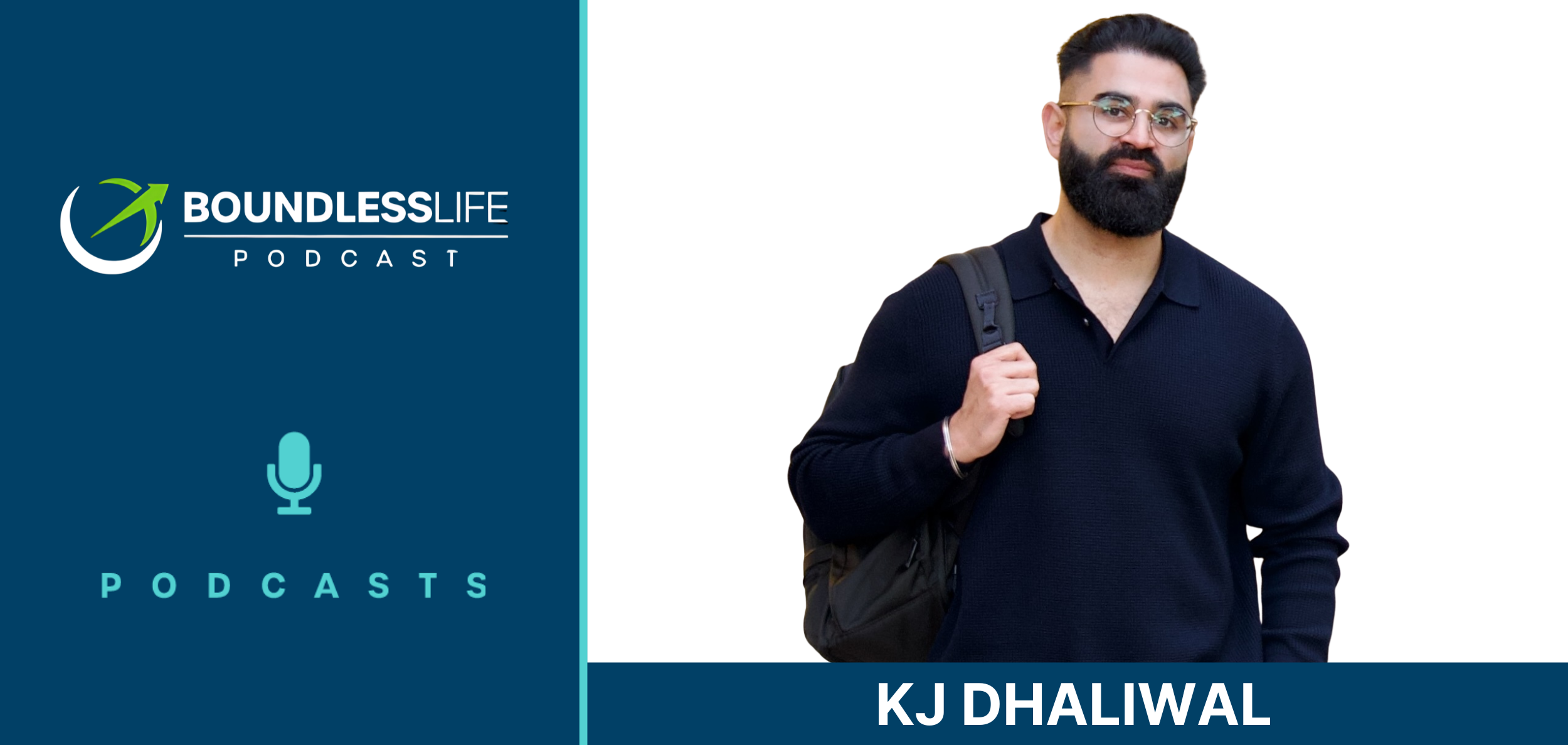
Home » Podcast » The Exciting FUTURE of AI-Based Medicine: How Patients Save Money & Doctors Save Time! with KJ Dhaliwal

The Exciting FUTURE of AI-Based Medicine: How Patients Save Money & Doctors Save Time! with KJ Dhaliwal

Listen on:

Reading time: 5 minutes

What I Discuss with KJ Dhaliwal:

  • How growing up as an immigrant child translating doctor visits for his parents, an 18-year-old disc herniation, and watching his sister become a physician led KJ to create Lotus AI…05:34
  • Why hospital systems have no financial incentive to make your data accessible or transferable, and why 100 million Americans currently do not have a primary care doctor…06:46
  • How Lotus AI pulls your entire medical history from every clinic, hospital, and lab you have ever visited in minutes after you sign a digital consent to treatment, and what it does with that data…13:06
  • How Lotus AI combines data aggregation, medical AI, and a real licensed physician network into one unified system, and why that combination is different from anything currently available….14:35
  • What the patient experience looks like inside the app: identity verification, connecting wearables, and getting a prescription sent to the pharmacy within minutes (without an in-person visit)…21:27
  • How Lotus Cortex works as an Iron Man suit for physicians, giving them your full health history, a suggested diagnosis, and a prewritten clinical note in under two minutes…26:54
  • How Lotus AI is bringing back the traditional concept of a doctor who knows your full health history…30:17
  • Why the business model of Lotus AI is completely free for patients…36:40
  • Two real patient stories in which a woman with years of unexplained tinnitus got answers within 24 hours, and a man whose Oura Ring data combined with his clinical history finally surfaced a sleep apnea diagnosis his doctors had missed…48:34
  • How hospitals are selling your de-identified health data to pharma companies without telling you, and what Lotus AI's transparent, patient-consented alternative could look like at population scale…54:16
  • How AI prescribing can eliminate the multi-layer pharmacist review chain that still misses medication errors, and why reinforcement learning from physicians is making Lotus AI increasingly accurate over time…55:57

In this episode with KJ Dhaliwal of Lotus AI, you'll hear how translating his immigrant parents' doctor visits as a child and years spent bouncing through fragmented specialty care as a teenager after a disc herniation shaped his mission to give 100 million Americans free, world-class primary care using AI.

KJ breaks down how Lotus AI pulls your entire medical history from every clinic and hospital you've ever visited in minutes, unifies it with your wearables and genetic data, and makes it available to both a conversational AI and a network of real licensed physicians who can diagnose you, prescribe treatment, and refer you to a specialist in under two minutes at any hour of the day. We'll also touch on why hospitals are selling your health data to pharma, how the business model works, and why KJ believes the AI-powered general doctor is not just possible but already happening.

KJ Dhaliwal is the founder and CEO of Lotus AI. Before Lotus, he co-founded the largest South Asian dating app, which he grew and sold. At Lotus AI, his mission is to collapse the cost of healthcare delivery while making world-class primary care free and permanently accessible to every American.

You can download the Lotus AI app here. If you are a physician, you can visit lotus.ai and sign up for Lotus Cortex.

Episode Sponsors:

Anthros: You can train hard and still undo a lot of that progress by sitting for the next eight hours, which is why Anthros takes a different approach, starting with a Precision Posture System at the pelvis so your spine naturally aligns, plus a built-in Clinical Posture Consult that helps identify issues you may not even realize you have. Go to anthros.com and use code BEN for an exclusive $200 discount and try it risk-free for 60 days.

Timeline: Give your cells new life with high-performance products powered by Mitopure, Timeline's powerful ingredient that unlocks a precise dose of the rare Urolithin A molecule and promotes healthy aging. Mitopure now starts at $79 when you go to timeline.com/BEN.

Quantum Upgrade: Recent research has revealed that the Quantum Upgrade was able to increase ATP production by a jaw-dropping 20–25% in human cells. Unlock a 15-day free trial with the code BEN15 at quantumupgrade.io.

Dr. Murray Natural Products – ThymoQuin®: ThymoQuin® is a clinically researched black seed oil formulated to support healthy cortisol levels, improve resilience to everyday stress, and promote overall well-being. It's the only black seed oil that meets U.S. Pharmacopeia guidelines and is backed by human clinical research. Visit doctormurray.com/ben and use code BEN25 for 25% off all Dr. Murray Natural Products.

Qualia Stem Cell: Qualia Stem Cell is a science-backed supplement designed to support your body's natural repair system by enhancing stem cell function, helping you recover, renew, and maintain healthy tissues as you age. Taken just four days per month and formulated with premium, clinically supported ingredients, it's an easy way to support long-term healing and vitality. Visit qualialife.com/boundless and use code BOUNDLESS for 15% off.

Episode Resources:

People

Companies & Products

Articles & Links


Upcoming Events:

Boundless Live Tour Presented by FormulaIQ | Summer 2026

Join the world premiere of Boundless: The Man Who Became Human, a new feature documentary that follows 20 years of body optimization colliding with life's immeasurable moments—marriage, family, and faith. Experience a live podcast recording and intimate Q&A with my family and me in Los Angeles, New York, Austin, and Moscow, ID, one night in a room full of people chasing the same thing. Purchase tickets here. 

Health Optimisation Summit | September 11–13, 2026

I'm speaking at the Health Optimisation Summit in London (September 11–13, 2026) at the Business Design Centre. This isn't your average health conference. HOS unites the best minds in biohacking, longevity, nutrition, fitness, and medicine, with one goal: to actually make people healthier. With 35+ world-class speakers, 120+ cutting-edge brands, and 4,000 like-minded people all under one roof, it's two days that could genuinely change how you approach your health. Get your ticket here and use code BEN to save 10% off registration! 

Eudēmonia | November 5–8, 2026

I'm speaking at Eudēmonia (November 5–8, 2026, in West Palm Beach, FL), a prevention-focused, science-based health, well-being, and longevity summit designed to add years to your life and life to your years. Across 3 days and 15 venues, you'll experience 200+ talks from 120+ experts, 300 treatments, and 160+ brands covering everything from biohacking, longevity, and hormonal health to gut health, brain health, peptides, mobility, and more. I'll be leading a talk and a movement session alongside some of the brightest minds in health today. Use code BGREENFIELD-EUD-100 for $100 off when you register here!

The Boundless Couples Retreat | November 10–14, 2026

Ready to reconnect and recharge with your partner in paradise? Join the Greenfields at the stunning Prana Maya resort in Belize for the Boundless Couples Retreat, November 10–14, 2026. It's a five-day, all-inclusive escape designed to deepen your relationship, restore your vitality, and create memories that last a lifetime. From relaxation and adventure to intimate relationship coaching with Jessa and me, every detail is crafted to send you home with a stronger bond and a reinvigorated spirit. Spots are limited, so discover more and secure yours here today!

The Manzo x Ben Greenfield Table Private Dinner | Throughout 2026

If you want to taste one of the world's rarest cuts of beef and experience my North Idaho biohacking compound firsthand, my family and I are hosting The Manzo x Ben Greenfield Table, an intimate, chef-catered VIP dinner on a few limited 2026 dates. The evening includes biodynamic wine, a live cooking demo, a multi-course Piedmontese feast finer than Wagyu, and a night of deep sleep in an EMF-free, fully grounded, circadian-optimized guest room. Anyone who reserves a half or whole Piedmontese bull from Manzo qualifies for a spot, so reserve your allocation and dinner here.

Stay tuned for future updates—and you can always keep up with my LIVE appearances by checking out bengreenfieldlife.com/calendar!

Do you have questions, thoughts, or feedback for KJ or me? Leave your comments below, and one of us will reply!

Ben Greenfield

My name is Ben Greenfield, and on this episode of The Boundless Life Podcast,

KJ Dhaliwal

the amount of medical knowledge that exists doubles every seven months in the world, so there's no way a human is able to keep up with it. 100 million Americans still don't have a primary care doctor, and we spend a trillion dollars on it. If you can do a couple of things, which we're doing, all of these, by the way, which are make the doctor ten times more productive and collapse the cost of care, it was sort of the convergence of all these things for me that was like, hey, now's the right time to build this company, even though I've been thinking about it the whole time.

Ben Greenfield

Welcome to The Boundless Life with me, your host Ben Greenfield. I'm a personal trainer, exercise physiologist, and nutritionist, and I'm passionate about helping you discover unparalleled levels of health, fitness, longevity, and beyond. I spent 20 years measuring and optimizing everything about my body, deep performance metrics, cold stress, heat stress, sleep scores, blood panels, peptide protocols, testosterone, telomeres, VO2 max, you name it, and somewhere in the middle of building what looked like a perfect life, I almost lost the lives that I was building it for. Boundless, The Man Who Became Human, is a brand new feature documentary that follows what happened when the optimization framework that I spent two decades constructing ran headlong into the things that metrics could never measure, my marriage, my sons, my faith. The private archive footage in this documentary has never been seen publicly. Some of it I debated even including at all. It shows basically the worst of what happens when longevity becomes the ultimate goal, and how you and I can turn that around to become fulfilled by what's truly important in life. Now, this is not just another biohacking film, it's an honest look at what it costs to chase the ceiling on human performance, told through real footage of one family, my family, finding that out, and I'm giving you the chance to join me for the brand new live premiere tour of this new film in a city near you. Here's what the night looks like. You watch the film with me and my family in a theater, and then you experience a live episode of the Boundless Life podcast on stage with open Q&A, real questions, no filters. My wife, Jessa, and my sons, River and Terran, will be there with us as well. VIP ticket holders get to join for an exclusive after party with upgraded food and drinks. This Boundless Life Tour kicks off in LA on July 24, Austin on August 20, New York City on August 6. Miami coming down the pipeline, London coming down the pipeline. More cities to be announced. Tickets are on sale now. Grab them now before they're gone at BoundlessDoc.com, that's BoundlessDoc.com, and I hope to see you there.

Shark Tank Shark Damon John recently introduced me to the company Lotus AI, and my guest on today's show, KJ Dhaliwal, is the founder and CEO of Lotus. They're up to a pretty cool project to give 100 million Americans world-class primary care for free by using AI to basically collapse the cost of care and make it personalized and available 24/7 via an app, and also make physicians' lives a lot easier too. So, the show notes are at BenGreenfieldLife.com/lotus. I'll also link to Lotus's website and app right there at BenGreenfieldLife.com/lotus. Let's go talk to KJ.

All right, KJ, you and I actually have not talked before, but multiple people have sent me a heads up on what you've been up to in the whole AI meets health realm, so I would love to start here. I actually kind of stalked you for a while. I went to the Lotus website, I saw there that you said that you saw firsthand how broken healthcare is, so that kind of made me curious. Did you have some kind of experience in the medical system that soured you on it?

KJ Dhaliwal

Yeah, definitely. You know, it's one of those things that I've been sort of thinking about for a really long time, because as a child I was an immigrant translating doctor's visits for my parents, and sort of, you realize all the inefficiencies and all the things that are wrong about American healthcare. And when I was 18, I had two disc herniations from a sports injury, so that threw me down a rabbit hole of years of specialty visits. I would literally carry around a binder of my physical health records, and you know, they would give it to you on CD-ROMs in terms of your imaging.

Ben Greenfield

By the way, just to interrupt you real quick, I sometimes wonder if we are in the dinosaur age, because when I get an MRI, for example, I will still get the CD mailed to my house, and I sit there scratching my head like, what do I even put this in?

KJ Dhaliwal

Look, I don't even have anything I can put it in anymore,

Ben Greenfield

exactly.

KJ Dhaliwal

Yeah, that's part of the problem, right? I think the industry is always sort of gatekept. A large part of that is causing people to get retested over and over again, so you end up with all these records in all these different places, and there's no way to unify it. And that was sort of most of the arc of my life, seeing it as a patient firsthand, but then as a child seeing my parents get misdiagnosed and struggle to get care, and then my sister ended up actually becoming a physician out of that, and I saw the problems from the physician side through her as well. And it really wasn't until I sold my last company, which I built, called Dil Mil. It's the largest South Asian dating app. That's where I really learned how to build consumer products that people trust and use on a daily basis. After I sold that company, I really started thinking about this problem again, because it was something I always thought about, but AI wasn't there, and healthcare data interoperability wasn't really there. A lot of things in life are about timing, and this is kind of why I'd say the why-now behind Lotus AI, and what we're doing today, is really the genesis of it. The seed was probably planted when I was a child, but it was really when AI came about, as well as health data interoperability and being able to pull the data but then use AI to reason over it, to do the things that physicians and clinicians do, to help them be more productive. I'd say those are three converging forces. And the other big part is, obviously, Americans have lost trust in these institutions and the system, and people are really at a breaking point. 100 million Americans don't have a primary care doctor today. So it was the convergence of all these things for me that was like, hey, now's the right time to build this company, even though I've been thinking about it for a really long time.

Ben Greenfield

Yeah, I think for a lot of people it's kind of like a black box when you go to the doctor, in terms of scratching your head about how the doctor is talking to, say, a hospital, or let's say an imaging clinic. I have a dashboard, I've actually lost track of the number of dashboards I have that I log into, and I have medical records that seem to be scattered across different practitioners, hospitals, clinics, etc. I don't know if you know the answer to this, but even just big picture, how do digital medical records actually work? Like when you go to the doctor and then maybe you go to the hospital three blocks down the street, how are they talking to each other?

KJ Dhaliwal

Yeah, that's a great question. So a lot of times they're not talking to each other. The way that they're trying to do that today, it's a pretty complex answer, but each EHR vendor, there are companies like Epic, and

Ben Greenfield

EHR is electronic health record,

KJ Dhaliwal

that's right, yeah, electronic health records, which really came about in the last two decades, mostly in the last decade, where hospital systems were incentivized by HHS and CMS to move to electronic health records, because before that it used to be all paper. You'd go to the doctor, the doctor would take notes on paper and put it in a file somewhere, so there was really no digital version of that. But as records got digitized, these hospital systems built up walls, because if you think about it, when you're a patient at a hospital or a health system, it's in their best interest to try to keep you as a customer, to keep you coming back there. So if they make that record retrieval super easy for you, then the switching costs go down, and you can go anywhere and get care, right? So it's

Ben Greenfield

that nefarious, it's not just, I guess, what's the saying, don't attribute to ignorance, or don't attribute malicious intent to ignorance or stupidity, basically. But it actually is like a marketing mechanism, making your records largely inaccessible to ensure you're coming back to the facility.

KJ Dhaliwal

Yeah, well, I mean, my point is there's no incentive for them to really push to make it super accessible and interoperable, because from a business perspective, they want to lock you in as a customer and keep you coming back, so the switching costs are higher, right?

Ben Greenfield

Yeah, so okay, I get

KJ Dhaliwal

it, that incentive really hasn't been the focus of the hospital system, or even the EHR vendors, quite frankly, because the customer of these electronic health record systems is the hospitals and the health systems, and they'll do whatever their customers want.

Ben Greenfield

So, in a nutshell, putting health data into patients' hands, or allowing there to be a nucleus that multiple clinics, physicians, or medical providers could access, has not been something that's in the best interest of your medical provider up to this point.

KJ Dhaliwal

No, because all of American healthcare is sick care today. You get sick, you go get treatment, they bill insurance, and they get reimbursed. Outside of that, there's really no one incentivized to get all the data from all these siloed, fragmented sites of care that you've interacted with over the course of your life, stitch that together, and then present it to you in a way you can actually understand. There was obviously the emergence of things like value-based care, and other organizations trying to do more preventative work, but because the system is so deeply entrenched, and it's largely a reactive sick care system, no one's really pushing to help the patient get agency over their data. But there are programs now under HHS and CMS pushing to get systems to commit to making data interoperability easier and more accessible for patients. There are systems called HIEs now, health information exchanges, and there's new legislation called TEFCA that tries to incentivize health systems and participants to share data. So we're pulling from some of that as well, but we're also directly integrating with all the EHRs. It's a very messy system today, and no one had really built something until Lotus AI came about, where you could sign up as a patient, verify your identity, and we would go get all your records for you in minutes. That was the big innovation that we did.

Ben Greenfield

When you just gave that brief description of being able to sign in and pull your records from anywhere, I guess it kind of opens up the discussion about AI, because I think the way people think about AI meets healthcare, or AI meets medical records, right now is, I've got Claude or GPT or whatever in front of me, and maybe I've researched or Googled or asked an LLM about good prompts for, let's say, reviewing my labs, solving a health issue, being a modern fancy version of Dr. Google. And possibly, if I'm really advanced, I've uploaded all my labs from the past ten years and gotten a really good result when it comes to actionable information. What you're describing sounds like something different, not just an LLM or AI-based model to make you sleuthing your own health easier, but something that's actually digging into your previous medical records and somehow interacting with the medical system.

KJ Dhaliwal

That's right. Yeah, there are three major components. First is getting the data, which is getting easier now. To your point, people have access to their lab work, maybe they went to Quest or LabCorp. They can upload some of that, they can log into what's called their MyChart portal through Epic, which is the EHR vendor that works with a lot of major hospitals. Getting that data is the first part. And then a lot of times that data is messy, and it can sometimes actually be wrong because of human error, somebody put something wrong into an EHR. So it's cleaning that data, structuring it, so our AI systems and our physicians and clinicians can actually utilize it, and then giving you treatment and care based on that. So we're not only pulling data in, we're actually a fully functioning medical practice that's able to give you care grounded in your longitudinal health history, as well as the latest evidence and research, by actual real human doctors. So we always say we're building the best AI doctor, powered by real doctors and the latest evidence and all of your data. That's the overall summary of what we do, but obviously there's a lot that goes into each of those pieces. By the way, it's not just medical records that we're pulling for the last ten or twenty years that you've seen doctors, it's also your wearables data, genetic testing data, your insurance claims data. So if you have a wearable, like an Oura Ring or Fitbit or Whoop, or Eight Sleep, we're able to aggregate all that data in as well. No one's really brought the medical records and this contextual health data into one system, normalized and standardized it, and then given that to AI agents as well as physicians to give care based on that. That's the big innovation we've done, and that's why it's super exciting, because we're doing this all outside of the existing healthcare system. We don't need to partner with a hospital or a payer or an insurance company, so we can go direct to the patient on one end, and direct to the physician on the other end. So we built two systems, basically, where the physician uses it and the patient uses it, and they're able to interact and just get world-class care.

Ben Greenfield

Okay, let's dig into that a little bit. For illustrative purposes, I'd love to know, and we've got time to unpack this, as the consumer, as the patient, what happens when I download the app in terms of the next steps, and then I'd also like to rinse, wash, and repeat that from the physician side.

KJ Dhaliwal

That's a great question. So as a patient, you download the mobile app on the app store, it's called Lotus AI. Once you sign up, you verify your identity, your name, date of birth, address. Then we do ID verification, or you can use your social security number, and once you do that, you sign a consent to treatment, the same way you would when you walk into a new doctor's office and sign the clipboard. We do a digital version of that, called a consent to treatment. When you give us the consent to treatment, we effectively become your doctor and provider, so that gives us the authorization, almost like a power of attorney, to go get all your records for you. We've built digital, programmatic endpoints to do that. So what happens is, within minutes, we're hitting all these endpoints across the country, aggregating all that data, and then we're doing something called ETL, which is a technical term meaning extract, transform, and load. That means you take the data, clean it, deduplicate it, structure it. A lot of it's unstructured data, some of it's wrong, so you make it accurate. All of that's happening in the background. So as a new user, as a patient, now you have all of your health history at your fingertips, and then you can optionally connect your wearables data, so you can sign in with, like, Oura, for example, and bring that data in.

Ben Greenfield

Okay, and then if I have data that maybe doesn't exist in the electronic health record world, but that I happen to have on my own, let's say I randomly got a full body MRI or a DEXA scan or some test, like a SIBO test or a genetic test or something that might not already be available online, can I directly upload that?

KJ Dhaliwal

That's right, yeah, you can upload anything. Our goal is always to make it as easy as possible for the patient, so you don't have to go find the records and upload them, but of course if you've gotten something outside the traditional care system, or even a wearable device with API access, you can, of course, upload the data yourself. There's also the Apple Health kit integration, so Apple Health data comes in pretty seamlessly as well. So you're bringing all that data in, and then you start to see insights about your health based on all the data, and you can ask any question to Lotus AI, and it'll take the context of your entire life's worth of health data and all the latest evidence and research and give you an answer. But whenever it's a medical question that requires care, that gets escalated up to a product called Lotus Cortex, which is a physician-facing tool, which I can talk about now if you like. There's kind of like

Ben Greenfield

two different levels, one, an AI that's trained on medical terminology, your health records, etc., that can directly and perhaps more quickly answer questions, and then once you get into something that requires medical care, like whatever, I've halfway chopped my arm off, then it's going to step up to some kind of physician on the other end,

KJ Dhaliwal

yeah, and it doesn't have to be that acute or drastic. It can be simple things as well, anything that requires medical advice, a prescription, a lab order or a referral, or just a second opinion. Lotus will escalate that up to a physician to review and give you advice pretty quickly. We can give you basically any prescription, we don't do controlled substances today, just to be safe in that area, because there's a lot of fraud and misuse there. But we can order labs for you, we can diagnose you, we can refer you to in-person care as well. So basically all the primitives of what you'd imagine when you visit a doctor in person, like a primary care doctor, we're able to do today. The only thing we can't do is touch you and examine you physically, because it's all virtual. But it turns out 70 to 80 percent of all primary care visits can be done virtually, so the number of times a doctor actually needs to see you is pretty limited.

Ben Greenfield

Until at-home palpating robots become a reality, which actually is a potential reality. Playing devil's advocate here, you mentioned that, for example, you might need to bring in the human physician when a prescription needs to be refilled. Is there a reason, legal or otherwise, that AI couldn't just see, okay, they've been on this prescription for x period of time, they need a refill, they've requested a refill, here's what the most recent labs show in terms of whether they do or don't need that refill, and couldn't that process be entirely automated?

KJ Dhaliwal

It is. Yeah, so the physician is there to review what the AI is coming up with and sign off on it. I can talk a little bit about that if you want, about what the physician experiences. So if you go to our website today, it's lotus.ai, and click on Physician Cortex at the top. As a physician, you learn more about how the platform works, and sign up. You go through an application process, and if we approve you, we verify you have an NPI number, and you're licensed in the state you're going to be practicing in, and we give you access to this tool called Lotus Cortex. As a physician, now it's almost like this Iron Man suit that we built for the physician. So what they see is a request come in from, let's say, Ben is using the product on the patient side, and let's say you have an infection going on, and you can't see a doctor for another two weeks, and you can't take time off work, you've got to take care of your chickens, and now you're talking to Lotus at 1 a.m. Lotus is asking you all these follow-up questions, building all this rich context. What it then does is create a SOAP note, which is a standardized clinical note that a doctor creates when you go see them, and it references basically all of the conversation history you've ever had with Lotus, but also all of your data and all the latest evidence. It creates a request that pops up in a queue for the physician, and the physician picks up that request, and in that request they see suggested care actions. This is what Lotus Cortex is suggesting to the physician, that this is, based on all the medical knowledge in the world as well as Ben's entire health history, probably the best option for Ben in terms of a prescription or a treatment plan. And then the doctor does their own clinical reasoning and is able to make a decision pretty quickly, and then they can hit a button, and all the other care is executed, your prescription is sent to your pharmacy, the lab is ordered, you get a response with a detailed breakdown of what to do next. All of that, by the way, on the doctor's side, happens within about two minutes. So we've effectively increased the productivity of the doctor by a factor of ten, because in a traditional primary care visit it's about a twenty-minute visit, where most of the time the doctor isn't even talking to you, they're looking at their computer trying to figure out what's going on. You walk out of there sometimes more confused than you walked in, with a thirty or forty dollar copay, and sometimes a much bigger bill when you get home from the insurance. And half the time it's not even a doctor, it's a nurse or a PA, because we don't actually have enough doctors in this country. Not to mention you waited like two months to get this visit, and you had all these questions, but they're like, no, no, we can only talk about one thing, because that's how I can bill insurance, you've got to follow up and come back for all the other stuff. So we've basically collapsed all of that down to a two-minute interaction, but in that two-minute interaction, the physician isn't just treating one thing, they're able to treat you holistically, because they can see all of your data at their fingertips. So they have this Iron Man suit superpower that lets them practice at the top of their license, and that's how we've been able to bring the cost of delivering that care down significantly.

Ben Greenfield

Okay, it is a potential, I guess, downside, or trade-off some might consider, the fact that you don't have a dedicated physician, like whoever your person, you know, Carrie or Bob or whoever, who you're used to seeing on a regular basis, whose face and name you know. Are you kind of working through a series of physicians based on whoever happens to be available when you're logged into Lotus?

KJ Dhaliwal

Absolutely, that's a great point, actually. And sadly, the reality today is most people don't have that anyway, right? Most people change insurance every couple of years, because most people change their job every couple of years. When you change your job, you change your insurance, you change your providers and your health systems. And even today, most of the time you're not seeing the physician, you're seeing a PA or a nurse. Medicine used to be, before the emergence of modern healthcare in America, there was this concept of a general practitioner who would know you for your entire life, basically treat everything, they even did things like surgeries. Then the emergence of specialty care and big hospital systems came about, where the practice of medicine went from a family medicine doctor that your whole family would go to, who understood your entire family and your life, and what was going on, that was great. That doesn't exist anymore, largely, in this country, because medicine has moved into these big health systems that have consolidated, private-equity-owned systems rolling up these small practices, and these small hospitals have now moved to specialty care. That's why, today, a family medicine practice, or even a family medicine doctor, is actually one of the least paid doctors, versus an internal medicine specialist or surgeon, because that's where all the money is, that's where hospitals make all their money. So the prestige of becoming a doctor has now moved into these specialties, and that stripped away the capabilities of a general practitioner, or a general primary care physician, to do all these things, and now they just do very surface-level things and become almost like a triage agent for the rest of the specialty care system. When in reality, that was the best way to deliver care to a community, because that physician was deeply embedded in the community, understood the community, understood the family, and what was going on over the course of your life. But that doesn't really exist today, and that's actually what we're building with Lotus. The way to build that is to have a single point of contact, which is Lotus AI, that remembers all the context of your life and is able to surface that up to whatever physician is treating you at that time, and give them all the latest context, and they can see a timeline of all the treatments that have happened through Lotus. So you still get that relationship you're talking about, it's just not with one doctor, it's with a group of doctors, but largely it's with AI, it's with Lotus AI,

Ben Greenfield

which is technically more convenient. Lotus is the version of the country doctor with the leather satchel who shows up at your door. And in our day and age, that might be annoying, because what you really need is to step up to XYZ specialists. So Lotus is kind of bridging that, and I guess one

KJ Dhaliwal

thing I'd add is, what Lotus is doing now for the doctors we have on the platform is upskilling them to practice in areas of medicine they may not normally be comfortable with, because they don't have all the context of the patient, and they don't have this Iron Man suit available to ask a question that can go and reference all the latest medical literature and evidence to answer it. So for example,

Ben Greenfield

so are you saying it's turning the country doctor into more of a specialist, then?

KJ Dhaliwal

It's allowing the country doctor now to practice all specialties, because they have all the information at their fingertips. And the reason specialties exist in medicine is an artifact of the human mind, the limitation of the human mind. There's no way a doctor can keep up with all this information, every single specialty. But now, with AI at their fingertips, they're comfortable practicing cardiology, comfortable practicing a lot of things they normally wouldn't be able to do. So now we can get a lot more care up front, and they only go to the cardiologist when they need, say, an interventional cardiologist to put in a stent, or when they need actual surgery and need to be under the knife. So that's really moving healthcare from the disjointed specialty care system, which charges you a whole lot of money every time you interact with it, to bringing all of that care up front. So that's kind of where we say we're upskilling the average doctor to be comfortable. The amount of medical knowledge that exists doubles every seven months in the world, so there's no way a human is able to keep up with that.

Ben Greenfield

Yeah, such a pattern interrupt, it kind of makes you wonder, as models like this progress, how it might change the face of medical education. Do you specialize, or since that knowledge is already going to be at your fingertips, do you go down a different path?

KJ Dhaliwal

Exactly. And we've actually come up with a name for it, it's called Infinite Care. It's infinitely available, infinite capacity, and it's really about giving doctors the confidence to practice in all areas of medicine, virtually, and giving the patient instant access to healthcare in general. And by the way, like I said, all healthcare today is sick care, reactive. What we're really doing here is preventative care and proactive care, before you get sick. Things like, how do I optimize my diet, my fitness, with these conditions I have. And then, from time to time, I have an issue, I need a prescription, I can escalate up and get that. So there's a lot to be said about the future of medicine, and I could keep going down that rabbit hole for another hour, but I think it's a fascinating time.

Ben Greenfield

Yeah, elephant in the room, I guess, because I noticed this on the website, unless I'm mistaken, from the physician side, from the monetization side, it appears to be largely free. So if I'm a doctor and I sign up for this platform, how am I getting paid for actual patient care or time spent working?

KJ Dhaliwal

Yeah, so we pay the doctor, right, and essentially the waste pays for the patient. For that request I was explaining to you, when it gets escalated, and they resolve it, every time they provide treatment and resolve a request, they're earning income, and we're basically paying the doctor out at the end of the month. That's how the doctor gets paid. Now, on the patient side, it's actually completely free, so that's the other radical part about what we're doing, flipping the business model of healthcare upside down. Happy to go into that rabbit hole as well.

Ben Greenfield

I would love to go into that, because I'm sure if I'm wondering, other people are too. Where's the money coming from if it's free for the patient, and the doctor's getting paid?

KJ Dhaliwal

Yeah, most of American healthcare today is what's called fee-for-service. You go and get something done, a service, whether it's a procedure or advice, and you typically pay a copay, and the insurance pays the rest if you're insured. There's a small percentage of the population that's uninsured, and a small percentage that sees concierge medicine doctors and pays tens of thousands of dollars a year out of pocket. But largely, American healthcare today is a fee-for-service, insurance-reimbursed model. What that does is incentivize the doctor to see a large volume of patients, so they can bill insurance as much as possible, and it incentivizes the insurance companies to deny a lot of those billings, called claims, and try to reduce the amount of care a patient is consuming from the system. So the system incentivizes the patient to not seek that much care, because the more care they seek, the more the insurance companies have to pay. And that's where they invent things like prior authorizations, to try to slow down that load a little bit. The problem with all of that is it leaves the patient delaying care. That's the big problem in this country today. Like you were mentioning, you have a bunch of dashboards with all your data on them, it's great to get some insights, but if you need a prescription, or a medical diagnosis, or someone to order a lab for you, you need to interact with the healthcare system.

Ben Greenfield

Right. So, for example, if I have imbalanced lipids, let's say high ApoB and Lp(a), high particle count, combined with some kind of hemoglobin A1c and glucose elevation, kind of like the warning signs that I could be at risk from a cardiovascular standpoint, and it would actually be very prudent for me, let's say for me to be able to be around for my family, I'm a male, I'm 50, to get a CT angiogram or something like that, the six-to-eight or twelve-plus-month process of waiting could actually be a long enough period of time for something like plaque rupture to occur. So in many cases we're talking about a life-or-death or significant hospitalization issue, if you're simply waiting and waiting and waiting after the warning signs have already been presented,

KJ Dhaliwal

that's right, yeah, and you're a very knowledgeable person about your health, and you understand why that's a risk, but the average person doesn't. And what ends up happening is people have one or two bad experiences with healthcare, where they'll wait three months to see a doctor and end up with a fat bill at the end of it, and the next time they get sick, they're just like, you know what, I'm just going to go to Google or ChatGPT and figure this out, I don't want to take time off work and drive an hour and sit there for thirty minutes to talk to a doctor for ten minutes. So the problem with that is, because it's a very reactive system, people just delay care, and because people are delaying care, Americans are getting sicker and sicker. Then what ends up happening is they get really sick and end up in the emergency room. That's why we have a flood of patients always, that's why the ER wait times are so high, because the hospital systems, from an ER perspective, are overwhelmed. And oftentimes, a lot of times, it's too late for that patient by the time they get to the ER. That's really where it's a reactive system, versus what Lotus is doing, which is saying, "Hey, no, we're, in essence, not charging you for this, come consume care, come use it every day if you want." We have patients, the average patient today on Lotus uses Lotus about two to three times a day, and it's not always about being sick, it's about, how do I think about this, I have a self question, or I'm trying to optimize this. And all of that, by the way, is context that's continuously building an understanding of you as a patient. So when you do get sick, when you need the care, we're able to give it to you much faster, but give you a way better, personalized level of care. So by keeping it free, we actually incentivize utilization, which is the exact opposite of how most of healthcare works today. And by doing that, we increase engagement with the system and the product, and what ends up happening is it starts to look like a consumer internet company, like Instagram, or WhatsApp, or even Google. So that's kind of how we're building it, as a consumer app, essentially, that people use on a very frequent basis.

Ben Greenfield

But Google monetizes with ads. Free usually means somebody is paying somewhere. So what's the vision there, as far as how you're going to keep the lights on, so to speak?

KJ Dhaliwal

Yeah, so it basically turns out that if you can solve the problem, we're spending five trillion dollars in this country today on healthcare, 100 million Americans still don't have a primary care doctor, and we spend a trillion dollars on billing, prior auths, admin, that layer of stuff. If you can do a couple of things, which we're doing, all of these, by the way, which are make the doctor ten times more productive, collapse the cost of care, we're doing that by a factor of 60x today, and I can talk about the math there, and then it turns out you can actually help the patient and improve the outcome, there's almost an infinite number of ways to make money. You think about things like CMS and Medicare inventing programs like the Access Program, where they're giving companies hundreds of dollars up front to take care of a patient over the course of a year, and no one's really able to do that, because the whole healthcare system is set up for reactive care. We're really well positioned to take advantage of that, actually, but we're completely free for the patient, so we're not participating in that right now, but we're very close to the HHS team and the CMS team, they're doing great work over there. But ultimately, I can give you a couple of quick ideas on how this makes money very long term. One, you brought up ads, and not all ads are bad, we see pharma ads on TV all the time, and 90 percent of the time it's not relevant to you, but even outside of pharma, fitness and wellness is a two trillion dollar market, so from a very safe, ethical advertising perspective, there's a massive advertising opportunity there. The second is, you look at these large employers across the country with thousands of employees, they're actually their own insurance providers, so they're deeply invested in keeping their employees healthy, because they can come to work and produce for the company. But these employees are often frustrated because they're trying to seek care and can't do it. So you can imagine an employer partnering with us and paying us fifty dollars per employee per month to give them unlimited care,

Ben Greenfield

Right, shifting that spend from company insurance to using something like Lotus,

KJ Dhaliwal

Exactly, it becomes an employee benefit. And then, by the way, the third, and there's an infinite number of ways to make money, but I'll give you the third one, which is health systems today, like I said earlier, make most of their money from specialty care. So for them, primary care is typically a loss leader, because they need it, that's how they get referrals into their specialties. But you look at companies like One Medical or Oak Street Health, direct-to-consumer primary care systems, One Medical was acquired by Amazon, but essentially 30 or 40 percent of One Medical's revenue actually comes from triaging sick patients into health system specialty care. But they can do it better than the systems can, because they can give these patients longitudinal care. So you can imagine Lotus is actually able to do that even better, because we deeply understand the patient, we understand where they live, what problems they have, and we can wait to refer them in only when they absolutely need to go in. So it's better for the patient, and it's better for the health system, because health systems have a term for this, it's called a good patient versus a bad patient. A good patient is someone who actually needs that procedure, and they can bill insurance and maximize the physician's time. A bad patient is someone who was just worried, and they came in, and they don't actually need that procedure, and now they've just wasted a thirty to sixty minute visit with the interventional cardiologist, for example. So it actually ends up cutting a lot of that waste, because now, when you go to a cardiologist, like for example the situation you were talking about, let's say you had cardiovascular disease you weren't aware of, if you went to a cardiologist today, the first thing they're going to have you do is get lab work and testing done. Now you've just waited six months to see that cardiologist, and now they're like, hey, follow up, go get all these tests done, come back. We're able to do that up front for the patient, and we're able to synthesize their entire medical history. So we only send you to the cardiologist when that interaction is actually going to be useful for you and for them. So you can imagine why health systems would be super interested in partnering with us for that, we're having some of those conversations as well, but we're really just invested in doing what's right for the patient today and building the best possible experience, and then also for the physicians. And we think once we get to scale, there's an infinite number of ways to make money.

Ben Greenfield

I wasn't quite sure when we started the interview, but it sounds like you actually do have patients using it right now, patients and physicians using it right now. Correct?

KJ Dhaliwal

Yeah, we've got patients.

Ben Greenfield

That allows me then to ask a few kind of data or evidence-based questions, and I don't know if you know the answers to these, but I'll throw a few at you. One thing I see happen a lot in the health world, and I'm not a doctor, I do wind up talking with a lot of people about health issues, spending several hours a week doing that, people a lot of times have mystery symptoms, mystery clustered symptoms, things that have been very hard to decipher and interpret, and they've been through the ringer of the medical system and have never been able to fully put the pieces together in terms of what their diagnosis or their problem actually is. Have you had any patients like that go through Lotus and actually get the answer, based on the complex interweb of AI and physicians you've described?

KJ Dhaliwal

Yeah, every day, we have new success stories every day that are incredible, and it really gets us out of bed, because we know we're making an impact on people's lives. There's a bunch on our website you can check out as well, there's a patient named Trisha who had pulsatile tinnitus for years and bounced around, that's

Ben Greenfield

like the ringing in the ears, right,

KJ Dhaliwal

yeah, that's a ringing in the ears, and she had no answers, and it wasn't until Lotus went and unified all her records and cross-referenced those symptoms and triggers and patterns with medical literature that she was able to start thinking about how to treat herself. She was able to start getting relief the next day, because she was able to start understanding her health conditions better. It's not that a doctor wouldn't know what to do, a lot of times, it's just that the doctor doesn't have time to sit there and talk to Trisha for five hours and understand everything that's going on, and know the latest research, evidence, and literature on these issues, or even have all the information unified in one place to look at. We're having patients, for example, you know a lot of your community is into biohacking and really optimizing health, and we had a patient wearing an Oura Ring for the last year, and their resting heart rate was continuing to go up month over month while they were sleeping, and they were going to doctors trying to figure out what was going on, and they never really brought that up, because it wasn't something they thought would be correlated with anything, but they told the doctor they were having night sweats. The doctor put that in the EHR, in the clinical note, and Lotus was able to pick up on that, and a few other things, and the person's medical history, and say, hey, you might have sleep apnea, based on all this data I'm looking at. The patient ended up getting diagnosed with sleep apnea, and now is on a CPAP and sleeping better. But that's just a simple example, recently, where it's not that the doctor wouldn't have known that, it's just they didn't have all that data in one place to look at, and they weren't incentivized to do that, and they didn't have the time to spend with the patient.

Ben Greenfield

Right, and you make a good point too. I think with big data you could actually, in the long run, and again I don't want this to be medical advice, I'm not a doctor, but you could eventually negate the need for more expensive protocols, as AI does a better job as a predictive algorithm using what I think the best terminology would be, proxies. Meaning maybe you haven't done a polysomnography or sleep lab test, using your example, but we've noted that this cluster of symptoms, let's say night sweats, elevated body temperature, a certain impairment or imbalance in sleep architecture on an Oura or a Whoop or an Eight Sleep, is correlated highly enough with sleep apnea that we can definitively say you have it, and you're skipping the sleep lab study and going straight to the solution. Or even with my example, we've identified, based on treating a quarter million patients, that this cluster of symptoms correlates with a certain percentage of unstable plaque in the arteries. Maybe we're going to save money in the medical system and just skip the CT angiogram and go straight into, whatever, rosuvastatin or a PCSK9 inhibitor or something like that. I think once you have enough data, you could make predictive algorithms like that, that save the medical system money.

KJ Dhaliwal

Yeah, that's exactly what I was referring to earlier, around cutting out a lot of the waste and being able to unify the data. There's a tremendous research opportunity, so we're doing a lot of research right now, we're publishing as well, both on the clinical side and the applied AI side, where we're looking at this data and finding incredible insights. I think our long-term vision, really, is to solve human health, and be able to, over hundreds of millions of patients, subtype that data, understand how diseases develop, how they progress, how to treat them, what treatments have worked for people similar to you or who've had similar symptoms. There's a tremendous opportunity there, even from a research and drug discovery perspective. So from a monetization perspective, that's not really something we worry about today, that's another idea there, but I think ultimately, it's really about how we build outside the system in a way that patients trust us, use us, and we're able to really be in their corner and give them agency over their health today, and that feeds into this really rich data set we're building. And people are, like you talked about earlier too, if you're free, you're the product. And I think that's one thing we deeply believe in, the patient owns their data, we're never going to sell data without your consent. If you want us to share it with someone, we'll absolutely share it. But the irony of it all, actually, is that hospitals are already selling your data, and most people don't know that.

Ben Greenfield

Who are they selling it

KJ Dhaliwal

to? Oh, there are others, and they're selling it to pharma, there are these big resellers of health data that do research to figure out how to optimize billing or optimize operations within a hospital. They claim to de-identify it, but at the end of the day, it's your data that's being sold.

Ben Greenfield

Yeah,

KJ Dhaliwal

most people don't even know that's happening. Every single hospital in the country is doing it.

Ben Greenfield

So what you're saying is, even if it's anonymized, it's being turned into a profit, and the patient certainly isn't profiting from that,

KJ Dhaliwal

exactly. So the way we think about it is, if we can be transparent about it and actually advance science and help patients, especially patients who might have a rare disease they don't know how to treat or solve in isolation, but if we can see that across millions of patients, there's an opportunity to help all of them, and get the patient's consent and be transparent about it. That's my hot take, I actually think people will be willing to sell their data if they're getting incredible care, incredible value from a product, but that's not even on our roadmap today. To your point, there's a massive opportunity on the data side, in terms of researching, subtyping, and being able to garner insights at scale, it's called population health.

Ben Greenfield

You know, back to prescriptions, I think some people don't realize the number of prescription errors, or inaccurate or redundant prescriptions, that result in damage to the patient. With Lotus, is there potential for there to be less of that occurring, in terms of how the funnel goes from patient to physician to diagnosis to prescription to refill?

KJ Dhaliwal

Yeah, absolutely. Like I said earlier, Lotus does a lot of the analysis that the physician typically doesn't have time to do. We've trained on not only the latest research coming out, but also all the clinical guidelines published across the hundreds of specialties of medicine, like the American College of Physicians, the American College of Cardiology, or the American Heart Association's standards of care and guidelines for each specialty. We've ingested that, as well as the FDA drug database and all the contraindications of prescriptions and medications. Lotus is able to reference all of that and do all those cross-checks before the physician even looks at it. So when they look at it, it's almost like the pharmacist. I don't know if you know this, but in hospital systems, typically a physician will write a prescription, and it goes to a pharmacist in the hospital who reviews the prescription to make sure it's not contraindicated with something else the patient is taking that the physician maybe didn't think of, or that it's the right dosage. It goes through two or three manual checks before it gets sent to the pharmacy and the patient gets the medication, but that's very inefficient, and there's actually human error that even happens within that process. I had a story recently, my sister was pregnant, and she was at the hospital, and my nephew was in the NICU because he was born a little early, and a nurse in the NICU gave the wrong medication to my nephew. He was in the NICU, one of the most intensive places to monitor this stuff, and he was still prescribed the wrong medication, probably because it was a resident who was tired at 3 a.m. or something, and then the pharmacist just checked it off, and it went through those two or three layers, and he ended up getting the wrong medication. Luckily he was able to recover from that, but they gave him an adult dosage that would normally never be given to an infant. So I think it's not that doctors are bad people, we think doctors are heroes, it's really that the system they're in today burns them out, because they're on this conveyor belt, a volume game where they have to see at least four or five patients an hour to turn a profit for the system. At the end of the day they're human, they burn out, and they forget things sometimes, and that's really where Lotus is able to reduce a lot of those errors and improve care delivery,

Ben Greenfield

right? Lotus, or AI in general, I guess, doesn't get sleep-deprived, exactly. Occasional hallucinations, which, from what I understand, you guys have ironed out with your particular AI.

KJ Dhaliwal

That's right, yeah. And that's what I was talking about, the stuff we've trained on. Lotus is grounded in all of that evidence and your data, and we have very strict guardrails on what it can and can't do, so all of that work reduces hallucinations, but also errors. And by the way, sometimes the doctors disagree with Lotus, but that information is very valuable for us, because every time they disagree, we use that to do reinforcement learning, so the next time the AI doesn't make that mistake. It's getting better and better every time.

Ben Greenfield

Right, so basically, as the system is used, it's being trained by both the doctors and the patients,

KJ Dhaliwal

that's right.

Ben Greenfield

Yeah. Quick question, in terms of accessibility, is this legal and accessible in all 50 states?

KJ Dhaliwal

Yeah, it's legal and accessible, we're just slow-rolling it out across the country right now, because, like I said, we have real physicians we need to hire in each state where they're licensed.

Ben Greenfield

Right, I'm out in the middle of nowhere in North Idaho, and I did download the app. It looked like I might have had a little bit of limited functionality, but that's not surprising based on my location.

KJ Dhaliwal

Yeah, we'll get some more physicians in Idaho, and once they can handle the capacity, we'll open it up more and give you access. That's basically our biggest limiting factor, and it's growing fast too, because physicians are using Lotus Cortex and realizing this is a better model of care, it's physician-wide care at scale. We're growing pretty fast across the country, and hopefully we'll be larger in Idaho soon on the clinician capacity side.

Ben Greenfield

Cool. Well, folks, you can find it in the app store, just Lotus. I assume physicians, should they go to the website, or is it also the app for physicians?

KJ Dhaliwal

No, Lotus AI on the app store, and for physicians it's just lotus.ai, the website, that'll take you to Cortex, where you can sign up and start treating today. If you're a physician, start making money.

Ben Greenfield

Cool. And for those of you listening or watching, I'll link to all this if you go to BenGreenfieldLife.com/lotus. That's BenGreenfieldLife.com/L-O-T-U-S. KJ, this is pretty cool. It's exciting to see developments in the future of medicine that hopefully will make patients' lives easier and physicians' lives more convenient. So thanks for doing this, and thanks for doing what you're doing.

KJ Dhaliwal

Thank you so much for having me.

Ben Greenfield

All right, folks, thanks for watching. Have an incredible week. To discover even more tips, tricks, hacks, and content to become the most complete, boundless version of you, visit BenGreenfieldLife.com.

In compliance with the FTC guidelines, please assume the following about links and posts on this site. Most of the links going to products are often affiliate links, of which I receive a small commission from sales of certain items, but the price is the same for you, and sometimes I even get to share a unique and somewhat significant discount with you. In some cases, I might also be an investor in a company I mention. I'm the founder, for example, of Kion LLC, the makers of Kion branded supplements and products, which I talk about quite a bit. Regardless of the relationship, if I post or talk about an affiliate link to a product, it is indeed something I personally use, support, and with full authenticity and transparency recommend in good conscience. I personally vet each and every product that I talk about. My first priority is providing valuable information and resources to you that help you positively optimize your mind, body, and spirit, and I'll only ever link to products or resources, affiliate or otherwise, that fit within this purpose. So, there's your fancy legal disclaimer.

Ben Greenfield

Ben Greenfield is a health consultant, speaker, and New York Times bestselling author of a wide variety of books.

What's Blocking You From Living Boundless?

Thoughts on The Exciting FUTURE of AI-Based Medicine: How Patients Save Money & Doctors Save Time! with KJ Dhaliwal

Leave a Reply

Your email address will not be published. Required fields are marked *

Related Podcasts

Boundless Life Podcast promotional graphic featuring a headshot of Dr. Mike Chesne, a smiling older man with a white beard wearing a blue patterned shirt, against a light background with the podcast logo and microphone icon.

The Potent Brain & Body Ketone Fuel You’ve Probably Never Heard Of: The Science Of R3HBG With Tecton’s Dr. Mike Chesne

Listen on: Reading time: 4 minutes What I Discuss with Dr. Mike Chesne: How a traumatic brain injury from combat...

#502 WP

How To Maintain Muscle On A GLP-1, Why Protein Stops Working As You Get Older, The Truth About Eating “Before Bedtime” & More! Solosode #502

Listen on: Reading time: 4 minutes What I Discuss: Why tinnitus is not a single condition but a symptom with...

Mazen Karnaby WP

What Happens When A *Pharmacist* Decides To Start A *Supplements* Company (WARNING: Be Careful With Your Creatine Gummies!)

Listen on: Reading time: 4 minutes What I Discuss with Mazen Karnaby: How he went from filling prescriptions behind the...