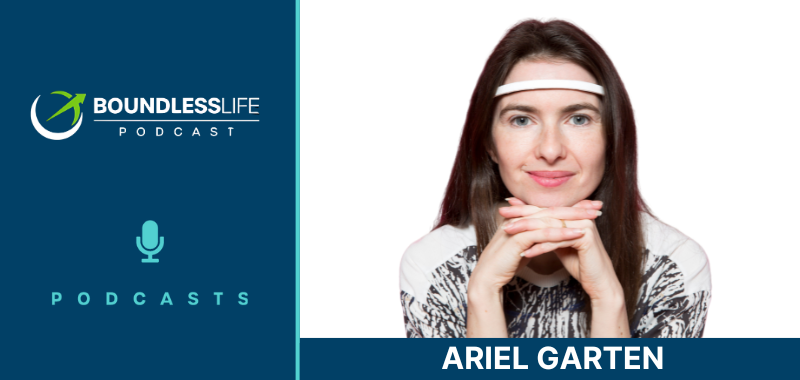
How To Train Your Brain Like A Muscle: Mental Fitness SECRETS (& A Headband That Makes You Smarter!) with Ariel Garten of Muse

Affiliate Disclosure

Listen on:

Reading time: 5 minutes

What I Discuss with Ariel Garten:

  • The Muse headband, which uses real-time brain sensing technology to fast-track meditation progress, improve focus and sleep, and give anyone the tools to train their mind with science-backed feedback…03:33
  • How the Muse headband uses real-time EEG and oxygenation cues to guide your meditation, teach focus, and show exactly how your brain responds during each session…07:36
  • Muse’s oxygen-sensing “strength sessions” that let you actively increase blood flow to your prefrontal cortex, building mental fitness and supporting cognitive function in real time…12:50
  • How Muse also acts as a clinical-grade sleep tool that tracks real brainwaves, delivers audio to deepen deep sleep, and adjusts in real time to help you fall asleep faster and stay asleep…18:51
  • How better prefrontal-cortex oxygenation can make you feel more alert, focused, organized, and emotionally steady throughout the day…25:23
  • Multiple Mayo Clinic studies, confirming that even brief daily use of Muse can noticeably improve focus, stress, and sleep…33:05
  • Different meditation modes, like eyes-closed EEG, eyes-open Athena, and heart, breath, or body sessions, and whether there’s really a “perfect” spot to practice them…37:07
  • When you can expect the first changes, and how emerging research shows promising benefits for OCD and ADD…41:42

In this fascinating episode with repeat guest, Ariel Garten, you’ll get to discover how the newest generation of brain-sensing technology can transform the way you meditate, focus, and sleep. We explore the Muse Athena headband and how its combination of EEG and functional near-infrared spectroscopy (fNIRS) gives you real-time neurofeedback to strengthen your prefrontal cortex, sharpen cognition, and track sleep with clinical-grade precision. Ariel breaks down the science behind mental fitness, how to weave Muse seamlessly into your daily routine, and the growing body of research showing benefits for stress, burnout, ADHD, OCD, and overall emotional resilience. If you’ve ever wondered how to upgrade your mind through measurable, evidence-based tools, this episode will show you exactly where to start.

Ariel Garten is the founder of InteraXon, the maker of Muse. She studied neuroscience at the University of Toronto and worked in labs at Toronto’s Krembil Neuroscience Centre, researching Parkinson’s disease and hippocampal neurogenesis. No mere science nerd, Ariel is a fashion designer whose clothing opened Toronto Fashion Week in 2003 and has had her work displayed at the Art Gallery of Ontario. Ariel’s distinctive combination of science and art is integral to the design of Muse and to InteraXon’s unique approach to brain sensing technology.

As a neuroscientist and former psychotherapist, Ariel witnessed the struggles many people face with mental health and the search for effective, accessible solutions. Inspired to make a real difference, she channeled her expertise into co-founding Muse, a healthtech startup aimed at revolutionizing brain health through technology.

Muse (use code BENGREENFIELD for a special discount), the brain-sensing EEG headband, has helped over half a million users globally improve their meditation, reduce stress, and enhance sleep quality.

Driven by a deep passion for understanding the human mind, Ariel is committed to empowering individuals to enhance their mental capacities. Through Muse, she provides innovative tools and insights that motivate people to actively engage in their wellness journeys, inspiring them to achieve their full potential. Ariel is a sought-after speaker on the global stage.

For additional information, you can check out our first show together here:

How Mindfulness Reshapes the Brain — Dr. Sara Lazar

Please Scroll Down for the Sponsors, Resources, and Transcript

Episode Sponsors: 

Muse: Muse S Athena combines clinical-grade EEG and fNIRS technology to train your brain in real time while tracking sleep with 86% expert-level accuracy. Get 20% off at choosemuse.com/BENGREENFIELD or use code BENGREENFIELD at checkout.

BIOptimizers Holiday Offer: You won't find a better Black Friday deal anywhere else, not even on the mighty Amazon. The biggest discount you can get and amazing gifts with purchase are available only on my page bioptimizers.com/ben with code BEN15.

BON CHARGE: BON CHARGE is a holistic wellness brand with a wide range of products that naturally address the issues of modern life. Their products can help you sleep better, perform better, recover faster, balance hormones, reduce inflammation, and so much more. Go to boncharge.com/GREENFIELD and use coupon code GREENFIELD to save 15%.

Organifi Shilajit Gummies: Harness the ancient power of pure Himalayan shilajit anytime you want with these convenient and tasty gummies. Get them now for 20% off at organifi.com/Ben.

LMNT: Everyone needs electrolytes, especially those on low-carb diets, who practice intermittent or extended fasting, are physically active, or sweat a lot. Go to DrinkLMNT.com/BenGreenfield to get a free sample pack with your purchase!

Quantum Upgrade: Recent research has revealed that the Quantum Upgrade was able to increase ATP production by a jaw-dropping 20–25% in human cells. Unlock a 15-day free trial with the code BEN15 at quantumupgrade.io.

Troscriptions: Explore Troscriptions' revolutionary buccal troche delivery system that bypasses digestion to deliver pharmaceutical-grade, physician-formulated health optimization compounds directly through your cheek mucosa for faster onset and higher bioavailability than traditional supplements. Discover a completely new way to optimize your health at troscriptions.com/BEN or enter BEN at checkout for 10% off your first order.

Resources from this episode: 

Ben Greenfield [00:00:00]: My name is Ben Greenfield, and on.

Ben Greenfield [00:00:02]: This episode of the Boundless Life podcast.

Ariel [00:00:05]: We have a very cool exercise inside of the Muse app where you're doing neurofeedback to actually train and upregulate the delivery of oxygen to your prefrontal cortex.

Ben Greenfield [00:00:16]: Wow.

Ariel [00:00:16]: So, yeah, it's super amazing.

Ben Greenfield [00:00:19]: Welcome to the Boundless Life with me, your host, Ben Greenfield. I'm a personal trainer, exercise physiologist, and nutritionist. And I'm passionate about helping you discover unparalleled levels of health, fitness, longevity, and beyond.

Ben Greenfield [00:00:39]: If you've never meditated before, you want to up your meditation game. Have no fear. Today's podcast covers some super cool technology to basically turn you into a Zen monk with better living through science. I interview Ariel Garten of Muse. Super cool.

Ben Greenfield [00:00:56]: We can do now with the power of science.

Ben Greenfield [00:00:58]: So all the shownotes are going to [email protected] Athena A T H that's BenGreenfieldLife.com Athena Enjoy the show. Well, I have a two Pete guest. Ariel, you're a two Pete or a three Pete. I forget now.

Ariel [00:01:13]: This is my second time.

Ben Greenfield [00:01:14]: Okay, I guess that's.

Ariel [00:01:15]: Make it a three. Four.

Ben Greenfield [00:01:18]: Keep your fingers crossed. Ariel Garten is the maker of this device called Muse. You may have heard of it before. I would roughly classify it in layperson speak as the most advanced meditation headband on the planet. But it goes beyond that. And Ariel has a really extensive background in neuroscience, which she studied at University of Toronto. She has worked in the Krembl Neuroscience center, where she researched Parkinson's disease and hippocampal neurogenesis, and she also has a background in fashion as well. Hence this fashionable headband that also delves into your neuroscience.

Ben Greenfield [00:02:01]: I think the Huffington Post called it actually the beautiful headband that will make you smarter. So, Ariel, welcome back to the show.

Ariel [00:02:09]: My joy and pleasure to be here with you, Ben.

Ben Greenfield [00:02:11]: Yeah. And in our first podcast, we actually really did talk a lot about your background in fashion in neuroscience, how you came to design Muse. And I think that'd be a great one for people to listen to if they want to learn more about how this came to be. I'll link to that if you're listening in right now and you go to BenGreenfieldLife.com Athena A T H E N A you can hear that podcast also. But Ariel, for people who didn't hear that first podcast, I specifically kind of would love the 40,000 foot overview on what the muse actually does.

Ariel [00:02:53]: So Muse is a brain sensing Headband that helps you improve your brain health. It allows you to track your brain activity. It has many modalities that help you train your brain and then helps you transform so that you can live a better, happier life. The Muse specifically integrates EEG and now fnir sensor technology that tracks your brain while you meditate, while you sleep, and in daily life. And then it gives you interventions to help you train your focus, train your attention, actually improve your sleep. And then lots of statistics so that you can track what your brain was doing, how your brain is improving, how your meditation was going, so that you can then utilize that information to help you optimize.

Ben Greenfield [00:03:37]: I was in bed with my wife last night and I was telling her I was going to interview you, and I was trying to explain to her what Muse does and correct me if I explain this improperly, but I said something like, it kind of allows you to become a really good meditator without necessarily having to spend 20 years meditating. It almost fast tracks the process because it's got this two way feedback going.

Ariel [00:04:05]: Exactly. So Muse's meditation tools give you real time feedback on your brain while you meditate. So. So that you know what you're doing during meditation and so that you can improve. When most of us sit down to meditate, we're like, okay, I'm doing it, but am I really doing it? And there's no little coach or guru there telling you what's going on in your brain, showing you or letting you hear your brain data and driving you to do better. So Muse solve that problem by giving you real time feedback on your brain to help you meditate with real data and real insight to. To help you hypercharge your meditation practice and see the benefits more quickly.

Ben Greenfield [00:04:43]: So when someone's wearing a headband, do they expect to, let's say they choose a meditation session, do they expect a voice that's guiding them into the proper process? Is it more like, you know, I've done neurofeedback before where it's really subtle. It's like the music fades a little bit or might change a little bit. Almost like this subconscious slap on the wrist for the brain to get it back to where it's supposed to go. What's the actual cueing that's occurring with the Muse?

Ariel [00:05:09]: Yeah. So the metaphor we use is your mind is like the weather. So when you're thinking or distracted, when you're not meditating, you hear it as stormy, and as you bring your mind to quite focused attention on your breath, it quiets the sounds. And then when you're able to maintain your focused attention for five seconds or more, you hear little birds chirping. And that really reinforces your brain to say, yep, you're in the state. You're doing it. That's right. Stay there.

Ben Greenfield [00:05:33]: Unless you really, really like storms.

Ariel [00:05:36]: And those of us who like storms also learn different lessons. So there's tons of mindfulness lessons packed within it, because when you start to listen to the storm and become one with it, it starts to dissipate. So just in our lives, when we end up in situations that are stormy, if you get frustrated by it, if you're like, I had that fight and it sucked and, and, and, and, and you only make it worse. But when you're actually able to be with the person that you're fighting with and listen to what they're saying, hey, the fight begins to dissipate. So there are all these subtle lessons of equanimity that are actually built into the neurofeedback experience.

Ben Greenfield [00:06:11]: So this Athena device shows up at my house a few months ago. I get an email from your team. They say, hey, we've upgraded this thing, added new features since our last conversation. What have you done from a tech standpoint?

Ariel [00:06:26]: Oh, my God, so much.

Ben Greenfield [00:06:28]: That's all right. We got time. We got time.

Ariel [00:06:30]: Awesome. The previous versions of our Device have been EEG only. And for the last 10 years, our first device came out in 2014, we've been providing amazing brain sensing wearables that track your brain with eeg. They track the electrical activity. Now we've added a second sensor modality into the device, and this is the only device that contains both eeg, fnirs and eeg. So FNIRS is functional near infrared spectroscopy. So you've heard about an FMRI machine?

Ben Greenfield [00:07:02]: Yeah, yep, of course.

Ariel [00:07:04]: So in an FMRI machine, what the researchers are looking at is the part of the brain that is working. So they see the part of the brain that's lighting up because it's consuming oxygen and consuming energy because it's working. So if you ask somebody to lie in an FMRI machine and do a math problem, you're going to see their prefrontal cortex light up because it's using more oxygen.

Ben Greenfield [00:07:26]: Okay.

Ariel [00:07:27]: We took that same concept and put it into this sweet little device. For those of you not watching the video, this is a tiny, tiny little headband, and it uses red and infrared light to track the blood oxygen to your prefrontal cortex.

Ben Greenfield [00:07:40]: Oh, wait, wait. This would be like. So people are familiar with Like a pulse ox device, the little thing you could wear on your fingertips to measure pulse oxygenation. You're, like, doing that for the brain by putting it on the head.

Ariel [00:07:52]: Well, even further. So pulse ox is just measuring your peripheral blood flow. So we're looking at the blood vessels in your body. This device is able to penetrate more deeply and actually read the oxygen levels that are going and coming from your prefrontal cortex. So we sample right at the blood brain barrier. So we're able to see your oxyhemoglobin. So how much oxygen is being delivered to your PFC and your deoxy, how much has been utilized by your prefrontal cortex. So we're seeing both the demand and the utilization.

Ben Greenfield [00:08:28]: So theoretically, you know, there's this guy out there, you've probably heard of him, Dr. Daniel Amen. He does these spec scans, and from what I understand, they measure oxygenation to the brain. And he goes on all these podcasts and talks about the things that he's found, like marijuana really decreases brain blood flow. Or alcohol would have a similar effect. Not that I'm endorsing anyone take marijuana and drink alcohol and go put the headband on, but could you start to correlate certain activities you're doing outside of the use of the headband that would influence oxygenation? Like, hey, I used beetroot or took Viagra or avoided alcohol. Like, is the muse capable of looking at those type of factors?

Ariel [00:09:14]: Yeah. So the way that we sample the blood at the brain barrier is it's called continuous wave. So we are looking at the difference between the minute before and the next minute. And the blood oxygen response takes a little while. It's not instantaneous, so it's not good for comparing between sessions. So yesterday I had coffee, today I didn't. What does my brain look like? But it can tell you what's happening during the course of your session. And in general, you can see, is my brain consuming more oxygen, demanding more oxygen now than it was previously.

Ariel [00:09:52]: So, yeah, it's a super fascinating tool.

Ben Greenfield [00:09:57]: So with the oxygenation piece is the theory that, as one meditates, they might experience better brain blood flow and oxygenation.

Ariel [00:10:06]: Meditation requires your prefrontal cortex. Your prefrontal cortex is doing a whole bunch of work during the course of your meditation, and so you may end up seeing an increase in blood flow to your pfc. Meditation, though, also may, over time, shift the way the blood is distributed through your brain. So blood flow in the brain is a fascinating, fascinating topic, and it's not always that Straightforward. What we do know is that as you age, the blood flow to your brain can sometimes decrease. As you have things like vascular dementia, you have decrease in blood flow to the brain. And the blood flow to the brain is directly related to the amount of energy that part of your brain is able to use, thereby inferring how much that part of your brain is functioning or is able to function. So we have a very cool exercise inside of the Muse app where you're doing neurofeedback to actually train and upregulate the delivery of oxygen to your prefrontal cortex.

Ariel [00:11:08]: Wow. So, yeah, it's super amazing. You're like, you're looking at an owl flying. Since the device is called Athena, this is Athena's owl. Athena's the goddess.

Ben Greenfield [00:11:16]: Oh, yeah, I've done the owl one. Okay.

Ariel [00:11:18]: Yeah, totally. So in the owl one, we. What you're trying to do is make that owl move based on an increase in blood flow to your prefrontal cortex and an increase in oxygen delivery to your pfc. And so just in the same way that you can go to the gym and like really move your arms to get your muscles bigger. And when you do that, it sends oxygen to that area because it requires nutrients. And then when you do that, it builds and gets larger. Same process for your prefrontal cortex. You're literally doing a targeted exercise for your PFC to increase the nutrient delivery.

Ben Greenfield [00:11:56]: Wow. See, I didn't even know that was going. I figured with the owl flying that it was the plain old school neurofeedback I'm used to that was just measuring electrical activity in the brain. But this nirs, it's not just electrical activity. This is actually showing like an improvement in what have you got, like brain fitness or mental fitness.

Ariel [00:12:16]: Exactly. And oxygen delivery. So that's why the Athena sessions, the OWL sessions, we call strength sessions, because you're strengthening your brain as you do it. Yeah. So now it's dual mold training. It's not just old school EEG neurofeedback, which we still do in the meditation sessions here. It is a brand new mode that has been demonstrated in the research to improve cognitive function.

Ben Greenfield [00:12:40]: And with the owl setting or the strength setting, is it also measuring EEG or is that one just doing nirs?

Ariel [00:12:47]: At the end of all of your sessions, you're able to see your data from the eeg, the fnirs, the ppg, your heart rate and your body movement. When you get to the results screen, you're going to see your EEG power bands, because We've been measuring them this whole time. Anyways, you're going to see your oxideoxy scores, you're going to see what your oxygen was doing in your pfc. You're also going to see your heartbeat because we have the PPG sensor going and you're stillness data. So you get that data now at the end of your meditation sessions as well as at the end of your strength sessions. So you might be training with EEG or training with fnirs, but you get the data from both.

Ben Greenfield [00:13:25]: Is ppg Polyplasmiography.

Ariel [00:13:28]: You got it?

Ben Greenfield [00:13:29]: Yes, I did it. I didn't even have notes for that. So this actually relates to something else I wanted to ask you. When you hear the word plesmiography, that's like a fancy term used for a sleep study, can I use that same function to do something like track my. Whatever you call the heart rate of the brain during sleep or something like that?

Ariel [00:13:50]: Small clarification. So plasmography is the tracking of the blood pulse. So when you're looking at the pulses of your waves in your blood there, it's plasmography. So we're able to determine your heart rate based on the pulses. Polysomnography.

Ben Greenfield [00:14:08]: Oh man, I just sounded so smart a second ago and then I just butchered the name of asleep. Yes, polysomnography is different than poly. Now I'm getting twisted. Than polyplasmiography. Okay, sorry about that.

Ariel [00:14:24]: We can use acronyms. Ppg. It's actually photoplesmography and PSG polysomnography. Okay, so in a polysomnography, in a sleep lab, you go in, you get all wired up with eeg, they track your blood oxygen levels, they track your heart rate in order to determine if you slept well or not. Turns out this device, also doing the ppg, acts like a sleep lab. So it's used for real clinical PSG measurements. We have a ton of folks that are using MUSE devices, including people at the dod, including folks at Harvard, Mayo Clinic, et cetera, that are using MUSE for sleep studies. So they send them home with participants, and they're able to track sleep data far more effectively than anything on your wrist or on your finger.

Ariel [00:15:13]: Cause it really is acting like a real sleep lab, tracking your brain.

Ben Greenfield [00:15:16]: So if you're looking at like a whoop, aura, ultra human, any of these devices, because they're not on the brain, you get more accurate sleep data by using the headband.

Ariel [00:15:26]: Exactly. So the ones on your fingers and your wrist, they're using your hrv. So HRV varies throughout the night, but it varies only as a proxy of what's going on in the brain. The only way to really know what's going on in sleep is by tracking the brain. And so that's why wrist and finger devices aren't very good at measuring how much deep sleep you have. The only way you can know if you're really in deep sleep is by tracking your delta waves. So Muse tracks full spectrum EEG in deep sleep. We know not only are you in deep sleep, but how deep is your deep sleep.

Ariel [00:16:01]: So. So you get reading of the amplitude of your delta waves during deep sleep. And then we have a super cool intervention coming out in early 2026 that helps you deepen your deep sleep with audio stimulation on the upswing of every delta wave.

Ben Greenfield [00:16:16]: How's that work?

Ariel [00:16:18]: So we started working with a research lab in the US and another one in Spain because they wanted to have a deep sleep stimulation experience for older adults with mild cognitive impairment. And their theory was if they could stimulate the delta waves of those older adults, they could improve their cognitive function in the daytime. And so we built this with them. And what's happening is the muse is tracking your brainwave activity. When you drop into deep sleep, it starts to track your delta waves so precisely. So delta waves are about 1,200 milliseconds each that going up and down, up and down. And it tracks it so precisely that it can deliver a little audio sound just through the speaker on your phone or through a pair of headphones, and delivers an audio sound timed to the upswing of your delta in a way that amplifies your delta activity, deepening and ultimately lengthening your deep sleep.

Ben Greenfield [00:17:09]: Wow. And I could do this even if I don't fall asleep with headphones on. If I've got my phone by the side of my bed, it could still do this.

Ariel [00:17:17]: Totally. And we've got this amazingly cool feature because we're constantly tracking the brain activity and knowing when the sound is delivered. We can actually tell if the sound is too loud and wakes you up. You can see it in the EEG activity. You're starting to have had a course. Yeah, that makes sense. So we can actually titrate the sound volume that's delivered in order for it to just keep deepening your deep sleep and not wake you up.

Ben Greenfield [00:17:42]: Now, if I'm doing this so I go to sleep, I'm wearing the headband, which, by the way, for those of you who are side sleepers, it's actually very soft. They designed it pretty well. I have the phone. I'm assuming I have the Muse app open. But when I go to bed, do I need to play a certain sleep sound or could I go to bed in silence and it's still tracking and then beginning to make a sound when I come out of those deep sleep stages? Or how's it work?

Ariel [00:18:06]: So you're going to be able to turn it on as you fall asleep. Wearing the headband, by the way, works for face sleepers, side sleepers, stomach sleepers, all the sleepers. And when you're in deep sleep, it's going to start delivering that tone. You don't need to go to bed listening to anything. If you have a bed partner, you may want to use headphones, but it may not be loud enough to wake them up, depending on their deep sleep cycles. We found it to be super effective. We're just in beta test, it's about to launch and it goes alongside our digital sleeping pills. The digital sleeping pill is a different experience.

Ariel [00:18:42]: You can choose which one of these you use or all of them. The digital sleeping pill tracks your brain as you move from wakefulness into sleep, predicting when you're going to move into N1, which is the first phase of sleep. And it starts to adjust the volume of a story that you're listening to. In that one, you are choosing to listen to something as you fall asleep. As it predicts your brain is about to move into N1, it starts to adjust the parameters of the sound in such a way that it cues your brain that it can just fall asleep. Then once you're asleep, it turns off the volume because it knows you're asleep. And if you wake back up in the night, it brings in the same experience that helps you fall asleep the first time and helps you fall back asleep. So that one's been out in market for the last three years.

Ariel [00:19:25]: It's been used in several studies. It's been demonstrated to improve overall sleep quality by 20% and improves latency to sleep onset, which is the time it takes you to fall asleep by 55%.

Ben Greenfield [00:19:36]: That's huge. Yeah, that's really big. The digital sleeping pill. With this new rollout, the deep sleep stimulation, are the two going to be able to work together at the same time?

Ariel [00:19:49]: Totally. So you can mix and match. You can use the digital sleeping pill alone. You can use a digital sleeping pill plus deep sleep or just deep sleep alone.

Ben Greenfield [00:19:57]: Okay, got it. Back to the concept of mental fitness. After that amazing sleep rabbit hole, I think a lot of people are going to get a ton of benefit out of that, the, the idea of mental fitness and brain blood flow, brain oxygenation, what is it that you tell people they would feel like at work or at school or during a normal day, if there is an increase in oxygenation or blood flow, what's the actual value add of what we might call mental fitness?

Ariel [00:20:34]: So, you know, when you go to the gym and the next few days, you just feel stronger, more alert, more engaged. It's a very similar activity, a similar feeling. When you've stimulated your prefrontal cortex, it's a little bit more of a feeling of awakeness, alertness, more focused, more able to function. So our prefrontal cortex is responsible for so many activities of our daily life. It's responsible for our attention, our planning, our organization, our executive functioning, and our inhibition. So you know when you meet somebody who's in their 70s or 80s and they're just sort of blurting out stuff and you figure, oh, it's because they're older, you know, they just don't give a shit anymore.

Ben Greenfield [00:21:17]: Yeah, grandpa's, grandpa's grumpy again. Yeah.

Ariel [00:21:20]: Yeah. Well, it's partially because their prefrontal cortex has begun to deteriorate and they don't have that same inhibitory capability to hold it all in and know how to self control in that way. So our prefrontal cortex is key to so many aspects of our cognitive functioning and our mental and emotional fitness.

Ben Greenfield [00:21:42]: Yeah, interesting. So, you know, you get a lot of recommendations. I actually have a book here. It's called Something Two Weeks to a Younger Brain. It's beside my desk. It's the next one I'll be reading. A Program for a Better Memory and Sharper Mind is a subtitle on it. And I've read books like this before and they tell you, do crossword puzzles, learn or play a musical instrument, do brain games, use something like Brain hq and do things that kind of make smoke come out the ears in terms of stimulating the brain.

Ben Greenfield [00:22:18]: And then you also hear about people using intranasal light or fish oil or, or other ways to stimulate neurogenesis or neuroplasticity. Where does something like this kind of rank compared to more traditional things like crossword puzzles or something more advanced like say a red light helmet.

Ariel [00:22:39]: First of all, all of these methodologies are great and there's no one solution for training our brain. We need to keep doing all that we can in order to keep our brain sharp. Red light solution is great. We work closely with violight and actually they use muse to demonstrate that they're red light Thera really has an effect because you can see the change in brain activity in terms of training with meditation or prefrontal cortex oxygenation training. It's something that gives you a completely different edge than any of those other kinds of activities. We should still all take our fish oil because fish oil is important for decreasing inflammation. It's also important for the myelination, the little fatty sheath on the outside of your neurons. So you know you need to take that to keep your brain functioning as you age.

Ariel [00:23:28]: And activities like meditation that train your focused attention, that teach you to downregulate the rest of your brain, activities that your brain can repair more effectively. And things that help you train your prefrontal cortex are key, key, key, key in helping you manage your mental function both here and today. And as we age. When you talked about these various different interventions like do crossword puzzles, et cetera, they're not also referring to managing the stress and emotional self regulation in our daily life so we can think about the things that we need to do in order to build an amazing brain when we're 70, 80, 120. And I hope you and I will still be having this conversation when we're both about 120. I don't know if you're younger or older than I am, probably about the same age. And you need to be doing the things that help you regulate more effectively today. Make sure that you're managing your stress, make sure you're sleeping well.

Ariel [00:24:30]: Those are all the things that make you feel good in the moment and help support your long term brain function.

Ben Greenfield [00:24:36]: There's gotta be at least a few people listening who are like, oh, another thing I have to do, you know, maybe I already have a violite and I'm doing the red light therapy you talked about and I'm doing nightly crossword puzzle or playing the ukulele. Tell me what the minimalist user case would be for something like the mus Athena, as far as how many times per week and for how long someone would need to use it to get results without this being a huge new source of friction in their lives.

Ariel [00:25:07]: Okay, so the great news is the minimum viable dose is really low. So one study that the Mayo Clinic did, they gave their doct doctors working in the ER super, super busy. They gave them used devices and said use it a minimum of five minutes a day, however it fits into your work day. And let's test the results after six weeks. And what they saw with these doctors, super smart people, they saw an improvement in Cognition, a decrease in stress, an improvement in sleep, and a 54% reduction in burnout. And when we looked at the statistics, the Mayo Clinic looks at the statistics and then shared them with us, they had used it on average 5.34 minutes per day. So doesn't take a lot.

Ben Greenfield [00:25:53]: Could you do the owl one in that shorter period of time?

Ariel [00:25:55]: Yeah, you can do a three minute owl session. I think we might have it at five minutes as the, as the minimum. But as far as I'm concerned, a three minute OWL session is sufficient.

Ben Greenfield [00:26:04]: Okay, so you could literally just like fly the owl how many days a week? Just every day for five minutes.

Ariel [00:26:09]: Yep. You can do every day for three minutes. What I would recommend is bring in the meditation as well. So there's several main pillars. Meditation is critically important to help you learn to emotionally self regulate. It is able to downregulate your amygdala activity. It's able to strengthen your prefrontal cortex. And in a super fun piece of research from a colleague of mine, Dr.

Ariel [00:26:32]: Dave Vago, meditation also can help clear amyloid beta from the brain. His latest research says, so don't skimp on the meditation, but you can meditate with MUSE for just five minutes a day. So we have lots of studies. There's over 200 studies published with Muse. Lots of studies that show that just five minutes is sufficient.

Ben Greenfield [00:26:50]: Let's say I was going to sit down and do like a 5 minute owl session and obviously my eyes are open. And then I was going to do a five minute meditation session. Just following that. I'm assuming something like that could work.

Ariel [00:27:02]: That sounds perfect. Okay, that sounds super perfect. And it doesn't really matter if you do the meditation first or the owl first. They both work synergistically in either direction. So I would do either of those. Takes a max of 10 minutes. I would try to do five minutes a day each day. So, you know, set aside five minutes and either do a meditation or an owl and then if you find you have another five minutes, once the headband is on, do the next thing.

Ariel [00:27:26]: So that way, you know, the threshold is super low for you to buy in. And if you have sleep problems, use the MUSE at night.

Ben Greenfield [00:27:34]: Well, that's easy because, yeah, you just put it on and go to sleep. Yeah, no extra time there, hopefully. That's interesting about the study on the doctors, though, have you done other studies with this?

Ariel [00:27:46]: So many of them. So Mayo Clinic, I think, has published six or seven studies using muse, so they just published a long Covid study. So. So they had 45 participants with long Covid use MUSE consistently. And what they saw was an improvement in cognition, decrease in stress and anxiety, and overall improvement in functions in long Covid. So that was massive. They're now starting a second, larger study. Because they loved it so much, they did another study in fibromyalgia, one with Cushing's syndrome patients.

Ariel [00:28:19]: Several cancer studies demonstrating that MUSE improves quality of life in the cancer care process. There are other studies on MUSE and ptsd. Muse has reduced the amount of times kids get sent to the detention. In the study by University of Kansas. The list kind of goes on and on. Wow.

Ben Greenfield [00:28:38]: And I noticed that some of the sessions are with eyes open and some with eyes closed. Is there a way to know which one's better, or should you alternate back and forth, or what's your recommendation for that?

Ariel [00:28:51]: Yeah. So the EEG mind neurofeedback sessions, those are eyes closed. And the mind neurofeedback is really the thing that's strengthening your brain through that meditation training. So I recommend doing those. Don't skimp on those. The Athena sessions are eyes open because the blood flow to the brain is equally tracked if your eyes are open or closed. And then we also have meditations for the heart, the breath, and the body. And those can be done eyes opened or eyes closed, whichever you prefer.

Ben Greenfield [00:29:19]: What does that mean? Meditation for the heart, the breath, or the body.

Ariel [00:29:22]: So in our heart meditation sessions, you're hearing the beating of your heart like the beating of a drum. And what you're actually hearing is your sinusoidal arrhythmia. As we breathe in, our heart rate increases. As we breathe out, our heart rate decreases. So I'm sure you know this HRV is simply a measure of your highest heartbeat on your in breath and your lowest heartbeat on your out breath. So when you're getting the metric of your HRV, my HRV is, you know, 26, which kind of sucks. My HRV is 35. It's great.

Ariel [00:29:52]: What they're saying is, how fast is your heart beating on your in breath, and how quickly can your vagal nerve come in, slow down that heartbeat, and respond, and leave you with a nice slow heartbeat at the bottom of your out breath. And then how quickly does that cycle repeat with the increase in blood pressure on the in breath and the decrease on the out breath? So what you're hearing in the heart meditation is actually that cycle. You're literally hearing your heartbeat increase and speed up and decrease and slow down.

Ben Greenfield [00:30:25]: So it's basically taking my heart Rate from the head and then creating, like an audio cue that's. That's directly synced to that heart rate. That's the same as your heart rate.

Ariel [00:30:34]: Exactly.

Ben Greenfield [00:30:35]: Okay, got it.

Ariel [00:30:36]: Yeah. And so this tunes something called your interoception. Your ability to sensitively understand your internal state. And interoception is negatively high. Interoception is negatively correlated with stress. So the more you have interoception, the less stress you're likely to have, because the more you're aware of your bodily symptoms and systems. And for those of you who are keen on training your hrv, making this process audible to you and helping you understand what HRV means also helps you see how in your life you optimize it. Because at the end, you get a graph that literally shows you what your heartbeat is doing, your HRV as it goes up and down.

Ben Greenfield [00:31:14]: Yeah, that's cool. What about the breath and the body ones?

Ariel [00:31:17]: Yep. So the breath, we are able to sense your breath rate. And so we have breath focused meditations like box breathing, et cetera. And it is tracking your breathing and letting you know if you're breathing in time with the guide to help you shift your physiology. Because you can use breath practices to either energize you or to calm you down, depending on what you need. And then body is helping you just find stillness in your body. It's sometimes a good one for beginners to. To see how the system works and how your own system works with it.

Ben Greenfield [00:31:47]: Got it. Have you ever looked at the concept of doing this in the same time, in the same place? I always go to this place in the house or this chair or, I don't know, for the biohackers out there, this hyperbaric chamber, to meditate. Or does it really matter? Does it make a difference at all?

Ariel [00:32:05]: Okay, so the most important place to meditate is the place you'll actually do it. Figured, you know, what you referenced is the creation of routine. And we all know that if you want to add more stuff into your busy life, the best way to do it is use a routine. You can habit stack. You can use cues by using it the same place, the same time. All of those things are good to help us organize our brain to make sure we get it done. However, it doesn't really matter where you do it. Short of the routine creation, I would say switching it up so that you're able to train your cognitive function in different environments so that you then have that skill available when you're in that different environment without the device is really helpful because meditation is just like going to the gym.

Ariel [00:32:51]: It's not just about the time that you spend in the gym, it's about how strong you are throughout the day. It's about how you're able to bring this skill back and utilize what it's taught you throughout your daily life. So if you are not somebody who's going to flake off and not do it, if you tried to do it in too many different places, I would recommend the cross training of trying it in different locations at different times.

Ben Greenfield [00:33:14]: Yeah, speaking of going to the gym, you tend to see a neurological response within two to four weeks. As far as better biomechanics, body awareness, et cetera. But anatomical changes are sometimes longer, sometimes like four to six weeks to start to notice whatever muscles in the mirror or the jeans fitting differently, et cetera. With something like this, do you see short term versus long term adaptations? Do you see results right away or what's kind of the timeline look like?

Ariel [00:33:45]: Over the first week people tend to say things like, I feel calmer, I'm better able to just manage the voices in my head. You start to notice subtle things. By week three, people around you might be noticing. And by week six, you're at the point where, hey, I'm actually seeing consistent changes in my life. I'm noticing that I'm less reactive, I'm noticing that I'm more focused. I'm noticing that I'm more aware of my distractions and better able to manage them from an anatomical perspective. There's a great study by Dr. Sarah Lazar.

Ariel [00:34:17]: She looked at people doing an eight week mindfulness course and she saw that after eight weeks you actually see a real change in gray matter density.

Ben Greenfield [00:34:27]: Wow, interesting. There's two things and you briefly mentioned this when I asked you about studies, but you talk to so many people, especially like hard charging, high achieving entrepreneurs. Many of the type of people who would listen to a podcast like this and still be listening, who struggle with either add, ADHD like issues or kind of like control like ocd, compulsive type of issues. Again, I know you mentioned add, but can we double click on that? And then I'd love to hear a little bit more about those two in particular.

Ariel [00:35:06]: So ocd. First of all, Muse is not a medical device. It's not used to diagnose or treat any condition check. Mark, There's a cool study on OCD done by Dr. Lawrence Harley. He looked at individuals with OCD using museum. He saw a meaningful change in Y box Scolars, Yale Brown Obsessive Compulsive Scale. That's the official scale for OCD measurement.

Ariel [00:35:29]: He saw a real change in WYBOX scores as well as a electrophysiological change in the brain that indicated that they'd moved away from more OCD like brain types. MUSE has been used both to improve OCD symptoms in that study and they could see real changes in the brain that indicated that those, that those symptoms didn't just change in life, but actually their minds had changed.

Ben Greenfield [00:35:53]: Oh, wow. Okay.

Ariel [00:35:55]: And then on the ADD front, again, we don't diagnose or treat. However, there are lots of individuals with ADD and ADHD that have found benefit anecdotally. Don't diagnose, treat. Benefit from using muse. ADD is a condition in which you have a decrease in hyper in your frontal lobe activity. You have hypoactive frontal lobe executive function. And people have been using MUSE and its various implementations to improve their symptoms. And frankly, I'm one of them.

Ariel [00:36:28]: I'm one of those people who had terrible ADD and through the course of using Musa's various tools have noticed dramatic improvements in my ability to focus, to be able to remember, to do things, to manage multiple conversations simultaneously, to stay on track. So it can be a real game changer.

Ben Greenfield [00:36:50]: Yeah. And for anyone potentially listening who has, I don't know, some nine year old boy running around the house with hypoactive frontal cortex executive function, I think is how you described it. Is this safe for kids?

Ariel [00:37:06]: MUSE is used in studies with kids. It is demonstrated to be safe with kids. We say that nobody under 16 can use it because we don't want the responsibility of not being GDPR compliant because we sell all around the world. To be GDPR compliant, it has to be 16. What a parent chooses to do when they do or don't use the tool with their kids is their own choice.

Ben Greenfield [00:37:30]: Okay, got it. Super interesting. Okay, so the Athena is the new one. And I was clicking around on your website before this podcast just to make sure I, I was fully up to date on the devices. And there's basically two options, right?

Ariel [00:37:46]: Right. So there's the Muse 2, which is the classic device that we've had for the last few years. And this one does meditation and tracking your brain only. And then the Athena does the meditation and brain tracking plus the FNIRs, plus the sleep.

Ben Greenfield [00:38:04]: Okay. And both of them are like a few hundred bucks, right?

Ariel [00:38:06]: Yeah. They're both incredibly accessible.

Ben Greenfield [00:38:09]: Yeah. Not much compared to a pharmaceutical or even a red light helmet. Shockingly low price. And they're fashionable. Thanks to you, Ariel. They're fashionable.

Ariel [00:38:18]: Thank you.

Ben Greenfield [00:38:20]: Well, I'm going to link in the show notes to our previous episode. I'm going to also link to everything we've discussed and I know we get special deals on the Athena that'll hook people up with if they go to BenGreenfieldLife.com Athena A T H E N A Anything else you want to share about this before I let you go? Ariel?

Ariel [00:38:40]: Just that if you get the devices, sometimes I hear people say like oh no, but I want the Deep Sleep upgrade. I want this and that. It actually all comes with the device because they're software upgrades. So when you get the device, you will forever, while you own the device, continue to get the upgrades that come in our software.

Ben Greenfield [00:38:56]: Yeah. Oh, and I should mention you can download so it can be in airplane mode. That's something my listeners often ask. Like, well, I have to have my phone on all night downloadable, which is kind of cool. All right, so BenGreenfieldLife.com Athena Ariel, thanks so much. I'm sure with your track record there's going to be a three peat at some point, but in the meantime, I just love the stuff you make and I appreciate you coming on the show.

Ariel [00:39:20]: Thank you so much. Always awesome to jam with you.

Ben Greenfield [00:39:23]: Awesome. Have an incredible week folks. I'm Ben Greenfield along with Aerial Garden of Muse signing out. Talk to you later.

Ben Greenfield [00:39:30]: To discover even more tips, tricks, hacks and content to become the most complete, boundless version of you, visit BenGreenfieldLife.com. In compliance with the FTC guidelines, please assume the following about links and posts on this site. Most of the links going to products are often affiliate links of which I receive a small commission from from sales of certain items. But the price is the same for you and sometimes I even get to share a unique and somewhat significant discount with you. In some cases, I might also be an investor in a company I mention. I'm the founder, for example, of Kion llc, the makers of Kion branded supplements and products, which I talk about quite a bit. Regardless of the relationship, if I post or talk about an affiliate link to a product, it is indeed something I personally use, support, support, and with full authenticity and transparency, recommend. In good conscience, I personally vet each and every product that I talk about.

Ben Greenfield [00:40:32]: My first priority is providing valuable information and resources to you that help you positively optimize your mind, body and spirit. And I'll only ever link to products or resources, affiliate or otherwise, that fit within this purpose. So there's your fancy legal disclaimer.

Upcoming Events: 

Do you have questions, thoughts, or feedback for Ariel Garten or me? Leave your comments below, and one of us will reply!

Ask Ben a Podcast Question

Leave a Reply

Your email address will not be published. Required fields are marked *