Home » Podcast » The AMAZING Future Of Regenerative Medicine, The New Sexier Alternative To Stem Cells, Where You Should Get Peptides (& The Best Peptides Stacks) & More With Dr. Matt Cook

The AMAZING Future Of Regenerative Medicine, The New Sexier Alternative To Stem Cells, Where You Should Get Peptides (& The Best Peptides Stacks) & More With Dr. Matt Cook

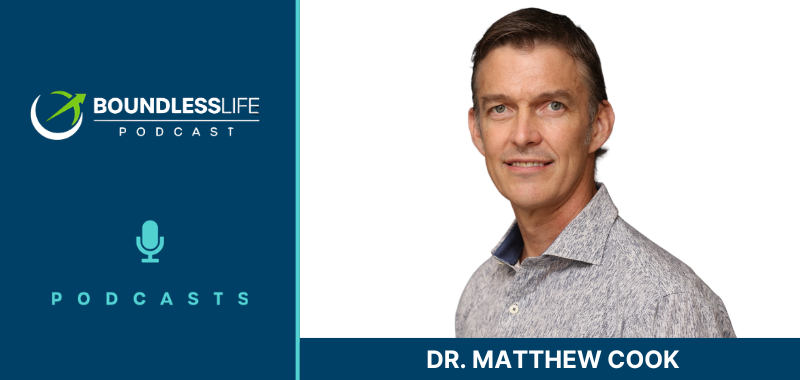
Boundless Life Podcast guest graphic featuring Dr. Matthew Cook. The left side has a dark navy blue background displaying the circular Boundless Life Podcast logo with a stylized athlete figure, the text "Boundless Life Podcast" in white, and a teal microphone icon labeled "Podcasts" beneath it. The right side shows a professional headshot of Dr. Matthew Cook, a middle-aged man with short gray hair and blue eyes, wearing a light gray button-up shirt, smiling slightly against a white background. His name, "Dr. Matthew Cook," appears in bold white text on a dark teal banner spanning the full width of the bottom of the graphic.

Listen on:

Reading time: 6 minutes

What I Discuss with Dr. Matthew Cook:

  • Dr. Matthew Cook breaks down regenerative medicine; its 20 years of progress, key products like stem cells/exosomes/peptides, and the integration of wearables and testing for biological optimization…04:14
  • The main biologics used for regeneration (stem cells, exosomes, and peptides), discussing the clinic landscape and the lack of imaging guidance…05:37
  • Unpacking the role of ultrasound in guided injections, anecdotes from Matt's anesthesia days, and comparing nerve blocks of the past to modern techniques…06:18
  • Platelet-rich plasma (PRP), advances in regenerative therapies, Moore’s Law-inspired Cook’s Law, doubling of quality, and predicting major future breakthroughs…08:24
  • Muse cells, their ability to migrate, immune reactions, HLA-G protein, and why they have a lower risk of rejection and swelling compared to mesenchymal stem cells (MSCs)…13:55
  • The story behind Muse cell discovery, accidental activation through stress, Japanese researcher Dr. Mari Dezawa, MuseCell Innovations, and the evolution from Petri dish to clinical applications…17:51
  • Regulatory shifts, legality in Florida, manufacturing advances in Texas, timelines for broader U.S. accessibility, and predictions for near-future expansion…24:21
  • Comparing targeted injection versus IV administration, systemic “mainlining” for longevity, musculoskeletal optimization, quarterly protocols, and holistic anti-aging strategies…25:26
  • The science behind combining Muse cells with exosomes, timing protocols, immune modulation, regulatory and geographical hurdles, and plans to test international vs. U.S. outcomes…28:12
  • Mapping the peptide landscape, regulatory crackdowns, gray market dangers, good manufacturing practice (GMP) standards, and physician/telemedicine prescription channels like Peptual…34:22
  • Peptide delivery mechanisms (nasal, patch, and injections), building a practical peptide stack, immune and mitochondria-targeting peptides, my personal growth hormone stacking protocol, and Dr. Cook's top peptide protocols…47:37
  • Hormone regulation, immune modulation, and forecasting the revolutionary impact of AI, wearables, and comprehensive dashboards in personalized medicine…53:24
  • The importance of relationships and creativity as technology frees up human time…58:42

In this episode with regenerative medicine expert and repeat guest, Dr. Matthew Cook, you'll discover the latest breakthroughs in stem cell therapies, peptides, and exosomes, plus you'll receive a look at the evolving world of precision medicine. Whether you're curious about the science behind anti-aging, optimizing recovery, or what's next for wearable tech and AI in healthcare, this conversation gives you the roadmap.

Dr. Cook is a board-certified anesthesiologist who shifted his career to regenerative medicine over a decade ago. He is a global thought leader, educator, and innovator in regenerative medicine, combining cutting-edge, non-surgical medicine and integrative care to harness the body’s natural healing power. Those who have worked with Dr. Cook know he is one of the best in the field, specializing in advanced treatments ranging from stem cell therapy to peptide protocols. He is one of the most knowledgeable doctors I know, and as one of the most popular guests I've interviewed, this marks his ninth appearance on the show.

Dr. Cook graduated from the University of Washington School of Medicine, completed his residency in anesthesiology at the University of California San Francisco (UCSF), and completed fellowships in Anti-Aging, Metabolic and Functional Medicine, and Peptide Therapy with the American Academy of Anti-Aging Medicine.

After a decade focused on functional medicine (with 14 years prior working as an anesthesiologist), Dr. Cook's specialty is addressing the most challenging conditions. His proprietary multimodal approach regenerates, repairs, and restores health on a cellular level, dealing with root causes rather than masking symptoms.

This work has led him to create BioReset Medical and BioReset International, two organizations built on the mission to widen access to restorative medicine around the world. BioReset Medical offers treatments for conditions such as chronic pain, orthopedics, complex illness, anti-aging and wellness, Lyme disease, PTSD, mycotoxin illness, cognitive impairment, and musculoskeletal injuries, especially for professional athletes. BioReset International locations offer additional top-of-the-line regenerative products and medical treatments not available in the U.S.

Dr. Cook leverages minimally invasive treatments, believing that the body can heal itself naturally when supported by the best technology and care. While humanizing the doctor-patient relationship, he is able to assimilate a patient’s complex health history and develop highly specialized treatment plans integrating the best of what both functional and regenerative medicine have to offer.


Episode Sponsors

MTE: Boost your wellness on a systemic level with the 13 healthy ingredients of MTE. Check them out at GetMTE.com/beng and use code BENG for 20% off your first order.

Formula IQ: Recuperate IQ by Formula IQ is a comprehensive copper supplement designed to support mitochondrial energy, iron balance, and metabolic health by pairing bioavailable copper with essential cofactors your body needs for proper utilization, which is especially crucial if you've been under chronic stress or supplementing with high-dose zinc. Try it at formulaiq.com and use code BEN for 10% off.

BIOptimizers MassZymes: MassZymes is a powerful, best-in-class enzyme supplement that improves digestion, reduces gas and bloating, and provides relief from constipation. Go to bioptimizers.com/ben and use code ben15 for 15% off your order.

BASED Bodyworks: BASED Bodyworks is a clean, plant-based men's grooming brand offering simple, high-performance essentials from shampoo and skincare to styling, formulated without harsh sulfates or hormone-disrupting chemicals, so you can look and feel your best without compromising your health. Visit basedbodyworks.com and use code BOUNDLESSLIFE for 20% off.

Hiya: Give your kids the full-body nourishment they need to grow into healthy adults. I’ve secured a special deal with Hiya on their best-selling children's vitamin—get 50% off your first order today! To claim this deal, you must go to hiyahealth.com/BEN (it is not available on their regular website).


Episode Resources

Dr. Cook's Top 5 Peptide Protocols—Use Code BGL10 for 10% Off Peptual Peptides

  • Musculoskeletal Stack: TB-500, BPC-157, KPV, and GHK-Cu
  • Mitochondrial Stack: SS-31, MOTS-c, NAD+ and NRC (Nicotinamide Riboside Chloride)
  • Sleep/Nervous System Stack: Semax, Selank, Epithalon, DSIP, and BPC-157
  • Hormone Stack: CJC-1295/Ipamorelin, Tesamorelin, Kisspeptin, PT-141
  • Gut Health Stack: BPC-157, TB-500, and KPV

People:

Companies:

Other:

Paper Man AI Illustration

My Previous Podcasts with Dr. Cook:


Do you have questions, thoughts, or feedback for Dr. Matthew Cook or me? Leave your comments below, and one of us will reply!

Upcoming Events:

ECO26 | May 14–16, 2026

Healthcare practitioners looking to achieve exponential clinical outcomes through Foundational Medicine: I'm speaking at ECO26 (May 14–16, 2026, in Boise, ID), a three-day event featuring cutting-edge education, powerful networking, and actionable strategies to elevate your practice (with up to 20 CEUs available for some practitioner types). I'll be presenting “The Detox Frontier: Lessons from The Edges of Biohacking to Everyday Vitality” on May 15th alongside some of the top minds in functional and foundational medicine. You can use this link to register and claim a $400 discount!

Ultimate Men Over 40 Health Summit | June 8–14, 2026

If you're a man over 40 looking to improve your strength, energy, health, hormones, recovery, longevity, and performance, I'm speaking at the Ultimate Men Over 40 Health Summit (June 8–14, 2026), a free 7-day virtual event featuring 100+ experts across 7 core pillars. I'll be presenting “Optimizing the Human Machine for 40 and Beyond” alongside some of the best minds in men's health today. You can register for free here now!

Health Optimisation Summit | September 11–13, 2026

I'm speaking at the Health Optimisation Summit in London (September 11–13, 2026) at the Business Design Centre. This isn't your average health conference. HOS unites the best minds in biohacking, longevity, nutrition, fitness, and medicine, with one goal: to actually make people healthier. With 35+ world-class speakers, 120+ cutting-edge brands, and 4,000 like-minded people all under one roof, it's two days that could genuinely change how you approach your health. Get your ticket here and use code BEN to save 10% off registration! 

The Boundless Couples Retreat | November 10–14, 2026

Ready to reconnect and recharge with your partner in paradise? Join the Greenfields at the stunning Prana Maya resort in Belize for the Boundless Couples Retreat, November 10–14, 2026. It's a five-day, all-inclusive escape designed to deepen your relationship, restore your vitality, and create memories that last a lifetime. From relaxation and adventure to intimate relationship coaching with Jessa and me, every detail is crafted to send you home with a stronger bond and a reinvigorated spirit. Spots are limited, so discover more and secure yours here today!

Stay tuned for future updates—and you can always keep up with my LIVE appearances by checking out bengreenfieldlife.com/calendar!

Ben Greenfield [00:00:00]: My name is Ben Greenfield, and on this episode of the Boundless Life Podcast.

Dr Matthew Cook [00:00:05]: The regular MSCs have about a 1% ability to home and, and go where they're supposed to go, but the MuCell has a 15% chance, so it's 15 times higher. And then when they go there, they migrate into damaged tissue, and then when they do, they'll pick up the proteins and, uh, and they will start to express as if they are one of the cells in those issues.

Ben Greenfield [00:00:33]: Welcome to The Boundless Life with me, your host, Ben Greenfield. I'm a personal trainer, exercise physiologist, and nutritionist, and I'm passionate about helping you discover unparalleled levels of health, fitness, longevity, and beyond.

Ben Greenfield [00:00:53]: In this episode, one of my favorite guests, Dr. Matt Cook, you'll learn all about the amazing future of regenerative medicine, the new sexy alternative to stem cells, some of the best peptide stacks, and where you should actually get peptides now, and a whole lot more. All the show notes are going to be at bengreenfieldlife.com/cook2026. Here we go. Hey, everybody listening in, you just jumped in on Matt Cook's and my little pre-show banter. You know, I got Matt a pretty sick Jason Momoa hoodie. Because frankly, he's often mistaken for Jason Momoa when he's at his clinic, mostly due to his, like, cannonball shoulders and his arms that just, like, keep ripping the sleeves. So I got him a Jason— look at that— I got him a Jason Momoa hoodie, and on the back it had Matt's tagline, which is, "This is going to be amazing." Amazing.

Ben Greenfield [00:01:55]: This podcast is going to be amazing. And, you know, I texted Matt like an hour ago and told him he should wear his Jason Momoa hoodie, um, which was apparently stolen. But I'm wearing the Willie Nelson shirt that Matt got me. So there you have it. And, and we should probably just address the elephant in the room for new listeners, um, which isn't who Matt Cook is, but the fact that Matt Cook and I recorded a country music album at a studio in LA. It's at— where is it, Matt? Rockyrootsmusic.com.

Dr Matthew Cook [00:02:33]: Yeah, I think.

Ben Greenfield [00:02:34]: Yeah.

Dr Matthew Cook [00:02:35]: There's a lot more where that came from.

Ben Greenfield [00:02:38]: Oh, a lot more.

Dr Matthew Cook [00:02:39]: There's a lot more of where that came from.

Ben Greenfield [00:02:41]: Yeah.

Dr Matthew Cook [00:02:42]: Yeah.

Ben Greenfield [00:02:43]: I need to retire soon so we can just play country music. So I think, you know, I was talking with my sons this morning and they said, how many times has Matt been on the podcast? And I said, I think this might be his 8th appearance, um, making you possibly at the top, if not near the top, of the, the most repeated guest on my show. How cool is that?

Dr Matthew Cook [00:03:11]: If you, if you get on 7 times, you get a Jason Momoa hoodie.

Ben Greenfield [00:03:15]: It's like on Saturday Night Live, they give you the jacket, you get the hoodie. That's where you get the hoodie as long as your guns, as long as your guns match the hoodie. So, all the show notes for everything that Matt and I are about to discuss because Matt is one of the most brilliant voices in all of regenerative medicine and you're going to want the juicy show notes are going to be at BenGreenfieldLife.com/Cook2026, BenGreenfieldLife.com/Cook2026. Matt's clinic is BioReset Medical. In San Jose, and people fly in from all over the world to see him. And a lot of the things that we talk about today are also things that you could bring up with your own doctor in terms of the type of stem cells and peptide approaches and things that Matt implements in his practice. So was that an okay introduction, Matt? Are you happy with that?

Dr Matthew Cook [00:04:09]: I'm 100% of the time I'm happy with you, Ben.

Ben Greenfield [00:04:12]: Okay.

Dr Matthew Cook [00:04:13]: All right, good.

Ben Greenfield [00:04:14]: So I think I already said twice since this podcast started the phrase regenerative medicine. How do you actually explain that to people, what that actually is?

Dr Matthew Cook [00:04:26]: Basically, there's a set of products that basically came out over the last 20 years, which is stem cells, exosomes, and peptides, which are the products of regenerative medicine. Regenerative medicine is actually practicing medicine using those tools, and they work by different mechanisms and in different ways, but basically using tools. And then there's a big overlap because basically the other thing that happened over the last 20 years is an explosion in the improvement in precision medicine tests or functional medicine tests. And so I think regenerative medicine is basically doing a deep dive in terms of understanding biological processes happening in the body with basically all of the new tech that includes testing, but also fundamentally is going to include wearables and all of these ways to assess the body. And then, and then using basically new approaches to regulate and optimize biology so that the body can heal itself and get itself functioning great.

Ben Greenfield [00:05:37]: Yeah, and related to how that's delivered, I was at a clinic about 3 months ago and they were talking about their use of stem cells and peptides and exosomes, kind of like, I guess you might define those as the holy trilogy of the biologics if you want to call them that used in regenerative medicine. And they weren't really using much like guided imaging for delivery. And I've run into that a few times. That's, that's something that you and I have talked a little bit about in the past. But for you, from what I, from what I can tell, ultrasound kind of fits into the picture pretty heavily. Yeah.

Dr Matthew Cook [00:06:18]: Yeah. So the ultrasound is everything. And, you know, I had 5 or 6 times that are like crazy moments, like in my life. And I was anesthesiologist. And basically what I would do is I would do nerve blocks to put a part of the body to sleep so they could do surgery. And the way we used to do it is we would take a needle that was connected to an electrical stimulator, and then you'd go and we would touch the nerve on the neck, and then the arm would start twitching like this, and we would turn it down, and then we would put numbing medicine around the brachial plexus. So super crazy. And then the other way we would do it is if a nerve was next to an artery, we would stick a needle into the artery and then pull back.

Dr Matthew Cook [00:07:03]: And then when that stopped having blood, we would inject local anesthetic around those nerves. This was like from like for me, 1998 to 2001. And so then somebody calls me and they go, you're not going to believe it. I go, what's that? And they go, there's an ultrasound and you just look at a nerve and then you put a needle right next to it. You don't even need to touch it. And you put a halo of fluid around it. And then, and then what happened is, is then that became available to us. And so I spent the, I spent the first half of my life putting nerves in people to sleep using ultrasound to put needles basically to nerves everywhere in the body from the head to the toe.

Dr Matthew Cook [00:07:50]: And then over that first 13 years, all of a sudden people started to do PRP and other sort of regenerative solutions. And so then we started doing PRP and early regenerative approaches where we would either treat a nerve or we would treat a joint and we'd use ultrasound to see that needle go and be where it needs to be. If you can't see it, if, if you're trying to get inside the knee joint but you don't end up in the knee joint, it's not going to do what you want.

Ben Greenfield [00:08:24]: That's kind of like the concept of taking supplements you don't need and making expensive pee. But on a much greater scale if you've got an expensive bottle of stem cells and you're kind of like jamming them blindly into a joint.

Dr Matthew Cook [00:08:36]: 100%. And so then, you know, now, now I think probably I'm going to, I'm going to dedicate half of my life to making music with you and then the other half to basically teaching people how to do ultrasound-guided injections. And then we've got The, the, the soul brothers to regional anesthesia, which is who I am, is anesthesia pain. And so then I've got a great anesthesia pain doctor, Dr. Wiegers, and we do basically X-ray guided injections where basically you use X-ray to go either into the epidural space or into discs by the spine or in difficult to get places because ultrasound can't see through bone.

Ben Greenfield [00:09:27]: Oh yeah. Okay.

Dr Matthew Cook [00:09:29]: So basically, you have two ways to see that you got your needle exactly where you wanted it to be in the body. Wow.

Ben Greenfield [00:09:38]: Okay. So, you know, you mentioned platelet-rich plasma, which I guess didn't even make that top 3 list of stem cells and exosomes and peptides. And It kind of seems like that's happening in regenerative medicine, like something that was really cool like 10 years ago is all of a sudden, you know, gradually at the same time replaced by something that's more advanced. Is it just me or is the whole field like becoming more popular and advancing at what seems like a faster rate now?

Dr Matthew Cook [00:10:11]: So that's crazy. You know, my joke, and it's true, you know, so my joke that was like a hardcore, just funny joke is because we live in Silicon Valley and ever since 1969, the computer chip doubled every 2 years and that's called Moore's Law. And so I made this law, Cook's Law, that regenerative medicine has been doubling every 2 years. But I thought for sure it's not going to continue, it's going to level off. And so then I would say it, but I would feel kind of bad about saying it. And so then I would be like, it was just a joke. But then consistently every 2 years, it seems like what we have has doubled in quality and it's been amazing. And I would say that that's— I think that I foresee that the next 10 years is going to be the best years of our lives.

Dr Matthew Cook [00:11:02]: And the following 10 years is going to be the same thing because the technology is just going to continue to get better and better.

Ben Greenfield [00:11:08]: Yeah. Okay. I want to dive into brass tacks, nuts and bolts when it comes to stem cells. Exosomes and peptides. But, if anyone wants to play a fun drinking game along the way, you would have already had to have taken 2 shots. Anytime Matt says it's going to be amazing, take a shot of your healthy superfood beverage of choice. So, let's talk about stem cells, Matt. I'm going to cut straight to the chase.

Ben Greenfield [00:11:36]: I have been hearing a ton about Muse. Cells. I would love for you to unpack what these are and how they're different than a lot of other stem cells.

Dr Matthew Cook [00:11:48]: Okay, great. So, MuCell stands for multi-lineage stress-enduring, and so stem cells, but MuCells are just a subset of regular stem cells. Okay. And so, there was this— there was an idea that— and this is kind of from the name— that a stem cell is a cell that could hypothetically turn into any other type of cell. Okay. So the idea is that maybe a stem cell is floating around in your bloodstream and it might migrate into your knee and then it might become a cartilage, a chondrocyte, a cartilage cell. But it turns out that the cells that we've talked about as stem cells, which are called mesenchymal stem cells, and Arnold Kaplan coined this term because he proved that in a Petri dish, he could force mesenchymal stem cell to become a cartilage cell. But it turns out, and this has been a big topic I've talked about so many times on podcasts, stem cells don't tend to do that.

Dr Matthew Cook [00:12:58]: They tend to be signaling cells. They tend to be a little mobile pharmacy that secrete exosomes or a secretome. And then, those signaling molecules tell the other cells what to do and tell them they can heal. And so then, that's what mesenchymal stem cell is. And actually, Arnold Kaplan actually renamed that to medicinal signaling cell because for the most part, regular stem cells are just signaling cells. Now, it turns out 2 to 5% of a regular stem cell population are these kind of Navy SEAL type of stem cells that are called mu cells.

Ben Greenfield [00:13:41]: Okay. And by the way, real quick before we get into mu cells, you said mesenchymal stem cells and medicinal signaling cells, but both of those people have probably heard the term MSC.

Dr Matthew Cook [00:13:53]: Yes.

Ben Greenfield [00:13:53]: That's what those are.

Dr Matthew Cook [00:13:55]: That's what those are.

Ben Greenfield [00:13:55]: Okay.

Dr Matthew Cook [00:13:56]: So two names, same, two names, same thing. And, and those are signaling communicating cells. I call them like the McKinsey consultants of the body. And so they're, they're telling people what to do. They're there and they tend to regulate the immune system. And, and the immune system is what heals the musculoskeletal system. So they tend to be helpful and effective at musculoskeletal problems. Now, there's this subpopulation of cells that are called mu cells.

Dr Matthew Cook [00:14:29]: And so then the interesting thing about this subpopulation and the MSCs can turn into a mu cell and then they can turn back into an MSC. So it's kind of like a superhero type of, kind of like Clark Kent. They're walking around like Clark Kent in the day and they can turn into Superman. There's a couple things. One is they're smaller, they're about half the size, and then they don't express a protein called integrins. And so as a result, they're much less likely to get stuck in the lungs. And so it's a theory that if you do IV MSCs, that a lot of those get stuck in the lungs, but then they tend to have an anti-inflammatory effect because they're secreting exosomes into your body. Whereas the mucous cells, because they're smaller, they actually can get through, get out of the heart and lungs and then go to the rest of the body.

Ben Greenfield [00:15:25]: Okay. And real quick, sorry if this is a dumb question, but is that a risk for something to get stuck in the lungs or does it just mean they're not really going where they need to be going? And real quick, sorry if this is a dumb question, but is that a risk for something to get stuck in the lungs or does it just mean they're not really going where they need to be going?

Dr Matthew Cook [00:15:48]: I don't think that's a risk because millions of people have gotten a wide diversity of mesenchymal stem cells and they seem to be fairly safe. Okay. Overall, however, it's the Wild West. There's all kinds of things going on out there and it's hard to have a product, hard to know what products are, what kind of standardization the lab had, and what you're getting. But probably those ones that get stuck in the lungs, this is just my theory, are having an anti-inflammatory effect there and you're gonna have a systemic anti-inflammatory effect over time. And that's what we've noticed. Now, the problem is that probably 15 to 20% of people that get an MSC can have a little bit of an immune reaction to them. And when they have that immune reaction, what happens is you get flu symptoms and then you can get from an injection sort of some chronic swelling.

Dr Matthew Cook [00:16:49]: And so then I, at first, the, you know, the first 3 or 4 times I did MSCs, I felt like amazing, bulletproof, was the greatest thing that ever happened to me. The last 3 or 4 times I did it, I got crushing night sweats and shaking chills for, for days. And then it went away. And then, and then I felt better. But I was one of those people that got an immune reaction. And the people that get the immune reaction when you inject it, a lot of times you'll inject a joint and people like who are healthy pro athletes a lot of times recover really quickly. But then people with immune problems, sometimes they get swelling that would last for a month. On the other side of the coin, the Mu cells express something called HLAG, and it's the protein that's expressed basically by, by like the fetus that's in, in the embryo.

Dr Matthew Cook [00:17:44]: These don't come from fetuses, though, but as a result, there's no rejection. And so that 20% of people that have kind of sketchy outcomes after stem cells, we don't tend to see that with the Mu cells. And then the other thing is, is that they probably— they seem to work much better for injections. And I think that's probably because of this lack of the immune reaction against them.

Ben Greenfield [00:18:11]: Okay. Where do Muse cells come from?

Dr Matthew Cook [00:18:16]: So then that's the thing. So the, the Muse cell comes from an MSC. So it's a subpopulation of an MSC. And essentially what happens is that in, you know, all of biological processes are kind of like life. And so then imagine if we had a problem here in San Jose, they could activate Delta Force or a SEAL team and send them in here, and then they would start doing stuff. Today, there's probably less than 1% Delta Force and Navy SEALs in San Jose, but if there was a problem, there might be, you know, 1,000 of them could show up. And what happens is, is in a case of stress, that MSC population, they will start to convert into becoming these mu cells. And so they convert, they turn into a superhero, And then once they do, then the amazing thing about them— maybe we're going to have to take a shot right there.

Dr Matthew Cook [00:19:25]: I just said amazing.

Ben Greenfield [00:19:27]: Oh yeah. Okay.

Dr Matthew Cook [00:19:28]: I'll do it later.

Ben Greenfield [00:19:29]: I actually don't have a shot glass handy right now.

Dr Matthew Cook [00:19:34]: I hate to do this to people, but I've got my Post-it notes.

Ben Greenfield [00:19:39]: I'm just going to keep track for Saturday night.

Dr Matthew Cook [00:19:44]: So, uh, The amazing thing about that is that they can go into all 3 germ layers, so they can become any cell type. And then the regular MSCs have about a 1% ability to home and go where they're supposed to go. But the MuCell has a 15% chance, so it's 15 times higher. And then when they go there, they migrate into damaged tissue. And then they go and start to clean it up. They're like the cleanup crew. And then when they do, they'll pick up the proteins and, and they will start to express as if they are one of the cells in those tissues. And so they start to do that relatively quickly.

Dr Matthew Cook [00:20:30]: And so then they can differentiate into basically any type of cell, but they came just in a, in a state of stress from a regular MSC.

Ben Greenfield [00:20:40]: Okay, got it. I heard there was some kind of a story about like a Japanese researcher who discovered these. There was something unique about their origin. Have you heard this story?

Dr Matthew Cook [00:20:51]: Yeah, I know. So it's great. So then the— this is Mari Daza, who's one of the— I think, you know, probably the best stem cell scientist in the world in terms of—

Ben Greenfield [00:21:04]: does that— that's like D-Z-A-W-A? Dezawa. Yeah. Okay.

Dr Matthew Cook [00:21:08]: And what, um, what happened is, is the, the story that I heard is, is that, uh, she's, she's completely dedicated to her PhDs, and so she's super focused on, uh, doing, uh, research with them. And so then there was a, an event that, uh, they called her and they're like, hey, you got to come, come to this event to celebrate basically how good everybody did. And so there was an experiment that they were doing in the lab, and then she accidentally put the wrong reagent in the experiment and it killed most of the stem cells, but a few of them lived. And that's basically what we were talking about in that stress environment. Some of them convert into this, this cell, this, the mu cell. So she did this and came and they came back the next day and half of them or most of them were dead, but some of them were alive. And then basically they figured all of this biology out and then they figured out a process. And so there's a company that she licensed all of her IP to called MuCell Innovations, and they've got a bunch of content and it's probably worth going there.

Dr Matthew Cook [00:22:24]: And I'm working on the sports scientific advisory board to kind of develop protocols to use these cells for injections for athletes and but also for longevity and wellness and also for difficult complex illness problems. So, that's kind of the story of how they came about.

Ben Greenfield [00:22:43]: So, for like the OG original Muse Cell, if that's what you wanted, you would need to ask your doctor if they were using like Dezawa.

Dr Matthew Cook [00:22:53]: Am I pronouncing that right? Yeah. Dezawa or MCI. MCI stands for Muse Cell Innovations. And, the issue is You know, our, our field basically, you know, came out and it was a missionary pitch to, to talk about regenerative medicine.

Ben Greenfield [00:23:13]: We, we—

Dr Matthew Cook [00:23:13]: our clinical experience was that it was working. But you have labs all over. It's unclear how you compare one lab to the other lab. And what they're doing all over the world is basically licensing her approach because they basically figured it out and it works. And then basically, you know exactly what you're getting. Viability, cell counts, all that type of stuff, safety measures in terms of making sure there's no infections. And I, I think that then what's going to happen is, is then the next 10 years is going to be about getting outcomes data across a wide variety of conditions and things that we're looking at and then seeing how these perform over time. But I predict they're going to perform really well.

Ben Greenfield [00:24:00]: And do you have to go international to get them?

Dr Matthew Cook [00:24:03]: So then this is going to be the great thing. There's been a big— a lot of regulatory changes here in the last couple of years. And so then right now these cells are going to be legal in Florida, but there's a process that needs to be followed, which is that they need to be manufactured in the United States. And so there's a lab in Texas that has basically figured this out. And my understanding is, is they're, they're just weeks to maybe a month away. And so then there's at least 7 or 8 other states that are looking at following the Florida law. And so then what I tell people is, is within 6 months, you're going to be a 2-hour plane trip from a clinic somewhere that's going to be able to follow these processes. And so, that's going to be amazing.

Ben Greenfield [00:24:59]: Is there anything to the idea of not just injecting them into a joint? Like, you know, you, for example, you know, years ago did some really good things for my knee, which I still owe you a debt of gratitude to for because that's why I'm playing pickleball now. But is there anything to the idea of just like mainlining them via IV into the bloodstream? Like, do they actually have like I know this term is overused. Maybe we can turn this into a drinking game also, but like an anti-aging effect?

Dr Matthew Cook [00:25:32]: Well, so I think so. I think so. And so, but I like that. I like that term. I'm going to mainline some new cells for anti-aging. But, but the— so then this goes back to that initial conversation. And so then what happens is, is One way that I could treat your knee would be to, to look at the knee, do a diagnostic ultrasound, and then inject either in the joint or around the joint or to the nerve that goes to the joint. The other thing that I could do is put an IV in, put some of those immune cells in, and they're going to float around.

Dr Matthew Cook [00:26:15]: They're small, they don't express the wrong proteins, and so they're going to get through your lungs, and now they're either going to go to your brain or they're going to go to your internal organs or they're going to go somewhere in your musculoskeletal system. Now, when they go to their musculoskeletal system, some of those can then migrate out and, and then those cells then are going to be able to go to an area of damage and then could become a cell in that area. So, A, you have that. B, they're regulating the immune system. And so what happens is all of these organ systems are all basically talking to each other all the time and working with each other. And so they regulate the immune system, which means they're regulating all of the systems. And then what happens is, is how do we prevent aging? A, we prevent aging by optimizing the musculoskeletal system. And I'll tell you that, you know, my approach is to do these on an IV basis every quarter.

Dr Matthew Cook [00:27:26]: And then I feel a lot better everywhere when I do that. And so I think that's a reasonable idea. But then the next thing is how do we prevent aging? And that is, is that we have to manage all 12 organ systems. Which is basically the musculoskeletal system, cell biology, genetics, and 9 organ systems. If we can optimize those, have them balanced and working, it's like a company. You need the, the, the factory, marketing, operations, strategy. All of those things need to be working. And if that's working, then basically biological processes are intact and that's going to lead to living longer, but more importantly, living better.

Ben Greenfield [00:28:12]: Okay. Now, exosomes, I know, I mean, I've seen studies that get into the double digits in terms of increased lifespan in rodent models. And those, as you mentioned, are pretty important cell signaling molecules. But with Muse cells, based on the size, do you still see it as a good strategy to combine them with something like exosomes? I mean, would that enhance the effect somehow?

Dr Matthew Cook [00:28:36]: Okay. So what I'm going to say is, to me, of the great questions that I would like to know the answer to, that's like in the top 5 that you could ask me. And I think that I'm going to have a progressively better answer for this every year over the next 4 or 5 years. And so then what happens is, is I could grow stem cells in a lab and then stem cells, when you're growing them in a lab, what they do is they just make those signaling cells or signaling molecules that are called exosomes. And so then I have regular stem cells that I'm growing in a lab, or I have, uh, Mu cells that I'm growing in a lab. Mu cells make Mu exosomes, regular stem cells make regular exosomes. So then now there's one theory and one theory A is, is that I should just give the stem cell by itself. And then if I give the stem cell by itself, it will float around and it's going to go maybe to your knee and look for inflammation, or maybe there's some neuroinflammation.

Dr Matthew Cook [00:29:47]: So that stem cell is going to go to your brain. And so theory A says, do the stem cell and then wait 3 or 4 days. And then after you, you do that, then do an exosome because the exosome will help continue and drive the process. And, and then subset of theory is maybe do several days of stem cells, wait, and then do exosomes and maybe even a couple of days of exosomes. Theory B says If I could give you the stem cell and the exosome at the same time, then the exosome is having an immune regulatory and calming the seas. And so then the stem cell comes in into a less inflamed environment and can do what it does. And then maybe the outcomes of that are better. And to me, that's the biggest question in my mind as to what's better between those two approaches.

Dr Matthew Cook [00:30:48]: And then the caveat then on the injection side, same thing. Should you do the injection with exosomes or should you do it without? Basically what's happening at a regulatory level is that in the States we're only going to be able to do stem cell injections and, and not exosomes. Exosomes are for topical use only. But okay, uh, that's where I say come to the Bahamas with me and Ben. We're going to do amazing event at Champion Spirit and we have a clinic we're really closely affiliating with there that's amazing that is— we'll have basically, I'm working with the regulatory organization of the Bahamas. And so then they're allowing stem cells, they're allowing exosomes,. And so then we can do everything and we'll ultimately compare that, that data to the US data and basically compare outside of US clinical data inside the US. And all of that pushes towards a regulatory framework that hopefully we bring that to the States.

Ben Greenfield [00:32:01]: Okay. I'm glad you brought it up because I probably would have forgotten that the event you and I are doing in the Bahamas, it's like this kind of like regenerative medicine immersive experience with Matt and I last week of April. I'll put a link to it in the shownotes if you go to BenGreenfieldLife.com/Cook2026. Pretty small crowd of VIPs we're taking down there, but it is open to get in right now.

Dr Matthew Cook [00:32:23]: On that front, Abdullah, and we're going to put up his bio, is co-running this, who is, I think, one of the most sophisticated physio training, exercise, sports medicine people that I've met. And we're doing it at his location, Champion Spirit. And it's truly impressive, like his approach and his philosophy. And we were talking and I was like, I said, what do you want me to— what do you want me to say? Or do you have any highlights? For the podcast, and he said, what I want to say to people is that they should invest. He said the most important thing to invest in is your health. And I thought, oh, that's really neat.

Ben Greenfield [00:33:16]: But although I actually— well, I disagree indirectly. I think the most important thing to invest in is your relationships. But I think that by investing in your relationships, you're also investing in your health. So amazing. Yeah.

Dr Matthew Cook [00:33:30]: Yeah.

Ben Greenfield [00:33:30]: No, wait, I got to write that down. That's another shot on Saturday night. Are people going to be able to get Muse cells there?

Dr Matthew Cook [00:33:35]: Do you know?

Ben Greenfield [00:33:41]: Are people going to be able to get Muse cells there? Do you know?

Dr Matthew Cook [00:33:44]: In the Bahamas? Yeah.

Ben Greenfield [00:33:45]: Oh, sweet. All right, cool. All right, folks, there you go.

Dr Matthew Cook [00:33:48]: And Muse exosomes. Oh, the nice thing about that also is, is that then As, as you think about designing like a year, then the, the thing is, is that stem cells act for 2 or 3 months, exosomes last for 2 weeks to a couple of months, and then peptides last for like days to a week. And so then you can do stem cells on a quarterly basis, exosomes on a monthly basis, peptides on a weekly basis.

Ben Greenfield [00:34:22]: Something like that. I never thought about it like that. All right, cool. Fly-in, by the way, folks, I think it's April 25th or 26th is the fly-in date to the Bahamas. Well, peptides there too, and I want to talk peptides. Honestly, you know, as much as I'd like to get into just a few of the sexy peptide protocols that you like, I couldn't bring up this topic without bringing up the current regulatory landscape because I know that's confusing to people. Like, people don't know what they can get. These sold for human research only peptide companies seem to be slowly disappearing.

Ben Greenfield [00:34:59]: You hear some horror stories about people getting peptides from these websites and having a pretty bad reaction or just basically getting burnt for a lot of cash because the peptide doesn't have in it what it says it has in it. Tell me about the current legal or regulatory landscape right now.

Dr Matthew Cook [00:35:19]: Well, fortunately, I'm not a lawyer and I don't play one on TV, but the basically the, the, the story about peptides is peptides came on over the last, let's say, 7 years, and that's about how long we've been doing it, like almost right from the beginning. And basically there's 12 organ systems that I talked about, and you can regulate all of those organ systems with stem cells. You can regulate with them with exosomes generally. And then there's peptides that work on each organ system and then often can influence multiple organ systems. So the peptide conversation is a big conversation. What happened early on is, is that they were being mostly delivered to people either through, A, a compounding pharmacy, or B, they were coming kind of from the gray market. And the gray market a lot of times was coming from labs that were making these in China. And often it was the same labs that were making it for compounding pharmacies, but they just didn't want to say where they were getting it.

Dr Matthew Cook [00:36:39]: And so then they were using a loophole and saying, okay, this is research purposes only, but there wasn't a doctor involved.

Ben Greenfield [00:36:48]: And I just, I kind of laughed because you just picture, you know, these, these gym bros in their white lab coats doing research, you know, in their kitchen, right?

Dr Matthew Cook [00:36:55]: Their pet. Although honestly, you gotta thank the gym bros. Because I was at a meeting with our friend John Francois and, and I was at Charles Poliquin had a big event. And so I was, I was talking at the event and there was like 100 gym bros there and it was amazing event. And then they all came up to me and they go, hey, do you know what BPC-157 is? It's like 7 or 8 years ago. And I go, nope. And they go, you know what thymosin alpha 1 is? And I go, no. And so then do you even peptide, bro? Do you know what a peptide is? And I was like, no.

Dr Matthew Cook [00:37:39]: Now. And so then they did something good. Now I got a pop quiz for you. What is— what is— what does DNA code for? RNA. That's good. What does RNA code for? Proteins. Yes. Yes.

Dr Matthew Cook [00:38:00]: So the language of biology is basically proteins. But if a protein has more than 50 amino acids, it's called a protein. If a protein has less than 50 amino acids, it's called a—

Ben Greenfield [00:38:16]: it's called a protein with High amino acid protein envy are also a peptide.

Dr Matthew Cook [00:38:25]: Amazing. So proteins and peptides are the language of biology, and that's how basically our body talks to itself. And that's why, you know, I had a great talk with Dr. Wiegers this morning thinking about stuff to say, and he was like, you know, if you sit down and look at a drug commercial, the list of chaotic side effects that you hear at the end of every commercial is crazy. Whereas if when you begin to think about the side effects of peptides, they're exponentially lower in general than drugs. And so back to the regulatory framework, and I think this administration has done a really great job on this one. Basically what has happened is, is a decision has been made, I think, that the gray market needs to go away. And so like peptide science shut down and I think every— everyone that— that whole market's going to go away.

Dr Matthew Cook [00:39:24]: And so then ultimately what's going to be left is, is the peptides are either going to be coming through a physician or they're going to be coming through a compounding pharmacy. And so then I helped start this peptide company with the goal of having GMP-manufactured peptides made in the States. And so, we're doing that now.

Ben Greenfield [00:39:45]: GMP, like good manufacturing practices.

Dr Matthew Cook [00:39:47]: That's right. So then, you know that the same level of sterility that is used to make anesthesia drug that I would inject in the operating room is used to make these peptides. And so then, that's really the the solve that we were looking for. And so then that's going to be, I think, a nice—

Ben Greenfield [00:40:14]: Okay. And from what I understand, I don't know if you call this a loophole or what, you can get peptides from a compounding pharmacist if you go through a doctor, but you could technically do a telemedicine consult with a doctor and be able to get peptides from a compounding pharmacist. You don't have to wander around your hometown trying to find a GP who's going to prescribe you peptides, right?

Dr Matthew Cook [00:40:39]: Right. So there's, there's going to be a big diversity of ways that you can do that, but that's, that's one of the ways. So you're either going to wander around your town, you're going to wander around your town, uh, saying, hey, have you ever heard of BPC-157? Yeah, exactly. Or, uh, you're, you're going to find a telemedicine channel where you can talk to somebody and And all of this is going to be like relatively quickly scaled. And what happened was about 4 years ago, basically the FDA said all of these compounding pharmacies are going to have to stop compounding most of the peptides that people liked. But now basically what's going to happen is, is all of those are coming back hypothetically also in the next few weeks. But if you want to learn more about peptides, you can go to our, our website and Vasalius is the name of the company and Peptual is the name of the brand.

Ben Greenfield [00:41:39]: Oh, sorry. Yeah, that's, that's where I get my peptides right now. Vasalius operating as the name Peptual, like P-E-P-T-U-A-L. Now they do patches and sprays like nasal sprays and injectables and like oral bioregulator peptide capsules. So there's a lot of different kind of like delivery mechanisms. But if you were to put together a peptide protocol for someone, and I know it's going to vary from person to person, but let's just say somebody generally wanted to feel good, look good, and perform better, what would it look like in terms of how you'd like mix and match different peptides via patches, sprays, injectables, or oral? I know it's a complicated question, but I have faith in you.

Dr Matthew Cook [00:42:25]: Okay, that's a good one. So then let's pause before we go into that and let's talk about all of those delivery mechanisms. Okay. Okay. So then that's a really good one in terms of the nasal sprays. And now this is a good one. When you, when you think about how do you get something to the brain, and it turns out that in the, the work that we've been doing and following over the years, one of the better ways to get exosomes into the brain is actually delivering them through the nose because they can crawl up through basically the olfactory nerves and then they get up into the brain. And so then the, the nasal, the nasal delivery mechanism is a good one.

Dr Matthew Cook [00:43:09]: And so CMAX and C-Lanc are peptides that are neurological peptides. But then as we think and frame the conversation, another one that you can do nasally is NAD+. And then NAD+ is a vitamin that's a derivative of vitamin B3, but is and has been a topic of many podcast, but is another one, and that's another way to get NAD to the brain. Yeah.

Ben Greenfield [00:43:35]: And, by the way, Nick Noritz just released a video a couple weeks ago. He's like a metabolic public health educator who I've had on the podcast highlighting some new research on brain NAD and decreased risk of Alzheimer's and dementia. So, it seems to me like a nasal spray-based NAD might be a good preventive therapy?

Dr Matthew Cook [00:43:59]: I think so. I think so. And then now, since you're on the NAD topic, basically NAD is basically is like a battery, and NAD goes from a high-energy state called NAD+ to a low-energy state. And if there was an assembly line, there's— in the assembly line of life, basically imagine you're making a car and you put a carpool sticker on it. It took no energy to do that. But then let's say we got to drop an engine block into the car. It takes— there's a crane that's got to drop that engine block. And if we're going to put a carbon molecule on, sometimes what happens is, is we've got to donate energy and NAD donates the energy to facilitate building something in an expensive biochemical reaction.

Dr Matthew Cook [00:44:50]: And so It's involved in DNA repair, it's involved in the electron transport chain and mitochondria for making energy, it's involved in the Krebs cycle, which in the initial parts for making energy, it turns on the sirtuin superfamily. And then, it's super helpful and super important in detox. And so, it helps break down alcohol. I found it to be very helpful for addiction because people with addiction tend to have super low levels of NAD. And so then longevity now is then managing and optimizing all of these supply chains. And so then that may be peptide-based, that may be NAD, other vitamins, and those expensive supplements that you talked about. But it's, it's really a total approach to all of that stuff.

Ben Greenfield [00:45:48]: That's the key. Okay. So you mentioned CMAX, C-Lanc, and NAD+ as potentially like a spray-based delivery mechanism. Let's say we were going to use that as a foundation for what we were using for like cognitive support, for example, and you were to be able to choose a few other things off the shelf like an injectable or an oral or a patch? What else do you think would be useful for folks?

Dr Matthew Cook [00:46:15]: So then what I'll tell you is, is that the injectable, there's two, two ideas. One is injecting something subcutaneously that's going to have a systemic effect. So another peptide is insulin. And so insulin, I inject insulin subcutaneously, let's say, into my belly. But then I'm not doing that so it's going to have a local effect. I'm doing that so that it's going to have a systemic effect all over my body in terms of regulating my blood sugar. And so then I can inject, and if I was injecting subcutaneously for a systemic effect, I can inject CMAX and C-Lanc and NAD. So I could do them in the nose or I could do them subcutaneously.

Dr Matthew Cook [00:47:07]: Some people like to do it in the nose because it avoids an injection. Some people, and then some people will find that they like the effect that they get cognitive-wise better from the nasal, but some people will like it from the injection.

Ben Greenfield [00:47:24]: Yeah. And by the way, increasingly for just logistical reasons, for one, I am shifting more and more towards nasal sprays and patches as my preferred delivery mechanisms. For peptides.

Dr Matthew Cook [00:47:37]: And so then, the crazy thing about this is that the patches are going to be delivering something over 7 minutes with the microneedling patches. And so then, what's going to happen is there's going to be this evolution where I could say, "Oh, okay." Let's say we're going to do an immune peptide like thymosin alpha-1, and then we were going to do another immune peptide that's useful for for musculoskeletal issues like TB-500 and then BPC-157. So then probably, you know, you're gonna be able to have the choice and say, "Oh, okay, I could inject those with an insulin syringe. I could inject them with a pen like an Ozempic pen." And so there's gonna be a wide diversity of pens Or I could put that in a patch and then that patch goes on and then you're getting systemic absorption.

Ben Greenfield [00:48:38]: Yeah. And then some of the patches are different, like the electrophoresis patches, which aren't a microneedling patch, but instead use an electrical current to deliver transdermally. You know, I wear the 1,300-milligram NAD patch when I'm doing like a long-haul flight. Those are the ones from, from Peptual. So I'm basically getting the equivalent of like an NAD IV. During the 12 hours that I'm doing international travel, and it's a game changer.

Dr Matthew Cook [00:49:06]: Yeah. So then that— and the good and bad thing about the subcutaneous injections is it's just like all anesthesia drugs, you're going to have a high blood level and then it's going to come down. And so, whatever you absorbed, most of our NADs that are used is in the liver and the brain. So, whatever got absorbed when it was at the high level is going to get absorbed and then it goes down. I actually think that over time, what you're doing when you have that low-level infusion for 13 hours, you're just getting nice steady absorption. And I think that that's a win for sure.

Ben Greenfield [00:49:48]: Okay, got it. And then, I would be remiss not to ask about a lot of these peptides that are usually champions for mitochondrial benefits like humanin, MotC, epitalon. Do you use those frequently in your practice or in your own protocol? Yeah.

Dr Matthew Cook [00:50:07]: So then I've been big fans of that and then SS31 also. Okay. Okay. SS31 actually stabilizes the mitochondrial membranes. If you said, oh, so what is going to be the doubling? What's going to be the doubling that happens in the next 2 years? And I've got some inside info on this, but it's basically the mitochondrial peptides are going to get exponentially better than they are right now. And what happens with that is basically one idea that you say, okay, what could we do that would be good for the brain and good for the liver and good for muscles and good for the gastrointestinal system would be to try to come up with something that was good for each one of those. The other thing is if you could improve mitochondrial function in the body globally, a rising tide lifts all boats, and that improvement in mitochondrial function then helps optimize everything.

Ben Greenfield [00:51:08]: Yeah. And a lot of these are working on different pathways, some on mitochondrial biogenesis, some on the mitochondrial membrane, some on cardiolipin. So, there's, you know, we probably don't have time to dive into the the network of ways that you could combine them. But there is ample information that exists on these, and I'll include some helpful links in the show notes. But even that alone, you know, on my little Post-it note here, not the one that is the drinking game Post-it note, different one, CMAX, C-Lanc, NAD as potential intranasal sprays, something like thymosin alpha 1, TB500, and BPC-157 as either injectable or nasal. You could top that off with like an NAD patch weekly. And then, for mitochondrial support, something like SS31, MOTC, Humanin, or Epitalon. And, that could be a pretty good base stack.

Dr Matthew Cook [00:52:02]: That's a pretty good base stack. And then, the final thing is when you think about— and a nice way to think about these is all of these systems. And so, then one of the systems is the hormonal system. And so, there's a whole group of peptides that'll help you either synthesize or make growth hormone. And over time, basically everything goes, as we age, everything goes down in the body. And so if we can use biochemistry to optimize that, then basically we're telling the pituitary gland to synthesize and make a little bit more growth hormone. And often that's a nice thing. And then people, some people will take those continuously, cycling 5 days on, 2 days off.

Dr Matthew Cook [00:52:47]: And then, some people will have— there's a variety of cycles that we can do. And, maybe what we'll do is we'll put together our top 5 protocols and we're going to post them up on the website.

Ben Greenfield [00:52:56]: That'd be incredible. I'll put them in the shownotes at BenGreenfieldLife.com/Cook2026. I think I did learn that. We'll call it the Jason Momoa stack from you, Matt. I do it twice a year for 12 weeks, 5 days on, 2 days off. I use one of the growth hormone secretagogues. Actually, typically I'll do Tesamorelin in the morning and CJC ipamorelin in the evening. 5 days on, 2 days off, 12 weeks, take a 12-week break, do it again.

Ben Greenfield [00:53:24]: And I've been doing that for a couple of years.

Dr Matthew Cook [00:53:27]: Yeah, that's an amazing protocol. And the CJC also seems to help at night for sleep.

Ben Greenfield [00:53:33]: Yeah, exactly. Yeah. And the Tesamorelin for kind of like the the visceral fat issue is pretty good at decreasing visceral fat adiposity.

Dr Matthew Cook [00:53:43]: And so then, you know, the, I think, you know, we, we, the whole world basically came to me and said, oh, you know what, you were right. Peptides work because the GLPs help people lose weight. And, and then so people realize, oh, and, but The hormonal thing and getting the hormones balanced is, I think, a key component in life. I think that the thymus and alpha-1 that you talked about is an immune peptide, and regulating and managing the immune system is key because I basically missed half a day of work in my entire life before 2020. And I was like, I met so many people, I was like, did you ever miss a day at work? They're like, no. And then suddenly COVID happened. And so, The, the immune peptides are helpful. They regulate the immune system.

Dr Matthew Cook [00:54:38]: Stem cells and exosomes also regulate the immune system. So now we've got a diversity of ways. And so then you say, how are we going to think about all of this stuff? And then basically it's been a little bit Jimbro kind of conversation of how we think about this stuff, which is Oh, Ben Greenfield does this, which is almost like the best thing in the world to do right now is just to find out what Ben does and copy it. However, the, the biggest disruption in my life before now was when they said, oh, you can see inside the body with ultrasound. The biggest disruption of our lives ever is going to be AI. Because what's happening is, is there's basically when you take all of the data of someone and put it inside of a language model, the AI can organize the precision and functional medicine data that used to take us 8 or 10 hours and now it takes us an hour and it's going to take us like 20 minutes. And so then what's going to happen? And so I've been working on this for a while, but it's coming together and I'll have something next time I talk to you. But basically, the, the AI is going to give us outcomes data from your labs, genetics, and wearables.

Dr Matthew Cook [00:56:05]: And so then what's going to happen is, is you're going to be taking— you're going to be doing the Ben protocol or the Jason Momoa protocol, and you're going to be doing that. And then we're going to see, oh man, his heart rate variability just got a lot better, or maybe it got worse.. And so then at a micro level between wearables, lab data, and then all of the other data that is feeding in, then we're going to begin to really understand how this stuff works. And then our jobs are going to be so much easier that we're going to be able to dedicate half of our time to country music. Yeah, yeah.

Ben Greenfield [00:56:45]: And I love it. So the In terms of how that manifests, right, delivery platform-wise, is this like some kind of a HIPAA-compliant dashboard that a patient or client would have access to that allows them to, using an API or other mechanism, import wearable data, upload labs that they're uploading or you're uploading, any other information, health history, goals, maybe even things related to spiritual practice, family relationships, some of those other things we know are important. And then, basically, the LLM is then within that dashboard able to provide the precise kind of prescription, and then you guys look at that and deliver it whether it's a peptide protocol or a pharmaceutical protocol or whatever?

Dr Matthew Cook [00:57:39]: 100%. 100%.

Ben Greenfield [00:57:39]: Okay.

Dr Matthew Cook [00:57:39]: And then, to give you an idea, There was a great article in The New York Times that I read, and it goes, the entire world is about to realize what Silicon Valley engineers realized last year and this year, which is that AI is something that was coming— was going from something that was a very helpful tool to something that's going to replace your job. And then basically the people that I'm talking to now don't believe that— believe that AI is going to do 90% of primary care. And so basically there's going to be a— there's going to be a thing that happens that all of your data is in there. It's going to be exactly what you said. And then you're going to be able to get primary care for $100 a month. It's something like that. And I'm working like in 3 or years, but that's where all of this is going. And so then, then this regenerative medicine is just a module that lives in, in, in inside of AI.

Dr Matthew Cook [00:58:47]: And so then what we will do is then we will, we'll get really great data, track that over time and compare that to the diversity of other approaches— surgery, interventional, other interventional approaches, medications.

Ben Greenfield [00:59:02]: Yeah, and you know, you joke about that freeing up more time for you to make music, but when it comes to the existential crisis of the so-called age of abundance, I actually think that's the direction that human beings will go as a lot of this stuff becomes more accessible and affordable and income generation becomes something more automated, is relationships, community, more time at the coffee shop with friends, making art, crafting, woodworking, being with people, having more time for family dinner or to hang out with the kids, or maybe having a couple extra kids because now you've got more time. Like, there's so many, I think, positive ways to look at, you know, what some people think might be a crisis of boredom that I think, um, could actually be really cool.

Dr Matthew Cook [00:59:51]: Amazing. I mean, it's amazing. And you think about relationships, I— there's a family that I work with, uh, that I've been friends with, the Frankel family, and they were, um, they were some of the first people that I ever met. Keith Pine, who's the greatest sports medicine doctor in the world, who was the team doctor that I worked with at the Nationals, who, uh, went to the Dodgers, and it's just an incredible guy, introduced them to me. So it's kind of one of my basically very first people that I met. And then Mitch ended up joining us and joining our team. And so we've had this sort of amazing relationship and he's been so helpful and he's an agent and gets stuff done. And I was sitting last night and I was thinking, how do I say thank you to Mitch and make him feel amazing? And so then I said, and we were, I say everybody is a superhero in our practice.

Dr Matthew Cook [01:00:51]: And so I said, Mitch, you're Paper Man because you get all of the contracts, everything. So I asked ChatGPT to create a superhero avatar of Mitch, a Paper Man, which I did. And then I had that. And then our entire team basically was just laughing all evening about Paper Man. But it was like that heart space. Connection relationship, and it was kind of AI facilitated. So we'll put that in the show notes also.

Ben Greenfield [01:01:22]: There we go. Paper Man TM. So by the way, everybody, also related to relationships and community, no joking here. The Boundless program that Matt and I are going to run at the end of April in the Bahamas will be pretty fun because we'll be playing sports. We will be eating amazing food. We'll be trying out a lot of these protocols and there's chances kind of like to meet privately with me and Matt about your exercise protocol or your medical protocol. So, you can go to BenGreenfieldLife.com/BecomeBoundless or you can go to the shownotes at BenGreenfieldLife.com/Cook2026 where I will also make sure to include information for you on the Dazawa MuCells and MCI, Vasalius or Peptual for the peptides, and then also a handy illustration of Paperman along with Matt's favorite peptide protocols. How's that for some juicy show notes, Matt?

Dr Matthew Cook [01:02:26]: I couldn't get any better. By the way, George Kettle said to say hi. He wants to meet you.

Ben Greenfield [01:02:34]: Oh, awesome. Wait, do I know who that is?

Dr Matthew Cook [01:02:35]: Oh, he's a football player. Oh, okay. Nobody confuses me with him because he's got to listen.

Ben Greenfield [01:02:43]: I'm sorry, George, I should know that. Um, all right, well folks, um, once again, 8th time, and I have 9 tick marks down on my Post-it, uh, for my drinking game. So however that goes down, I'll have to get the alcohol metabolizing peptide. Beforehand. Matt, thanks so much for doing this.

Dr Matthew Cook [01:03:05]: I love you. You're the best.

Ben Greenfield [01:03:06]: I love you too. I can't wait to see you in April. Okay. All right. Bye-bye, everybody.

Ben Greenfield [01:03:12]: To discover even more tips, tricks, hacks, and content to become the most complete boundless version of you, visit BenGreenfieldLife.com. In compliance with the FTC guidelines, please assume the following about links and posts on this site. Most of the links going to products are often affiliate links of which I receive a small commission from sales of certain items, but the price is the same for you, and sometimes I even get to share a unique and somewhat significant discount with you. In some cases, I might also be an investor in a company I mention. I'm the founder, for example, of Kion LLC, the makers of Kion-branded supplements. Supplements and products, which I talk about quite a bit. Regardless of the relationship, if I post or talk about an affiliate link to a product, it is indeed something I personally use, support, and with full authenticity and transparency recommend in good conscience. I personally vet each and every product that I talk about.

Ben Greenfield [01:04:14]: My first priority is providing valuable information and resources to you that help you positively optimize your mind, body, and spirit. And I'll only ever link to products or resources, affiliate or otherwise, that fit within this purpose. So there's your fancy legal disclaimer.

Ben Greenfield

Ben Greenfield is a health consultant, speaker, and New York Times bestselling author of a wide variety of books.

What's Blocking You From Living Boundless?

Thoughts on The AMAZING Future Of Regenerative Medicine, The New Sexier Alternative To Stem Cells, Where You Should Get Peptides (& The Best Peptides Stacks) & More With Dr. Matt Cook

3 Responses

  1. I went to the Peptual website and I did not see any BPC or Tesemorelin Patches. Has it not been updated or are they not available yet? I find the patches to be easier to place in spots where it is hard to inject and for me they just seem to work better.

  2. Hi, Ben! I’m a 69 year old fan of yours and have read (devoured) your book, Boundless! 6 years ago I started my love affair with the Wim Hof Method and it was after breast cancer had me overweight and extremely depressed. By luck I saw him on tv and it was like he was speaking to me! Fast forward, I’m 40lbs lighter doing the Method and also intermittent fasting. About a year ago, I started taking NAD+ NR as a booster for energy. After doing some research into possible doing injectable NAD, I have been using injectable 157, I came across information that the NR booster could be closely associated with triple negative breast cancer. That is the type of cancer I had! I stopped using it right away. My question is is there any way to take NAD with another booster that’s not NR?. Do you know of any? Or have you heard of this? I know my oncologist doesn’t know. Thanks in advance!

Leave a Reply

Your email address will not be published. Required fields are marked *

Related Podcasts

Boundless Life Podcast guest graphic featuring Jason Klop. The left side has a dark navy blue background displaying the Boundless Life Podcast logo and a teal microphone icon labeled "Podcasts" beneath it. The right side shows a professional headshot of Jason Klop, a young man with short dark hair and a warm smile, wearing a light beige blazer and a dark bow tie against a plain light background. He is looking directly at the camera. His name, "Jason Klop," appears in bold white text on a dark teal banner spanning the full width of the bottom of the graphic.

Are “Poop Pills” The Ultimate Bowel Biohack Of The Future? The Science of Fecal Microbiota Transplants (FMT) with Jason Klop.

Listen on: Reading time: 6 minutes What I Discuss with Jason Klop: What fecal microbiota transplantation (FMT) actually is, why...

Dr. Guosong Liu WP

Can the RIGHT Form of Magnesium REALLY Boost Brain Performance, Reverse Cognitive Decline & Protect Against Alzheimer’s? with Dr. Guosong Liu

Listen on: Reading time: 6 minutes What I Discuss with Dr. Guosong Liu: How Dr. Liu‘s accidental discovery at MIT’s...

Boundless Life Podcast guest graphic featuring Brigham Buhler. The left side has a dark navy blue background displaying the circular Boundless Life Podcast logo with a stylized athlete figure, the text "Boundless Life Podcast" in white, and a teal microphone icon labeled "Podcasts" beneath it. The right side shows a professional headshot of Brigham Buhler, a bald man with a neatly trimmed dark beard, wearing a dark teal henley shirt with button placket detail, against a clean white background. He is looking directly at the camera with a composed expression

“Oil Changes” For Your Blood, DIRTY Pharmaceutical Secrets, AI-Powered Medicine & More With Brigham Buhler.

Listen on: Reading time: 6 minutes What I Discuss with Brigham Buhler: Brigham’s background and disillusionment with big pharma, navigating...