Home » Podcast » ONE Tiny Blood Spot = HUNDREDS (!) Of Biomarkers, Age & Disease Prediction With Dr. Matt Dawson

ONE Tiny Blood Spot = HUNDREDS (!) Of Biomarkers, Age & Disease Prediction With Dr. Matt Dawson

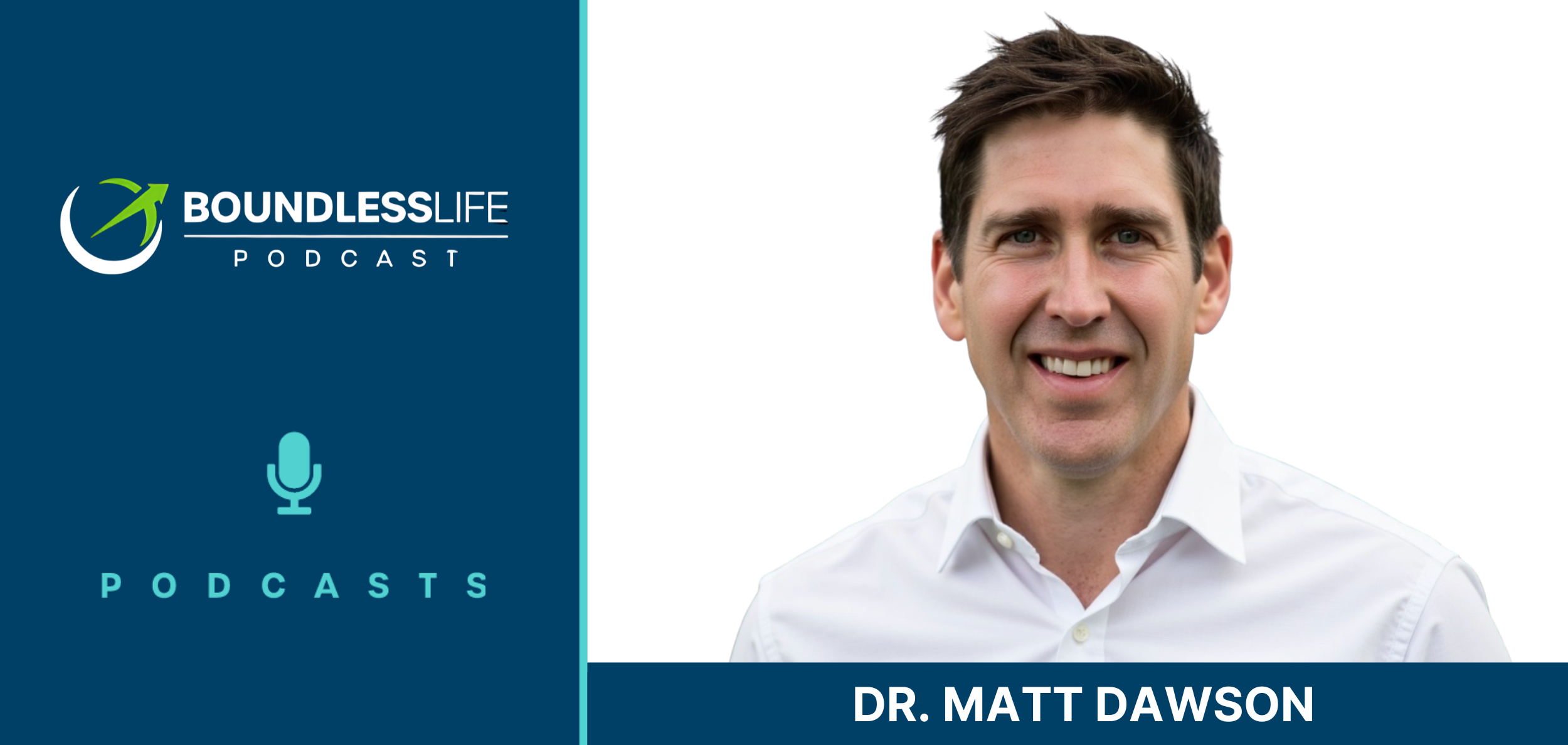
Boundless Life Podcast promotional graphic featuring a headshot of Dr. Matt Dawson, a smiling man in a white button-up shirt, against a light background with the podcast logo and microphone icon.

Listen on:

Reading time: 6 minutes

What I Discuss with Dr. Matt Dawson:

  • How a high-altitude Kilimanjaro expedition and Dr. Matt Dawson‘s Guinness World Record climb became a real-world test of how adaptive AI can coach you to train smarter, avoid injury, and outperform stronger competitors…1:54
  • Why he left Wild Health to join TruDiagnostic, shifting from genomics (the genes you're born with) to epigenetics (how your lifestyle controls how those genes behave)…07:19
  • Why your DNA explains only about 20% of your health, and how epigenetics captures the remaining 80% driven by sleep, nutrition, stress, and daily habits…09:03
  • Research showing a small blood sample can detect disease risk by identifying epigenetic “fingerprints” earlier and more accurately than traditional lab testing…11:06
  • How the TruHealth Test, an at-home finger-prick blood test you can take alongside the TruAge Test (use code BEN20 to save 20%), identifies the 100+ most predictive markers for assessing disease risk and overall health…13:30
  • Why chronological age alone doesn't tell the full story, and how the TruAge Test measures your true biological age, pace of aging, and organ-specific aging using epigenetic clocks like DunedinPACE, OMICm Age, and SYMPHONYAge…16:50
  • My TruAge results and what the data reveals about my overall health…19:28
  • The four criteria that define a legitimate biological age test…22:14
  • Why DunedinPACE is the strongest predictor of morbidity and mortality, and how it outperformed consensus biomarkers like grip strength and VO2 Max in the BASE-II trial…26:55
  • Why combining TruAge and TruHealth tests gives you both the macro view of aging and the specific biomarkers driving it…30:19
  • How large-scale population data like BASE-II is helping validate which biomarkers truly predict real-world disease risk, aging, and longevity…41:57
  • Why caloric restriction and GLP-1 drugs may both slow aging, but through different biological pathways, and why the effects could be additive rather than interchangeable…46:50
  • How epigenetics is starting to reveal what biohacks actually change your biology, from hyperbaric oxygen therapy to psychedelics activating neuroplasticity genes…49:12
  • How a real insomnia case revealed that pairing TruHealth biomarker data with large language models (LLMs) can uncover hidden interactions between medications, diet, and biology to guide precise, personalized intervention…57:15
  • Why strong social relationships remain the most powerful longevity factor, outperforming supplements, drugs, and biohacks, as shown in the Harvard Study of Adult Development…01:01:31

What if a simple blood test could reveal how fast you're aging, your risk for chronic disease, and which interventions are most likely to improve your health?

In this fascinating episode with repeat guest Dr. Matt Dawson, you'll discover how epigenetic testing analyzes DNA methylation (chemical tags that control how your genes behave) to expose how fast you're biologically aging, what's driving your health, and your risk for disease. You'll also explore how these signals can detect chronic disease risk cancer earlier than traditional labs, and how TruDiagnostic built the TruHealth Test by analyzing ~1,000 biomarkers to pinpoint the most predictive indicators of health and disease.

You'll also get a clear breakdown of their TruAge Test, covering your biological age, how quickly you're aging (pace of aging), and how different organs are aging, along with insights from my own results and what they reveal about my overall health. We also discuss how AI and LLMs are being used to identify which interventions actually improve specific biomarkers, and what truly moves the needle for longevity, from caloric restriction and GLP-1 drugs to the often-overlooked impact of relationships, stress, and recovery.

👉 You can receive 20% off your TruAge + TruHealth kit with code BEN20 here.

Dr. Matt Dawson is a physician-entrepreneur dedicated to harnessing the power of genomics and epigenetics to transform health and extend human lifespan. He has established six innovative companies and non-profit organizations over the past decade. He is the author of two medical textbooks, has contributed to over two dozen scientific publications, lectured extensively in more than 20 countries, and received national recognition for his contributions to medical education and innovation.

As the founder of Wild Health, he pioneered a genomics-based precision medicine practice that expanded nationwide across all 50 states and was subsequently acquired by a publicly traded tech company for its advanced AI-driven health recommendation platform.

He currently serves as the CEO of TruDiagnostic, an industry-leading epigenetic longevity laboratory specializing in biological age testing and diagnostics, leveraging AI and epigenetic biomarkers to revolutionize chronic disease diagnosis and management.

Deeply passionate about unraveling the complexities of the genome and epigenome, Dr. Dawson is committed to optimizing human health and maximizing healthspan. When not immersed in advancing precision medicine, he enjoys life in the woods alongside his wife, four children, and two adventurous dogs.

View my TruHealth and TruAge results here:


For additional insights, you can check out my previous podcasts with Dr. Dawson below:

Episode Sponsors:

ZBiotics Pre-Alcohol Probiotic: The world's first genetically engineered probiotic that helps break down the toxic byproduct of alcohol, ZBiotics Pre-Alcohol allows you to enjoy your night out and feel great the next day. Order with the confidence of a 100% money-back guarantee and 15% off your first order at zbiotics.com/BEN15.

Troscriptions: Explore Troscriptions' revolutionary buccal troche delivery system that bypasses digestion to deliver pharmaceutical-grade, physician-formulated health optimization compounds directly through your cheek mucosa for faster onset and higher bioavailability than traditional supplements. Discover a completely new way to optimize your health at troscriptions.com/BEN or enter BEN at checkout for 10% off your first order.

Manukora: You haven’t tasted or seen honey like this before, so indulge and try some honey with superpowers from Manukora. If you head to manukora.com/ben or use code BEN, you’ll automatically get $25 off your Starter Kit.

Qualia Stem Cell: Qualia Stem Cell is a science-backed supplement designed to support your body’s natural repair system by enhancing stem cell function, helping you recover, renew, and maintain healthy tissues as you age. Taken just four days per month and formulated with premium, clinically supported ingredients, it’s an easy way to support long-term healing and vitality. Visit qualialife.com/boundless and use code BOUNDLESS for 15% off.

MTE: MTE is a caffeine-free daily drink mix with adaptogens, nootropics, and superfoods for clean energy, sharp focus, and balanced mood, without the crash. Boost your wellness at a systemic level with MTE's 13 healthy ingredients. Check them out at GetMTE.com/BENG and use code BENG for 20% off your first order.

Episode Resources:

People

TruDiagnostic Tests — Use Code BEN20 for 20% Off

Studies

Supplements

Devices


Do you have questions, thoughts, or feedback for Dr. Matt Dawson or me? Leave your comments below, and one of us will reply!

Upcoming Events:

Boundless Live Tour Presented by FormulaIQ | Summer 2026

Join the world premiere of Boundless: The Man Who Became Human, a new feature documentary that follows 20 years of body optimization colliding with life's immeasurable moments—marriage, family, and faith. Experience a live podcast recording and intimate Q&A with my family and me in Los Angeles, New York, Austin, and Moscow, ID, one night in a room full of people chasing the same thing. Purchase tickets here. 

Health Optimisation Summit | September 11–13, 2026

I'm speaking at the Health Optimisation Summit in London (September 11–13, 2026) at the Business Design Centre. This isn't your average health conference. HOS unites the best minds in biohacking, longevity, nutrition, fitness, and medicine, with one goal: to actually make people healthier. With 35+ world-class speakers, 120+ cutting-edge brands, and 4,000 like-minded people all under one roof, it's two days that could genuinely change how you approach your health. Get your ticket here and use code BEN to save 10% off registration! 

Eudēmonia | November 5–8, 2026

I'm speaking at Eudēmonia (November 5–8, 2026, in West Palm Beach, FL), a prevention-focused, science-based health, well-being, and longevity summit designed to add years to your life and life to your years. Across 3 days and 15 venues, you'll experience 200+ talks from 120+ experts, 300 treatments, and 160+ brands covering everything from biohacking, longevity, and hormonal health to gut health, brain health, peptides, mobility, and more. I'll be leading a talk and a movement session alongside some of the brightest minds in health today. Use code BGREENFIELD-EUD-100 for $100 off when you register here!

The Boundless Couples Retreat | November 10–14, 2026

Ready to reconnect and recharge with your partner in paradise? Join the Greenfields at the stunning Prana Maya resort in Belize for the Boundless Couples Retreat, November 10–14, 2026. It's a five-day, all-inclusive escape designed to deepen your relationship, restore your vitality, and create memories that last a lifetime. From relaxation and adventure to intimate relationship coaching with Jessa and me, every detail is crafted to send you home with a stronger bond and a reinvigorated spirit. Spots are limited, so discover more and secure yours here today!

The Manzo x Ben Greenfield Table Private Dinner | Throughout 2026

If you want to taste one of the world's rarest cuts of beef and experience my North Idaho biohacking compound firsthand, my family and I are hosting The Manzo x Ben Greenfield Table, an intimate, chef-catered VIP dinner on a few limited 2026 dates. The evening includes biodynamic wine, a live cooking demo, a multi-course Piedmontese feast finer than Wagyu, and a night of deep sleep in an EMF-free, fully grounded, circadian-optimized guest room. Anyone who reserves a half or whole Piedmontese bull from Manzo qualifies for a spot, so reserve your allocation and dinner here.

Stay tuned for future updates—and you can always keep up with my LIVE appearances by checking out bengreenfieldlife.com/calendar!

Ben Greenfield 0:00

My name is Ben Greenfield, and on this episode of The Boundless life podcast,

Dr. Matt Dawson 0:05

your DNA makes up about 20% of your health outcome, but the other 80% of what you do, what you eat, how you sleep, your stress levels. With epigenetics, you're measuring that that other 80% you're actually looking at how much every gene is turned up and turned down. What we can predict with epigenetics is limited by our imagination and the size of the data set.

Ben Greenfield 0:24

Welcome to the boundless life with me. Your host, Ben Greenfield, I'm a personal trainer, exercise physiologist and nutritionist, and I'm passionate about helping you discover unparalleled levels of health, fitness, longevity and beyond. Ben,

Ben Greenfield 0:46

I guess today, Dr Matt Dawson, physician, entrepreneur, I don't know what you call yourself, man, you're kind of both and also an athlete. Now, a competitive endurance athlete, by the sounds of it. Tell people about this adventure you just got back from.

Dr. Matt Dawson 1:03

Well, first off, I love your sweater. Your sweater says, Dad, I think I'm just going to call you dad for the podcast, because

Ben Greenfield 1:08

that'd be maybe, actually, I'll just throw this in right now. This is the most expensive sweatshirt I own. I was at a spa in Portugal, and the weather was colder than I thought the weather was going to be in Portugal, and so I went downstairs, and I'm like, I need to buy a sweater from the spot this hotel. And I just grabbed this one because it looked like the cheapest sweater in the joint, and put it on my hotel account. And as I was checking out, realized I'd spent 350 bucks on a sweatshirt that says Dad on it. So this, this, and it literally, it literally feels like a cheap champion sweatshirt. I think I just

Dr. Matt Dawson 1:47

paid for the brand. It was like, it was like $50 for the stretcher, and then $100 per letter for your dad there. So that's great.

Ben Greenfield 1:52

Yeah, exactly. But you had a more exciting adventure than a

Dr. Matt Dawson 1:56

spa sweatshirt, yeah? So the Kilimanjaro, so, so it was almost a year ago, probably nine to 12 months ago, somebody reached out to me and said they were going to try this Guinness World Record Group speed attempt of up and down Kilimanjaro. And I thought, I am definitely not that fit. I am no Ben Greenfield, but that sounds fun. So I haven't really trained. I've done a couple Ironmans, but I'm extremely slow, kind of barely finishing. But it was like so much fun. I spent nine months really training and seeing how my body would respond. I basically built an AI coach for myself that I would feed in all my true health data, all the stuff they're going to talk about, all my training data, my lactate threshold stuff. And it was just cool. Yeah, had a blast like watching my body respond. And in the end, I think there were 34 of us that tried. We needed four of us to finish under a time to get the group world record, and five of us did. I think there are a couple more that may have came under. But yeah, I was, I was part of that group, so I got a new Guinness World Record for Kilimanjaro, up and down.

Ben Greenfield 2:57

Congratulations, that the AI training thing is interesting. So did you just kind of, like, upload all of your data and say, Here's, you know, the fitness level I need to be at and the mountain I need to climb in X number of months. Tell me what to do every day. Yeah, the exact route,

Dr. Matt Dawson 3:15

the exact kind of set we did, seven days of kind of acclimation before the the first week, we settled it twice. So the first route, the second route, which one we're taking, where my fitness was. I had it give me tests to do, like, where's my muscular endurance? Where's my cardiac drift, where's my vo two, Max? And I got all that in there, all my biometrics, my health stuff. And then come up with a plan, come up with a supplement plan, come up with everything. And every day, I would upload my workout that I did. It would adjust every couple weeks. We'd do tests. It would readjust based on how I'm doing. And it was the first time I've ever trained for something, or went through a sports season without getting injured, without overtraining, because I just really listened to it, followed the plan, and in the end, even the climb was a science experiment, like I still was, not the people who were on the climb with us, there were Army Rangers, Special Forces, Delta Force, guys, like famous Ultra marathoners and adventure folks, and they were way stronger than I was, but I was actually the first one to the top, because I was so dialed into, like, the science of I knew it's really an eating contest with a lot of hiking, but I was dialed into, like, what calories I could take, how many, which macronutrients, at which heart rate? Like, what could I take in at 125 versus 135 versus 145 it was just all science. This is so much fun. Okay, so

Ben Greenfield 4:33

the professor beats the meathead, the the app, or, I guess, like the LLM that you use for that. I mean, where my mind goes is, couldn't you kind of, like, take that entire set of training that you did for those months and, like, vibe code that into an app that would do the same thing for other people?

Dr. Matt Dawson 4:50

Yeah, absolutely. And it progressed and so, and also we were creating, including us, and we were creating, kind of a beta product of something that does this, not necessarily for fitness, but all the biomarkers. Yeah. So I was using that a little bit. Also, I started out using just a chat GPT folder where I could keep everything. But then I ended up progressing and switching when open Claude came out. And there was the whole craze on open Claude in January. And so my final kind of coach rested on was open Claude using Opus 4.6 as the base. Was the final thing. So it kind of progressed how I was using it. And, I mean, every month, the cool thing is, every month it got better as the different models got better. But that was the final version. Was a, actually an open call agent that I just talked to via telegram.

Ben Greenfield 5:30

Sign me up for a beta user, if you ever develop that into Now, that sounds super funny. It would all it almost sounds like it would almost be able to reverse engineer motivation into you to sign up for an event, just because, you know you'd have a a pretty precise script written for preparation.

Dr. Matt Dawson 5:47

Two things about that. One, in the next couple of months, we are releasing something true diagnostic that is not exactly that, but it would function that way, but it's more geared towards optimizing your pace of aging and all that with true health. But number two, the guy that organized that trip. He organizes these really incredible trips and adventures. His name is Dave pickles. So great name, not made up. Dave pickles. He's in Great Britain. Sounds like

Ben Greenfield 6:15

a badass adventurer.

Dr. Matt Dawson 6:16

Dave Pickles. Well, the funny thing is, like he sounds like he's from a children's story, but, yeah, he was like, ex delta for I mean, he is a, he is a badass, even though it sounds, yeah, he's incredible. The stuff that he's done is amazing. But he has, like, I don't know if I can talk about this yet. He told me about, there's a, there's an incredible of interest around in Africa, I'll say, because I don't think I asked was talking about next year that he's going to release really soon. And he wants to partner like that. I told him about the app that I'm building and stuff, and he wants to partner and kind of use that with all of his adventure things. So if anyone is into that stuff, you should totally go to, like, check out Dave pickles. I think it's maybe like, yeah, just Google Dave pickles. And he's probably going to have something really cool like that in the future, but he does such a phenomenal job of organizing it. I mean, he there were some people in our in our group on the first trip, not the world record, one that you wouldn't think would be able to necessarily do this. And he just got everybody to the top just because of the level of organization. Nothing like a little

Ben Greenfield 7:17

pickles motivation. Interesting. You mentioned true diagnostic couple times. I mean, people who have been longtime podcast fans have probably heard you like four or five times on this podcast. We first met you were running wild health. You know, physician network, like for precision medicine. I know that you've moved on, and now you're at the helm of this company, true diagnostics. You got the true age test, you have the true health test. And these are very unique tests. So I would just love to hear what the full update is on the field of epigenetic testing. You know what it is when it comes to helping people understand that? But let's, let's start there. Like, what is the quick version of epigenetic testing, and why and why I

Dr. Matt Dawson 8:02

kind of moved from from Wild Health. So I founded Wild Health and was a CEO, and it was acquired by a public traded tech company. We built kind of some AI tech to take millions of data points get precision medicine recommendations. So I stayed on a CEO, but then about two, and that was about three and a half years ago, when it was acquired about two and a half years ago, I got a call from true diagnostic, and they were they wanted to show me some some science they were doing with Harvard. At first it seemed too good to be true, but after about a week of looking it into the science, I became convinced was the most exciting thing I'd ever seen in science and medicine, and that's what prompted me to leave Wild Health. So Wild Health was based on genomics, was really the core like precision recommendations, or personalized recommendation based on your data.

Ben Greenfield 8:42

Recommendations based on your DNA. Just to explain that to people, this would be something similar to, like, what I don't know, like self decode 10x I think 23andme tried to do it at one point, but this is just basically getting your DNA tested and getting health recommendations based on that DNA.

Dr. Matt Dawson 9:03

That's right, and your DNA makes up about 20% of your health outcome. And so at Wild Health, we'd also add like lab tests and other things to that, but epigenetics is the other 80% so you're born with a DNA that's 20% of health outcome, but the other 80% is what you do, what you eat, how you sleep, your stress levels. With epigenetics, you're measuring that that other 80% you're actually looking at how much every gene is turned up and turned down. So it's not what genes you have, how are you expressing them? And that's just a much richer data set. I remember when I this, this Harvard study, for example, they got excited about they were looking at. So everyone's familiar with cologuard. So that is a test for colon cancer and Grail test, that's a test for 50 different cancers. Both of those

Ben Greenfield 9:48

are blood tests, right? Cologuard and Grail. So cologuard

Dr. Matt Dawson 9:51

is, is actually a stool test, but, but, but, but Grail is a blood test. And so to talk about Grail, because it's a good analogy for the heart. Harvard study, when you get pancreatic cancer, lung cancer, prostate cancer, colon cancer, you start expressing your genes differently. And so if you just take a small blood sample, you can you can find that epigenetic fingerprint for those different cancers. And so that's why, with a few drops of blood, they can diagnose all of these 50 cancers. So the Harvard study, they were asking, Well, why can't we find the epigenetic fingerprint of every other chronic disease, cardiovascular disease, COPD the things that are killing us the most, Alzheimer's and dementia, and they had incredible results with that. Now, what people normally think of epigenetics is you also can tell biologic age, pace of aging. That's what people normally think of. But really, when you're measuring genetic expression, it's just much richer information. What I've become convinced of is what we can predict with epigenetics is limited by our imagination and the size of the data set. So I told Mike, when I saw this data from Harvard, I was like, we've been wasting our time in genetics. It's epigenetics. That's where you get all the predictive power, and that's why we moved over to true diagnostic So is there an

Ben Greenfield 11:06

example of like, something that just a basic blood test that people might be familiar with would show you that you could get tested via an epigenetic test also, but it would say something different, like, are there, I don't know, genes that are expressed that are related to vitamin D that you could test, but then you could also test vitamin D in your blood. You know what I'm saying? Like, like, what the difference.

Dr. Matt Dawson 11:30

would be? So to talk about that Harvard test specifically because it answered that question. So I'm going to back up and go a step at a time, so listeners are getting this biologic age and pace of aging. We test that with true age, and we can talk about those, but let's set those aside for a second, because most people are familiar with those. In this Harvard study, they were saying, can we diagnose cardiovascular disease? COPD these things? But they also asked another question. They said, can we also predict other biomarkers? So to your question about things like vitamin D and those things. There was a researcher named Richard Marioni who, several years ago, he found that you could, with epigenetics, predict CRP and hemoglobin, a, 1c, now his obvious question, when he found these two, that you could predict these two was, well, how good do they perform? So how good is this CRP compared to a lab core quest CRP. Well then you have to answer the question, what makes a biomarker good?

Ben Greenfield 12:24

How good is a prediction versus

Dr. Matt Dawson 12:27

a direct measurement? That's exactly right. So the reason you order a CRP or any lab test is to be able to predict disease. Does someone have disease, or are they going to develop it? And so that is measured by hazard ratio and odds ratio. And so he looked at how predictive is his epigenetic CRP measure of inflammation versus the traditional CRP, and he actually found it was more predictive for cognitive decline and these other things. So it was actually kind of an upgraded measure of inflammation, because it wasn't just measuring CRP, it was measuring the epigenetic effect of inflammation. So in the Harvard study, we had hypotheses. We thought it'd be really cool if we could find another dozen or two dozen of these upgraded biomarkers, biomarkers that predict something like vitamin D or inflammation, CRP, hemoglobin, C, but are better predictors at what you care about, which is the disease progression. And we found 1600 biomarkers we could predict when we measured them against their traditional versions, about two thirds performed better, so better hazard ratio or odds ratio. So we found about 1000 quote, unquote, upgraded biomarkers, and that's how we developed the true health test. It's about it's the top 100 or so of the ones that actually are better at predicting disease than the traditional lab core quest versions of those biomarkers.

Ben Greenfield 13:45

Okay, so if I'm getting a true health test, I mean, like I got one, I have my results pulled up somewhere here, and there's a lot of different data points, like, more than I might see on an average, you know, blood panel that I might get from the doctor. But are you saying that a lot of these biomarkers, like, I'm just scrolling through everything from like stress biomarkers to mitochondrial biomarkers to vitamins, etc, that these were all like my levels of these were predicted, not directly measured, or were some of them directly measured and used to predict others? That's right.

Dr. Matt Dawson 14:20

So they were not directly measured. They were predicted. Now that prediction when the only ones that are included into health are ones that are then better at predicting disease. So I'll give you an example, hemoglobin a 1c so all hemoglobin a 1c measures is is glycolated hemoglobin that correlates to glucose, which correlates to my stroke, microvascular damage, which correlates to stroke and heart attack. So that a 1c is a correlate for heart attack and stroke. Well, our a 1c measurement isn't directly measuring a 1c but is a. Better predictor of the metabolic outcomes. So if I have a hemoglobin a 1c that I got from labcorn quest or this version, they're not going to be exactly the same, but I know that the hazard ratio and odds ratio the prediction of disease is better with the epigenetic version, we only included ones that had better hazard ratio or odds

Ben Greenfield 15:18

ratios, and it is predicting my hemoglobin, a 1c based on certain genes that are being expressed. That's right, yeah.

Dr. Matt Dawson 15:26

So yeah, so we looked at, yeah, that's

Ben Greenfield 15:28

exactly right. Okay, I'm tracking now and then the prediction. Obviously, you need data to make a prediction. So is the predictive data just basically from like, a large pool of individuals who have had both blood markers and gene expression,

Dr. Matt Dawson 15:45

tested and outcomes. Yeah. So Harvard has 100,000 patient biobank, and then we also have access to generation Scotland, which is 18,000 patients with epigenetics and outcomes. And so we train on that massive data set then. So now, when we take your blood, we look at about a million sites how much each gene is expressed, and then from that, we can give that. Here's your metabolic health number. It's not actually a 1c it is a more predictive version of that

Ben Greenfield 16:13

got it. And I'll embed my own results in the show notes. If anybody wants to actually see what results look like. Those will be at https://bengreenfieldlife.com/trupodcast It was a combo test that you sent me so that we could kind of look at it leading up to this podcast. It was a true age test and a true health test. You just got done describing kind of like what the true health test does, but what's it? What's actually doing that the true age test doesn't because the true age test does give you your pace of aging, and I think even like your your risk of certain

Dr. Matt Dawson 16:50

diseases, doesn't it? Yeah, so we'll talk about to talk about true age for just a second. There are hundreds of quote, unquote, biological age tests out there, and what does that even mean? What is your biologic age? So not, not to get too simplistic with your listeners, but I think this is important because there's a lot of confusion around it. We know age is the number one risk factor for disease and mortality period, but we all know that a 45 year old. We've seen 45 year olds that look and perform like a 35 year old, and those looking for him like a 55 year old. So we know there's something other than chronological age, and that's what that's what we're talking about. We say biologic age. There's no formal definition of biologic age, but when I talk about biologic age, I'm talking about a global number that tells me your risk of dying and getting sick. That's what biologic age is to me. We have over 1000 algorithms that we have rights to. We only report on three biologic age tests developed by Harvard Duke and Yale. So in your report, you got your omic MH, so that's a Harvard algorithm, and it's been published in Nature aging, and it is the best one at predicting your mortality over the next 10 years. The likelihood of that did you're going to die, then you have the Dunedin pace, that is my favorite of the biologic age test. It's developed by Duke, and it has actually been shown to be the best predictor of morbidity and mortality period. There was a really big trial called the base two trial that just came out in the last month, and it is better than grip strength, VO, two, Max, all the other things. It was shown to have a better predictive power. And I want to know that what is someone's risk of mortality and morbidity, and the last one that we report on is Symphony age that's developed by Yale. And the great thing about it is it that while omic age tells you that kind of global biologic age, number pace tells you your pace of aging, it's more like your speedometer. So if omic age was your odometer, how many miles pace would be your speedometer? And then Symphony age tells you different organ systems, because we age in a heterogeneous way. Your brain may faster than your liver than your kidneys, so that then kind of tells you why you'd be aging faster or slower, like what is the weakest link in the chain with the organ? So they tell you three very different things you may ask this question, but I will say one thing important to talk about is what makes a good biologic age test or not, and why we chose those three. I don't want to let you lead, but I think there's so much confusion in the field that that would be something important.

Ben Greenfield 19:28

Yeah, I'd be curious about that. It is interesting. Like I have my results pulled up right now and again. If people want to look at him, you can. I'm an open book, as you all know, like my heart, my immune system and my kidneys on that Symphony age, those are the ones that seem to be aging faster, right? So you can get a little bit more precise here with the organ systems. Looks like my hormones are aging slowly, liver aging slowly, metabolism and musculoskeletal those are the healthier values on the symphony test. So those are like. Some of the organ systems that you can look at my my dune din test, like the pace of aging is point seven below one is good. That means, like, every year that passes my, my body is aging biologically, point seven years. But then the the Oh, Mike M, you know, I think it's just a load of hooey that test, because it says I'm 47 it's lying. It has to be, No, I'm just kidding. You know, I would not be surprised if that could be my, my O, mic, M age, the one that was developed with Harbor, like the deeper reflection of biological age. Part of that might be due to, like, speaking of Kilimanjaro, you know, 20 years of masochistic endurance racing for the early phases of my life, but it is interesting. Or you can pair all three of these together and see the pace of aging, the biological age, and then the different aging rates of the different organ systems. So you had mentioned that there's, like, a certain level of quality or or difference when you're looking at a biological test. What do you look for on these? Just, just to know, like, what biological test is good?

Dr. Matt Dawson 21:02

Yeah, and I will say your tests are actually pretty classic for for your life, and they're similar to mine. They're similar to other either hard charging entrepreneurs or athletes who have done the masochistic stuff like you said, yeah.

Ben Greenfield 21:17

Let's face it, we are not just like gardening and walking, you know, dwarf goats up the side of a mountain to collect water each morning. We are, you know, I know you, you're a little bit like me. We do like to go out and pound the pavement, yeah. And at the same

Dr. Matt Dawson 21:30

time you, from what I understand, just talking to you, you've, you've, you've tempered that down a little bit at this stage of your career, and, and, or you're just your life, well,

Ben Greenfield 21:40

relative to Iron Man training. Yet, you know, anybody who goes with me to the gym typically still gets their soul crushed, but it's, it's definitely less voluminous,

Dr. Matt Dawson 21:51

yeah, and you're a little smarter about it. You've learned a lot over the years, and while you may have done some real damage and have that kind of slightly elevated biologic, HS, the one that matters for what's going on right now is the pace test, and you're aging 30% slower than normal. So what that tells me is sure you did some crazy stuff, but now you're like, dialed in, and you're like, pulling it back, but to get back to your question of what makes a good one. So I just had an hour and a half discussion with Matt caberlin yesterday, and there's been recently things about Matt caberline and Peter T and had you been talking about biologic age tests in general? And there's some skepticism in the field, which is absolutely correct, because what I would say is 90% of the biologic age tests out there are junk, and I'm not going to talk about any other like companies, or anything in any negative way. But I think it's, there's very there's four criteria that make a good biologic age test, and almost, almost no tests follow this. Number one, it has to be the test, and the results and all the metrics have to be published, the methodology, all of those things. So we, we've published almost 100 studies over the last few years. And these three age tests that we're talking about are published nature aging, these big journals by Harvard, Duke and Yale. So it has, it can't be a black box. You can't say I've got an algorithm, trust me, on biologic age. So that's number one. Number two, it has to actually predict outcomes. The reason if it doesn't, if it's not better at predicting morbidity and mortality than chronological age, then it's useless. If it's and very few tests actually, actually achieve that, actually better at predicting mortality and morbidity. But these three do, and they've been published. The third thing is they have to be reliable. So if you send the same test, two of the same test the same day, there has to be reliability, which

Ben Greenfield 23:48

you would you hear a lot about, like these investigative journalists or, you know, YouTubers will actually do that, send in two tests different days, sometimes figure out how to use different name, get completely different results,

Dr. Matt Dawson 24:00

yep, yep, and that. And there's a very specific metric for that, for that reliability. It's called ICC, or intraclass correlation. I haven't really, I don't think I've seen a published ICC for almost any of the other biologic age tests other than these three. And these three are excellent to just to give you examples of what ICCs are. You think you take things like lipids, like LDL, HDL, those are usually kind of in the point eight, as far as ICC. So one would be perfect. Most of your lab metrics are between point seven and point nine. VO two, Max grip strength, those are like low point nine pace. Omic, age and Symphony are all over point nine five, really good technical reliability when you're saying seeing the same one. So have to, have to be reliable. You have to know if you when you get a different result, it's actually different, or is it just random noise in the system? Yeah. And the last thing is these tests have to respond to interventions, like as a clinician. Right? I'm sending them because I want the predictor of outcomes like your morbidity and mortality. It's got to be reliable, and then I want to be able to do interventions and see how it changes over time. So those are the four things that really have to be true to make a biologic age test good. And when I hear people talk about biologic age test, quote, unquote, not being valid. I shake my head, yes. 90% aren't. And these three, the reason we report on these three is because they nail this they nail those four things, and they're the ones that are reliable and meet these criteria,

Ben Greenfield 25:34

yeah, with the true health test, it is a little bit of a leap of faith, isn't it, because you'd be tempted to do the test, but then maybe do a separate blood test to check and see how accurate all this data is. But again, like, what you're saying is it's based on such big sets of population data that you guys have already accounted for that like, like, you can literally do the true health test and just know that with pretty good confidence those levels are going to be close to what's in your blood, and, perhaps more importantly, close to what's actually reflective of potential disease.

Dr. Matt Dawson 26:15

That last part is the real one. Yeah, because I'll do both, I will send regular lab tests and the true health, and they don't always match up. And so if I get hemoglobin a 1c is one place, and I get the true health and the other they're measuring slightly different things. Hemoglobin, a 1c is directly measuring glycolytic hemoglobin, the true health version is measuring the effect of that in the body. So if I feed both of those into an AI engine, I'm actually going to give higher weight to the one that is actually predictive of disease for me, because there's other factors that go into that so they won't match perfectly. But again, the only ones we report on are ones that have better hazard ratio and odds ratio for disease, which is what we really care about.

Ben Greenfield 26:55

Yeah. And back to what I think you named as like, the fourth criteria, this idea of responding to intervention, has that actually been studied, much like, like, when I look at this data, if I were to act on it and implement some of the I mean, you got supplement lifestyle, I don't recall if there are exercise recommendations on there or not. But are there actual interventional trials showing that acting on this data actually works in some meaningful way? Yeah, so

Dr. Matt Dawson 27:23

that's a great question. It's an important question to ask for any epigenetic test. So there are a ton of intervention conventional studies for the biologic age ones you report on, specifically Dunedin pace. So there was the calorie trials. This is a randomized control, controlled trial two years caloric restriction, Dunedin pace, all the things you would think would improve with caloric restriction, your lipid, blood pressure, glucose, inflammation, weight improved, as did the Dunedin pace. So it was proven like, okay, yeah, this responds to interventions. The reprieve study, this was looking at metavastatin and HIV. The slim liver study, this is semaglutide study. There's several others. So we know Dunedin pace and these biologic age tests they do, the ones we report on respond to intervention. Now, the ebp, the true health, these biomarkers, those are multiple universities are studying those. There's no published data yet on those responding. So I like to only talk about published data when we can. But Yale generation, Scotland, like multiple other universities, are validating those as well. Right now, all the validation we have is internal. We validate it in multiple different cohorts. There's a lot of interventional trials showing you do the right things, and these actually respond, so you can follow them over time and kind of optimize your health with them.

Ben Greenfield 28:47

Yeah, I've got my true age test pulled up right now, and towards the end of the test, it gives recommended interventions. And testing just lightning round, there's spermidine, there's NMN or nr for boosting NAD levels. There's quercetin or other senolytics right to clear senescent cells. There's vitamin d3 and k2 for immune system. Mediterranean diet, polyphenol, rich foods, cruciferous vegetables, adequate protein intake, prebiotics and fermented foods. And then, as you were just talking about caloric restriction, strength training, high intensity interval training, hyperbaric therapy, prioritizing high quality sleep, and then goal setting, journaling, dietary modification, sleep hygiene, avoiding harmful habits and stress management. Now those are all listed on my test. I'm assuming those are like generic and those are going to appear on anyone's results because you've looked into those as actually being the research proven methods that would change biological age in a

Dr. Matt Dawson 29:50

positive way. So they're not completely generic. So most of those are things that we just know in general do, and a lot of those are driven by what. The Advanced true age test, where you see the epigenetic biomarker proxies. So if there are certain things that are off, then it'll reflex to giving those recommendations. But yeah, most of those are things that we just know in general, improve biologic age based on those interventional studies that we that we talked about.

Ben Greenfield 30:19

Okay, when you said the advanced, I guess I do have another report here. What's, what's the advanced true age test showing me that the other one isn't well, everyone's getting

Dr. Matt Dawson 30:29

it is that that part is just so in the Harvard study where we, where we came up with omic MH, and again, that was just published in Nature aging in the last few months, they were looking at these epigenetic biomarker proxies for why are you aging faster or slower? And so we report on a lot of those as well, and that helps give a little more personalized guidance to the recommendations, not just decrease your stress, sleep, better those things. So a lot of the recommendations are things we know will help everyone, but some of them are more related to for example, if you had more stress markers in the EBPs, then there may be more of an emphasis on stress reduction than other people would get.

Ben Greenfield 31:11

Okay, I got it. I might have to take a deeper dive into that advanced report, because I didn't realize it was getting more personalized. So it's the same test. You get two reports, either basic overview, true age report, and then you get your more advanced Deep Dive. That's right, okay, and that's still separate from the true health report, yeah.

Dr. Matt Dawson 31:28

And the test you got is one finger stick, few drops of blood, and we can run both the true age and the true health that's what most people get when they order the test. And so you can just get one, but they just go together so well. It's like how my global marker, my pace of aging, that correlates most over any other biomarker with morbidity and mortality, based on the base two trial, I'm saying that with evidence. And then why? Like, what are all the biomarkers that I need to improve so they just go together, the big picture, and then the why? What can I actually do about it?

Ben Greenfield 31:58

And this base two trials pretty new,

Dr. Matt Dawson 32:01

isn't it? It's brand new. And that's why, like, it's for me, when I hear, I mean, I want to hear, sometimes, some influencers and things talk about biologic age tests. A lot of times they're talking about old literature and they're talking about past tests. And I don't necessarily blame them, but it's, it's all the really good data. It's been in the last year or so. Base two was just in March in the last 30 days, and it really is the nail in the coffin for anyone that says biologic age testing isn't ready for prime time. I mean, what they what they did, they looked over 1000 adults like multi year follow up between four years and 10 years. And they looked at the 14 kind of consensus biomarkers that we know are really good, or we've thought are really good, at predicting mortality. So things with it. Everybody talks about grip strength, il six, inflammatory stuff, standing balance, cognitive health. Neo two, Max Muscle Mass, all the IGF, one, all these big things, and they ranked those 14. What are the strongest predictors of mortality? Dunedin pace was the number one. It was above all of these other ones.

Ben Greenfield 33:15

And then that's just a very simple pace of aging, like zero to above one, like the

Dr. Matt Dawson 33:20

clock, that's right, the one that you got point seven on, which is phenomenal. That means you're aging 30% slower. So when I see that, and I see your entire like test, I'm like, All right. Number one, Ben is crushing it. He's got this point seven pace. That's phenomenal. Great. Now I can look and say, how, what can we dial in? What can we improve? What are other things? But that is just like the number. If there's one global marker of health, for me, it's a Dunedin pace. And I base that, I've said that for a while, and I and I've referred to certain, certain studies, certain reasons why. And when I saw the base trial come out last month, I was like, All right, great. This is the real study that that answers that better than any other. And I feel, I feel much better in my belief. My belief is more science now and less belief. Yeah, back to

Ben Greenfield 34:04

your Kilimanjaro training trickery. It seems to me like there's potential. I don't know if you guys are working on this. I don't think we've talked about it. At least if you are, it seems to me like there's potential to take, let's say, each of those epigenetic biomarkers on something like a true health test, and track certain interventions and see how they individually respond right above and beyond, like the global like raising or lowering of the doomed in pace. Couldn't you theoretically using like a, like an, LLM actually track, you know, whatever you know, I'm taking spermidine. I'm taking NAD, I maybe, you know, increased my HIIT training, lowered my zone two, what markers

Dr. Matt Dawson 34:47

were affected absolutely so. And that's the beauty of true health. So, before true health, what I the way I use, like the Dunedin pace is okay. Ben wants to do an experiment. Wants to do IV stem cells in Panama. He just wants to start spermidine supplementation, for example. Well, I want something an objective marker of is it working? So I would use Dunning paste, because I look at it as the biggest global one, because I couldn't really measure your spermidine of time. I couldn't really measure the effects of stem cells so well. So I'd use that global one. The problem with that is, if you started spermidine, it's not, you know, every we all know it's not a perfect experiment. You may or may not sleep better or worse for those two months, you may or may not, eat differently, your travel schedule. It's not a perfect experiment, and so it's hard for to see a change in something like Dunedin paste from one supplement. So that's difficult to isolate those variables, but with true health. Okay, great. Now we're actually measuring your epigenetic proxy for spermidine. So it's a little easier to do these one off experiments when you have more granular data, and that's exactly what I did. So in my AI training, I would upload my true health, and that was what would guide kind of my supplementation stack to your vitamin D, your Omega three, your Are you going to do spermidine, or you do vitamin C, all of these things, I would have it help guide the supplements more by having the more granular data.

Ben Greenfield 36:06

Have you ever thought about the potential for a platform where people are actually granting access to their information, uploading their protocols, and you're basically collecting enough big data over time to say, Okay, we have found that the, let's say maybe, like the the number one thing that affects something like hemoglobin, a, 1c, or the or the top five things are these five parameters that we can predict with pretty good accuracy across a wide range of individuals, is going to be effective at modulating that value?

Dr. Matt Dawson 36:37

Sure. So there's a few ways to do that. We've done it some, and we're going to do it more. So most of our studies we've done with with Harvard or generation Scotland, and in Harvard, when we pull the, say, 10,000 patients from their biobank, we also get all the medical records, all that data, granular data, so we can do predictive things. Now, when people just do our test, they have the option for opting in to research, and if they do that, there's also a questionnaire of what are you taking, what medications you're taking, what supplements you're taking, and so we're collecting that data as well, and if people opt into that, then we absolutely can, can create more and better recommendations.

Ben Greenfield 37:16

Now you're jogging my memory. I've done what I've probably done, four tests, I think, through true diagnostics. And I know the test landscape is evolving, and what you're testing for is evolving, but I think every single one I answered a pretty comprehensive questionnaire. So that questionnaire is not just, you know, for mere curiosity, for my own purposes. You can use that data to develop more precise recommendations

Dr. Matt Dawson 37:40

over time. Yeah, that's exactly right. We have the largest data set, private data set, of DNA, methylation epigenetic tests in the world. We have over 100,000 so we can do this, this science, and create better predictors. Now, when we release kind of the AI version that's in beta now, answering those questions will actually help give better recommendations for you. So far, they've just been answering these questions have been great. Now we're going to be able to give you better information on your next tests, because we'll feed it into the to the AI engine. But and some people, you also can opt out. It's either an opt in or opt out to letting that be be studied. We respect people's decisions there, right? You don't

Ben Greenfield 38:19

have to tell people whether you're sleeping in Boxers or briefs, you can keep that to yourself. So based on what you do know, I mean, I want to get into some brass tacks, because this is interesting. So far, I just listed off a little while ago, a whole bunch of somewhat proven tactics for slowing aging or addressing these biomarkers. But on your end, you've mentioned spermidine A couple of times. What are some tactics that, just in the experience you have so far with your own data, seeing a lot of, you know, other individuals data, what really moves the dial, like, like, what are the things that maybe are lesser known or underrated, or you just know globally, are going to have a really good impact for

Dr. Matt Dawson 38:58

people on aging so I'll name the big ones that are published now, name the ones that just is kind of internal data. And we've seen, I mentioned some. I mean, we know caloric restriction that that that does increase longevity in most mammals,

Ben Greenfield 39:10

caloric restriction, is there a dip? I know there's a difference between, say, like alternate day fasting, intermittent fasting, fasting, mimicking diet in terms of certain diets having greater potential, to say, preserve lean muscle mass through calorie restriction. But what I'm curious about is, have you seen or come across anything that would show the impact of calorie restriction if it's done via, let's say, just steely willpower versus calorie restriction accomplished through the use of GLP agonist. No, that's

Dr. Matt Dawson 39:47

not been studied directly, and we have actually done studies with both Novo Nordisk and Eli Lilly on semaglutide and enterzepatide and. And interestingly, both of those compounds, those GLP ones, have other kind of longevity effects too. Some have been published now, and they get a lot of press, and that those, those were our studies we did analyzing that data. Others haven't been published yet, but what I'll tell you is those are two very different like we see it in caloric restriction. We also see it in the GLP ones, they seem to be two different things and additive. It's not just from the caloric restriction. Now, having said all that, one of the things that, like no tool gives you the entire picture. So just because you're done eating pace and your pace of aging goes down with culture, it doesn't mean more of it is better. You and I know how important muscle mass is, so you could have an incredibly low Dunedin Pace, pace of aging, great biologic age, and then you fall and get a hip fracture. You have no muscle mass

Ben Greenfield 40:48

exactly where you fall off your bicycle and you die Exactly.

Dr. Matt Dawson 40:53

So just you got to be smart about this stuff and know that everything is a piece of the puzzle. It's not the entire puzzle.

Ben Greenfield 41:00

Yeah, all right, so calorie restriction,

Dr. Matt Dawson 41:02

calorie restriction, the couple things that have been studied, and then I'll get into what we've just seen. I mentioned the potavastatin and HIV, that was great. But, I mean, I don't know how many of your your listeners have HIV, so how applicable it is to them. There's been some supplement studies. There was the do health study, and what they showed is omega three, vitamin D and exercise, all had good effects. Those were kind of basic things. Now, what they didn't do is separate out people who had good levels of baseline versus not. But when you looked at the population, those vitamin D, Omega three, like those are ones that people take and they had, they had effects. There also was a really cool study of preschool children where these kids had some some psychosocial issues, and they gave the parents training in how to approach them. And the parents that got training, versus not the controls versus they actually reductions in in rate of aging for these kids. So there's social factors we know make a difference, and the other things you would expect, like sleep, optimizing your stress, which has to do with the social things, an interesting one that there's not not published out on this yet, but we just seen it anecdotally that, I mean, just today, I had a fair amount of exogenous ketones, like, when we've seen I don't have, like, good, big studies on this, but it's pretty reliable. When I've seen people do studies on themselves, of I am going to increase my ketone levels, even if it's not fasting, it's through exogenous ketones, we'll see interesting effects on pace of aging. And I wish someone would do a bigger study on that, because it's the magnitude has been interesting. That would

Ben Greenfield 42:41

be interesting. It's kind of similar to the calorie restriction with the GLP agonist versus without. It sounds like there's, there's different effects of both, and they could be combinatorial. It'd be interesting to see. Okay, so maintaining high blood levels of ketones not via carbohydrate and calorie restriction, just via exogenous ketones, if there's a clear winner, or if those also are common

Dr. Matt Dawson 43:03

material, yeah, it would be. Now the fact that caloric restriction a big study, thought it worked, I in, obviously, in that caloric restriction, they may have had raised ketone levels. Who knows what their diet was, but just exogenous ketones, without really changing your caloric intake, seems to make a difference as well, but there's not a big study

Ben Greenfield 43:22

on that yet, yeah, what about some of the common biohacks that are popular now, I know hyperbaric is one that's mentioned on the report, but then there's photobiomodulation, there's cryotherapy, there's, you know, certain electrical modalities, Like PMF or tDCS. Anything evolving on those as far as like any insight or potential clues.

Dr. Matt Dawson 43:45

The tough thing is, so hyperbaric, there was a study several years ago that showed some some reduction in biological age. The other one is, there's not any big trials. We love doing research. So if any of those companies that have the problem is, who funds these trials that none of them are cheap. So we any of those companies that are doing those things, we would love to study it, but there haven't been big trial. Actually, I'll give you one really interesting one. I just got an email today. We were doing a study with someone who was looking at Ayahuasca. So this was fascinating. It's not published yet, so I'm not sure how much I'm supposed to talk about it, but, but we'll still analyze the data. But what it looked like initially is the fast most fascinating thing is a lot of the genes that were became hypomethylated Post Ayahuasca. Were genes related to neuroplasticity, and people talk about that neuroplastic window, and those genes actually turned on, which was a fascinating outcome we still have to analyze, like biologic age, pace of aging, but it's interesting when you see, when you hear about subjectively, and you'll hear people talk about things like neuroplasticity. Post psychedelics, and then when you see the science of the specific genes being turned on or off related to that right after the experience. So there's more and more studies on all of these biohacks, whether it's the traditional things you said, or even something like that. And the cool thing about epigenetics is, not only can you see, does it increase or decrease biologic age or pace of aging. When you get really granular, you can start to see why, oh, it turned on these neuroplastic genes, for example,

Ben Greenfield 45:29

yeah, the the window of neuroplasticity, from what I understand, is highest for Ibogaine me, I think it's like 90 to 120, days, you know, versus, say, I think a few days for something like ketamine. And, of course, I think many listeners have probably already started to hear and see stories, you know, on podcasts like Joe Rogan or I think Jillian Michaels had one on some pretty profound neurological changes that occur that treatment.

Dr. Matt Dawson 45:58

Yeah. Well, even this, even this one, we're just looking at preliminary data, BDNF. So, so genes that express BDNF were actually turned up too, and that's one of the things with also with ketamine, we see in some other of these, of these, of these chemicals, yeah, like Miracle Grow

Ben Greenfield 46:15

for the brain. Let's say that I were, I were somewhat reckless and masochistic and wanted to speed up that doomed in pacing clock a little bit. What would be, what would be my strategy? What would be your recommendations to someone, as far as, like, the top things that are going to make you age faster?

Dr. Matt Dawson 46:33

Yeah, we could do it all at once. What I say is, like, stay up all night and don't sleep and while you're up, smoke as much as you can smoke, be as stressed out as you can, as you can be, and then just overeat, like those are the biggest things. It's like excess calories, lack of sleep, stress. And then the things that we know, like smoking and excess alcoholic those are the big ones that everybody knows about.

Ben Greenfield 46:58

Basically go to go to college stage faster. Exactly, yeah. What about anything related to more like psychosocial dynamics, relationships, etc. I mean, you know about Harvard's, you know, longevity study that was like 80 plus years long, you know, showing that when isolating for a lot of confounding variables, relationship quality seemed to trump everything.

Dr. Matt Dawson 47:22

That's right, it was by far the big, bigger than bigger than smoking, versus not smoking, bigger than than everything. So again, because the studies are expensive to fund, there's not been a ton on psychosocial but there's some, like the one that I mentioned around kids and parents just getting good, better parenting skills. So we know that exists. And what I would say about that is, I wish more people would do those studies. But all of these studies on like the pace of aging and biologic age we're looking at, those are surrogate markers. They're really good surrogate markers. The fact that this Harvard study on healthy aging was 80 years and 1000 people, it is the definitive so in my mind, we don't need studies on biologic aging, pace of aging, to know that the number one intervention over everything I'll ever tell you about oh, they studied this supplement, they studied this medication. None of that is close to the strength of your social relationships. And I think that study was so definitive on that that anyone who's biohacking and not and not focusing on that they're wasting their time with, with everything else that is the biggest thing is the strength of those social relationships. Yeah, how many

Ben Greenfield 48:30

markers total are on this true health test? Because I'm actually scrolling through my results right now, which, again, I'll put in the show notes for people to take a look at. It's, it's a lot like I'm still scrolling and scrolling and scrolling. I'm seeing a lot of green, which is good. There's a few reds that pop up. Looks like histidine, ApoE, dimethyl arginine, a few cardiovascular markers, but, but how many markers are you testing? And are there markers that are added on a regular basis? We will add,

Dr. Matt Dawson 49:01

as we feel really good that the market has been validated. Right now, it's about 100 we have about 1000 that we think perform better than regular biomarkers. We just like to validate them. It brings up an interesting point and something important to note. I'll give you an example of how to use this. So before we actually even rolled this out to the public, you met Mike. Mike Mallon. He, as he was developing this, he was having a really difficult issue with he has familial hypercholesterolemia through the roof, and even, like a little bit of some issues on, I could clearly scan and stuff. And so he's taking, he was taking some medications for that. He's having some insomnia for a year trying to figure out this, in this loop around insomnia, these cholesterol medications, trying to get it dialed in. Couldn't get it really figured out. And when we got his true health report back in, these 100 biomarkers, it's a lot for anyone to digest. It's too much for a human brain, so we put it into an AI system with, hey, having trouble with. Insomnia. Here's the medication is taken, and in seconds, it was able to ingest all of that data and tell him, Okay, it looks like the medications you're on are causing issues with methylation. It guessed he was a vegetarian, which he was, and it basically was like your medication and your vegetarianism are causing issues with taurine, riboflavin, butane. All you got to do is eat some meat bro, or take a few supplements. And he started doing that, and he got better, and we actually weren't able to piece that together just looking at all the biomarkers ourselves. So it brings up an issue like one, you get so much information, which is great, but it also Thankfully we're living in a time where llms can actually parse this and give us really good information. That's why we're we're building the product we're going to be releasing soon that actually has it built in. So anyone that's actually getting this test, honestly, one of the recommendations I'm making, there's all all kinds of privacy issues and other issues for people to consider, but I get a tremendous amount of benefit by uploading these to the correct llms And getting information. I mean, as I mentioned, my AI trainer I was doing that, I was uploading these wires

Ben Greenfield 51:07

to it. Yeah, but you're a physician, and you probably have a little bit better grasp of the prompts to use. What you're saying is that for people who might not be totally sure of how to query that you, you are in the process of developing something that will make that a little bit easier for people to upload

Dr. Matt Dawson 51:23

and analyze. That's right, and initially that'll be a tool that our physicians use. People can order these tests just on their own. They also can order them through their physician. And I always recommend, even though I love enabling people and empowering people to take control of their their own health. This is a lot of information, so someone does have a physician that orders it, can help them interpret it. That's great. We're initially going to be giving the AI tool to the physicians as well. Main reason is, there's just regulatory things around AI practicing medicine. So like it? Yeah, people can get it either way, on their own or through the physician. But I generally like to steer people towards Hey, do this, and if your doctor's not ordering them, they can. They can get this for you if they just were to go to our website as well.

Ben Greenfield 52:10

Yeah, I feel like most of my results look pretty good, but there were a few, I mean, freak me out, neurogranin, haven't? I haven't really been studied up on. It's a memory health protein, calmodulin binding protein that says linked to synaptic plasticity and cognition. High levels are linked to neurogenerative diseases. And I have like off the charts, like 98th percentile, but then underneath that, and this is helpful, it says, avoid overtraining, right? Stress Management, adequate sleep. L theanine, magnesium, ashwagandha, Phosphatidylserine and vacopomanieri. So there's kind of like, you know, kind of like a clue already embedded in the existing PDF report about action steps you could take.

Dr. Matt Dawson 52:55

Yeah, and for this cognitive one, honestly, I listened to your last few podcasts, and I was going to bring up issues with cognition, just from listening to them, anyway. So I think this, this matches for you

Ben Greenfield 53:09

know, it's my job sometimes on a podcast, to be the dumbest person in the room and look

Dr. Matt Dawson 53:15

at your face where you thought I was serious for a second.

Ben Greenfield 53:18

You had me for about half a second there you talked about some of the logistics of being able to go through your doctor versus at home blood spot test, meaning it's the circle that you drip blood on. I forget, you just do one blood spot test and send that off and that gives you both the true age and the true health. Or do you do two separate blood spots?

Dr. Matt Dawson 53:35

No, it's just one. Yeah. And so when we get that, and then we separate it out, and can run the test, I will say, in looking at your results too, they look again. The number one was at any pace which was excellent. And then all the small things. Whenever you test 100 things too, there's fluctuations in the system based on training and everything else. So I never put too much stress on one thing.

Ben Greenfield 53:56

Okay, so there is an acute effect, like if I had a, you know, back to the soul crushing workout thing. Like, if I'd done something hard that the night before and tested that could acutely

Dr. Matt Dawson 54:07

affect data, yeah, and when I look at your entire picture, that's what I that's what I kind of saw. Is like I said, it looks like on the February test. You may or may not have been in a acute phase of overreach. Okay, we do that to grow. I mean, in fact, the Ayahuasca say that I mentioned it looked like right after that, there were some it was like a worsening of a lot of markers. But then the effect later, at like late, like three months later, was actually an improvement, just like it would an intense exercise. You're going to have liver function tests from from liver acute stress after and CRP, all these things, but we know then two days later, it was a good thing for us. So it really looked like a picture of just like there was a little bit of designed overreaching or some other stressful thing during that. Yeah, it's so interesting

Ben Greenfield 54:53

how acute things can can affect this. Like, in this case, the February test was after an 18 hour flight back from Munich during. Many testing the next morning, after arriving at about 11:30pm the night before, and then I had different tests through just, just a normal blood test, through my doctor, I have had a history of elevated liver enzymes. So I thought, What the heck I'm going to be lazier than I've ever been for a few years and just basically sit on the couch, hang out with my wife, you know, stretch a little bit, and then go in and test. And the liver markers were, like, pristine, perfect. And I think one of the reasons I see these elevated liver enzymes is usually I'm testing the day after I've lifted weights or, you know,

Dr. Matt Dawson 55:39

don't work out, yeah, I got labs right after the Kilimanjaro thing and my liver. I was like, Holy crap. I see this in a patient. I'm like, having them test for all these things and but, yeah, just get it. It's good. It's good

Ben Greenfield 55:49

to get that removed. Definitely. You know, if you're listening and you have high levels that kind of stuff, do a washout period, like 4872 hours of just pure laziness, and then then go test.

Dr. Matt Dawson 55:59

And this is why I like, Hey, if you can do this with a position, that's great, because not everybody, other people get these tests, and they're not into this as much as you or I am, and they can get concerned. So yeah, take it with a grain of salt. Make sure you have someone that you can kind of go over this with. I would recommend, again, love empowering people, but there's some nuance to it and how you interpret them.

Ben Greenfield 56:23

Yeah, Okay, last question here, combo test. Most of these, I'm assuming, are not covered by insurance, so cash cost for for someone to order a true age, true health, approximately So.

Dr. Matt Dawson 56:34

And I will say one thing about insurance, so where our company is moving is we are actually coming out. We're going to be more we actually have some incredible diagnostics and predictors for actual diseases, and we're moving down the reimbursement pathway. So we just got the AMA, just gave us 12 PLA codes, so we're going down the pathway of getting a lot of our tests reimbursed, not the true age and not the true health, but like, we have a predictor for dementia of, are you going to get dementia next five years that has an AUC of over point nine, so over 90% ability to discriminate that and some other really amazing ones. So we are going down in the future, a lot of our tests that the new tests that will be coming out, predictive and diagnostic, will hopefully have insurance reimbursement, but biologic age and these true health, these are cash pay the prices on them. Either one true age or true health alone are 499, together, they're 850, but I'm 95% sure that we've got a code for your listeners. That is a we

Ben Greenfield 57:41

had one the last time we podcasted. So I know it's in there, so I'll make sure it winds up in the show notes, and then frequency of retesting. I mean, the pattern I've kind of been on, I think has been approximately quarterly. Is that overdoing it?

Dr. Matt Dawson 57:56

I would say there's. It depends on how much you're into this. I also do it quarterly. My my Chief of Staff is a great reference for this. She would do her every quarter for a year and a half, do her pace and her true health, and then she would optimize the true health, and she got all the way down to, I think, around point six of her pace by doing that. So you can be really intense and go every quarter. In fact, we have a subscription for every quarter, but you don't have to, I think every six months, or even every year, if you're kind of a casual consumer, but if you're a bin level crazy optimizer, every quarter is, I would say, don't do it more than that. I don't do it more than that, but I think that's the top level to do it is every quarter. Gosh, I

Ben Greenfield 58:39

think, I think that covered everything I wanted to ask about true age and true health. It's just so cool how rapidly this science is evolving. And for me personally, I find it motivating when I look at my score and see, okay, so this organ system use a little TLC, this number is looking good, so it gives you motivation, gives you a little bit of power and control of your health. Matt, thanks for being a five Pete or six Pete guest, or whatever you are now. Yeah, thanks for having me on.

Dr. Matt Dawson 59:07

I will say I'm really proud of myself for not calling you dad at all. I'm looking at you wearing his dad the entire time. And yeah, for those who are

Ben Greenfield 59:12

watching the video version the most expensive sweatshirt in all the land, https://bengreenfieldlife.com/trupodcast for the show notes, which will be juicy. I'll link to the tests. I'll link to my other podcast with Matt, which are equally as fascinating, and I can grab all that over on the website, Matt, until next time. Thanks Ben to discover even more tips, tricks, hacks and content to become the most complete, boundless version of you visit bengreenfieldlife.com

Ben Greenfield 59:51

in compliance with the FTC guidelines, Please assume the following about links and posts on this site. Most of the links going to products are often affiliate links, of which I receive. A small commission from sales of certain items, but the price is the same for you, and sometimes I even get to share a unique and somewhat significant discount with you. In some cases, I might also be an investor in a company I mentioned. I'm the founder, for example, of Keon LLC, the makers of Keon branded supplements and products, which I talk about quite a bit, regardless of the relationship. If I post or talk about an affiliate link to a product, it is indeed something I personally use support and with full authenticity and transparency, recommend, in good conscience, I personally vet each and every product that I talk about. My first priority is providing valuable information and resources to you that help you positively optimize your mind, body and spirit. And I will only ever link to products or resources affiliate or otherwise that fit within this purpose. So there's your fancy legal disclaimer.

Ben Greenfield

Ben Greenfield is a health consultant, speaker, and New York Times bestselling author of a wide variety of books.

What's Blocking You From Living Boundless?

Thoughts on ONE Tiny Blood Spot = HUNDREDS (!) Of Biomarkers, Age & Disease Prediction With Dr. Matt Dawson

Leave a Reply

Your email address will not be published. Required fields are marked *

Related Podcasts

#502 WP

How To Maintain Muscle On A GLP-1, Why Protein Stops Working As You Get Older, The Truth About Eating “Before Bedtime” & More! Solosode #502

Listen on: Reading time: 4 minutes What I Discuss: Why tinnitus is not a single condition but a symptom with...

Mazen Karnaby WP

What Happens When A *Pharmacist* Decides To Start A *Supplements* Company (WARNING: Be Careful With Your Creatine Gummies!)

Listen on: Reading time: 4 minutes What I Discuss with Mazen Karnaby: How he went from filling prescriptions behind the...

Boundless Life Podcast promotional graphic featuring a headshot of Tom Benson, a smiling older man in a dark blazer, against a light background with the podcast logo and microphone icon.

Is Mitochondrial Transplantation The Longevity Intervention Of The Future (OLD Mice Climbing Up Walls Like YOUNG Mice!) With Tom Benson of Mitrix

Listen on: Reading time: 3 minutes What I Discuss with Tom Benson: Why Tom decided to address damaged mitochondrial DNA...