
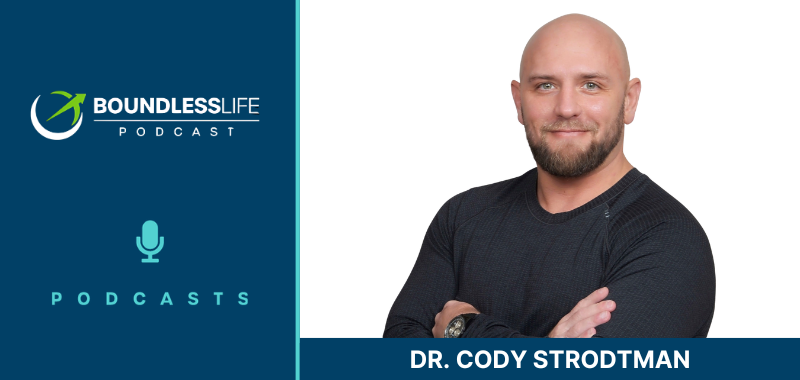
Home » Podcast » A Potent NON-Drug Hack For Blood Pressure, Giant Beaver Attacks During Cold Therapy, A Simple Mineral *Trick* For Muscle & More With Dr. Cody Strodtman

A Potent NON-Drug Hack For Blood Pressure, Giant Beaver Attacks During Cold Therapy, A Simple Mineral *Trick* For Muscle & More With Dr. Cody Strodtman

Listen on:

Reading time: 7 minutes

What I Discuss with Dr. Cody Strodtman:

  • His path to naturopathic medicine, fueled by his mother’s battle with cancer and a desire to answer the question “What is health?”…02:52
  • Core principles and philosophy of Adaptive Medicine: health as robust function vs. disease as dysfunction, and environmental hormesis—the “challenge, recover, repeat” cycle of physiological adaptation…04:26
  • Circadian rhythm biology and the “three ratios” that shape the circadian clock: light/darkness, movement/rest, eating/fasting…06:00
  • Differences between intermittent fasting and caloric restriction, and their impacts on hormones, recovery, metabolism…11:28
  • Inspiratory muscle training (IMT) and how just 30 resisted breaths per day can improve oxygen efficiency, athletic performance, and lower blood pressure…12:25
  • Benefits of increased CO2 tolerance: improved blood flow, oxygen, calmness, nervous system health, and HRV, along with CO2 training methods and devices…16:48
  • Benefits of inducing short bouts of hypoxia (low oxygen), how intermittent hypoxic training (IHT) boosts mitochondrial repair, stem cell count, and stress resilience, and the Adaptive Breath protocol..24:33
  • His pre-gym cold therapy routine…31:54
  • The science behind using local cold application during chemo to prevent peripheral neuropathy and mitigate hair loss…34:26
  • The metabolic theory of cancer: Why prolonged fasting and caloric restriction show promise for cancer therapy, the difference between glucose-dependent and ketone-adapted cancers, and the importance of dietary context…37:47
  • Controversies surrounding red meat and cancer, critiques of related nutritional studies, and nuances of carnivore diet research…41:40
  • Heat stress as cardiovascular medicine…43:48
  • Balancing the carnivore diet for gut recovery with the adaptive benefits of low-dose plant defense chemicals and antioxidants…49:20
  • The “mineral trick”: using baking soda to prevent “keto flu,” buffer metabolic acidosis, and spare muscle mass during fasting or ketosis, along with practical dosing, cautions about gastric distress, and the importance of electrolytes…52:06
  • Why the nervous system (not muscle length) controls flexibility: retraining the brain’s “governor” on pain and instability, plus Voodoo Flossing techniques for mobility and retraining pain-free movement…55:19

In this episode with Dr. Cody Strodtman, a naturopathic doctor, acupuncturist, and the author of Your Life, Your Choice: The Rise of Adaptive Medicine, you'll explore the science of adaptive medicine and how everyday lifestyle practices can become your most powerful healing tools.

Dr. Strodtman unpacks the essence of adaptive medicine, drawing from a decade-long obsession with understanding health beyond just treating disease. You’ll hear compelling discussions on circadian rhythms, environmental hormesis (think: cold plunges and sauna sessions), breathwork, fasting, and innovative techniques to optimize both your body and mind. He also shares science-backed routines—from inspiratory muscle training that can lower blood pressure, to strategic uses of cold and heat for boosting immunity and recovery.

The conversation also takes fascinating turns into cancer therapies, the mettle-testing world of the carnivore diet, and how small, consistent lifestyle stressors can fortify resilience at a cellular level. Whether you’re curious about how to leverage CO2 for calm, boost mitochondrial function through hypoxic breathing, or simply want actionable takeaways for better sleep and metabolic health, this episode is packed with practical wisdom and clinical nuance.

Dr. Cody Strodtman is a leading authority in adaptive medicine, blending his medical expertise and training as a naturopathic doctor and acupuncturist, with a passion for empowering individuals to optimize their health. In his book, Your Life, Your Choice: The Rise of Adaptive Medicine, Dr. Strodtman offers foundational insights on preventing, treating, and reversing chronic diseases, while also enhancing performance and longevity. His unique approach emphasizes the power of lifestyle change, inspiring individuals to take control of their health through their behaviors.

Dr. Strodtman helps people transform their lives by integrating science-backed strategies in nutrition, mindset, exercise, fasting, breathwork, and more through his website, book, coaching services, and online program. His commitment to providing actionable tools and resources empowers people to live healthier, longer lives.


Episode Sponsors:

Troscriptions: Explore Troscriptions' revolutionary buccal troche delivery system that bypasses digestion to deliver pharmaceutical-grade, physician-formulated health optimization compounds directly through your cheek mucosa for faster onset and higher bioavailability than traditional supplements. Discover a completely new way to optimize your health at troscriptions.com/BEN or enter BEN at checkout for 10% off your first order.

Quantum Upgrade: Recent research has revealed that the Quantum Upgrade was able to increase ATP production by a jaw-dropping 20–25% in human cells. Unlock a 15-day free trial with the code BEN15 at quantumupgrade.io.

Young Goose: To experience the transformative power of Young Goose's cutting-edge skincare products, visit younggoose.com and use code BEN10 at checkout to enjoy a 10% discount on your first order.

Truvaga: Balance your nervous system naturally with Truvaga's vagus nerve stimulator. Visit Truvaga.com/Greenfield and use code GREENFIELD30 to save $30 off any Truvaga device. Calm your mind, focus better, and recover faster in just two minutes.

Hiya: Give your kids the full-body nourishment they need to grow into healthy adults. I’ve secured a special deal with Hiya on their best-selling children's vitamin—get 50% off your first order today! To claim this deal, you must go to hiyahealth.com/BEN (it is not available on their regular website).


Episode Resources:

People

Books

Devices & Products

Techniques

Studies & Scientific References


Do you have questions, thoughts, or feedback for Dr. Cody Strodtman or me? Leave your comments below, and one of us will reply!

Upcoming Events:

ECO26 | May 14–16, 2026

Healthcare practitioners looking to achieve exponential clinical outcomes through Foundational Medicine: I'm speaking at ECO26 (May 14–16, 2026, in Boise, ID), a three-day event featuring cutting-edge education, powerful networking, and actionable strategies to elevate your practice (with up to 20 CEUs available for some practitioner types). I'll be presenting “The Detox Frontier: Lessons from The Edges of Biohacking to Everyday Vitality” on May 15th alongside some of the top minds in functional and foundational medicine. You can use this link to register and claim a $400 discount!

Ultimate Men Over 40 Health Summit | June 8–14, 2026

If you're a man over 40 looking to improve your strength, energy, health, hormones, recovery, longevity, and performance, I'm speaking at the Ultimate Men Over 40 Health Summit (June 8–14, 2026), a free 7-day virtual event featuring 100+ experts across 7 core pillars. I'll be presenting “Optimizing the Human Machine for 40 and Beyond” alongside some of the best minds in men's health today. You can register for free here now!

Health Optimisation Summit | September 11–13, 2026

I'm speaking at the Health Optimisation Summit in London (September 11–13, 2026) at the Business Design Centre. This isn't your average health conference. HOS unites the best minds in biohacking, longevity, nutrition, fitness, and medicine, with one goal: to actually make people healthier. With 35+ world-class speakers, 120+ cutting-edge brands, and 4,000 like-minded people all under one roof, it's two days that could genuinely change how you approach your health. Get your ticket here and use code BEN to save 10% off registration! 

The Boundless Couples Retreat | November 10–14, 2026

Ready to reconnect and recharge with your partner in paradise? Join the Greenfields at the stunning Prana Maya resort in Belize for the Boundless Couples Retreat, November 10–14, 2026. It's a five-day, all-inclusive escape designed to deepen your relationship, restore your vitality, and create memories that last a lifetime. From relaxation and adventure to intimate relationship coaching with Jessa and me, every detail is crafted to send you home with a stronger bond and a reinvigorated spirit. Spots are limited, so discover more and secure yours here today!

Stay tuned for future updates—and you can always keep up with my LIVE appearances by checking out bengreenfieldlife.com/calendar!

Ben [00:00:00]: My name is Ben Greenfield, and on this episode of the Boundless Life Podcast,

Cody [00:00:05]:health is synonymous with robust function in the systems that we need for life, and disease is dysfunction in those same systems. So health equals function and disease equals dysfunction. So any technique that improves function will improve health.

Ben Greenfield [00:00:19]: Welcome to the Boundless Life with me, your host, Ben Greenfield. I'm a personal trainer, exercise physiologist, and nutritionist, and I'm passionate about helping you discover unparalleled levels of health, fitness, longevity, and beyond. There's obviously a lot of doctors out there who are well-known on the podcast circuit and you see them all over the place. And then, there are others who I consider to be like diamonds in the rough who I like to have on my show and expose to the world. And today's guest is One of those individuals, he's out of Portland, Oregon, Dr. Cody Stroedman. This is his book, by the way, I'm holding it up for those of you watching the video, "Your Life, Your Choice." And Cody sent this to me and as you can see, I've got plenty of pages folded over. I always, when I interview an author, just read the book cover to cover and like to take a deep dive into the things that I think are really going to help you.

Ben Greenfield [00:01:31]: The listener learn some new things. So, the show notes as we go through this are going to be at BenGreenfieldLife.com/Adaptive, BenGreenfieldLife.com/Adaptive, because Cody, you have the subtitle here for Your Life, Your Choice: The Rise of Adaptive Medicine. So, I guess we should just address the elephant in the room, right away. What is adaptive medicine?

Cody [00:02:00]: Great question. So adaptive medicine came out of a 10-year obsession with— to try to answer one question, and that is, what is health? During that time, I became a naturopathic doctor and acupuncturist, where I was trained to diagnose disease and treat and manage it with a whole bunch of tools ranging from pharmacology, supplements, herbs, nutrition, and more.

Ben Greenfield [00:02:21]: By the way, how long does that take to do naturopathic medicine and acupuncture?

Cody [00:02:26]: For me, it took 6, and that was the, the faster time track. So— it ranges between 4 if you're just wanting to get the ND and they got 5 years, so it varies. But, for me, it was a 6-year sentence.

Ben Greenfield [00:02:37]: Yeah. And, did you grow up kind of like in the— not the stereotype, but like the hippie patchouli oil alternative medicine mom gives you homeopathics instead of vaccines type of environment or did something else draw you to naturopathy?

Cody [00:02:52]: Yeah, not at all. I grew up in— born and raised in Kansas, more rural. It's opposite, in fact, very anti-hippie and just more of the conventional route. But, um, I got to naturopathic medicine for various, various reasons, one of which is my mother's sickness. And after that, I just really wanted to answer what is health, and I realized that pills can be helpful in emergent conditions, but they're not going to boost overall health. So that's why I went the route that I did, to Stand Health so I could help improve myself and help others improve their health as well.

Ben Greenfield [00:03:27]: Okay, yeah. What happened with your mom?

Cody [00:03:28]: Cancer. So she got breast cancer and then got remission from that, and then ovarian cancer, and that was an ordeal. And eventually she just succumbed to that, and that really hit me hard. I was in naturopathic medical school at the time, and to tell you the truth, Ben, that just turned the tables on a lot of things. Um, she, she tried almost everything. And that hit me hard and really developed my thought process around adaptive medicine, which is attempting to transform individuals' life into living, breathing medicine by their own behaviors. I'm of the opinion that we have everything that we need to prevent, treat, and oftentimes reverse diseases. We just need to put that into action.

Cody [00:04:10]: And that's what the book and the philosophy adaptive medicine is all about.

Ben Greenfield [00:04:13]: Yeah, and assuming this goes beyond just Positive Thoughts and the Biology of Belief. What's an example of like a lifestyle practice you would consider to be medicine?

Cody [00:04:25]: Oh, man, there's so many of them. Many of them that you've already talked about, exercise, functional circadian rhythm being one. The whole premise of adaptive medicine is that adaptation is in and of itself medicine because from a physiological perspective, Health is synonymous with robust function in the systems that we need for life, and disease is dysfunction in those same systems. It's really that simple. So health equals function and disease equals dysfunction. So any technique that improves function will improve health, and that is the adaptive process, which follows a very simple protocol: challenge, recover, and repeat. And so when you challenge those systems regularly with the right dose, which I talk about in my book, which is environmental hormesis, allow it to recover and align that with a functional circadian rhythm, you will improve function, your health will improve, and your overall quality of life will get better.

Ben Greenfield [00:05:21]: So, that is adaptive medicine. Environmental hormesis. So basically, you're throwing challenges at your body, your body's adapting, your cells are growing more resilient, and you're just basically weaving that into a daily cycle. Exactly. Okay. Alright, cool. So, I want to talk about some of these environmental hormetic stressors and things that help us to adapt. You cover a lot in the book.

Ben Greenfield [00:05:45]: We're going to kind of dip our toes in here and there. But one thing that I noticed early on in the book, you're talking about circadian rhythm and you say it's a 24-hour cycle, which I think a lot of people know. And then, you also say it contains three, what you call ratios. What does that mean?

Cody [00:06:04]: Right. So, I would agree most people have heard of the 24-hour clock or the circadian rhythm and associate it with the clock., but the ratios are what sets that clock. And each ratio has a stimulatory input that wakes the body up and a recovery input that brings it back down into rest and recovery so it can repair. So the first ratio is light versus darkness. Light, especially in the early morning, anchors the clock. It tells the brain that it's time to get up and get after it, and then also sets a timer for melatonin release later in the day. Which improves sleep. So, that's number 1.

Cody [00:06:38]: Number 2 is movement versus rest. Most of the body isn't exposed to light, so movement becomes one of the stimulatory inputs by increasing metabolic demand. And of course, rest helps you shift your body back into recovery. And then, the 3rd ratio is eating versus fasting. Eating will literally ring the dinner bell for the trillion microbes residing in your digestive tract and impact hormones and neurotransmitters and a whole bunch of other things that are great for the body. Whereas fasting gives your body a break and allows it to recover.

Ben Greenfield [00:07:12]: I just got back from Germany a couple days ago. And, what you just described is, I think, one of the keys beyond Ambien, modafinil, and all these pharmaceuticals people use for managing the circadian rhythmicity that just tends to get just shattered during travel. And I mean, what you just you described is so simple, but I mean, if I get to, let's say I'm traveling back east and I get to my final destination at, I don't know, 6:00 PM and I want to adapt super fast. That means that I'm not doing the, I don't know, you hear about Joe Rogan and The Rock, they talk about first thing, go hit the gym. The gym is bright lights, it's movement, and typically post-workout fueling, I will opt instead for sauna, infrared sauna, walk outside in the dark and the fresh air. And then, if I do need to eat, really light. And then, the morning, just that's the blue light overhead in the gym, big protein-rich meal. But, just those ratios alone when it comes to travel are a game changer.

Cody [00:08:29]: I wholeheartedly agree. And, I like the eating aspect because a lot of people know about light and jet lag. But if you're eating balanced, your fast-fed cycles are off, it's like metabolic jet lag. So ultimately, even with circadian rhythm dysfunction, shift work, when you're traveling, you line those stimulatory aspects up when you want to be active and the recovery aspects up when you need to rest. That is by far the best adaptive approach for circadian rhythm alignment.

Ben Greenfield [00:08:54]: So you're firing on all cylinders no matter what, where you're at, where you're going. Yeah, Gary Breck has this approach where if— and he travels a lot, a lot more than I do, He only eats even when he's traveling at the time that he would normally be eating in his home time zone if he wants to maintain his circadian clock at his home time zone. So, that means basically you would have a watch and time 1 is the time back home and time 2 is where you're at and you're only eating when you normally eat breakfast, lunch, and dinner in time 1. I think that's a decent approach if you're just popping all over the place. But then, the flip side of that is if you're traveling and you're in a location for a longer period of time, like I was in Germany, I shift my clock more rapidly by eating at the times that they're actually eating in the zone that I'm in. And, I'll even go so far as to— actually, I'd love to hear your thoughts on this. I'm a fan of intermittent fasting, But to get the body onto the clock more quickly, I will make sure I actually have a protein-rich breakfast sometimes even before hitting the gym if I want to get adapted more quickly to a time zone.

Cody [00:10:09]: Interesting. Yeah, I'm unfamiliar about the macros and how that impacts the circadian rhythm, more so the expert in the timing really. And intermittent fasting is a whole nother topic altogether because a lot of people confuse it with caloric restriction. When in my perspective, time-restricted eating, which is commonly referred to as intermittent fasting, it's a circadian rhythm diet. And to tell you the truth, Ben, like, I don't know about protein and how it early in the morning sets up the clock or doesn't. Maybe you could help me out. So that seems to be your go-to strategy. You've had good results with that.

Ben Greenfield [00:10:42]: Yeah, the, the main reason for the protein is I think there is a little bit of an upregulation of the mTOR response that does feed into circadian rhythmicity. So, instead of the green juice for breakfast, opting for the eggs and olive oil with avocado seems to do a better job for me getting me onto that time zone. But then, what you mentioned about intermittent fasting being more of a circadian rhythm thing than a calorie restriction thing, it is interesting because you see studies that compare for weight loss intermittent fasting calorie restriction, And, they tend to be pretty even, but I think what a lot of people miss is those studies are just looking at weight loss. Exactly. And, with intermittent fasting, like you're saying, there's a lot more, right?

Cody [00:11:28]: Yeah, there's a lot more. So, like I said, intermittent fasting, the circadian rhythm, it goes within those 3 ratios. And, as you probably know, if any one of those are off, your cortisol is going to be out of balance, your hormones are going to be out of balance, which impacts how you recover, how your metabolism runs. So, there's definitely crossover, but the key distinction in which a lot of companies don't make is that caloric restriction is completely different than time-restricted eating. It's often lumped in together and that just makes research just difficult to try to suss out, well, what's actually being looked at? Is it circadian rhythm biology or overall caloric balance?

Ben Greenfield [00:12:05]: Right. And the circadian rhythm biology then is going to affect downstream like inflammation, hormones, et cetera. Yeah, I think having a period of time during a 24-hour cycle where you're not shoveling food into your gaping maw is a good idea regardless of whether you're interested in weight loss.

Cody [00:12:22]: Exactly. Yeah. It just gives your body that time to recover.

Ben Greenfield [00:12:25]: Yeah, yeah. Breath is another interesting one. You go pretty deep into breath and you talk about some things that people might not think about when it comes to breathing. Including you have one method for improving respiratory function. I think you call it inspiratory—

Cody [00:12:44]: was it inspiratory muscle training? Inspiratory muscle training. I absolutely love it. It's simple and it's very, very straightforward. You breathe through a small hole and this adds resistance, which strengthens your breathing muscles. And this added resistance increases the negative pressure inside the lungs, which is needed to pull air into them. By up to 28 times compared to normal breathing. So essentially it's a, it's a pressure workout. And the reason why I love it and why this matters is because when you strengthen your breathing muscles, you improve lung and cardiovascular function, which in the real world translates over to better oxygen efficiency, lower blood pressure, and improved athletic performance.

Cody [00:13:24]: And the best part about inspiratory muscle training is that all it takes is 30 resisted breaths a day. That's it, just 30 breaths a day to get all those benefits. So, as long as you're getting resistance on the inhale, you are building those strengthening or strengthening your breathing muscles and you can tap into all those adaptive benefits.

Ben Greenfield [00:13:43]: Ben: Okay. So, 30 inhales a day. And by the way, I noticed you mentioned it could lower systolic blood pressure by 9 points, right? So, if I'm normally like 129 over 79, I could drop down to like 120 over 79. As an example, but 30 inhales a day, would this be literally as simple as grabbing a straw, one of those fancy microplastic-infused straws and just pulling in 30 times?

Cody [00:14:11]: Yeah, you could do that. You could pucker your lips. You can buy an inexpensive tool. There's plenty of inspiratory trainers out there online. I use the Breather Fit. I'm not associated with this company at all,. I just like it. It's been reliable for me.

Cody [00:14:24]: But the key point here is, as long as you're getting resistance, you're good to go. And the studies typically show 50 to 75% of an individual's maximal inspiratory pressure, which just means as long as the last few breaths are challenging, similar to lifting, you want your last couple of reps to be challenging, but you still want them to be controlled and repeatable. As long as it's within that window, you're going to get those adaptive benefits.

Ben Greenfield [00:14:52]: And how fast should it be? Like, is it— is it real quick or like a long drawn-out inhale?

Cody [00:14:57]: Well, there's going to be a resistance, so it's going to be— it tends to be more slow because you're really inhaling and trying to get that resistance. Remember, the negative pressure in the chest can go up to 28, so it tends to be a little bit more long and drawn out just because it's very, very difficult to do a quick inhale with resistance.

Ben Greenfield [00:15:14]: Yeah, I've got this one called the, um, Relaxator and it kind of looks like a whistle. I'll use that sometimes when I'm walking and it is a resisted breath in and— I'm sorry, it does not allow you to breathe in through your mouth. So, you're breathing in through your nose, but you're breathing out against resistance. So, I guess that's more like expiratory muscle training, right?

Cody [00:15:39]: Yeah. If you're breathing out, it's interesting the muscles required for exhalation are mostly the abdominal muscles. But you can still blow against resistance like a, I don't know, like a heavier balloon or like the, that whistle thing that you use when you walk. You can still get benefits, but the inspiratory muscle training aspect is unique just due from the inhale, adding resistance to the inhale.

Ben Greenfield [00:16:01]: Yeah. I did not realize how impactful that was on blood pressure. So, big bookmark for those of you out there working on blood pressure, inspiratory muscle training, 30 per day, just like breathing through a straw or like Cody said, through puckered lips. That was a pretty cool one. I hadn't heard of that before. And then, related to breathing, you also talk about carbon dioxide. Tell me about carbon dioxide.

Cody [00:16:25]: Yeah. And before we get there, I just wanted to touch the science on inspiratory muscle training, those benefits of reduced blood pressure. The study showed that even after the participants stopped, those results were maintained for 6 weeks after. So it's really a good adaptive response and a very, very easy thing to incorporate into your schedule in regards to lowering blood pressure. And then, so now on to carbon dioxide. Let's, let's talk about why somebody would even want to leverage carbon dioxide in the first place. So carbon dioxide has a powerful effect on the body. When CO2 levels rise, our blood vessels will dilate, and this improves oxygen efficiency, and it tends to calm the nervous system.

Cody [00:17:09]: But when CO2 levels drop, the opposite happens. Our blood vessels will constrict, oxygen delivery decreases, it tends to excite the nervous system. A simple— a great example of this would be blowing up a balloon. So all that huffing and puffing will decrease your CO2, which will cause blood vessels in your brain to constrict temporarily and decrease blood flow. So even though you got plenty of oxygen, that's not happening in the brain, which causes the dizziness. So ultimately what you people want to do when they train CO2 is to improve their tolerance to it, which is CO2 tolerance, and that's trainable. And there are a few— and the reason you want to do that is to get all those benefits that you want: better blood flow, you want a calm and relaxed state, and you want improved oxygen. And that's what a higher CO2 tolerance does.

Cody [00:17:58]: And there's a couple easy ways individuals can do that. So number one would just be nasal breathing, especially during, say, zone 2 cardio, because the nose will naturally slow the breath, which allows for CO2 retention. The next, very easy, is just breath holds. You— this causes CO2 levels to increase and trains your body to stay calm when these levels start to rise.

Ben Greenfield [00:18:20]: Okay, but by the way, breath holds, would you— would you— does it matter if you do a breath hold on the inhale or breath hold on the exhale, like full lungs or empty lungs?

Cody [00:18:29]: That's a good question. So with CO2 training, it's just all about the CO2. So if you do a full exhale then hold, obviously your breath hold's probably going to be a little bit shortened, as long as you didn't hyperventilate beforehand. But you're, you're wanting that to build that CO2 tolerance. So really it doesn't matter in, in regards to building the CO2 tolerance. But if you're wanting to maximize your breath hold, obviously holding on an inhale would be preferred.

Ben Greenfield [00:18:54]: Yeah. And a lot of people, they are focused on HRV, their readiness score, vagal nerve tone, but the high CO2 levels, if those are more parasympathetic, that could translate into training for a better HRV, right?

Cody [00:19:11]: Oh, absolutely. Better HRV, better resting heart rate. It has all sorts of benefits just because it has that calming relaxing state. On your, your nervous system along with better blood flow and everything that I've just mentioned.

Ben Greenfield [00:19:22]: And you say in the book, anytime you're exhaling longer than you inhale, CO2 levels would rise and that would have the calming effect, right?

Cody [00:19:30]: Exactly. And that's why a lot of the breathwork centered around improving sleep either requires a short inhale and extending the exhale or holding your breath. It's all back to that basic physiology of increasing that CO2.

Ben Greenfield [00:19:43]: I got deep into CO2 A couple of years ago, and then this guy, he's actually a former podcast guest, Anders Ohlsen, he sent me this thing called the CarDihaler, C-A-R-D-I-Haler. And I've got a canister of medical-grade CO2 on the floor underneath my desk here, and it attaches to the CarDihaler, which pulls in the CO2 And then, there's another tube that goes to a mask that I can put on just at some point during the day. I typically put it on for 15 to 20 minutes while I'm checking emails, and it will feed you anywhere from 4 to 8% carbon dioxide that you just breathe through this mask while you're working.

Cody [00:20:30]: Have you seen devices like this before? I have, and that's an interesting topic. So, when I was writing this book, I kept coming across papers that said inhaling CO2 at higher levels, would reliably put people into an anxious state or sometimes like a full-blown panic attack. And I'm a fairly skeptical guy, so I wanted to see if this was true and have my own experience. So I set up an experiment myself with 7% CO2. I started slow and 2 minutes a day and worked my way up to 20. And to tell you the truth, Ben, the only thing that I noticed was rosy cheeks, and then afterwards I felt more calm.

Ben Greenfield [00:21:05]: Yeah, you don't feel calm during, you feel calm after. Like, during, you almost feel like you're a little bit oxygen-starved.

Cody [00:21:11]: Yes. Yeah, your breathing heavier, things of that nature. And that points to the CO2 tolerance. I think breathing machines like you just mentioned is a great way to passively increase your CO2 instead of breath holding and nasal breathing and all those other tricks that can increase your CO2. So that's been my experience with it. Like, what has—

Ben Greenfield [00:21:31]: what have you noticed doing this every day? The main thing is vasodilatory effects. So you definitely get like you mentioned the rosy cheeks, but almost more vascularity afterwards, which is indicative of better blood flow, vasodilation, possibly the effect of blood pressure that happens from that. And then, you're kind of zenned out. I like to do it— usually, I've got a lot of reactive work between about 4:00 and 6:30 PM leading up to pre-dinner, and I'll pump it out at some point during or right before I start into all of that. And, it seems to have this mild anxiolytic effect.

Cody [00:22:10]: Yeah, absolutely. It doesn't surprise me. That doesn't surprise me at all.

Ben Greenfield [00:22:13]: Have you noticed any long-term benefits other than those immediate zen-like effects when you're doing it? Not necessarily that I've quantified. I mean, I stack a lot of stuff during the day, but with the— because you talk about CO2 and all these things in the book like how it dilates blood vessels and activates vagal nerve function, but then there is There's another really big book that just came out on a host of benefits of carbon dioxide therapy in terms of vascular function, bone density, goes into neurological function, a whole bunch of effects that I kind of fingers crossed assume that this 7% CO2 inhalation each day is helping with. I think a lot of people just aren't aware though that you can actually train your CO2 tolerance and even use machines like that to just increase your CO2 even more.

Cody [00:23:09]: I agree. It's definitely on the fringe and CO2 is considered the bad boy breathing. Everybody focuses on oxygen. But, to tell you the truth, CO2 is a powerful lever that we all can push to improve oxygen delivery. And, it's simple. You can modify your breath. There's simple machines like you just mentioned to improve CO2 tolerance and it has a significant impact on overall function.

Ben Greenfield [00:23:31]: Ben: Yeah. There's even machines that do it transdermally. It's almost like a sauna called the HOCCAT. It stands for what? Hypoxia something, something carbonic acid transdermal. And, it's actually feeding CO2 into this sauna unit. So, it's combining heat, transdermal CO2, and ozone. And then, there's this other device that I've come across a couple of times at health conferences. It literally looks like the Blueberry Boy from Willy Wonka, and it's like this suit that you wear that feeds carbon dioxide into the suit for transdermal absorption.

Ben Greenfield [00:24:11]: Have you tried that? I tried it once. Yeah. I don't mind putting a mask on while I'm checking emails, but for me to climb inside a full-on suit and just lay there, I don't think it'd be the best use of my time. It's a bit much. Yeah. Yeah, yeah. Then hypoxia, you also get into this idea of intermittent hypoxic training.

Cody [00:24:33]: So, tell me about hypoxia. In regards to hypoxia, in my regards, it's one of the best biohacks for mitochondrial function and oxygen efficiency by far. It's at the top of the list for that. Honestly, Ben, it's one of my favorite tools. And, for individuals, hypoxia is just briefly lowering oxygen. And, this happens in the womb. So, the fetus is exposed to around 3 to 5 minutes of hypoxia multiple times a day. And researchers have claimed that this improves their antioxidant capacity and stress resilience.

Cody [00:25:04]: And then when we do this in adulthood, it activates over 100 genes responsible for repair and cellular survival, predominantly by activating one particular gene of oxygen regulation, hypoxic inducible factor 1 alpha, which unleashes a cascade of benefits. Growth factors, mitochondrial function, oxygen delivery. It's even been shown to increase our circulating stem cells by 50%, which is huge, all by briefly lowering oxygen. Briefly being the key word, that's the intermittent part. And most people will get a good shot of hypoxia during high-intensity muscle or high-intensity training, but most of those adaptations will happen in the muscles being worked. Whereas with intermittent hypoxic breathing, you're giving your body a whole cell— a whole hypoxic signal which impacts the brain, heart, lungs, blood vessels, mitochondria, and more. You're literally priming the system from a whole adaptive response. That's why I like it so much.

Cody [00:26:06]: It's just a minimum effective dose with huge upshot of adaptations to the whole system. And I've developed a breathing technique called the Adaptive Breath that's anybody can do, and it's, it's free, it's simple, and it has 3 phases if you want to hear more about it. Yeah, yeah, definitely. Okay, so the first one is resonant breathing, which just means a 5-second inhale followed by a 5-second exhale, and this calms the nervous system and improves oxygen delivery. And then the second one is— second phase is the hypoxic phase, which goes for 3 to 5 minutes and ends with a pressure phase that helps build our baroreceptor sensitivity and trains our body how to adapt to changing pressures. So, those 3 components are 1 round. And ideally, someone would repeat this 3 to 5 times to fully tap into the adaptive benefits.

Ben Greenfield [00:26:53]: Ben: Okay. I got the resonance part where you're going 5 seconds in, 5 seconds out. I actually just did a big podcast on resonance breathing with Jay Wiles who even developed this lamp that kind of lights up that helps walk you through a resonance breathing cycle. It's called an Ohm Lamp. But then, you said you go from that into, you said, 3 to 5 minutes of hypoxic training? Of hypoxic breathing, right? Hypoxic breathing.

Cody [00:27:18]: So, what's that look like? So, it's a breath hold after the initial oxygen phase. And then, once that CO2 starts to climb and you get that breaking point, that panicky sensation that we all get, instead of breathing in again, you just take a quick breath, just a quick in and out. And this decreases that CO2 but doesn't fully oxygenate the system. So you can maintain hypoxia for as long as you want, but ideally we want that to be in that hormetic window, hence the 3 to 5. That's why— so that's how it's done.

Ben Greenfield [00:27:50]: That's the hypoxic phase. Okay, so it's just one massive breath hold where every time you start to get oxygen starved, you're just out real quick and back in.

Cody [00:27:58]: Very similar to, uh, the SOMO breath.

Ben Greenfield [00:28:00]: Are you familiar with the Renegade Pharmacist? Yeah, the Renegade Pharmacist. He, he actually was one of the first guys I ever interviewed about breath. I met him literally in a sauna at an event. I think we were in Estonia or Finland or one of these Northern European countries. And, he was in the sauna, I'm sitting there in the sauna, and there's this dude across from me doing these weird breathwork cycles. And, I started chatting with him about it and that's who he was, the Renegade Pharmacist. And then, he wound up coming on my show, my sons and I did his multi-work breathwork or his multi-week breathwork training, which is great. And so, yeah, very familiar with him.

Ben Greenfield [00:28:41]: But then, the hypoxia, back to your 3 steps, you do the several minutes of the hypoxic breath hold. And then, what'd you say the third one is?

Cody [00:28:50]: It's a pressure phase. So, since after that, you just breathe in, take a full inhale, and do the Valsalva maneuver, which is increasing internal pressure similar to blowing up a difficult balloon or straining during your morning bowel movement. And so, you increase pressure and that trains those baroreceptors. So, it's full-on increasing CO2, decreasing oxygen, increasing pressure, just a full adaptive breathwork. Okay.

Ben Greenfield [00:29:15]: So, as I'm doing this Valsalva pooping, not pooping maneuver, how long am I holding that one? 30 seconds. Okay. So, it's pretty quick, just basically all out. It sounds kind of similar to the end of like a Wim Hof cycle where you breathe in, in, in, in, in and just try to shoot all the energy out the top of your head. Instead, this one, you're kind of doing an internal pressure buildup.

Cody [00:29:41]: Yeah, yeah, very similar. So, like you said, the pressure adds or is applied to the Wim Hof method. I believe on the Soma Breath as well. It's been a while since I've done it. Maybe you can speak to that. But yeah, it just incorporates at the very end, increases the pressure, just helps drop you in. And then, often I'll use a pulse oximeter which measures your oxygen levels. Most of the time, I'm still hypoxic even though I'm still doing the pressure change.

Cody [00:30:06]: So, that's just an interesting caveat.

Ben Greenfield [00:30:08]: So, if somebody was going to quantify, they're nerdy enough to do this with a pulse oximeter, what would you consider hypoxia to be? If somebody's normally at whatever, 97 to 99% oxygen saturation, what are you looking for for hypoxia?

Cody [00:30:23]: Anything below 90% is the hypoxic window in the research. Tries to go around 80 to 90 in the intermittent hypoxic breathing literature. But even with this technique, it's not uncommon to dip below into the mid to high 70s temporarily as your body will adjust and bring it back. What I like about this is if you're dipping too low, just take a longer inhale, just take a longer breath, and you can go up and you can titrate just based on that pulse ox.

Ben Greenfield [00:30:51]: Okay, got it. Have you seen these gyms like the— or not gyms or devices like the Cellgym, which is just a mask that you wear that brings the oxygen up and then down as a form of, I think they actually call it intermittent, IHHT, intermittent hyperoxic hypoxic training.

Cody [00:31:10]: Yeah. So, I mean, this would just be a free version of that. And that's exactly what the machines do, except you're breathing the whole time, so you don't get that CO2 fluctuation. It just decreases oxygen and then floods you, so you're getting that pulse of high and low oxygen.

Ben Greenfield [00:31:26]: Yeah. I know there's another unit called LiveO2 that you can use while you're exercising, same thing. But, it's a good point, you don't get the CO2 effect that you're getting from just manually doing it yourself.

Cody [00:31:37]: But, I mean, you could stack that with a different machine like you're doing yourself for a passive CO2 boost as well.

Ben Greenfield [00:31:44]: So, just climb inside your Bubble Boy suit and then put an IHHT device on and best of both worlds, baby. Somebody's going to do it, by the way.

Cody [00:31:51]: I guarantee somebody's going to do it.

Ben Greenfield [00:31:53]: I have no doubt. No way we could talk about environmental hormesis without Diving into cold therapy. So, what's your cold therapy practice?

Cody [00:32:03]: So, for years, I've been going in the river before going to the gym. And, because it's a river, I go mid-fall to early spring when the water is cold. But, I got to tell you the truth, Ben, that my schedule has changed due to an aggressive beaver taking over my spot. So, there I am one morning in the river just up to the neck just enjoying myself, and I hear this breathing behind me. I turn around, and about 10 feet away, I just see a beaver's head swimming at me and then just disappears under the water. And that was more frightening than the cold.

Ben Greenfield [00:32:34]: So I just bolted by the Jaws side effects. Exactly.

Cody [00:32:38]: So I bolted to the shore, looked back, and there's this beaver just smacking his tail on the water. And I was like, oof. So I tried it again a couple times that week, had this— a similar run-in. I wasn't in the water, I, you know, checked the scene. But needless to say, I'm doing cold showers for now. My routine is 3 to 5 minutes before going to the gym. And even though I know there's a bunch of physiological benefits, I primarily do it for discipline because I never want to do it. I never want to get in the cold.

Cody [00:33:05]: But every time that I do experience that discomfort for 3 to 5 minutes, I'm always glad I did. And it's a good way to start your day off with a win.

Ben Greenfield [00:33:15]: You're the third guy on the podcast. I think Brad Kearns and Thomas Seeger also brought this up. Who recommends the cold therapy before the gym. It's hard to explain unless you actually do it, unless you've actually tried it, but it is one of the best free versions of a pre-workout drink that, I mean, it beats the pants off any pre-workout blend. And, I know for some people, it almost creates too much friction. It's like, "Wait, first you told me I got to go to the gym and suffer for a little while and now you're telling me I got to get cold before I do it." But if you are demotivated to exercise or whatever, like back to the jet lag travel thing for me, if there's any resistance to exercise and you just even like hotel room, like you said, 2-minute cold shower, total game changer pre-workout.

Cody [00:34:09]: Absolutely. It's so simple. I love it. I write in the book how Beethoven allegedly would put cold water on his face before he composed just to wake his system up. That's exactly what the cold does. It's the best biohacker ever. It's just a quick 2 minutes, you're good to go.

Ben Greenfield [00:34:24]: It's like a shot of coffee. Yeah. And then there's effects, I mean, beyond just exercise. I think you mentioned cancer in the book for cold, which I thought was interesting because you hear about cancer hyperthermia. It's big in Europe, like hyperthermic treatments to enhance the efficacy of chemo or as an adjunct therapy with chemo. Has its own protocol for heat shock proteins and cancer cell cytotoxicity, but I don't think I've ever heard anybody talk about cold in cancer.

Cody [00:34:56]: Yeah. So, in the book, I talk about cold being specifically used to counteract some of the negative side effects to chemotherapy, particularly peripheral neuropathy, which is this nerve damage that typically appears in the hands and feet. And I want to stress that this condition is excruciating. I've had patients describe it as if they were walking on glass or someone's holding a lighter under their foot. And worse still is that it can persist for years after the treatment has ended. So it's, it's, it's a big, big thing. And if we could alleviate that with simple cold, that would be great. That's exactly what the research has shown.

Cody [00:35:31]: So what they do is place cold gloves and socks on patients undergoing chemotherapy. They apply this chilly treatment 15 minutes before and keep it on until 15 minutes after. What the results show is that it can almost completely abolish chemotherapy-induced peripheral neuropathy against the most commonly used chemotherapeutics, which is huge, absolutely huge. And then this same treatment is also applied to the scalp to help mitigate hair loss. I absolutely love that. This is a perfect example how we can use environmental hormesis to protect function.

Ben Greenfield [00:36:07]: Yeah, it makes me think too about that, like the protocol they use in this study with the, the cooling gloves and cooling socks. Is that something people can just purchase? Do you know if that's available or if it's just more of a medical technology they used?

Cody [00:36:24]: No, you can absolutely purchase it. I checked on Amazon, believe it or not, when I was writing the book, and there's a bunch of cool mittens and socks that individuals can buy.

Ben Greenfield [00:36:33]: There would have to be considering how many underwear companies have popped up. There's probably Brian Johnson is partially responsible for, and this is great for making more widespread the notion that, yeah, if you're going in the sauna and your boys are getting hot, you're going to decrease your sperm count. So now, you can get snowballs underwear and ice diaper underwear to keep the testicles cool while you're in the sauna. So, you could do the same thing for things cooling the body if you didn't have access to jumping in cold water with gloves, socks, cap, et cetera.

Cody [00:37:06]: Ben: Yeah. And the underlying mechanisms here why that helps out with chemotherapy is when you apply cold to the surface, the blood vessels will constrict, which reduces blood flow. So, that means less exposure to the chemotherapy's toxicity to those affected areas. I mean, that's ultimately why it works. And you're right, you can apply that to anywhere in the body if you would like to.

Ben Greenfield [00:37:26]: But this one that I talk about in the book is specific to peripheral neuropathy. Yeah. And related to cancer, you point out the power of cold, especially in combination with chemo. But then you have, I think what you described as the most robust non-pharmacological intervention for cancer that exists. Yeah.

Cody [00:37:47]: So that was a statement from a paper published in Nature Communications by Pomato and Watson. And I love it so much is because it showcases the collective data on caloric restriction and fasting in regards to its anti-cancer properties. Now, I want to be clear here because this is kind of a taboo subject. There is no human clinical trials evaluating prolonged fasting for treatment for cancer, not one. And I find that unbelievably fascinating given the fact that we have robust animal studies, strong epidemiological studied studies, and there are shared physiological mechanisms between mammals that show fasting creates a potent anti-cancer environment. Prolonged fasting in particular activates genes and compounds that disrupt cancer, activates anti-cancer immunity, and improve mitochondrial function, along with a long list of other benefits. In fact, one of the biggest impacts fasting has is metabolic in nature. And this is the whole principle of the metabolic theory of cancer that was pioneered by Otto Warburg and Carl and Greta Core back in the 1920s, and since later work with Thomas Seyfried.

Cody [00:38:54]: Great book I would recommend is Tipping Over the Truth by Travis, uh, Krusofferson. Which he lays this out and really gets into that. And I'm a big advocate of metabolic theory of cancer, but I want to preface it with most cancers are glucose dependent. They just love sugar, but some types of cancer are metabolically flexible and can utilize ketones. So here I want to preface that metabolic theory of cancer is a good strategy and it's not a guarantee.

Ben Greenfield [00:39:24]: Yeah, I'm sure there must be publicly available data on which types of cancer would be— would basically not be responsive to carbohydrate restriction or a ketogenic diet.

Cody [00:39:36]: There is some, but it's a little hard to get down into the weeds with that just because there's so many cancers and each one hasn't been studied altogether. But just to throw this out here, only 10% of all cancers are due to DNA problems in the nucleus. All the other ones, 90%, are predominantly mitochondrial in nature and do benefit quite well with metabolic theory of cancer, metabolic treatments that is, such as prolonged fasting and caloric restriction.

Ben Greenfield [00:40:06]: Okay. So, in this case, because earlier we were talking about fasting and caloric restriction being kind of two different beasts, with cancer, is the calorie restriction as important as like the compressed feeding windows or some form of fasting?

Cody [00:40:22]: In regards to cancer, it seems to be the most protective response is the ketones levels itself, like shifting the body over to ketones, because most cancers don't have that metabolic flexibility. You're essentially creating an environment that is stacking the odds against cancer and improving overall healthy cells because they do have that metabolic flexibility, right?

Ben Greenfield [00:40:40]: And unless someone say, well, okay, so if I wanted to control say cancer growth, I could just stay on my current diet but start using drinkable ketones, you would still have an issue with high levels of glucose and arguably even in some cases, high levels of amino acids and mTOR activation still contributing to the cancer problem, right? You couldn't just— basically what I'm saying is you can't just elevate ketones exogenously by drinking one of these drinks but then just keep stuffing your face with carbs and protein if you wanted the best approach for cancer, right?

Cody [00:41:16]: Yeah, all the growth factors for cancer are going to be present. Insulin is going to be there. They're going to get a robust response of sugar, and that's just going to feed, feed them. So ideally, you just want your whole body to be in a ketogenic state, and this can be done either through prolonged fasting, a well-formulated ketogenic diet, or dare I say, even carnivore diet in some folks, to get a long-lasting response, to get that anti-cancer environment.

Ben Greenfield [00:41:40]: Okay, got it. Now, a lot of people would hear you say carnivore diet as a therapy for cancer and say, well, what about the— all the, like, you know, red meat contributes to cancer studies?

Cody [00:41:49]: Well, all the red meat studies, I, I don't want to disagree with them all, but, um, they're— how do I say this— they could be improved. They could be improved greatly just due to their methodology. A lot of them don't distinguish between the different types of meat, and they don't account for different lifestyle factors that contribute into cancer. And a lot of nutritional studies actually, they try to isolate one particular thing, but it's, it's a lifestyle. If meat was damaging and caused cancer, you would see it across the world, and you don't. Different populations have different results, which is reflective of an individual's lifestyle. And to my knowledge on the carnivore diet in regards to cancer, I, I'm unaware of any studies that have even looked at it. In fact, I've— in regards to carnivore diet, there's only As of writing this book, only one study out of Harvard, and it was a survey, and it didn't even touch cancer.

Cody [00:42:43]: It talked about type 2 diabetes, heart disease, and a lot of, a lot of other types of conditions, which was astonishing, the, the results of that. So carnivore diet itself is amazing a lot for not only cardiovascular disease, autoimmune disease, and a bunch of other diseases, but in specific regards to cancer, I don't think that the evidence or research is out there yet.

Ben Greenfield [00:43:05]: But physiologically, it makes sense. The big difference between the overweight red-faced businessman or businesswoman throwing down an espresso martini and 20-ounce French cut ribeye mowing through the bread basket and the Brussels sprouts drenched in Parmesan cheese 5 nights a week and someone who's at home having grass-fed, grass-finished beef and maybe some organ meats and high-quality forms of carnivore nutrition in a controlled environment without alcohol, carbs, stress, circadian disruption, et cetera.

Ben Greenfield [00:43:42]: Absolutely.

Ben Greenfield [00:43:42]: Well said. Well said. Yeah. Yeah. Okay. I know we're bouncing around, but there's so much in this book. Heat shock proteins, which I mentioned earlier, heat stress, I'm a big fan of it. We've talked about it a lot before on the podcast, but you have an interesting section where you talk about apparently what's a commonly prescribed pharmaceutical, I think it's a pharmaceutical, I believe it's called HCTZ, and then you present heat stress as a pharmacological alternative to that.

Cody [00:44:14]: Can you get into that? So, the pharmacological agent is called hydrochlorothiazide, abbreviated HCTZ, just because no one can pronounce that. But, I presented in the book as heat is heart medicine. That's the section of the book where I talk about this. And lay out evidence of how repeated heat stress has been shown to prevent, treat, and even reverse several forms of cardiovascular disease, high blood pressure being one of them. And here's the contrast between hydrochlorothiazide. So it is one of the most commonly prescribed first-line treatments for hypertension. At typical doses of 25 to 50 mgs, uh, and a patient can expect a blood pressure reduction of around 10 points. On the systolic and 5 points on diastolic.

Cody [00:45:00]: Now, with heat, it generates similar if not way greater results. And a study I bring up in the book is they looked at hypertensive patients who took 2 sauna sessions for 3 months. That's it, just 2 sauna sessions, 3 months. And their average, their average systolic reduction was 23 points.

Ben Greenfield [00:45:18]: Wait, wait, you mean 2 sauna sessions total over 3 months, like 2 per week for 3 months?

Cody [00:45:23]: Oh, sorry, good clarification. So 2 times a week for 3 months. Yeah, so their average systolic reduction was 23 points and their diastolic was 9 points. So that's huge. That's almost double of what the HCTZ pharmacological agent was. And these adaptive benefits, why that lowers the pressure, it was because of the adapt— adaptations, the heat stress, including improved blood vessel function, reduced arterial stiffness, improved baroreceptivity. And together, all of this lowered blood pressure and improved cardiovascular function. So, in other words, heat stress is indeed cardiovascular medicine.

Ben Greenfield [00:46:00]: Especially if you do your resisted inspiratory muscle training while you're in the sauna or you drag your bubble suit with the CO2 delivery into the sauna and do inspiratory muscle training in the sauna wearing your bubble suit. Stack them up. Yeah, just stack them up, baby. That's super interesting about blood pressure. I mean, if anyone struggles with blood pressure, automatically we've got two pretty potent natural methods of adaptive medicine for this already in this podcast. Now, what about heat stress? This is something I've wondered, and I'm pretty sure there's a link, but I will often do sauna more frequently when I'm traveling or when I'm about to do a big bout of traveling to strengthen the immune system.

Cody [00:46:45]: Is there something to that? Absolutely. But context here matters in regards to does heat stress help decrease sickness. Our resiliency is determined by how well our system is functioning. So even if someone reg— is a regular sauna goer, they can still get sick if the recovery is poor, they're not sleeping good, their circadian rhythm is off, etc. So it's not a cure-all. That said, it is a powerful form of medicine because it mimics a fever and it definitely activates our immune system. One single session will activate both branches of the immune system: the innate, which acts as our first line of defense, and our adaptive immune system, which creates antibodies for more targeted response. Heat stress will also increase our circulation, which improves immune surveillance.

Cody [00:47:31]: And then at the same time, speaking of your heat shock proteins, that will help our immune system recognize infected cells and compromised cells to help clear them out. And what's really cool is one single session will increase heat shock proteins. It'll peak for about 2 days. So essentially you're priming your whole system for enhanced immunity for a couple days after one single session. And the last point here I want to make is heat stress will improve compounds that are antiviral in nature, such as interferon gamma, which will inhibit viral replication. So together, this is just a huge, easy, simple adaptive boost that you can make to improve overall immune function. With the hopes of decreasing your ability to get sick, increase resiliency.

Ben Greenfield [00:48:20]: You think there's anything to the idea of doing it while you're already sick?

Cody [00:48:23]: You know, I, I go back and forth with that. My idea is if you're, you're already sick, you're already— your body's already stressed out, I wouldn't add additional stress to it. Just focus on recovery, sleep, hydration, the basic things that your body knows how to deal with, and improves recovery too.

Ben Greenfield [00:48:37]: I want to come back to the carnivore diet real quick because something I was thinking about since we had that exchange is that it does eliminate, and I think this is one of the reasons it helps people who have pretty significant gut issues, it eliminates a lot of plant defense mechanisms that might be irritating to someone with autoimmune issues, especially at high doses. And yet, when you look at the EGCG in green tea or curcumin or a lot of other bitter herbs and spices, they themselves as plant toxins can induce a little bit of hormetic stress. So, aren't you missing out on some elements of adaptive medicine if you're going strict carnivore?

Cody [00:49:20]: Yes and no. And here I would go back to where we're at in the body. We're always— challenge is breaking down the body and then recovery builds it back up and we want balance. For a lot of people that go on carnivore diet, and I understand that perspective, I go on the carnivore diet myself for about 3 months every year, just because that's how long it takes me to get rid of a quarter of a cow. So I love it, I feel good on it. All right, but, but yeah, so that's what we're working with. And so for a lot of people that find great benefit with the carnivore diet, they may be overtaxing their body. It just gives them a chance to, to balance it back up.

Cody [00:49:54]: It gives the body a break because they're not consuming so many plant defense chemicals as their normal food. That being said, from adaptive standpoint, you're right, the goal is not to eliminate every stressor. The goal is to expose the system to small, brief challenges and to— so it can improve function. I would say EGCG and curcumin are great examples of that adaptive principle because at low doses, such as green tea or sprinkled turmeric onto your food, they act as hormetic stressors in the body. This increases our internal defense systems and increases antioxidants in our repair pathways. And this response, interestingly enough, our body's response is often greater than that challenge. This leads to overall reductions in inflammation and acts as an overall net positive. However, there is a hormetic aspect to it.

Cody [00:50:49]: High levels of EGCG in curcumin, and most plant defense chemicals for that matter, will have the opposite effect. It'll be inflammatory, overwhelm the system, and cause more, more harm than good. So I'm less focused on diet ideology and more focused on function. If an individual function and feels good with no plants, that's fantastic. That's the right move for them at that particular time.

Ben Greenfield [00:51:11]: Yeah. And it's not like super black and white, huh? Because you could do a carnivore diet and let's say, yeah, you aren't going to do a bunch of big-ass salads and bread hurts your gut and you're not going to do alcohol, but you could do carnivore and have a cup of green tea or antioxidant-rich coffee in the morning. And then, when you are preparing your meat, use some choice herbs like rosemary, thyme, you mentioned turmeric, and kind of just weave them in condiment style here and there.

Cody [00:51:43]: Yeah, absolutely. And then, just listen to your body. I believe your body is the best doctor out there. You know your body better than anybody and you know how it functions. So, if you add in the rosemary and then brain fog starts coming, maybe not choose that. Maybe your body doesn't do good with rosemary. But you— but yeah, that the whole idea of small stressors added in to improve function, I mean, is rock solid, and it can be accomplished with the carnivore diet as well.

Ben Greenfield [00:52:06]: Yeah, there was one section in here for people who want to get the benefits of fasting but also stay swole. You taught— you have like this mineral trick for maintaining body mass, you know what I'm talking about?

Cody [00:52:19]: So the mineral trick is good old-fashioned baking soda. So here's how it works, or why it works rather. So in prolonged fasting, ketone levels will rise, which is a good thing. That's what we want. But they, they need to be neutralized in order to be cleared from the body. So early on, the body uses sodium to accomplish this task. But after a few days, our sodium levels will start to drop, and this acts as a stress response. Cortisol will go up.

Cody [00:52:44]: Well, before I get there, when sodium levels drop, these are the symptoms of the keto flu. This is like fatigue, headaches, irritability. It's low sodium levels.

Ben Greenfield [00:52:54]: That's the keto flu. Yeah, a lot of people think it's just low blood glucose, but a lot of times it's just like mineral depletion.

Cody [00:52:59]: So a great way to do that is just a pinch of, um, salt— normal salt, depending on your duration of the fast— or baking soda. So that's one of the mechanisms. And then also the second issue is when ketones are acidic, so they create a mild form of metabolic acidosis. So to compensate, our body will break down protein to form ammonia to help act as a pH buffer. And baking soda deals with both. It replaces the sodium, and then the bicarbonate helps buffer that pH so you don't have to break down protein for the body to compensate.

Ben Greenfield [00:53:34]: So if I have the average, like, kitchen teaspoon, how much of that in terms of baking soda are we talking?

Cody [00:53:40]: That's a great question. There is considerable variation with sodium excretion between individuals during prolonged fasting. So, a very conservative approach would be 3 to 4 grams of sodium bicarbonate.

Ben Greenfield [00:53:52]: I believe that's a teaspoon and you will— Yeah. That's like not a heaping teaspoon. Right. I've seen some studies where they did this to improve lactate buffering and sports performance in athletes and they actually use small amounts for 2 hours going into a competition. One of the reasons for that, for doing a gram 4 times rather than say whatever, 4 grams once is the gastric distress that the higher doses of baking soda can cause. So, I'm assuming if you're fasting and you want to maintain muscle or if you're shifting into ketosis and you want to ease the transition that doing a few almost 1 gram, just the tip of a teaspoon a few times a day would be a reasonable approach.

Cody [00:54:42]: Ben: Absolutely. Yeah, spread out throughout the day, that's the best approach. To alleviate, like you said, those— the gas, the gastric stuff, and all those negative side effects. That's a, that's a perfect approach. And if you're doing like a 24 to 48 hour fast, you're not really going to get into the high ketones where the metabolic acidosis is a factor. Just simple sea salt, you know, just get some electrolytes, and that's going to help you out to get over the ketogenic hump, the keto flu hump. It's just going to make you feel better and the experience just more enjoyable.

Ben Greenfield [00:55:15]: Bold font on page 309 of your book. It says, "A person's flexibility is directly linked to their perception of pain." Tell me about that.

Cody [00:55:26]: So, this one's fascinating. I learned this myself in the book. I was shocked. So, most people think stretching is about lengthening the muscles. Okay. But in most cases, range of motion is limited by our nervous system. So, this means that our brain acts as a governor by restricting movement based on our perceived level of pain or instability. And perceived is the key word here, because when we perform novel movements or stretch, the receptors in our muscles, ligaments, and tendons will send information back to the brain.

Cody [00:55:57]: If the position feels unstable, the nervous system will increase tension to stop you. So think of it like when you just tweaked your back, your whole spinal column, the muscles will just constrict and get really tight. This is a protective mechanism. So that's how stretching works. However, when you— but when you stretch and engage in novel movements that slightly introduce new ranges of motion, you're essentially training your brain and your nervous system that these positions are safe, which ultimately allows you to bend, twist, and move more freely and reduce musculoskeletal pain.

Ben Greenfield [00:56:30]: Okay, got it. Have you ever come across the concept of voodoo flossing or heard of it?

Cody [00:56:36]: Yes, years ago. Um, And it's essentially compression and then movement alongside that.

Ben Greenfield [00:56:41]: Is that correct? Yeah, you kind of like using an elastic band. I learned this from Kelly Starrett, and you'll wrap around a joint and that limits the pain and allows you to kind of like retrain the muscle to move through pain-free range of motion. So, if you have tennis elbow, for example, I'll hold up my arm here, you'd wrap an elastic band above and below the joints, the same elastic band at 50% blockage making sure that you still have blood flow return in the fingers. And then, you kind of move the arm for a couple of minutes through different ranges of motion. And, I think it's using similar mechanisms as what you've just described in terms of putting the muscle on stretch, actually decreasing pain perception. And, beyond just injury prevention in terms of mobility, you actually get this loss of pain when you stretch or when you stretch with that Voodoo floss on. And, have you used this practice before? Yeah, I use it for my knee all the time. I just got back from several days of snowboarding in the Alps and I was Voodoo flossing my left knee every morning before I went out.

Ben Greenfield [00:57:51]: Total game changer. And, we're talking just 2 minutes, wrap above the joint, below the joint. You could just go to YouTube or I'll put a video in the shownotes of how to do it. And you just need an elastic band, which is super easy to travel with anywhere in the world. And, combining that with stretching, I think is super underrated for pain.

Cody [00:58:11]: Oh, that's great. Yeah. Thank you for that.

Ben Greenfield [00:58:13]: I'll have to look into that. Cody Strohman, we barely even scratched the surface of everything that's in "The Rise of Adaptive Medicine." I did want to ask you, you're obviously licensed and practice in Portland, Oregon, but do you do like telemedicine, anything like that, if anybody ever wanted to hop on a, on a phone call with you?

Cody [00:58:33]: Yeah, most of my work I do is remote, and I still do, uh, one-on-one consulting for people who want to improve their health and performance. But then most of my focus now is working with my wife, Dr. Cindy, through our program called Fertility for Two. We work with couples who are trying to conceive by helping both partners improve their health and fertility. So they can expand their family and model healthy behaviors to their children.

Ben Greenfield [00:58:58]: I thought Fertility for Two was like how to have twins.

Cody [00:59:02]: Uh, Fertility for Two just means we treat both partners, man and female.

Ben Greenfield [00:59:06]: Yeah, got it. That's cool.

Cody [00:59:07]: Yeah, everything we do is online and we work with couples from all over the country. And if anybody would want to check us out or learn more, just hop on to adaptive-medicine.com, fertilityfortwo.com, or anything social @fertilityfortwo.

Ben Greenfield [00:59:21]: That's the handle. Okay. I'll link to all this in the show notes. So, you learned how to lower your blood pressure, but also you learned if you get some of those ice pack underwear and do a call with Cody and his wife or use their Fertility for Two, higher chances that you will populate the planet. BenGreenfieldLife.com/Adaptive are the show notes. I'll link to everything that Dr. Cody and I talked about. Dude, thank you so much for coming on the show.

Cody [00:59:43]: Oh, it's been a pleasure.

Ben Greenfield [00:59:44]: Thank you. All right, folks.

Ben Greenfield [00:59:46]: Folks, thanks for watching. To discover even more tips, tricks, hacks, and content to become the most complete boundless version of you, visit BenGreenfieldLife.com. In compliance with the FTC guidelines, please assume the following about links and posts on this site. Most of the links going to products are often affiliate links of which I receive a small small commission from sales of certain items, but the price is the same for you, and sometimes I even get to share a unique and somewhat significant discount with you. In some cases, I might also be an investor in a company I mention. I'm the founder, for example, of Kion LLC, the makers of Kion-branded supplements and products, which I talk about quite a bit. Regardless of the relationship, if I post or talk about an affiliate link to a product, it is indeed something I personally use, support, and with full authenticity and transparency recommend in good conscience. I personally vet each and every product that I talk about.

Ben Greenfield [01:00:49]: My first priority is providing valuable information and resources to you that help you positively optimize your mind, body, and spirit, and I'll only ever link to products or resources, affiliate or otherwise, that fit within this purpose. So there's your fancy legal disclaimer.

Ben Greenfield

Ben Greenfield is a health consultant, speaker, and New York Times bestselling author of a wide variety of books.

What's Blocking You From Living Boundless?

Thoughts on A Potent NON-Drug Hack For Blood Pressure, Giant Beaver Attacks During Cold Therapy, A Simple Mineral *Trick* For Muscle & More With Dr. Cody Strodtman

Leave a Reply

Your email address will not be published. Required fields are marked *

Related Podcasts

Boundless Life Podcast guest graphic featuring Jason Klop. The left side has a dark navy blue background displaying the Boundless Life Podcast logo and a teal microphone icon labeled "Podcasts" beneath it. The right side shows a professional headshot of Jason Klop, a young man with short dark hair and a warm smile, wearing a light beige blazer and a dark bow tie against a plain light background. He is looking directly at the camera. His name, "Jason Klop," appears in bold white text on a dark teal banner spanning the full width of the bottom of the graphic.

Are “Poop Pills” The Ultimate Bowel Biohack Of The Future? The Science of Fecal Microbiota Transplants (FMT) with Jason Klop.

Listen on: Reading time: 6 minutes What I Discuss with Jason Klop: What fecal microbiota transplantation (FMT) actually is, why...

Dr. Guosong Liu WP

Can the RIGHT Form of Magnesium REALLY Boost Brain Performance, Reverse Cognitive Decline & Protect Against Alzheimer’s? with Dr. Guosong Liu

Listen on: Reading time: 6 minutes What I Discuss with Dr. Guosong Liu: How Dr. Liu‘s accidental discovery at MIT’s...

Boundless Life Podcast guest graphic featuring Brigham Buhler. The left side has a dark navy blue background displaying the circular Boundless Life Podcast logo with a stylized athlete figure, the text "Boundless Life Podcast" in white, and a teal microphone icon labeled "Podcasts" beneath it. The right side shows a professional headshot of Brigham Buhler, a bald man with a neatly trimmed dark beard, wearing a dark teal henley shirt with button placket detail, against a clean white background. He is looking directly at the camera with a composed expression

“Oil Changes” For Your Blood, DIRTY Pharmaceutical Secrets, AI-Powered Medicine & More With Brigham Buhler.

Listen on: Reading time: 6 minutes What I Discuss with Brigham Buhler: Brigham’s background and disillusionment with big pharma, navigating...