Home » Podcast » Low-Carb Vs. High-Carb Battle — What’s BETTER For Your Health & Metabolism: Fats or Sugar? with Dr. Eric Westman and Jay Feldman

Low-Carb Vs. High-Carb Battle — What’s BETTER For Your Health & Metabolism: Fats or Sugar? with Dr. Eric Westman and Jay Feldman

Listen on:

Reading time: 7 minutes

What I Discuss with Jay Feldman and Dr. Eric Westman:

  • How efficient cellular energy is at the root of optimal health, disease prevention, and how carbohydrates play a vital role…03:11
  • The links between carbohydrate intake, stress hormones, and mitochondrial function…07:34
  • Low-carb's rise from anecdotal success to validated clinical application in obesity and diabetes reversal…08:41
  • Whether the human body is optimized for carbohydrates or fats, referencing history, species, and new research methods…14:09
  • Mitochondrial impacts of fat oxidation: increased reactive oxygen species, reduced efficiency, and long-term consequences…19:31
  • Eric argues that the human body is well-adapted to ketosis and fat burning, especially in muscle cells, citing clinical and evolutionary evidence…31:41
  • How and when to extrapolate findings from basic science to patient care, touching on clinical standards…39:22
  • Evidence from human studies, especially in diabetes and heart health, on substrate utilization and cell function…41:45
  • If ketones might be protective against the reactive oxygen species generated by fat metabolism…46:09
  • Eric stresses the unmatched clinical utility of keto, revealing it as both safe and highly effective in real patients…49:36
  • Jay likens ketosis to cortisol—beneficial in context but not ideal chronically; they debate survival vs. thriving in human evolution…53:11
  • Theories of mitochondrial membranes and intra- vs. inter-species differences in the metabolism-longevity link…55:18
  • How do people succeed or fail on carbs vs. keto in daily life?…57:07

In this fascinating debate podcast premiere with Jay Feldman and Dr. Eric Westman, you’ll get to discover the dynamic clash of ideas around how our bodies fuel cellular energy—and why this is at the root of optimal health, disease prevention, and long-term performance.

From the role carbohydrates play in stress hormones and mitochondrial efficiency to the rise of low-carb diets from anecdotal success to validated clinical tools in obesity and diabetes reversal, this conversation dives deep into how different fuel sources shape both longevity and daily vitality.

You’ll hear Jay argue that carbohydrates are central to thriving, while Eric makes the case for the unmatched safety and effectiveness of ketogenic approaches, drawing from both evolutionary evidence and clinical practice. Together, they explore the tradeoffs of fat oxidation, ketone protection, mitochondrial function, and survival versus thriving, weaving in history, species comparisons, and cutting-edge research methods.

Jay Feldman is a health coach, independent health researcher, and the host of The Energy Balance Podcast. He has degrees in neuroscience and exercise physiology from the University of Miami and decided to forgo medical school after realizing that the conventional medical approach was not the solution to the health problems many people face.

After working through various conventional and alternative health paradigms and trialing countless diets (including everything from vegetarian to keto), Jay came across the idea that cellular energy is the foundation of health. He now uses a bioenergetic approach to help men and women around the world maximize their cellular energy and achieve freedom from low-energy symptoms like chronic hunger and cravings, fatigue, brain fog, poor sleep, gut issues, and stubborn weight gain.

Dr. Eric Westman is an Associate Professor of Medicine at Duke University. He is board-certified in Obesity Medicine and Internal Medicine, and founded the Duke Keto Medicine Clinic with Dr. William S. Yancy Jr. in 2006 after 8 years of clinical research regarding low-carbohydrate ketogenic diets.

He is a past president and a master fellow of the Obesity Medicine Association and a fellow of The Obesity Society. He is an editor of the textbook Obesity: Evaluation & Treatment Essentials and the author of the New York Times bestseller The New Atkins for a New You, as well as Cholesterol Clarity and Keto Clarity. He is also the co-founder of Adapt Your Life, an education and product company based on low-carbohydrate concepts.

Additionally, Dr. Westman is the course coordinator for MED415c, a fourth-year medical student elective on the medical management of obesity, and a faculty member of the Duke Clinical Research Training Program.

Whether you’re curious about carbs, keto, or simply how people succeed or fail with each in everyday life, this first debate-style episode of Boundless Life will leave you with a fresh understanding of the science and real-world applications of human metabolism.

Please Scroll Down for the Sponsors, Resources, and Transcript

Episode Sponsors:

Hiya: Give your kids the full-body nourishment they need to grow into healthy adults. I’ve secured a special deal with Hiya on their best-selling children's vitamin—get 50% off your first order today! To claim this deal, you must go to hiyahealth.com/BEN (it is not available on their regular website).

Healthlighting: If you want to see and feel the difference better light can make in your life, give Chromalux® full-spectrum light bulbs a try. Go to healthlighting.com and use code Ben10 at checkout to save 10% off your order.

Organifi: Get the restful sleep you need with the most soothing ingredients! Organifi is a delicious tea with powerful superfoods and mushrooms to help you sleep and recover so you can wake up refreshed and energized. Go to Organifi.com/Ben for 20% off your order.

Prolon: Prolon's 5-Day Fasting Nutrition Program is scientifically tested and patented to nourish your body while keeping it in a physiological fasted state. Right now, you can save 15% on your 5-day nutrition program when you go to prolonlife.com/GREENFIELD.

Pique: Pique Teas are where plants and science intersect to produce teas and supplements of unrivaled efficacy, purity, and convenience. Go to Piquelife.com/Ben to get 20% off for life, plus a free starter kit with a rechargeable frother and glass beaker to elevate your ritual.

Seatopia: Seatopia delivers lab-tested, sushi-grade seafood that’s verified to be mercury-safe and free from detectable microplastics. Frozen at peak freshness, you'll receive the benefits of super nutrients like EPA, DHA, selenium, zinc, and vitamin D. Right now, you can save 15% on your first box and get a FREE 1:1 chef-led cooking class to kick-start your journey to cooking gourmet seafood at home by going to seatopia.fish/ben or by using code BEN at checkout.

Resources from this episode: 


Upcoming Events: 

  • Health Optimisation Summit — London, UK: September 13–14, 2025

Grab your spot at the Health Optimisation Summit, Europe’s premier biohacking and wellness event happening in London this fall. I’ll be taking the stage alongside 35+ leading experts to share my latest strategies for building boundless energy, resilience, and performance. This two-day experience is packed with hands-on insights and next-level protocols, from wearable tech and regenerative therapies to metabolic upgrades and brain-boosting tools. If you’re serious about optimizing your biology, this is the place to be. Use my discount code to save on tickets here.

Do you have questions, thoughts, or feedback for Jay Feldman, Dr. Eric Westman, or me? Leave your comments below, and one of us will reply!


Ben Greenfield [00:00:00]: My name is Ben Greenfield, and on this episode of the Boundless Life podcast...

Jay Feldman [00:00:05]: Or what I would argue biologically is that one of those effects is to turn down the metabolic rate so we can continue to survive as long as possible without food.

Dr. Eric Westman [00:00:12]: Whoa, whoa, whoa, hang on. If you look at a graph of the animals that have the lowest metabolic rate, they live the longest.

Jay Feldman [00:00:19]: Yeah. And interestingly, if you look within the species of the animals that have the lowest metabolic rate, they live the shortest and age the fastest.

Ben Greenfield [00:00:25]: Welcome to the Boundless Life with me, your host, Ben Greenfield. I'm a personal trainer, exercise physiologist and nutritionist. And I'm passionate about helping you discover unparalleled levels of health, fitness, longevity and beyond.

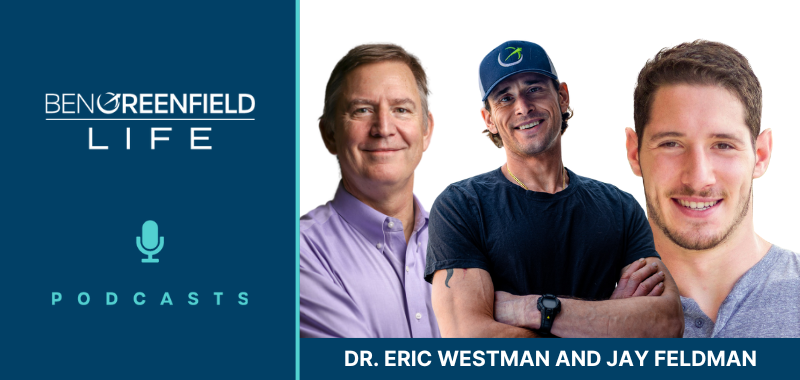
Ben Greenfield [00:00:45]: So I was, I was on Instagram last night and I saw a guy who's pretty prolific in the health and fitness sector post about this newfangled diet that lots of people seem to be talking about, the high sugar diet, where I think people are eating like gummy worms and candy and mostly high amounts of fructose, which is interesting because I wanted to get a couple guys on the show today to talk about this whole high-carb versus low-carb approach to diet and which might be superior for just human metabolic health and decreased all-cause mortality and body composition and some of the things that people look to for diet. But I think it's interesting at the same time, this high sugar diet just seems to be popping up everywhere. And to me, eating gummy bears out of a plastic bag sounds like maybe not the healthiest thing, but I could be wrong. So anyways, my guests on today's show who could probably speak to this much more intelligently than me, the first is Jay Feldman. He's been on the show before. He has a podcast called the Energy Balance Podcast. He has a degree in neuroscience and exercise physiology from the University of Miami, and he's a proponent of what he calls a bioenergetic approach to eating.

Ben Greenfield [00:01:58]: And I'll let him explain what that is. And my other guest is Dr. Eric Westman, who is a professor of medicine at Duke University, board certified in obesity medicine and internal medicine. He founded the Duke Keto Medicine Clinic. So he obviously is a proponent of a lower carbohydrate, or at least maybe a lower gummy bear intake than some people on social media might be consuming right now. And he also has edited the textbook Obesity: Evaluation and Treatment Essentials and helped to co write the New Atkins for a New You and Cholesterol Clarity and Keto Clarity, two books that I've actually read. So Jay, Eric, welcome to the show, fellas.

Jay Feldman [00:02:42]: Yeah, thanks for having me on.

Dr. Eric Westman [00:02:43]: Great to be here.

Ben Greenfield [00:02:46]: Yeah, yeah. And you know, obviously when we've got a three way show here, it's always kind of like a rock, paper, scissors, who goes first type of thing. But you know, I think I'd love to hear from you first, Jay, as far as how you describe just your approach to how you think a human would best be served in terms of their macronutrient composition and how they eat or how you eat or what you recommend.

Jay Feldman [00:03:11]: Yeah, sure. Well, thanks for the introduction. And yeah, as you mentioned, sugar diet is gaining a lot of traction. That's not me. So I just want to start off there that that's not what I'm going to be advocating for here today. But I also want to first thank you Dr. Westman for agreeing to come on here and I'm looking forward to our discussion. But yeah, so as far as my approach to health, obviously, well, you know a little bit about my background and my story.

Jay Feldman [00:03:37]: I was interested in health from a young age, you know, fitness, nutrition and just trying to be the best version of myself and be as healthy as possible. And so as a result I went through a number of different dietary iterations, everything from the kind of classic eat less, exercise more to whole grain standard American diet or kind of the more healthier low-fat vegetarian versions and then got interested more in low carb and paleo for several years. And this was around the time that I was in college, I was studying, you know, I was pre-med at the time. And this was a pivotal moment for me. It was something that allowed me to recognize that maybe some of the things I was reading in the textbooks was, you know, some of those things might have been a little outdated, maybe didn't have the full picture. And you know, I recognized that I wanted to shift gears and focus on a way of helping people that allows me to help people improve their health as opposed to manage symptoms, which is kind of the general orientation, which is when it came to at least what I was learning about in my pre med studies. And so I, I shift shifted gears at that point. And it was around that time, you know, several years into different low-carb variations, you know, ketogenic diets and intermittent fasting, cyclical ketogenic diets where you know, I, I was always looking for optimal health and didn't feel like I was quite there yet.

Jay Feldman [00:04:56]: There were still some nagging issues. And uh, at that point came across this idea called the bioenergetic approach to health, which centers on the idea that the energy that we produce in the mitochondria of our cells is really the primary determinant of our function and of our health. And as a result of that, one of the conclusions there was that consuming carbohydrates was actually going to be something that was really supportive of health.

Ben Greenfield [00:05:23]: And, and by, by the way, Jay, real quick, when you, when you say you came across that. Was this like a paper or a textbook or a certain person who you were following?

Jay Feldman [00:05:32]: Yeah, I mean, there are a number of different papers, books about this all the way dating back to, I mean, Albert St. Georgi, who is a Nobel prize winner, he wrote a book titled Bioenergetics. But I came across it through the work of Dr. Ray Pete, who kind of continued writing about it. He has some books, articles, and did some podcasts and things like that.

Ben Greenfield [00:05:53]: Okay, yeah, I've heard of him before. All right, so. And describe to me exactly what the bioenergetics approach is.

Jay Feldman [00:06:00]: Yeah, so it's the idea that when we're looking at health, the primary driver is our efficiency of energy production. When we have a lot of energy available, our organ systems are able to function at optimal capacity, whereas when we don't have as much energy or ATP available, we have to turn down the function of various organ systems, various functions. And that leads to degeneration. And we see this play out in all sorts of different disease processes, everything from neurodegenerative diseases to fatty liver disease, heart disease, diabetes, and autoimmune conditions on from there. And so that's the kind of broad stroke. And I started experimenting myself with a little bit of carbs very hesitantly and eventually really shifted my perspective in terms of what I think the optimal diet is with this view of health in mind. And so that's kind of landed me where I am now, which personally, I do consume a higher carb diet, mostly from sources like fruit juice, honey, root vegetables.

Jay Feldman [00:06:58]: And I also currently have a business called Jay Feldman Wellness, where I have a podcast, as you mentioned, and we help people, different programs, one-on-one coaching and things like that, and help people reverse various chronic health issues, symptoms. We help people with everything from insulin resistance to high blood pressure, autoimmune conditions, weight loss, hypothyroidism, and do that through this bioenergetic lens, which typically includes a decent amount of carbohydrates, although it goes beyond just what our macronutrient balance is.

Ben Greenfield [00:07:30]: Okay, got it. And before I hear from Dr. Westman, about his dietary approach. When you're talking about a low-energy state perhaps causing some amount of mitochondrial impairment, I would imagine, even though you just said you go beyond macronutrients, that what you're saying is that the best way to address that low energy approach is by providing more glucose to the cell.

Jay Feldman [00:07:52]: I would say that that's a necessary part of it. But yeah, I mean, our sleep quality is also going to have a major impact. Nutrients are going to have a major impact. Stress is going to have a major impact. So it's certainly a multifaceted approach. There's a ton of things that affect mitochondrial function, but having a diet that contains carbohydrates, I would say is necessary for optimal function there.

Ben Greenfield [00:08:15]: Okay, got it, got it. How about you, Eric? What's your approach here?

Dr. Eric Westman [00:08:19]: Well, so I learned from my patients in 1998. They did a diet that was out there, read a couple books. I didn't know much about nutrition. I'm an obesity medicine doctor now, but back then I was in internal medicine. We weren't really taught about weight loss or nutrition at all. So when two people lost over 50 pounds doing the Atkins Diet, I took notice and I asked what they did, how they learned it. And so I sought out doctors who were using it.

Dr. Eric Westman [00:08:54]: I met Dr. Atkins, met Dr. Eads, Dr. Rosedale, Dr. Bernstein, the doctors who kind of did low-carb from 1970 to 2000. And I thought, well, maybe I didn't know everything about nutrition. Maybe we could apply what I knew for drug development toward diet development. And so Dr.

Dr. Eric Westman [00:09:19]: Yancy and I at Duke, Dr. Volek at UConn now at Ohio State, he's a professor there, started doing research on low-carb diets, just telling people to reduce carbs, total carbs under 20 a day, eat normal food, meaning, you know, not in a box or a bag. Our first paper was studied and published in 2002, 50 people over six months in a peer reviewed journal. It was an uncontrolled trial, but that's my minimal level of evidence today that I say, well, to Jay, let me know, do you have a paper? I'm sure this is harsh, but I'm an academic. I can get away with it. I can be brutally honest so that the research is done now on low-carb diets. That's how you tell people how to do it. It's not just a concept.

Dr. Eric Westman [00:10:07]: You do it. Now, all over the world, there are meta-analyses of randomized controlled trials of low-carb diets versus low-fat diets. And that was the diet of the day thought to be the best diet for everyone. There was no science behind it. So now 2025, you know, I talk about a low-carb diet as therapeutic. I reverse diabetes, obesity, all those conditions. You can too, Jay, by using a different approach. It can be very simple for folks.

Dr. Eric Westman [00:10:39]: And now though, what's changed is there's a playing field that's open for studying the keto diet. This is a paper by Isabella Cooper, just a couple years old, where she took 10 people who are keto-adapted. She calls it euketonemia, meaning it's normal to have ketones in the blood and she gave them a SUK diet, meaning suppress ketone S-U-K diet.

Ben Greenfield [00:11:06]: Horrible name for a diet, but yeah, okay.

Dr. Eric Westman [00:11:09]: And looking at biomarkers, the average age is 30 years old. The biomarker in many of these women, they're all 10 women, many of them had babies on a keto diet. I think she was one of them as a study participant. After 21 days of the traditional UK 270, 267 grams of carbs per day, all the biomarkers, you know, went to hell in a hand basket. Even, you know, VEGF and all these inflammatory markers cancer doctors are trying to reduce. And so then she refed them on a euketonemic diet after 21 days and everything went back to their state of, you know, optimal diet. So basically the background says humans really haven't had carbs for up until recently and no sugar since a hundred years ago. We're supposed to be in ketosis.

Dr. Eric Westman [00:12:04]: And so she's basically measuring people in ketosis, perturbing the diet by adding carbs and their health looks worse. So, Jay, I don't know, I would like to see, you know, this is published in a peer-reviewed journal 2023. Isabella is in London and I just met Isabella at a meeting called the Public Health Collaboration in London. So what's fascinating is I don't believe there is one right diet, Ben. I think you match the diet to the metabolism of the individual. And now though that there's an animal study in rats or mice where you put them on keto, they live 10% longer. There's another animal study, they didn't live longer. I mean, that's all well and good, but we can be measuring the biomarkers of people right now and seeing year by year how things change.

Dr. Eric Westman [00:13:01]: And the other major problem we deal with today, not only diabetes, obesity that I can reverse obviously, is cardiovascular disease. And at long last there's a paper out with these people with extremely high LDL levels who have no coronary disease at all. And so either it's a different metabolic state or LDL is not the be all end all. So I guess, Jay, what I've learned over time is that there are a lot of ways to be healthy. And for those who say, yes, it's the best way, well, we do that in Durham. We have several programs, and every program says ours is the best way to get motivation, to get people. But I don't think we know, actually. And this is after, what, 30 years now, looking at different diets that come and go.

Dr. Eric Westman [00:13:55]: The one that hasn't come and gone is the low-carb one. It's just changed names.

Ben Greenfield [00:14:02]: Now, Jay, what do you think about what Eric was saying there about how glucose or sugar or carbohydrates are like a new phenomenon, if I'm understanding correctly what you're saying, Eric, or that they're not like the primary fuel that humans have kind of been adapted to for a very long time, perhaps up to the advent of, you know, more processed foods, agricultural revolution, et cetera?

Jay Feldman [00:14:25]: Sure. I mean, what we're talking about here is a different story, right? And one that's contrary to the one that we're typically told, this idea that having carbohydrates is the natural normal state. Anything that's a derivation from that is going to lead to some negative effect. Maybe the opposite is actually the case and we're looking at it all backward. Maybe we never really ate carbs. That was our natural state. So everything we should look at should be in reference to ketosis as the natural state, and eating carbs is the opposite. And that's a story.

Jay Feldman [00:14:53]: I prefer not to concern myself as much with stories that aren't directly something that we can directly point to in terms of research, there's—

Dr. Eric Westman [00:15:05]: —may I add, again, finally, it's 2025. My first paper is 2002. There's a, you may know, Herman Ponzer who talks about people eating all over different ways, and they're recruiting for subjects now. Finally—finally, I mean, got a call to my clinic. They're looking for people on a keto diet and they're going to be looking at radioisotope signals in the nails and in the hair of different diets. And so actually, Jay, I'm sorry to interrupt, but they might actually then be able to scientifically, on radioisotopes, figure out from old fossil material what people were eating then, based on a modern analysis, you know, a new technique. And I agree with you that I don't...

Dr. Eric Westman [00:15:54]: ...you know, I believe we can come up with an even better diet than the history of it. You know, I, I, I, I believe that we can come up with new ways to feed mitochondria and, and be healthy. So I, I'm kind of with you. The stories of, you know, people kind of bring up what they want, they cherry pick to take their position. Right?

Jay Feldman [00:16:17]: Right, yeah. And, and I think there's a number of different other lines of evidence we can look to that would suggest high amounts of carbohydrates in the diet. You know, historically, we can look at the location where humans have evolved through. In the case that we've been in tropical or subtropical regions for millions of years, it was only 30 to 40,000 years ago that we left. Of course, those are areas where we do have carbohydrate rich foods available year round. You know, there's some suggestion that the fruits that were available at that point didn't actually have large amounts of carbohydrates, but there's a number of fruits that, that did and were available. And there's a number of different lines of evidence that we could go to looking at other apes and their diets during those times, other hominids during those times.

Dr. Eric Westman [00:16:56]: No, no, no, no, I can, let me help you with that one. We don't have the intestines of a gorilla or an ape.

Jay Feldman [00:17:03]: I'm not suggesting that. What I'm suggesting is, is that if we're going to say carbs weren't available then, but we see other apes that were eating large amounts of carbs that we can say confidently, then I think it would be, I think that that would conflate, uh, conflict with the argument that there weren't carbs available for us to be eating. Doesn't necessarily mean we ate them. Just saying that there would have been carbohydrate availability at that time. But, you know, looking at that paper, for example, you said it was Isabella. I didn't catch her last name. Where we saw, you know, Cooper.

Jay Feldman [00:17:32]: Great. Where we saw an increase in inflammatory markers following, you know, going from a ketogenic diet to adding carbohydrates in. You know, of course we have parallel effects that we see when going from a higher-carb diet to a low-carb diet. And a lot of that is pointed to as an adaptation period. Right. The body's utilizing fats, the hormonal state or utilizing carbs. Hormonal states shifted toward that. So of course we'll see a major elevation in stress hormones like cortisol and glucagon when we shift into low-carb.

Jay Feldman [00:17:58]: We do see increased lipid peroxides. In various studies looking at people on low-carb diets, we see increased methylglyoxal. So we do see increases in the same metabolic or inflammatory markers that we want to be concerned about in a transitionary period, at the very least, going from a higher-carb to a lower-carb diet. So I think, as you were pointing out, we want to look at longer term what those effects are.

Dr. Eric Westman [00:18:18]: Another way to say that is if you started people on an exercise program for 21 days and they haven't exercised, they're going to feel like they're not going to feel well as they get started. So that adaptation period, sure, but it's just the idea that perhaps turning things upside down and studying the state of a human of euketonemia, meaning ketones should be around is a, that's a, it was just two years ago when the first paper on that came out. So I'm encouraged that at least at the research level there's an openness to consider other approaches.

Ben Greenfield [00:18:58]: You know, when I, when I was having a conversation with you a few months ago, Jay, I, I recall you describing almost how a higher fat intake could somehow—I don't know if you use the word damage mitochondria—but that the processing of fats for energy was somehow inferior to those of carbs from either a, a health or an energetic standpoint. Can, can you describe to Eric, like how you look at that, how you look at the burning of fats versus carbs when it comes to mitochondrial health?

Jay Feldman [00:19:31]: Yeah, absolutely. And this is where some of my concerns with low carb diets begin, is looking at what's going on in terms of the mitochondrial effects and the capacity for energy production. And so to kind of look at this in a broader sense... again, talking about stories which I think looking at biology that can help provide us some context for looking at a system. I would say that we see a couple of different scenarios where we are eating—where our bodies are utilizing ketones and fats as their primary fuels instead of carbohydrates. We know if we're eating a carbohydrate-containing diet, a large portion of, of energy needs will be met with carbs. If we're either not eating anything at all, if we're fasting or starving, we'll start to produce ketones and utilize fat as a fuel. One of the...

Jay Feldman [00:20:14]: ... so you know, in starvation this is a state that we see, and we also see it if we're eating a low-carbohydrate diet, a diet devoid of carbohydrates. Now, when we're in this situation, when we're in this state, let's use starvation as the example. The vast majority of the body is going to be utilizing fat as a fuel, except for particular areas that either need to still utilize glucose or can utilize ketones. And the nervous system is one of those primary areas where it can't actually use fat in any significant amount as a fuel, but instead can use glucose and can use ketones as a fuel. And so the body shifts toward producing ketones, still producing some glucose, if there's none in the diet to provide some fuel where it's needed, and then also mostly utilizing fats as a fuel in the rest of the body. And what I would basically argue here is that I think ketones are generally fine as a fuel relative to carbs. I still think that glucose is—edges it out, and I'll explain why. But my primary issue with this sort of approach is that I would argue that fats are utilized in a far less efficient way in the mitochondria compared to carbohydrates.

Jay Feldman [00:21:17]: And this is actually the reason why our brains can't utilize fat as a fuel. They have to utilize glucose or ketones as the primary fuels because of the inefficiency in terms of energy production from fat. And so to dig into those a little bit, the—when we look at glucose versus fat oxidation, there's really one primary difference because the rest is all the same, right? In terms of glucose, we have glycolysis leading to the production of pyruvate that enters, you know, the Krebs cycle as acetyl-CoA. And then we have the Krebs cycle and electron transport chain. When we have fat oxidation, we undergo what's called beta oxidation, which converts the fats, you know, cuts them up into the two carbon molecules that become acetyl-CoA, and then that enters the Krebs cycle and the electron transport chain. And so the main differences come in before the Krebs cycle in terms of glycolysis versus beta oxidation. And one of the primary differences is the amount of NADH versus FADH2 that are produced, these electron carriers that bring the electrons to the electron transport chain, where we're producing the vast majority of the ATP that we produce.

Jay Feldman [00:22:19]: And if we're to use a typical fat, let's use palmitate as an examplea 16-carbon fat and look at the amount of NADH versus FADH 2 it produces and then do the same with glucose. There's a pretty big difference. When we look at the ratio between FADH2 and NADH production with glucose, we're at about a 0.2 ratio. With palmitate, with the 16-carbon saturated fat, we have a 250% increase in this ratio to nearly 0.5. It's like 0.48, .49. And as a result of this difference in FADH2 to NADH ratio, there's a difference in function at the electron transport chain. What we see is when there's increased FADH2 dropping off electrons at complex 2, there's greater competition for ubiquinol to pick up those electrons and carry them on throughout the rest of the electron transport chain.

Jay Feldman [00:23:08]: As a result, we see this buildup of electrons there and we see what's called reverse electron transport, where the ubiquinone begins to actually drop the electrons backward. The process of producing energy at the electron transport chain starts to reverse. We start to drop those electrons back to complex one and they leave as reactive oxygen species. So we see an increase in reactive oxygen species at the electron transport chain as a result of this difference in ratio. There's a couple of other differences that then also happen because of this backup of electrons at the electron transport chain. We also end up seeing a lower NAD+ to NADH ratio on, from when we're utilizing fat as a fuel. And this, then, has other kind of upstream effects. It slows down various enzymes in the citric acid cycle, including the rate-limiting step of isocitrate dehydrogenase as well as others throughout that cycle.

Jay Feldman [00:24:01]: We also have a similar effect of the reactive oxygen species, where in general increased oxidative stress and ROS has been shown to inhibit certain steps of the certain enzymes in the Krebs cycle, including aconitase, which is very sensitive to it. Also, when the level of reactive oxygen species builds up, we start to see an effect called uncoupling, where essentially the cell is recognizing that there's a lot of oxidative stress. This is potentially damaging. This is what damages proteins, nucleic acids, obviously very concerning. And so it increases the—it brings the uncoupling proteins to the electron transport chain to dissipate that gradient and prevent the continued production of reactive oxygen species. There's one other difference that's worth mentioning here, which is that when we oxidize glucose as a fuel, we produce 50% more carbon dioxide than when we're utilizing fat as a fuel. Carbon dioxide also provides greater protection against reactive oxygen species and reactive nitrogen species and allows for efficient oxygenation inside the cell via the Bohr effect.

Jay Feldman [00:25:01]: So as a result of these different effects, what we eventually get to is that there's less efficient energy production with palmitate compared to glucose or any fatty acid. Compared to glucose, we see a higher reactive oxygen species to ATP ratio in terms of energy production. And I wouldn't argue that this is universally a problem. I actually think this is totally fine, in the case of low energy or low metabolic demands, for example, our muscles at rest. You know, this is a situation where the muscles are not particularly active. Obviously they're still producing a bit of energy, but they don't have very high energy needs. And so to produce energy at that slower rate with a bit more oxidative stress that can be quenched isn't such a big deal. When we start to get into a scenario with higher metabolic needs, this is where we start to accumulate the oxidative stress and start to cause some downstream negative effects as a result.

Jay Feldman [00:25:48]: And, and in order to deal with that, we have to activate various defensive pathways, but in the process we also activate the stress hormones, which we can come back to glucagon really being the primary one. But we'll also see an increased propensity toward increases in adrenaline and cortisol, and we then see downstream effects of those hormones as well.

Ben Greenfield [00:26:09]: Quick question—I'm sure Eric has questions, but I guess my number one question, when we're looking at increased production of reactive oxygen species, altered CO2 pathways, and inefficient energy production, have you seen in research that to be clinically meaningful?

Jay Feldman [00:26:28]: So that's, it's a great question and one that isn't generally well-answered in the research because we're not normally taking somebody on a ketogenic diet for a period of time, pulling out their mitochondria and looking to see what's going on, or zooming in on them and seeing what's going on. There are, though, some down, some of those downstream effects that I mentioned that we can look at that do suggest this is happening. And we do see it in animal models. We do see it in mammalian cells when they're oxidizing fat versus carbohydrates. So in those cases we can see it, but in terms of looking at it in a, like in vivo human, we would have to look at downstream effects. And we do see elevated glucagon on a chronic sense or in a chronic basis. And as a result, we also see lower T3 levels on these longer-term low carb diets. Both of those can be driven, or I would say are driven by this underlying state that we're seeing biochemically increasing the stress hormones on a chronic basis, which is not the only factor.

Jay Feldman [00:27:24]: There's also just the absence of glucose and needing to drive the production of gluconeogenesis, which also requires these stress hormones. But as a result we see reduced conversion of T4 to T3. And that's, you know, these are some things that we are able to see. So it's one of those things where I would love to have all of the intermediate steps shown very, very clearly in the research, but instead we have to look at bits and pieces that we do see.

Ben Greenfield [00:27:44]: Okay, got it. Eric, what do you think of Jay's idea about how the mitochondria, particularly the electron transport chain, responds to...

Dr. Eric Westman [00:27:51]: .... well, I'm reminded of some years ago there was a book called the Zone Diet. Remember that?

Ben Greenfield [00:27:58]: Sure, yeah, yeah, yeah. I never followed it, but I remember the name. I think, I think it sold a lot of copies.

Dr. Eric Westman [00:28:04]: 40-30-30: carbs, protein, fat. And I went up to Dr. Sears, Barry Sears, who was pushing it to sell his bars at the time. I said, "How do you know you're in the zone?" And he said, "Well, the eicosanoids are here." And I said, "well, to my knowledge, these are fleeting things. They come in, in the blood and then they're gone. So they're really hard to measure, aren't they?" So...

Dr. Eric Westman [00:28:27]: .... well, we haven't measured them, you know that they've just called it The Zone. You know, it's—but so Jay, have any of these things actually been measured? So there's a theory, there's the biochemistry, but I want to know if there's actually—is it beyond theory? Because there's so many adaptations and then what cell are we talking about? So you toggle between brain and then muscle and it's like this is so different. So why does it take insulin to shepherd the glucose into a muscle cell? Not the brain, the brain, it's like a free pass to get in the red cells, the glucose, free pass to get in because they need it. It takes insulin to get into the muscle cell. To me, that insulin and the glute receptor, glucose receptor, it's a—it's a lock. It's to keep the glucose out of the muscle cell.

Dr. Eric Westman [00:29:31]: Because when you don't have glucose in blocking the fat going to the TCA citric acid cycle, in fact, glucose too much glycolysis through Malonyl-CoA stops Acetyl-CoA from going into glucose into the TCA cycle. So too much glucose in the cell stops the fat burning. So in a disease called McCardell, which is a glycogen storage disease of the muscle, the people themselves stopped eating carbs. And they went from walking 50ft and having to stop to walking up a mountain because they shifted their body from having to use glucose muscle more specifically to allowing the fat to get in the cell. And the fat loves the cell—muscle cells love to run on fat. I mean, at a, at a macro level here. So have you measured all this concerning reactive oxidation? And, because the other thing that came up, I was just at a meeting of the glycation of the proteins intracellularly from too much glucose in the blood—that might be pre-diabetes, might be okay in a clinical situation, but the cells inside get glycated.

Dr. Eric Westman [00:30:44]: If there's too much intracellular proteins get glycated and then don't function as well. I know I threw a lot out at you, but has it ever been measured? I mean, so can you go into the cell and say, oh yeah, they're in a human and this person, there's too much NADPH. When I had the biochemistry map on my wall for about 10 years, I don't have anymore. But someone came in and said to me, you know, a lot of that's just from animal models and mice. I said, "What?" You know, the biochemistry pathways are—a lot of it is not from human science, which to me was distressing. I'm a flagrantly human-centric researcher.

Jay Feldman [00:31:32]: Sure, and so there's a number of things we can look to here. A) Yes, we can look at human cells that are taken outside the body. Obviously it's much harder to study them while they're inside without just looking at various proxy markers, which I'll talk about as well.

Dr. Eric Westman [00:31:47]: Well, you could take a biopsy of a human. That, that's something we medical doctors can do.

Jay Feldman [00:31:54]: I don't, but you can. Right, Jeff—sure. And maybe we'll, we'll talk about some of Jeff Volek's work here in a moment, but yeah. Are you asking as to whether you take a muscle, you know, myocyte cardiomyocyte, something like that, and provide it palmitate versus glucose, if you're going to see this difference in reactive oxygen species production and NAD, to NADH ratio?

Dr. Eric Westman [00:32:19]: Like putting all the theory into practice.

Jay Feldman [00:32:27]: Yeah, yeah, absolutely. So here's a—I'll just read a quote from a paper. This is a paper titled Palmitate induced Changes in energy demand cause reallocation of ATP supply in rat and human skeletal muscle cells. They state "Probing the bioenergetics of rat and human myoblasts in real time. We show here that the saturated fat fatty acid palmitate lowers the rate and coupling efficiency of oxidative phosphorylation and under conditions it causes insulin resistance."

Dr. Eric Westman [00:32:53]: What was the model or what was the methodology? Is it a keto-adapted human?

Jay Feldman [00:33:00]: This was in...

Ben Greenfield [00:33:02]: ...and while he's looking at the methodology, the reason that you're asking whether it was in a keto-adapted human, Eric, I'm assuming is because there's a big difference between a model that has perhaps had a substrate utilization change over the past 12 months versus six weeks versus not at all. And I only know this because, full disclosure, I was part of the Jeff Volek Faster study where I followed 12 months strict keto diet and then because I worked in an exercise fizz lab, I was able to monitor the changes in my respiratory quotient and fat burning. So I know there's a difference. But what about this paper, Jay?

Jay Feldman [00:33:40]: Yeah, I'm not seeing, just briefly looking at the methods, I'm not seeing, it's not specifying whether the human cells that it was getting are coming from people who are on low carb diets, but—

Dr. Eric Westman [00:33:48]: —well just is it clinically relevant?

Jay Feldman [00:33:52]: There would have to be evidence for it to be clinically relevant, right? So if we see, let's say we see a rat that is on a low-carb ketogenic diet, we take their skeletal muscle cells out, we see this very clearly. We see and I can go through some other markers that we see that are very clearly elevated in, in rodent models on a low carb diet.

Dr. Eric Westman [00:34:08]: I can't. Those don't count. Those aren't currency of the realm.

Jay Feldman [00:34:13]: So we, we would start there, right? That's normally where research starts because we don't want to test something that could be dangerous on humans, then we would—do you disagree with that?

Dr. Eric Westman [00:34:22]: That that's for drugs, that that's part of the FDA rule, is that you start in animals which is really, it's corrupt because we're not animals. And so yeah, no, actually clinical epidemiologists, so many things we observe in the clinical practice become practice like going to penicillin is the best—so no, I don't think we have to study everything in mice. So Finney, Steve Finney talks, you know, for hours about how the brain of the animal is critical for the ketone metabolism and because of the rodent situation, it doesn't apply. But you can use that. But then sure, let's go to further. What was the human case there? Sorry.

Jay Feldman [00:35:11]: Well, the first thing I was going to say here is there are important physiological differences between species. I think we both agree with that. And obviously we're not rats. There's very important differences between us and rats. However, there's also very important overlaps. And when we're looking at the percentage of overlappers versus the percentage of difference, there's far more overlap. This is why we use rodent models to study not only medications, but various interventions. I'm not saying that this means that this will lead to the exact same outcome in humans.

Dr. Eric Westman [00:35:36]: Well, but, so let me, let me give you my. I'm talking to a human in a clinic. They're paying me or insurance is paying me to give them advice that has been evaluated and vetted to a certain level. So I'm just bringing that criteria to a research level discussion where I wouldn't talk about this happened in mice to my patient and say, therefore you should do it. Do you understand that perspective?

Jay Feldman [00:36:02]: Of course. And that's not what I'm saying. I'm saying that we start by looking at that research and then we look at human research, which is what I was getting to.

Ben Greenfield [00:36:08]: All right, let's hear the human stuff. Keep going.

Jay Feldman [00:36:12]: Sure. Well, so as I, as I was getting to. We see this play out in rodent models very clearly. We then see the same thing happen in human cells, right? So we can, at that point, it sounds like, Dr. Westman, you were saying it's not necessarily a difference between rat and human physiology, but rather instead the human cells. Since this wasn't coming from a human on a low-carb diet, something would have been different biochemically, which I'd be curious to know if there's anything that you would point to that would be different biochemically going on in the mitochondria in terms of a muscle cell from a human that's on a keto diet versus one that's not.

Jay Feldman [00:36:44]: But there are other lines of evidence here that I'd like to just touch on first and then maybe we'll, we'll come back to that, if that's all right. So looking at, I mean, I guess there's a few different lines of evidence that we can look at here. One that we can look at is, is humans who have diabetes and looking at the, what's going on in terms of their mitochondria, in terms of fat utilization versus carb utilization. And what we actually see there very clearly is, is that as we see elevated fat utilization, elevated free fatty acids, we see not only impaired energy production and increased reactive oxygen species, we also see an interference with glucose metabolism. So we can go through some of those studies. We could also look at the same thing going on in the heart in people with type 2 diabetes, where we see that there's actually a shift, you know, in, in a healthy heart, you know, someone who doesn't have insulin resistance, we see that they're typically relying largely on fat. 70 to 90% of those energy needs are being met by fat, whereas glucose is meeting about 10 to 30%. But we.

Jay Feldman [00:37:47]: What we actually see is that in heart disease, heart failure and type 2 diabetes, there's impaired mitochondrial respiration in the heart and an increased reliance on fat for energy, while glucose metabolism is reduced by as much as 40%. And we see a direct consequence there in terms of increased, increased oxidative stress and impaired mitochondrial function. But there was something else you had asked about, which was talking about some of those maybe downstream effects that we might see that would tell us that this is going on. Because it's not something that is studied very often in terms of someone who's on a ketogenic diet, right, as you mentioned, maybe there's a difference, right? Obviously we want to acknowledge that possibility, that maybe there's some sort of biochemical change. Obviously we know there's changes in enzyme concentrations, but that alone, I don't think would account for the difference in reactive oxygen species between a cell from a human on a low-carb diet and a higher-carb diet. But we can look at studies. What's that?

Dr. Eric Westman [00:38:48]: Where is your intuition coming from? I mean, that's the amazing thing about science is until you study it, I didn't know anything about a keto diet or Atkins before someone put it in my face. And it—so I, I guess I'm still—why would you not think that would be different enough to have different effects?

Jay Feldman [00:39:10]: Because there are inherent biochemical pathways that don't, that don't change when someone's on a low-carb diet, there's no getting around a difference in FADH2 and NADH ratio.

Dr. Eric Westman [00:39:19]: There's no changes, no question.

Jay Feldman [00:39:21]: The expression of what—well, let me just, let me just touch on these last two points, and then I'd really like to hear what you're talking about in terms of the difference in expression. So two things I would want to point to here. One is that we know as an example of the inefficiency of fat metabolism relative to glucose or ketones, even in someone who is fat-adapted on a low-carb, ketogenic diet, they're not using a large proportion of fuel in the brain.

Dr. Eric Westman [00:39:46]: You're giving me the answer before you give me the data. Wait a second. What's the evidence that it's less efficient?

Jay Feldman [00:39:53]: Well, I went through that evidence biochemically. I'm also saying one point of evidence there—

Dr. Eric Westman [00:39:58]: —but it hasn't been measured. You can't—

Ben Greenfield [00:40:01]: I think what Eric is asking is—Jay, I believe you just said we know, referring to the altered fat utilization in the brain, I think you were referring to—are you asking Eric when you are replying to that, how we know?

Dr. Eric Westman [00:40:18]: Yeah, well, I thought we were still on diabetes.

Jay Feldman [00:40:22]: We can go back to diabetes, too. I mean, obviously we're jumping around a bit. What I was saying that we know is that there's no increase in fat utilization in the brain, in a local—

Dr. Eric Westman [00:40:29]: —when you say we know. And this was taught to me some years ago by a professor who met with me. He didn't put his paper, his name on the paper I wrote because he had been vilified in the press as a basic scientist. But he told me it had to do with carbs as an essential nutrient. They are not an essential nutrient. So don't get into that discussion with me because—but Professor Al Harper, rest his soul, said under the conditions studied should be at the end of every sentence of every paper. So when you say we know, it's under the conditions studied.

Dr. Eric Westman [00:41:11]: And I learned that the hard way when I go to a meeting and I do some research and then someone gets up and says, have you measured, have you studied any Asian people? And I look at it, it's a sea of Asian people, you know, so under the condition study, and what I'm trying to just say is that things are different. So I reverse type 2 diabetes by having people eat fat, no carbs, and they burn fat because they're not burning the sugar, they're not burning the carbohydrates. I think what we're talking about is a similar—it's an accelerator, it's a brake. And when you cut all the carbs out. Actually, Murashiga did a system-wide look at the fuel of the heart. And in the abstract he wrote, we were surprised to find the heart muscle didn't use much glucose. All he had to do was talk to professors of medicine who put ketones and fat and sugar in the heart muscle petri dish and the ketones get sucked up by the heart first, then the fat and the sugars just kind of misses heart and muscle itself.

Dr. Eric Westman [00:42:23]: Now—at Duke, now, there's a researcher who's eating ketones for heart failure. So it's interesting because this is a paradigm view. When you said, and it's only X percent sugar, in my mind, I went, that was too much sugar. Because the fat consumed by the heart should be 90%. I mean, it, it wants fat. The fat is—

Ben Greenfield [00:42:49]: —are you, are you saying that basically, like some low-carb diet studies aren't low-carb enough to see the metabolic effects?

Dr. Eric Westman [00:42:55]: Apples and oranges. Yeah.

Ben Greenfield [00:42:58]: Yeah, okay.

Dr. Eric Westman [00:42:58]: Well, and—but it's okay. I, I grew up in an era where everyone ate carbs and we eat carbs and it's normal and all that. And it doesn't have to be normal. And I'm afraid either the adaptation phase, if it's a month, or even in the movie Cereal Killer, Sami Inkinen and his wife took six months to fully keto-adapt before they went into a rowboat and rowed from San Francisco to Hawaii.

Dr. Eric Westman [00:43:24]: They consulted Steve Finney, who said, we're not going to take anyone's gas. We're going to put you in a gym and see your fat burning and maximize it before we put you in a rowboat. So the short term things really, I think we're in agreement, don't tell us all that much. But I didn't come out, I didn't make what I do. I just studied it. And the studies have been kind of on pause for a long time.

Dr. Eric Westman [00:43:51]: So just stay tuned. I'd like your take on the Faster study, although that's a different population. So once you're in the clinic population, I have to say that a low-carb, high-fat diet reverses diabetes. I don't care about the energetics you're talking about. I don't—it doesn't matter to me in the short run. I reverse it. I take people off...

Dr. Eric Westman [00:44:13]: My record is 180 units of insulin in two days, 600 units in eight weeks. We usually make 20 units of insulin. So if you don't believe this, you come to my office. I'm happy to have visitors. And the interesting—so you're coming at it at a certain paradigm view that actually may look different when you—

Ben Greenfield [00:44:36]: —I don't know whether one of you guys have the answer to this question. And by the way, I talked to Sami after that rowboatexpedition. I think he described it as very intense marriage counseling. The idea of the reactive oxygen species that you were referring to Jay: It's my understanding that ketones kind of have, like, an antioxidative or anti-inflammatory effect. Is there possibly some pathway via which fats may cause via that uncoupling that you described, Jay, the increase in reactive oxygen species, but then ketones are, for lack of a better scientific term, mopping up the mess?

Jay Feldman [00:45:12]: Well, I would say that these are generally happening in different scenarios, different places, right? So in a brain that's utilizing ketones, we're not seeing the fat there versus in a muscle that's utilizing fat, we're generally not seeing the ketones there. I would actually say that ketones also create some oxidative stress in the brain, based on certain studies that we can go through as well, and then create antioxidant defense responses in response to that, which we can discuss whether that's a good thing or a bad thing. But just before that, I think maybe there's a bit of a misconception here. And I just want to make it clear. I'm not saying that I don't think there can be incredible benefits from a low-carb diet.

Jay Feldman [00:45:48]: I've seen that many times. And a lot of the people I work with are people who have gotten a lot of those benefits or people that are very excited or were very excited at different points about low carb diets, ketogenic diets, carnivore diets, and had a lot of benefits, but over time started to see quite a bit of negatives crop up. But what I'm generally trying to get at here is I think that there are certain aspects of the diet or the approach that are very beneficial, but there's also an underlying aspect which is inherently stressful and over time that stress is going to accumulate. And so a lot of the people who I'm working with, I know, Dr. Westman, you're focused very much on weight loss and then type 2 diabetes, insulin-resistant, which, insulin resistance, which is fantastic. And I, I work with that population as well. But my focus isn't as much on those things as much as it is on overall health. And ideally seeing or looking to see improvements in insulin resistance and weight as a byproduct of that.

Jay Feldman [00:46:37]: And so a lot of people who are coming to me, they're dealing with over time on these low carb diets, they're seeing increases in anxiety, trouble sleeping, decreases in reproductive hormones, you know, on the male side, testosterone on the female side, interruptions in cycles, maybe low progesterone. Sometimes we're also seeing weight regain, we're seeing blood sugar start to come back up again after they come down initially, or maybe it was fine to start and continue to creep up. And we're seeing A1C follow. So those are the kinds of effects that I'm seeing and seeing these mechanisms in the research and outcomes in the research that are also pointing in that same direction. So I just wanted to make that clear. I'm not saying I don't think you can see great benefits in terms of insulin resistance from a low-carb diet.

Dr. Eric Westman [00:47:15]: What outcomes? What are you referring to?

Jay Feldman [00:47:17]: Oh, things like reduced T4 to T3 conversion.

Dr. Eric Westman [00:47:21]: So, I know, so this paper by Cooper basically shows that if you take people in ketosis and you feed them carbs, their T3 goes down, their function is fine. Finney also talks about either goes down or up.

Jay Feldman [00:47:34]: Sorry, Dr. Westman.

Dr. Eric Westman [00:47:36]: T3 goes down when you feed, it goes up when you feed. Who cares? That's what I mean. So let me—Finney taught me years ago—we test the blood because it's convenient, not that it tells us what's going on inside the cells. And so when you see, when you see an outcome, I want to know, what do you mean a blood tetany, the blood markers?

Dr. Eric Westman [00:48:02]: So we basically compare the blood to unhealthy Americans now who eat carbs. I want the levels to be different in some ways. And so, and then the idea that just in human nature, it's hard to get people to stay on a keto diet. Well, you're not, you know, pulling out all the bells and whistles like you do when you talk a vegan diet. What if, what if you said you're going to live longer, you're going to, you're going to save the planet, you're going to do all the—

Dr. Eric Westman [00:48:33]: No, most people. In fact, one of my colleagues says, "Yeah, no one can do keto here, take a medicine." So if we knew that it was better, we'd teach it in a different way and help people stay on it. In fact, I've learned a method of helping to substitute for cauliflower rice, for chaffles, some waffle with cheese and eggs for all the—anyway, so I agree with you, there are a lot of ways to be healthy. But— so why did you say people have to eat carbs? That's what I'm—and I was hoping that you would say, when Ben asked the question, that it's possible, you know, do you have a crystal ball? Really? Like, that...

Jay Feldman [00:49:14]: ...what, Sorry?

Dr. Eric Westman [00:49:15]: That some study will show that what you're saying is—I forget your question, Ben. I Think you said, isn't it possible that...

Ben Greenfield [00:49:24]: ... oh, I was saying whether or not it's possible that ketones might infer some kind of a protective effect on reactive oxygen species generation.

Dr. Eric Westman [00:49:31]: So why not just say, Jay, it's possible, it just hasn't been proven?

Jay Feldman [00:49:36]: I. I didn't say it wasn't possible. But of course the question would be, is it, is there any physiological likelihood of it, right? Are we seeing both ketones and fatty acids in the brain, right? Is there fatty acid metabolism in the brain? Creative—creating oxidative stress where ketones would then mop it up and the opposite? Are we seeing a lot of ketone utilization in the muscles? If so, absolutely. I would say that's not only possible, it could be likely. But if that's not the case, why, why create a story that doesn't have any basis in physiology?

Dr. Eric Westman [00:50:01]: The story I'm teaching now is everyone goes into ketosis if they don't eat for two or three days. How can that be bad for you? In fact, I woke up one day, okay, I'm getting older, didn't have enough sleep or had too much sleep. My phone told me I'm low on energy. You want me to go in self-destruct mode? It didn't say that. It just said, do you want me to go into safe mode? Safe mode: You don't check the emails as frequently, the light goes down on the dimmer. What would be evolutionarily conservative about ketosis and fat burning? If we all do it and when there's no food, and you and me, we're such carb eaters and have grown up in an era where everyone has eaten carbs, we're too blind to even see. Nope, not Isabella.

Dr. Eric Westman [00:50:59]: She wrote, basically, you know, you're supposed to be in ketosis. Babies are born in ketosis. So, what—I don't understand the concern, other than people like carbs. I get it, fine, you know, but that people liked to smoke. I used to help people quit smoking for 10 years. We helped develop the nicotine patch and the Chantix pill and all that. So I guess my rant is, why then do we go into ketosis after two or three days of not eating? You call it starvation.

Dr. Eric Westman [00:51:36]: I call it, you know, that's the way humans evolved. We didn't have food, like now as a commodity.

Jay Feldman [00:51:43]: Yeah, I love the question. I love the question. And so in terms of that question of like, if we can go, if we don't eat for a few days and we go into ketosis, how can that be bad? First, I'm going to provide a parallel example, and then I'm going to come back and explain why I do think it's bad. So in terms of the parallel example, I would say if we are stressed, we produce cortisol. Is that bad? Well, on one hand, no, it's fantastic that we have cortisol. If we didn't have cortisol, we'd be in a lot of trouble. If we went and exercised and we didn't have cortisol, we'd be in a lot of trouble. Cortisol is a very necessary hormone.

Jay Feldman [00:52:11]: It provides a lot of good function. That's why it exists. That's why we utilize it. But that doesn't mean that excessive amounts of cortisol are good. It doesn't mean things that drive cortisol are inherently good. It doesn't mean inherently doing things that are all going to increase cortisol for an extended period of time are beneficial. And so that would be like a parallel question, right?

Dr. Eric Westman [00:52:30]: So in some cultures, some cultures where they just ate meat and never got carbs, how did they survive?

Jay Feldman [00:52:37]: Well, and that's another good question, right? Because the question is survival versus thriving versus optimal health. And so when it comes to, I mean, obviously they're producing carbs from gluconeogenesis from the protein, they're also going to be producing a lot of ketones and fat. But what I would say is that when we, you know, our bodies are really intelligent, and so when they are starving for a few days, a week, multiple weeks, there are certain physiological effects. Or what I would argue biologically is that one of those effects is to turn down the metabolic rate so we can continue to survive as long as possible without food. If we don't do that, we run out of fuel faster and we die.

Dr. Eric Westman [00:53:11]: Whoa, whoa, whoa, hang on. You just said something that stop—lowering the metabolic rate lets us live as long as possible—stop that without food. If you look at a graph of the animals that have the lowest metabolic rate, they live the longest.

Jay Feldman [00:53:27]: Yeah. And interestingly, if you look within the species, if you look within the species that the animals that have the lowest metabolic rate, they live the shortest and age the fastest, there's actually a confounding variable there which has to do with the membrane saturation of the like inside the mitochondria, actually. This is called the membrane pacemaker theory of aging. And it explains why we do see lower metabolic rate and longer lifespan when we look across species, but not within species, which is a fascinating theory to look into.

Dr. Eric Westman [00:53:52]: Among carb eaters?

Jay Feldman [00:53:54]: Among animals, looking at, yeah, so their natural diet.

Dr. Eric Westman [00:54:00]: Not humans?

Jay Feldman [00:54:02]: Well, obviously a much more challenging thing to do in humans. But when you see it across all species, at the very least, I think it would. If you're going to use that as your evidence and say across all species, low metabolic rate equals lifespan. And then we say, well, actually within species, across all species, like if we look within each species, that's not the case. I think that challenges that as a good evidence for what you're suggesting.

Ben Greenfield [00:54:22]: Just real quick here, Jay, what you're saying is potentially a higher metabolic rate induced by higher carbohydrate consumption could not reduce, but would rather improve mortality.

Jay Feldman [00:54:32]: That's the far extension. But when we're just talking about the idea of, of low metabolic rate and lifespan, the association there has to do with an inefficiency of mitochondrial respiration that occurs when there's higher unsaturated fats in the membrane of the mitochondria. And so as a result of that, you see a higher metabolic rate in shorter-lived species because they aren't producing ATP as effectively, they produce a lot more reactive oxygen species, cause a lot of peroxidative damage. If you look within the species, would that have generally the same rate of unsaturation of the membranes? Because that's conserved within a species. And you actually see that the higher metabolic rate lives longer. So this confounding variable is how efficiently we're producing energy due to the unsaturation index of the membranes. And so this is something that actually really flipped a lot of those ideas on their head.

Jay Feldman [00:55:18]: This idea that, you know, fast metabolic rate leads to quicker aging and shorter lifespan. But some of this other data has since come about that has flipped that on its head. And there's a number of other lines of evidence that have, have also demonstrated that.

Dr. Eric Westman [00:55:34]: This is fascinating. And there's so many different situations, compartmental, that I think will probably be different. If you, if you say what we know, well, you got to study those who don't eat carbs for, you know, over a year. It may be different. And I, I bet those studies haven't been done. They need to be done. So, and I don't have a crystal ball, I don't know that'll be better or worse. But there are people who have already decided, for whatever reason not to eat carbs if they're sugar addicts.

Dr. Eric Westman [00:56:06]: Actually, the damage of you telling people that they need carbs is that they're going to go back to the unhealthy sugar-addictive carbs. So that is a certain subpopulation. And I would say that there's a clinical world and then there's a non-clinical—so let me get into the what am I doing? Or what, what is Isabella Cooper doing? I'm not yet convinced that I need to be in ketosis. I, I, Jeff Volek has been, I mean, I, I ask him every year, "Have you learned anything that should tell me to stop my patients from doing a low-carb keto diet?" And he says, "No, in fact it, it looks better and better and better." So I don't, I, it may be a paradigm view, apples and oranges, that you're just, these researchers are trying to bolster their own like echo chamber, the bias that you get into because the clinical world, this is totally disruptive of the cholesterol story, the idea that you need medicine for diabetes. No, you don't.

Dr. Eric Westman [00:57:14]: And so what you're saying is that the low carb diet may be therapeutic to get you to reverse this diabetes, but then you should shift to eating carbs. The problem with that, if that's what you're arguing for the sake of argument, is that some people can't moderate it and in today's toxic environment they're just going to balloon up to where they were. And so there's a nuance in a clinical population. But I sure would like to see all this mitochondrial debate under the context of low-carb keto circumstances.

Ben Greenfield [00:57:50]: Yeah, guys, just so you know, we're getting super close to running out of time on this and there's a lot of avenues we haven't yet gotten into. I want to throw one thing out there and then I would love to hear kind of some, some final comments on you guys in terms of where you stand with your overall dietary recommendations, if anything at all has changed the way you'd phrase it based on this discussion. But you know, I think one important thing I want to point out here also just being a part of that Faster study where we're all exercising, I think that someone's goals, someone's physical activity, you know, someone's level of exercise plays into this equation quite a bit as well. And just speaking from personal experience, for me, you know, a ketogenic low-carb diet at my current levels of activity is like 250 grams of carbohydrates. And for somebody on like a therapeutic ketogenic diet, it's like 30 to 40 grams of carbohydrates. So like, if you were to watch me have dinner, you wouldn't think I'm on a low-carb diet. I'm kind of like restocking glycogen levels for the next day's workout.

Ben Greenfield [00:58:57]: But if I were sedentary, if I were sitting on an airplane all day, literally for like a day of airline travel, I'm having like a jar of coconut yogurt and a shot of ketones and some amino acids, right? So I kind of tweak things according to physical activity levels as well. We haven't talked about exercise much, but I was telling my wife at the dinner table last night, I'm like, when it comes to all these diet wars, if we want to call them that, I think exercise trumps a lot, a lot of this. But that being said, I'd love to hear your guys kind of like final, what we'll say. Watch the clock, try to go for two minutes or so. Final thoughts here. Whoever wants to go first, jump in.

Jay Feldman [00:59:35]: Sure. So just to comment real quick as to whether my approach would be we go low-carb and then transition out, that's not really the approach that I would take. I would say there's ample research, well-controlled studies, tons of different studies showing that on a high-carb diet, insulin resistance can be reversed. People can get off of insulin as a medication, they can get off of other hypoglycemic drugs. Also see those sorts of things in the people that I work with, improvements in insulin resistance and in other markers while including carbohydrates in the diet. That doesn't mean that I'm just advocating for standard western diet or the carbohydrates that are generally consumed there. And I think that there's a lot of problems with that. And when we talk about people who mention that they feel like they eat more on a, on a carbohydrate-containing diet, I think most of the time if we were to ask them what they're eating, it's things like pizza and donuts and candy and sugar-sweetened beverages, which I'm not advocating for those things, nor are they necessarily just carb-based. We know, of course pizza and donuts are higher fat foods as well.

Jay Feldman [01:00:31]: But there's also a number of studies looking at ad libitum, higher-carb, low-fat diets and showing that people spontaneously eat less just from the more of the restriction on the fat side being more intentional about a macronutrient. I'm not saying that that's even the approach that I necessarily take, but to suggest that in general carbohydrates are inherently leading to overeating, I think is ignoring a lot of that research in humans showing otherwise. You know, coming back to, I think the, the broader questions here, you know, I, this is not just a matter of seeing what's going on in the mitochondria. It's that on, on multiple different levels coming down from the bioenergetic level, looking at what's happening to the mitochondria, to the hormones on top, the hormones that respond to those. We do see those sorts of effects on low-carb diets. We see everything from, from the more inefficient energy production inside the cells to the increased stress hormones to the lower T3 downstream effects on reproductive hormones even in populations that are on these diets for longer term. And so those things corroborate what I also see in terms of the people who I work with and the people in my programs who are dealing with a lot of symptoms that seem to be directly related to those things and also who have blood work that directly corroborates those exact same effects. And so that's why I would say while there are benefits to avoiding carbohydrates for a number of different reasons, which obviously, obviously we didn't have the chance to touch on today because I guess we're both in agreement at least in part on those.

Jay Feldman [01:01:54]: I would also say that there are downsides there long-term stress effects. And the people who I'm working with are not people who just didn't stick to the low carb diet. These, many of these are people who are very, very committed to their health and certainly wouldn't want to gaslight them into saying they didn't keto hard enough, they didn't low-carb hard enough because you know, they, they are certainly people who are committed to their health and ended up with some of these negative effects. And considering that we can also see improvements in insulin resistance and weight loss for sure on higher carb diets, I would say that to necessitate that a low-carb diet is, is the approach is something I would disagree with. And I would say there are inherent negative stress effects as a result. I know, Dr. Westman, you weren't saying that this is the only approach, which I appreciate and I think is different from a lot of other people in the space who basically say there's an inherent advantage, metabolic advantage to fats over carbs.

Jay Feldman [01:02:42]: So just saying I appreciate that, that nuance, Dr. Westman.

Dr. Eric Westman [01:02:45]: So in my latest book, End Your Carb Confusion, everything becomes clear; an award-winning book, because I asked Amy Berger, a writer and keto person in her own right, to help write it. There's three carb levels and we ask people to take a quiz and match themselves to under 20, under 50, under 150 grams of carbs per day is what we ask them to switch to. So I totally know. So our research was keto and I still use keto as a tool. But low-glycemic research, even higher-carb research. But Jay, I have to say, as past president of the Obesity Medicine Association, 5,000 doctors around the U.S.—I don't know anyone who just uses high-carb diets for weight loss.

Dr. Eric Westman [01:03:32]: They use high-carb diets and drugs. And yes, there are isolated papers here and there by those who are in that world. There aren't meta-analyses of the RCTs of high-carb, plant-based stuff, randomized trials, that is. But anyway, that aside, most of the medical doctors in my space are using any diet—doesn't matter—plus the shots and the pills. The only diet that really works because you start fat-burning and then you eat less. In terms of a keto diet by itself without, I mean, you can do a clinical trial, but out in the real world is a low-carb keto diet.

Dr. Eric Westman [01:04:11]: And I don't think that's the only way to be healthy. Although I'm curious and it just might be. It's possible it might be.

Ben Greenfield [01:04:18]: Well, guys, this was absolutely fascinating. And then my closing comments are basically, I realize this debate, if we want to call it that, and this discussion probably generated just as many questions as answers for those of you watching. So you can of course leave your comments, continue the discussion going in the show notes. But I always like to think about it this way: Yeah, a lot of this stuff is important, but in my book, a big part of it also comes down to this: Eat less and move more. That solves a lot of people's problems. So think about that and then dive into the macronutrient stuff.

Ben Greenfield [01:04:54]: Jay, Eric, thank you guys so much for joining in. This is fascinating. I learned a ton. So thanks so much for doing this, guys. I really appreciate you.

Jay Feldman [01:05:01]: Yeah, thanks so much.

Dr. Eric Westman [01:05:02]: My pleasure.

Ben Greenfield [01:05:03]: All right, folks, thanks for watching.

Ben Greenfield [01:05:05]: To discover even more tips, tricks, hacks, and content to become the most complete, Boundless version of you, visit BenGreenfieldLife.com.

Ben Greenfield [01:05:21]: In compliance with the FTC guidelines, please assume the following about links and posts on this site. Most of the links going to products are often affiliate links, of which I receive a small commission from sales of certain items but the price is the same for you, and sometimes I even get to share a unique and somewhat significant discount with you. In some cases, I might also be an investor in a company I mention. I'm the founder, for example, of Kion, LLC, the makers of Kion branded supplements and products, which I talk about quite a bit. Regardless of the relationship, if I post or or talk about an affiliate link to a product, it is indeed something I personally use, support, and with full authenticity and transparency, recommend. In good conscience, I personally vet each and every product that I talk about. My first priority is providing valuable information and resources to you that help you positively optimize your mind, body and spirit, and I'll only ever link to products or resources, affiliate or otherwise, that fit within this purpose. So there's your fancy legal disclaimer.

Ben Greenfield

Ben Greenfield is a health consultant, speaker, and New York Times bestselling author of a wide variety of books.

What's Blocking You From Living Boundless?

Thoughts on Low-Carb Vs. High-Carb Battle — What’s BETTER For Your Health & Metabolism: Fats or Sugar? with Dr. Eric Westman and Jay Feldman

3 Responses

  1. Great podcast! Context is still the most important factor; a strict, universal diet that excludes entire food groups or macros will never exist. I like that Jay challenges scientific assumptions and proposes alternative explanations to many closely-held health tenants.

Leave a Reply

Your email address will not be published. Required fields are marked *

Related Podcasts

Kyal Van Der Leest YT

The Coolest, Craziest Oral Peptides (& Where To Get Them), Boosting Testosterone Without Drugs & More With LIFE Network Expert Kyal Van Der Leest

Listen on: Reading Time: 8 minutes What I Discuss with Kyal Van Der Leest Kyal’s quick reference guide for understanding...

RAW 12 NSDR podcast WP

Ben’s #1 “Sleep Simulation” Tactic: The Art & Technology of Non-Sleep Deep Rest (NSDR) – LIFE Network: RAW Podcast #12

Listen on: Reading time: 4 minutes What I Discuss in this RAW episode: How chronic slight sleep deprivation can quickly...

Dr. Khanh Nguyen on Regenerative Medicine

The Surprising Science Of Injecting Young Blood, Salmon Sperm & Stem Cells Into Your Face (And Other Places) With Dr. Khanh Nguyen

Listen on: Reading time: 7 minutes What I Discuss with Dr. Khanh Nguyen: The distinction between therapeutic plasma exchange (TPE)...