
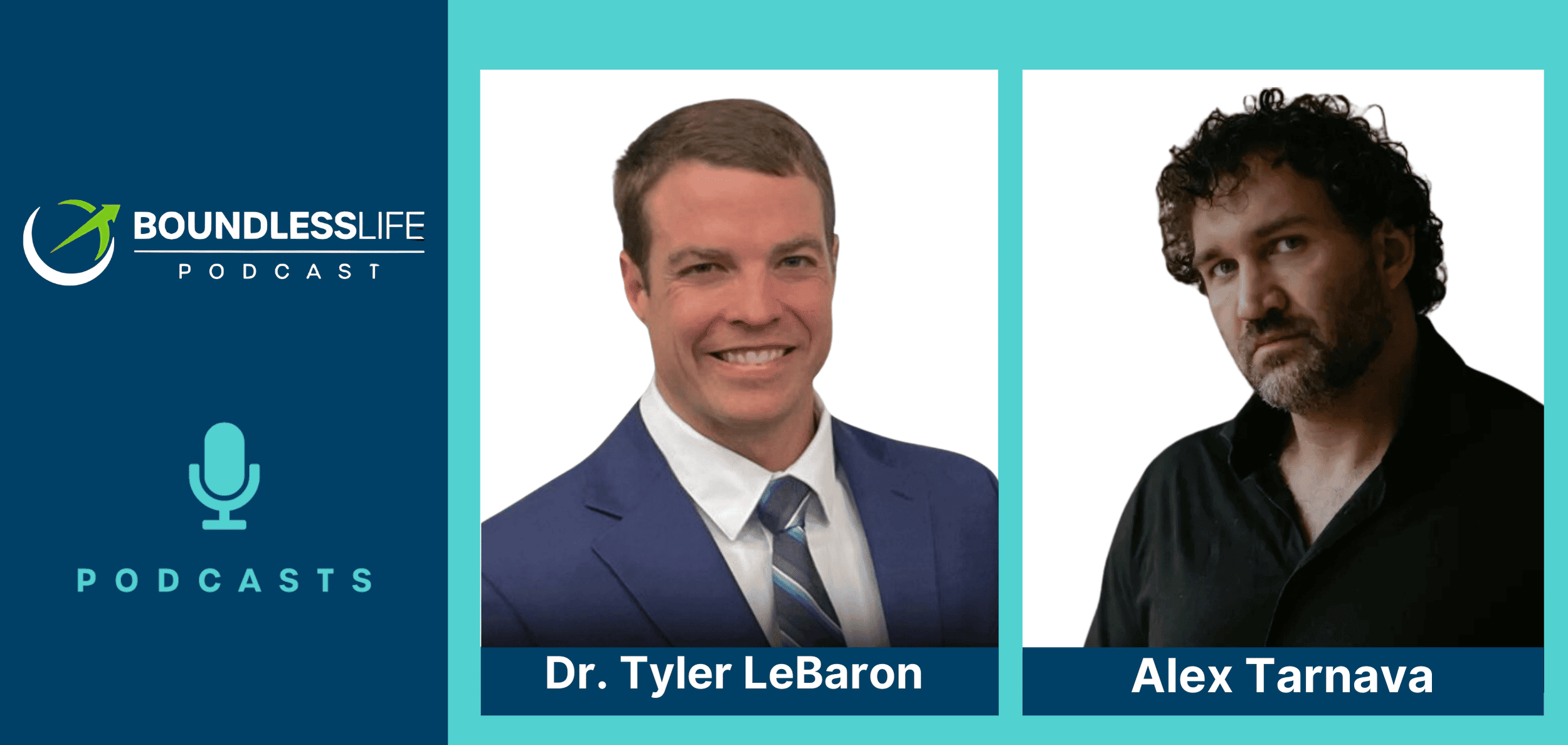
Is This Like Drinking HUNDREDS of Bottles Of Hydrogen In A Single Sitting? The Massive Antioxidant Benefits of *Inhaling* Hydrogen, With Dr. Tyler LeBaron & Alex Tarnava.

Affiliate Disclosure

Listen on:

Reading time: 7 minutes

What I Discuss with Dr. Tyler LeBaron & Alex Tarnava:

In this episode with Dr. Tyler LeBaron and Alex Tarnava, you’ll get to discover the cutting edge of molecular hydrogen science and its surprising benefits for recovery, stress modulation, athletic performance, and even sleep. You’ll hear first-hand updates on the latest research and technology behind hydrogen-rich water and hydrogen inhalation, why hydrogen acts as a redox adaptogen rather than a conventional antioxidant, and how it stacks with other wellness tools like red light and cold therapy. Along the way, Tyler and Alex also tackle the potential risks and rewards of hydrogen inhalation devices—including flammability concerns—while sharing practical advice on dosing, delivery methods, and the best practices for safely and effectively using one of the most fascinating compounds in modern health optimization.

Tyler W. LeBaron, MSc, Ph.D., is the founder and executive director of the science-based, nonprofit, Molecular Hydrogen Institute. His background is in biochemistry, physiology, and exercise science. He has taught physiology and currently teaches exercise physiology and chemistry lab classes at Southern Utah University as an adjunct instructor. He interned at Nagoya University in Japan, in the Department of Neurogenetics, to research the molecular mechanisms of hydrogen gas on cell-signaling pathways. Tyler is a director of the International Hydrogen Standards Association (IHSA) and the International Molecular Hydrogen Association (IMHA). He speaks at medical conferences in the US for doctors’ Continuing Medical Education (CME)/Continuing Education Units (CEUs) and at academic biomedical hydrogen symposia and conferences around the world. Also, he is a member of the Academic Committee of Taishan Institute for Hydrogen Biomedical Research. He collaborates with researchers at home and abroad and helps advance the education, research, and awareness of hydrogen as a potential therapeutic medical gas. When not doing research, he is often found training and competing in running and, recently, as a competitive arm wrestler.

Alex Tarnava is a self-taught scientist, inventor, and author whose work sits at the intersection of biomedical innovation, sovereign health, and philosophical disruption. He is the inventor of the world’s only open-cup molecular hydrogen tablet—a patented delivery system that has become the most studied and widely adopted form of hydrogen therapy globally. The technology has been used in over 21 published clinical trials and has helped catalyze a new wave of research into the therapeutic potential of molecular hydrogen.

Alex has co-authored 17 papers through peer review, with one additional publication in press and several others under review. His contributions are widely cited in the field and have played a prominent role in advancing research on molecular hydrogen as a therapeutic.

He is also the co-inventor—alongside Tyler—of Inhale H₂, the first safe and effective hydrogen inhalation system. Alex’s work on advancing research in the field of hydrogen has been recognized by the Molecular Hydrogen Institute (MHI), which invited him to become the first chairman of the MHI Research Committee.

So stay tuned, because by the end of this episode, you’ll walk away with a clear understanding of the science and best practices behind hydrogen therapy—one of the most fascinating frontiers in health, recovery, and performance.

Please Scroll Down for the Sponsors, Resources, and Transcript

Episode Sponsors: 

LeelaQ: Not only do LeelaQ’s products neutralize EMFs, increase ATP production, optimize HRV, and improve blood flow, but they've been third-party proven to do so in placebo-controlled double-blind studies. Visit leelaq.com and use code BEN10 for 10% off.

Gameday Men’s Health: Gameday Men's Health offers science-backed, physician-led men's health optimization with personalized protocols for testosterone, peptide therapy, ED treatment, and more—helping you perform at your best whether you're training hard or keeping up with life. Visit gamedaymenshealth.com/bengreenfield for a free testosterone test and consultation at a clinic near you.

BEAM Minerals: If you want to up your mineral game, give BEAM Minerals a try. Go to beamminerals.com and use code BEN at checkout for 20% off your order.

Thrive Market: Discover how Thrive Market delivers premium, clean-label groceries from top brands like Simple Mills and Primal Kitchen at up to 30% off retail prices, making healthy eating accessible without compromising your budget or values. Skip the junk without overspending—visit thrivemarket.com/ben for 30% off your first order plus a FREE $60 gift.

BIOptimizers MassZymes: MassZymes is a powerful, best-in-class enzyme supplement that improves digestion, reduces gas and bloating, and provides relief from constipation. Go to bioptimizers.com/ben and use code ben10 for 10% off your order.

BON CHARGE: BON CHARGE is a holistic wellness brand with a wide range of products that naturally address the issues of modern life. Their products can help you sleep better, perform better, recover faster, balance hormones, reduce inflammation, and so much more. Go to boncharge.com/GREENFIELD and use coupon code GREENFIELD to save 15%.

Resources from this episode: 

Ben Greenfield [00:00:00]: My name is Ben Greenfield, and on this episode of the Boundless Life podcast.

Tyler Lebaron [00:00:04]: Our machine gives you up to 4% hydrogen gas, which on the extreme, depending on how you're breathing, you'd have to provide over 7 liters of hydrogen gas per minute in order to ensure you can always have that same level of hydrogen.

Ben Greenfield [00:00:19]: Welcome to the Boundless Life with me, your host, Ben Greenfield. I'm a personal trainer, exercise physiologist and nutritionist. And I'm passionate about helping you discover unparalleled levels of health, fitness, longevity, and beyond.

Ben Greenfield [00:00:40]: Both of my podcast guests today have been on the podcast before. Actually, Tyler, I think you've been on like two or three times.

Tyler Lebaron [00:00:48]: It's been a while. I mean, the first was like 2018 and then we've done some other like, live stuff or whatever, but... yeah.

Ben Greenfield [00:00:56]: Yeah, that's right, guys. That's the voice of Tyler Lebaron, the founder and executive director of the Molecular Hydrogen Institute. He's also an incredible athlete. Probably right now training for the carry a kettlebell with one arm up the side of a mountain grip strength test with a backflip and pull ups at the top of the mountain. I don't know. He's a competitive arm wrestler too, and I'm actually not joking. Tyler's an incredible athlete.

Ben Greenfield [00:01:19]: Tyler, what's your marathon time?

Tyler Lebaron [00:01:22]: I mean, the last one I did was a 20-30, at 2 hours and 30 minutes. So, you know, I'm, I'm probably, you know, in the 2:20s right now, I'm thinking.

Ben Greenfield [00:01:31]: You almost fit into the category of like hybrid athlete though, because you do the grip strength. You don't do any deadlifting, do you?

Tyler Lebaron [00:01:38]: No, I do deadlifts also just because I want to have that overall strength. I mean, you know, my, my deadlift isn't, you know, way up there, you know, but I can still hit, you know. You know, I did what, 385, you know, a couple weeks ago.

Ben Greenfield [00:01:51]: Yeah, that's respectable. So 385 and a 2:30 marathon and a competitive arm wrestler. And like I mentioned, the director of the Molecular Hydrogen Institute. We're going to talk a lot about hydrogen today for those of you listening in. But not just the same old, same old, like put hydrogen tablets in a glass of water. There's some cool emerging science in hydrogen. And my other guest, Alex Tarnava has also been on the show. Alex, I'm sure you recalled, you shared your crazy story of healing your body using molecular hydrogen and just the whole background of hydrogen tablets and what to get and what to avoid so we won't have to rehash a lot of this stuff on today's show.

Ben Greenfield [00:02:32]: Because I want people to go and listen to those other shows just so we don't have to spend the entire next hour in review mode. I want to jump into just some of the cool, sexy new shit if that sounds good to you guys.

Alex Tarnava [00:02:44]: Works for me.

Ben Greenfield [00:02:46]: Yeah. Okay. All right, cool. So before we do jump in, I guess I'll ask just one review question. Some people may have been hiding under a rock for the past few years and not really heard that much about molecular hydrogen. Let's say we're on an elevator, like 0 to 30th floor. Each of you guys, in your own words, tell me why it is that you think molecular hydrogen is so darn cool enough for you to actually have this as your main gig.

Alex Tarnava [00:03:16]: One, it was such a complex problem when I jumped into it. It was the first thing that as I learned more and more, and I felt I needed to learn more, the complexity. But two, as the story started to emerge and we're putting it together, we're realizing that hydrogen has been integral to us throughout all of evolution. And the mechanism that we evolved to produce it internally, endogenously is no longer working properly due to changed diet, disrupted microbiome. We used to consume 100 to 150 grams of dietary fiber per day. Through 10,000 years of horticulture, we've stripped the fiber from our foods. Now we consume a fraction of that and it's largely killed a lot of bacteria.

Alex Tarnava [00:04:05]: We need to make hydrogen. So even if we up our dietary fiber intake, it might make us sick. If we go too high, we don't produce as much hydrogen. So really the only way that we get this critical gas now is exogenously through inhalation or water or bathing. And we're learning to understand that it plays some pivotal roles in basically our stress responses. So it really helps keep us in homeostasis and in our bodies in harmony. Right? So it's not like a miracle for anything, but it helps us correct and heal and adapt to situations and the daily stressors of life.

Ben Greenfield [00:04:51]: Yeah, I mean, you just listed probably like eight different benefits, Alex. And before I kind of get your take on this, Tyler, I did want to also mention that two days ago and I kind of bookmarked it just so I can mention it. On today's show, I saw a recent study indicating, and this was a six week randomized controlled trial that training adults who were drinking hydrogen rich water twice A day during the resistance training protocol had lower markers of muscle damage. I think they had an improvement in blood lipids as well and enhanced recovery. And from what I could tell, there was not an impact on muscular strength or development. Meaning that unlike a lot of other antioxidants, hydrogen didn't seem to blunt any type of mitochondrial or strength effects of exercise. Did you see that one, Tyler?

Alex Tarnava [00:05:42]: Was, was it in 50 plus year old individuals?

Ben Greenfield [00:05:45]: Yeah, it was, it was an older adult.

Alex Tarnava [00:05:47]: So I, I'm an author on that paper.

Ben Greenfield [00:05:49]: So you're an author on that paper, Alex?

Alex Tarnava [00:05:51]: Yeah, yeah.

Ben Greenfield [00:05:51]: Oh, okay.

Alex Tarnava [00:05:52]: I, I actually I, I presented this a poster in Milan last year at a academic conference called Aspen.

Ben Greenfield [00:05:58]: Yeah, the effects of drinking hydrogen rich water for six weeks on exercise related biomarkers. Blah, blah, blah. That one?

Alex Tarnava [00:06:04]: Yeah, yeah.

Ben Greenfield [00:06:05]: Okay, cool.

Alex Tarnava [00:06:06]: Yeah, it was an interesting study. And actually Tyler and I are authors on a different study that showed very similar things in a completely opposite study group in basically high level elite athletes, Olympic level athletes. So we're seeing it in opposite groups now. In this group, the placebo group had borderline rhabdo. They had very serious damage. They had a 700% increase in creatine kinase and 1,100% increase in myoglobin. So they were wrecked. The hydrogen group had no significant rise in either creatine kinase or myoglobin.

Alex Tarnava [00:06:44]: And it regulated their cortisol response or their stress response. So athletes will actually see higher spikes in cortisol after exercise as part of the stress adaptation. And hydrogen corrected that to increase the cortisol after exercise for these uninitiated. So these were older adults who had no adult exercise experience. It also increased free testosterone and DHEA in that study.

Ben Greenfield [00:07:09]: Wow. I don't know. Tyler, what do you think would be the mechanism of action for hydrogen to do something like increase free testosterone? I didn't have—know it had an impact on the endocrine system.

Tyler Lebaron [00:07:21]: Well, it's not huge. I mean, we're not talking about some sort of endogenous luteinizing hormone or something to stimulate the testicular production of testosterone. But when you are able to reduce the amount of oxidative stress and inflammation that's going on, then your cells can work normal again. And a lot of people are suffering from cellular stress. And if you're able to clear out that debris, then your cells are going to start functioning properly again. And so it's expected that some of these levels will go back up or back down, depending on what we're talking about. And be corrected to go back to homeostasis.

Ben Greenfield [00:08:01]: Okay. Yeah. I mean, I think it kind of makes it a no-brainer in terms of the antioxidant that you would choose to use before or after exercise. Was there anything special about the diurnal dosing? Taking it twice a day?

Alex Tarnava [00:08:13]: The reason we often do twice a day—now you want hydrogen intermittently and a lot, especially as you go to older people away from elite athletes, they can't drink a large enough volume of water. So we're basically just trying to get the dosage higher. We've been seeing in a lot of these study groups, hydrogen is working in a dose and concentration dependent manner. So we use the tablets to up the concentration and then we might do it two or three times a day to get a total dose increase.

Ben Greenfield [00:08:41]: Tyler, I didn't really give you a chance to give your, like elevator pitch for hydrogen. How do you describe it to people?

Tyler Lebaron [00:08:47]: Well, first we need to know what we're talking about. Hydrogen is a molecule of gas. It's just two hydrogen atoms that are bound together. And that's the craze of these new days, is an alternative energy source. And I am very excited about this area because I've been studying it since 2009. It's been 16 years. And when I went to Japan in 2013 to do research for an internship at Nagoya University, and I was able to meet the actual researchers and then go to their labs and then be part of the research myself. And that made me realize that molecular hydrogen has the potential to radically revolutionize healthcare and to provide something that is safe and potentially effective to everybody.

Tyler Lebaron [00:09:33]: And as Alex mentioned earlier, it's something natural to our bodies. We have evolved to naturally produce hydrogen gas in our gut microbiome. And so it's not like we're introducing some alien or foreign pharmaceutical substance that could potentially have adverse effects. To your point earlier about antioxidant supplementation with athletes, often what we can see is these high levels of antioxidants can blunt exercise performance or the adaptations more specifically, whereas hydrogen gas does not do that. So that's where my passion comes from, is because the safety profile is so high, it is evolutionarily linked to and correlated to longer improved health and improved metrics. And it does have this potential to really radically revolutionize healthcare.

Alex Tarnava [00:10:24]: Yeah. To expand on what Tyler was saying, there's actually a really interesting paradox with hydrogen and exercise and stress. So what we're seeing in the literature is when you say rats will do a forced swim test with or without hydrogen, the hydrogen Group actually has a higher spike in cellular stress than the control group during the exercise, but they rebound to homeostasis faster, so they're recovering quicker. It's like they're exercising harder and recovering quicker. But in physiological stress, we're actually seeing a reduction. We're seeing an anti-fatigue effect and we're seeing, say, things like a lower submaximal heart rate doing the same amount of work. So there's an acute spike in the cellular stress to drive further adaptation while also lowering the total physiological stress.

Alex Tarnava [00:11:11]: It's very interesting, but this is actually one of Tyler's areas of expertise, so he can probably explain it a bit better than me.

Ben Greenfield [00:11:17]: Yeah, it sounds almost like adaptogenic.

Tyler Lebaron [00:11:19]: Yeah. In one of my earlier publications and we published in the Canadian Journal of Physiology and Pharmacology, we talked about how the molecule of hydrogen acts more like an exercise mimetic and a redox adaptogen because it really is a modulator of all these different areas. And it's—it has this mitohormesis or hormetic like effect on our cells. So it's going to mimic some of the effects like exercise or caloric restriction.

Ben Greenfield [00:11:45]: Yeah. Okay. Now, I know a lot of people, probably, especially those who have been listening to health podcasts for a while, they've probably heard their fair share of take these hydrogen tablets and put in a glass of water and that's the way they get hydrogen, and that's the way that most people have seen hydrogen get assimilated in the body or delivered. When I was in Vegas, in Las Vegas last year, I went to this conference put on by A4M, the American Academy of Anti Aging Medicine. And it seems like whenever I go to that conference, which is the Consumer Electronics Show of biohacking, in a way, you just see all the different things that are coming down the pipeline, like shockwave therapy. You know, peptides and exosomes were a huge one. And then I was shocked, like, all the way down to like the VIP lounge, which I somehow got into. I think I had a fake name tag.

Ben Greenfield [00:12:41]: There were hydrogen inhalation machines, like everywhere. This appeared to be the newest craze. Obviously it kind of made me perk up a little bit and pay attention because all of a sudden, here's this new delivery mechanism for hydrogen that people are saying, depending on who you ask, is the equivalent of drinking dozens or hundreds of bottles of hydrogen water. And then, Alex, after you and I recorded our last podcast, and close to the time that I was at A4M, you started talking to me about hydrogen inhalation. So I don't know who wants to start, but fill me in on this craze. Is it effective? Is it safe? I realize it's kind of a loaded question, but what's the deal with hydrogen inhalation?

Alex Tarnava [00:13:26]: I'll start, and then Tyler can jump in. So hydrogen inhalation is, I'd say, additive to hydrogen water. They have different distributions throughout the body. Inhalation is going to get in far higher amounts to your skeletal tissue, for instance, into your lungs, actually to your brain, too. Hydrogen water is getting far better into your gut and digestive tract, into your liver, and through the gut, it will drive certain hormones that have neuroprotective effects, like ghrelin. Right? So they're different for different applications. I think you should do both of them.

Ben Greenfield [00:14:00]: When you say you think you should do both, you mean, like, inhale hydrogen and consume it in, like, water form?

Alex Tarnava [00:14:06]: Yeah, yeah, that's my thoughts. Now, hydrogen inhalation units hadn't really emerged as being popular for a number of reasons. One, the units that they're using in the large clinical trials are not actually commercial units. The researchers are designing this in the lab. Tyler has actually had to do this during his PhD program program. And the reason for that is they can become quite explosive. Right? There's already emerging case studies of them blowing up people's faces.

Alex Tarnava [00:14:36]: Yeah. Because they're explosive concentrations of hydrogen gas that are coming through nasal cannulas and off-gassing around people's heads. So Tyler and I had started talking about this problem together seven years ago and have spent seven years engineering a machine that's both safe and effective, that gives a precise concentration of hydrogen below the explosive limit, every breath, no matter how you breathe, because we're not breathing at a constant rate. And Tyler will get a lot deeper into this. But those are the big considerations. Hydrogen inhalation is the future. For a lot of purposes, hydrogen water is still important.

Alex Tarnava [00:15:16]: But as with any therapy, the two considerations we need to look at is is it safe and is it effective? And that cannot be said for a lot of these units on the market that are designed by Chinese engineers.

Ben Greenfield [00:15:31]: Well, not to stereotype or anything, Alex. Geez.

Alex Tarnava [00:15:35]: What I'll say to that, it's shouldn't be controversial. The Chinese government has lower levels of safety regard for their people than the western world, so they're designing them within the acceptable parameters of their law, not of ours.

Ben Greenfield [00:15:50]: Okay, so a lot of little questions there. Specifically, even though I'm not an engineer, my engineering mind goes to why is it that inhalation would somehow reach or penetrate some of these tissues that you talked about better, like the gut and liver, Alex? And then how these machines actually deliver hydrogen. Can you speak to that, Tyler?

Tyler Lebaron [00:16:13]: Yeah. So, again, when you take hydrogen water, the water just goes to your stomach, and then that hydrogen gas goes to the liver, goes to the venous blood, goes to the heart, and then you exhale 90% of all the hydrogen gas out. So a very small amount actually reaches the brain or your skeletal tissues because it goes to the lungs. And if you think about taking hydrogen water and you just pour it into a cookie sheet, all the hydrogen gas is going to be gone really quick because it reaches equilibrium with the atmosphere very quickly. The same thing is happening when you take hydrogen water. It's gone quickly. But yet, as Alex pointed out, there's still a lot of benefits to drinking hydrogen water because of the direct effects in the microbiome. It activates second messenger systems and so on.

Tyler Lebaron [00:16:57]: So there are specific benefits from hydrogen water that you actually do not get from inhalation. But when you inhale hydrogen gas, that gas is just dissolved into the blood. And the heart pumps that blood to all your tissues, to your muscles, to your brain, to your big toe and the little toe. It gets everywhere. And again, hydrogen gas is not attached to, like, hemoglobin or something like oxygen is. It just dissolves in the blood and goes everywhere. And then it can have direct effects on those cells and those tissues. So when we're dosing molecular hydrogen in our research studies, what we'll want to do is make sure that the fraction of inspired air is a specific therapeutic concentration.

Tyler Lebaron [00:17:39]: So it's really easy. In cell culture studies, we'll have, like, an incubation chamber, and we'll just fill the incubation chamber with a specific percent of hydrogen gas, say 1%, 2 or 3 or 4%. Now, here's the important part. You have to keep the concentration below 4%, because once it goes above 4.6%, it becomes flammable.

Ben Greenfield [00:18:01]: Okay. I was wondering that, by the way, because I have a hydrogen inhalation machine now. We can talk more about that later. And it tops out at 4%, which, to me, I didn't know if that was low, high, but it sounds like that's a good thing, because otherwise it could get explosive.

Tyler Lebaron [00:18:15]: Yes, it's a very good thing. But there's going to be a caveat with what you're talking about that's very important. But just to be critical on this point—is when hydrogen gas exceeds that 4.6% concentration, it becomes flammable. And that becomes a very major risk for an individual, as well as doing research in the laboratory. So in the incubation chamber, we can just keep the percent. All the hydrogen gas in the headspace is like 2% hydrogen gas. Same thing with an animal study. You have an animal cage—

Tyler Lebaron [00:18:47]: —you can connect the hoses of the gas tank and mix the ratios so that the animal cage is exactly 2%. And now it doesn't matter if that rat is, you know, running around on the wheel or plane. All the air in their environment is exactly 2%. Just like right now, you're exercising and the air around you is 21% oxygen. And we're sitting down and our air is also 21% oxygen. We're still getting the same fraction of inspired air, the same fraction of inspired oxygen. I mean, it doesn't matter if you're breathing fast or slow.

Tyler Lebaron [00:19:23]: So when we do the clinical studies, the big clinical studies, we actually will use a face mask and we'll connect this to a tank of gas, which is exactly 2.3% hydrogen gas or 3% hydrogen gas, whatever it is that we're using. That way it doesn't get diluted, because when you take a breath of air, then if you just have, like a nasal cannula in, then you're going to entrain or you're going to take in a lot of the outside air and you're going to dilute the gas that you want.

Ben Greenfield [00:19:54]: Right, because there's not a seal between the cannula and the nostrils.

Tyler Lebaron [00:19:58]: Yeah, exactly.

Ben Greenfield [00:19:59]: Yeah, I got it. That makes sense.

Tyler Lebaron [00:20:01]: And remember, and that machine, let's say a typical hydrogen machine that provides you with, say, 600 milliliters per minute. Well, that most people we know, like what's called minute ventilation, is how many liters of air you breathe per minute. It's called minute ventilation. And that's going to range between, you know, 5 to 12 liters per minute. So that's. So if you think about, like, let's say, 10 liters per minute, 10,000 milliliters. Well, if a machine's only providing 600 milliliters, there's no way that you can ever get a therapeutic effect with that. Plus, when it's in your nose, when you take a breath, what if part of the breath is through your mouth and not only your nose?

Ben Greenfield [00:20:46]: Right.

Tyler Lebaron [00:20:46]: You're going to dilute it. And what if it's only—

Ben Greenfield [00:20:48]: —which could also happen because, by the way, I've got mine. Just so you guys know, I have one of those Roxiva light sound machines. Have you seen those? Where you lay underneath the light and it does weird psychedelic images, increase theta and delta brainwaves, use it for meditation. And next to that, I have one of those PEMF chairs. So my H2 inhale machine is sandwiched in between those. So I'm typically breathing from it while I'm sitting there doing PMF or laying there. But the light sound machine kind of like knocks you out. And there's a pretty good chance I'm breathing through my mouth for some of that.

Tyler Lebaron [00:21:23]: And that's—so if you had a nasal cannula, you can understand that you would be diluting all the hydrogen gas. So it'd be below a therapeutic level. We know from all the studies that you need to have at least a 1% hydrogen gas in the air that you breathe, or the fraction of hydrogen gas being inhaled needs to be at least 1%. And in order to do that with a nasal cannula, you need to be anywhere between 300ml and above, even up to a liter of hydrogen gas per minute to get a therapeutic effect of hydrogen gas. Because we talked about you're diluting all that hydrogen gas by taking your inhalation.

Ben Greenfield [00:22:03]: Have you guys seen one of these actually explode?

Tyler Lebaron [00:22:06]: That's the other part that we—see, when we were doing my research, when I was doing my PhD, we had to use a tank that we would make sure is below the 4% hydrogen gas because we couldn't run the risk of having an explosion in the laboratory, right? There are documented cases in China and Japan and other areas here in the world. But these ones have been documented with the governments where people have been inhaling hydrogen gas, like with a nasal cannula in, and some ignition source ends up happening and it causes a facial fracture. I mean, literally their nostrils, you know, combusting.

Alex Tarnava [00:22:47]: And in one instance, it traveled back into a woman and burned her lungs.

Ben Greenfield [00:22:51]: Is this because there's a malfunction within the machine itself?

Tyler Lebaron [00:22:54]: No, there's nothing to the—no, it means the machine is working great. It's actually providing you with high concentration hydrogen gas. It's just that if there is a static electricity, some discharge, an energy source or something, then that can travel into the lungs. And I guess actually to your point, it is possible that if there's a problem with the machine, like if it's a typical oxyhydrogen machine, that they're connected into the machine itself. If there was some sort of spark or something in the machine, and that ignited in the machine, then that flame would be carried through the nasal cannula and down into the lungs.

Ben Greenfield [00:23:35]: Okay, got it. So you guys basically engineered a machine that could hold it at 4%, that has a mask, that has these safety features built in. What else is different about the one that you guys do? It's called the H2 inhale, by the way.

Tyler Lebaron [00:23:48]: This is really important because you mentioned there's another machine, there are some other machines out there that will just take and dilute the concentration. So it is. Instead of 100% hydrogen gas, it is only, say, 4% hydrogen gas. Now, the problem is when you do that, when you take an inhalation, like when I just. Like right now is we're just sitting here, we take a breath. You inhale around 500 milliliters per second. 500 milliliters to 600 milliliters per second. Okay.

Tyler Lebaron [00:24:18]: This is called the peak inspiratory flow is basically what we're talking about. And actually, when we look at it, you're closer to, like, we do this in oxygen therapy a lot, where you're talking about a peak inspiratory flow rate of around 35 to 45 liters per minute. That's just the rate. And so when you end up inhaling from these other machines, you dilute the concentration down from that a hundred percent all the way down to maybe 0.1%. And if we remember what I said earlier, you need to have at least 1% concentration to be therapeutic. So if you dilute the concentration because of your normal breathing below 1%, it won't be therapeutic. So how do we overcome this? Because the only way to provide a flow rate that will ensure that you're always getting enough that gas is to provide about 35 to 45 liters per minute of a gas through the nasal cannula. That is really high. I mean, most nasal cannulas can only handle a few liters of gas per minute.

Tyler Lebaron [00:25:34]: And so we're talking about 35—that's like a—that's a totally different type of nasal cannula, actually. But you can't just do that. So how is our machine different? If the reason how it works is because we have a reservoir, we have an inflatable bag. So this bag, which is three liters, gets filled with exactly the precise amount of hydrogen gas that you decide whether it's 1, 2, 3, or 4% hydrogen gas. This bag gets filled with that precise amount of hydrogen gas. And then when you take an Inhalation at, like I said, a rate of, say, 35 liters per minute.

Tyler Lebaron [00:26:13]: You're able to inhale around 500 or even a liter or even up to three liters in that single inhalation. And every molecule of air you put into your body came from that bag. So you know what the precise concentration of hydrogen is. And then when you exhale, all the exhalation just goes out the mask. That's because it's a one way mask. So that is the biggest part of the IP is this inflatable bag aspect ensures that three things, okay? It ensures that every inhalation you take is therapeutic because it's above 1%. It ensures that it's a precise concentration.

Tyler Lebaron [00:26:53]: It's not going to be sometimes 1%, sometimes 3%, sometimes—it's not going to be all over the place. It's exactly what you set it at. And that way we can do real studies and real research. And number three, it's never going to be flammable.

Alex Tarnava [00:27:06]: Tyler, to add—that way, people can set their machine to the exact concentration used in the clinical studies, because right now they're just guessing, you know, and some of these studies say in rodents will find for one indication, 4% is better than 2%, but for the next indication, 2% might be better than 4%.

Ben Greenfield [00:27:24]: Give me an example of that. Like, like a high percentage versus a lower percentage.

Tyler Lebaron [00:27:29]: Yeah. So, for example, the. The very first study, not the very first one, but the most cited pioneering study was the Nature Medicine article published in 2007. And it was a stroke model. They took the rats and they induced a stroke model by cutting the blood supply to the brain. And they administered hydrogen gas to the experimental group or the control. And they found that the administration of hydrogen gas drastically prevented the brain damage from the stroke. And you can look at the brain slice and you can tell so easily that there's a whole bunch of white area in the brain, which is the dead portion of the brain.

Tyler Lebaron [00:28:07]: Whereas the portion that was administered, or the rats, the group of rats that were administered just 2% hydrogen gas, they had significant protection. All right, and again, how do they minister that? They didn't put nasal cannulas in these rats. They were in this cage. So they would ensure that every amount of air they were breathing was exactly 2% hydrogen gas. But in that study, they also compared different concentrations and they compared to different drugs. They compared it to, say, edaravone, a medical drug, and hydrogen gas is more effective, but they also compared it to 1% hydrogen gas. That means that when animals would inhale, the rodents would inhale 1% or that fraction of the air inhaled would be hydrogen. They also did 2%, they also did 4%.

Tyler Lebaron [00:28:55]: And they found that 1% was also therapeutic, but not as good as 2%. But when you compare that to 4%, 4% was not as effective. In fact, 4% wasn't even as effective as 1%. And that could have something to do with our conversation earlier about this hormesis-like effect of hydrogen. There's a number of questions and anomalies going on here.

Ben Greenfield [00:29:19]: Just what I'm thinking about is it could be hard for a consumer to know, like let's say they were doing it for, I don't know, skin benefits versus digestive issues versus sleep. Could you, at this point, with the research that's out there, query GPT about proper percentages to choose, or would there be a chart somewhere? Or is it still just kind of guesswork?

Tyler Lebaron [00:29:39]: I love that question. You're a true scientist at heart, because that is exactly the question that we all have and that we can finally start answering because we have access to a machine like this. And so there are some things that we can base it just on what was done in the clinical studies, what was done even in the animal studies. So we can start doing that, but now we can start really doing research to determine, hey, I want skin benefits, so let's do this concentration. I need neurological concentration, so I'll do a 2%. I have cancer, so I want to do 4%. And I think over time we will be able to have like a chart or something.

Tyler Lebaron [00:30:15]: So you can really make sure you're getting the precise concentration you want for the correct duration that you want. And the only way you could do that is with this type of machine. Because all the other machines with the nasal cannula, you're getting anywhere between a zero point or a less than 0.1%, which is not even therapeutic, all the way up to maybe as high as a 5% or 6% concentration or potentially higher, depending on how you're breathing and how big you are, all these things. So it's not a precise concentration, but ultimately you can do that with ours.

Alex Tarnava [00:30:48]: I want to add something and I'm sure Tyler will have something else to add after this. He mentioned cancer. And first and foremost, cancer is very complex. There's a lot of different types of cancer. I don't for a minute want to say that hydrogen is going to cure anyone's cancer. We need a lot more research. But there's a lot of positive research on cancer. Now, for instance, in certain cancer cell line cultures, actually that Tyler's [unclear].

Alex Tarnava [00:31:12]: There are instances where a low concentration of hydrogen can actually strengthen the cancer cell, whereas a high concentration can have anti-tumor effects and reduce cancer. And actually one of the first papers that was published on the therapeutic effects of hydrogen goes all the way back to the 1970s. I think it was a joint project between researchers at Baylor and Texas A&M and they had rats in a hydrogen-rich hyperbaric chamber. I think it was something crazy like 7 atmospheres of pressure. And it basically killed the cancer, like wiped it out completely. So, and this is what we need a lot more research on. And for each population group, with each ailment, what is the precise percentage that we should be aiming for, the precise duration of treatment? And now with inhalation, we can finally start answering those questions with this machine we've designed.

Ben Greenfield [00:32:10]: Talk to me about the dosing and timing. And I really probably should have asked you guys this question just privately at some point for the past few months, because I've had the machine for a couple of months because I tend to be in my lounge for maybe 20 to 40 minutes. I've usually got the mask on for 20 to 40 minutes at 4%. Just while I'm sitting there meditating or relaxing or whatever. Talk to me about what you know about ideal dosing and timing.

Tyler Lebaron [00:32:38]: Yeah, at this point there's still no optimal or ideal. We don't quite know yet. We just are basing things off of the clinical studies, what has been shown to be effective and also looking at a, the pharmacokinetics, because it takes about 20 to 30 minutes for hydrogen gas to distribute throughout the body and reach equilibrium. And we know from cell culture studies, some of the work that I've been involved in, that we can see effects of hydrogen gas in cell culture studies within just a few minutes. But when you're inhaling hydrogen gas, it's gonna take, like I said, 20 to 30 minutes in order for that hydrogen gas molecules to reach the therapeutic concentration in all of your tissues. So at a minimum, you probably want to inhale it for 20 to 30 minutes. And some of these studies, many of them will go for an hour to a few hours and some even as long as 18 hours. And animal studies, they'll sometimes go several days.

Tyler Lebaron [00:33:40]: So our probably recommendation right now, until we have better data, is probably a minimum of 20 to 30 minutes and probably one to an hour a day and just kind of play around with that. Every individual will be maybe a little bit different until we have more research.

Ben Greenfield [00:33:58]: Okay, yeah. Based on the saturation you explained, that makes sense. What about breathing? Do you need to focus on breathing deeply or can you still get good saturation just with your normal breath pattern?

Tyler Lebaron [00:34:10]: I love this question because breath work is so popular and there's a lot of benefits to doing these types of breath works, like just these quicker inhales or a double inhale and then a slow, extended exhale. If you did that kind of breath work with any other device using a nasal cannula, you can almost be assured you will not get a therapeutic dose of hydrogen. With this machine, because every inhalation you take, whether big or small, faster, slow, you will get a therapeutic dose. And it absolutely does not matter how you breathe. You just need to breathe. Now, I think it's probably a good practice if you can. Yeah, you can do some good breathing, you know, do some extended exhales and you can do all of that.

Tyler Lebaron [00:34:59]: It's not going to increase the rate of saturation necessarily. I mean, I guess there is a. If you increase your minute ventilation more than if your normal minute ventilation is, say, 8 liters per minute, and now you're going to just breathe more consciously, now you're going to do 12 liters per minute, then, yes, maybe that'll increase the rate of saturation from say, 30 minutes. Now it's gonna be down to 20 minutes, but it's not gonna reach a higher concentration because the amount of hydrogen gas being inhaled is identical. And that's what really sets this machine apart from anything else, is you can always do any type of breathing you want and you'll always get a precise, therapeutic, non-flammable concentration of hydrogen.

Alex Tarnava [00:35:43]: I want to add a few things to this, and this is anecdotal, but we're hearing it from a lot of people. I'm experiencing it, too. Hydrogen does have a big effect on the brain, and I do practice controlled breathing. At times I have to shift gears, triage what I'm doing in real time. I work 100 hours a week between projects. Sometimes I have some time to say, work on one of my books, but my head isn't in it, it's racing. I can't calm myself down. I found that when I take my laptop, go into the room where the inhalation is, put it on and practice deep breathing, that within 10 minutes, 15 minutes, my mind is clear enough to start writing.

Ben Greenfield [00:36:27]: Have you placebo-controlled that against deep breathing without the hydrogen machine?

Alex Tarnava [00:36:32]: Yeah, but I mean—I know, I don't have the hydrogen machine on, so it's not a perfect placebo control. I use deep breathing every day. So there's another aspect again, this could be totally placebo. My wife is three months postpartum. She's waking up to pump in the middle of the night, every night. And she's been finding she can't fall back asleep when she comes to bed with her perfect setup. You know, we have the waves crashing, you know, dim purple light, like all the things going, all her pillows, everything's perfect. Or a comfortable bed doesn't work.

Alex Tarnava [00:37:05]: She can't fall back asleep. So she started setting herself up on the hydrogen inhalation unit in this chair that is not comfortable to sleep on. You know, it's pretty upright. And she is conking out for an extra two, three hours every morning.

Ben Greenfield [00:37:21]: Is that because there's some type of sedative, parasympathetic activating effect of hydrogen?

Tyler Lebaron [00:37:28]: There's a lot that could be said about that. But when your body is out of homeostasis and has a dysregulation of your parasympathetic and sympathetic nervous system, it's not going to work as it should work. So you might be totally, chronically fatigued, but you're sympathetic activity is too much. And yes, hydrogen, due to all of its mechanisms on the mitochondria, the energy level, the cellular stress, oxidative stress, the inflammatory effects, all of these can contribute to the cells functioning correctly or properly now. And so now can help your organs and your body and your system start integrating correctly so you can get back to homeostasis and then you can fall asleep like you should.

Ben Greenfield [00:38:15]: I briefly alluded to this earlier, but even at that event, a few people came up to me and told me, this is like drinking hundreds of bottles of hydrogen water. Is that a fair comparison? Does it not even matter because there are different delivery mechanisms going to different tissues, like Alex was saying? Or could you make a comparison at all between this—and one reason I'm asking, just so you know, is some people are like, well, if I'm going to take the money and buy a hydrogen machine, I'm going to quit buying tablets. And then are they going to miss out on something from not using tablets? You know what I'm saying?

Tyler Lebaron [00:38:45]: Yeah. I'll just briefly say that it's probably best to think of it as an apple and orange comparison. They really can't be compared that way. Now, you can attempt to compare things in the sense that how many milligrams of hydrogen are in the water you're drinking versus how many milligrams of hydrogen there are in an hour long inhalation session. And in that case, yes, you are getting hundreds of more, hundreds of times more hydrogen from the inhalation session. But the effects are materially and distinctly different. And one of our, the first publications actually is out of the lab. I was at Nagoya University as well when they actually looked at the effects of hydrogen gas inhalation and drinking hydrogen water and a combinational effects.

Tyler Lebaron [00:39:34]: And indeed in this study, they found that there are certain things that were changed from drinking hydrogen water that were not changed from inhalation and vice versa. And there was an additive effect on some of those markers as well as other effects that happened when you did them both. And this just makes sense when we go back to the pharmacokinetics of different methods, because again, with hydrogen water, you're mainly getting that into your GI tract and it's going to the heart and the lungs and you're losing it. So all the benefits to the brain and the other tissues of the body from hydrogen water are likely due to other second messenger systems, like improving the microbiome induction of gastro ghrelin secretion, as Alex mentioned earlier. Whereas inhalation, you're getting the direct effects, hydrogen gases going directly to the brain. You can measure concentrations in the brain and, and it reaches a therapeutic threshold to directly induce changes in the brain and the skeletal tissue and other organs and so on.

Ben Greenfield [00:40:41]: Okay, another engineering type of question. Why is it that I fill this basin that's attached to the machine with distilled water?

Tyler Lebaron [00:40:49]: Yeah, that's because it uses the process of electrolysis, which is by definition the decomposition of water to hydrogen gas and oxygen gas. So that's the water becomes a source of hydrogen gas because water is just H2O. So you split the water molecule, you get hydrogen gas, the oxygen gas is vented out into the room air, and then the hydrogen gas is what you end up, is what ends up going to the inflatable bag with a specific ratio so you can dictate what the concentration is and so on. Now you want to use only distilled water because you go through the electrolysis process, the chamber, and that uses platinum electrodes, and it's a proton exchange membrane. And you want to have very clean, very pure waters, distilled water, because the minerals will damage the membrane, because the membrane itself acts like an electrolyte. Otherwise in electrolysis, you typically have to have ions in the water. But with this type of technology. You don't do that because the membrane itself acts as the electrolyte.

Tyler Lebaron [00:41:50]: So that's why it's required to have distilled water.

Ben Greenfield [00:41:52]: Okay, pause here for just a second. Just for people listening, I am taking show notes. They're going to be at BenGreenfieldLife.com/InhaleHydrogen that's BenGreenfieldLife.com/InHaleHydrogen. So, shifting focus just a little bit here, guys. It was actually at that same expo that I also saw a little bit lesser trend, but still a trend, because I think I saw three booths talking about or showcasing this transdermal absorption of hydrogen. Like these hydrogen baths. Have you guys seen these?

Alex Tarnava [00:42:24]: Yeah.

Tyler Lebaron [00:42:25]: Yes.

Alex Tarnava [00:42:25]: Yeah.

Ben Greenfield [00:42:26]: Okay. Is this. Is this funk science? Like, is there—is there a thing to transdermal absorption or—talk to me about that.

Alex Tarnava [00:42:32]: I mean, with the tablets, we actually—I have IP and we manufacture larger bath tablets and getting them larger and more effective. We have two clinical trials and a few case studies on them. We're seeing some quite remarkable benefits. We do need bigger studies to continue replicating this. But for instance, we showed equivalency to RICE protocol after grade two ankle tears in pro soccer players.

Alex Tarnava [00:42:59]: So rest, ice, compress, elevate. And actually, if you look at the data, there was multiple strong trends that the hydrogen bath was significant, was trending to be better than the RICE protocol. I know the researchers were not expecting that. And if they'd recruited like another four people, they think they would have been able to show that hydrogen bathing was potentially preferred over RICE.

Ben Greenfield [00:43:25]: Yeah. Geez. I wonder what would happen if they would have been inhaling hydrogen while taking a hydrogen bath.

Alex Tarnava [00:43:30]: We don't have good pharmacokinetic data on what is going to get to the soft tissue, better: inhalation or water. I suspect, like bathing in hydrogen water—just from the visual effects we see.

Ben Greenfield [00:43:45]: I was kind of joking. I know there's going to be at least one biohacker listening in who's like, I'm getting a hydrogen bath and there's going to be a hydrogen inhalation machine hanging above it with a glass of hydrogen tablets next to that on my bath caddy. Have you taken a bath in the hydrogen water, Tyler?

Tyler Lebaron [00:44:01]: Yeah, yeah. I mean, that's—I was like over like 10 something years ago, you know, when this was coming out.

Alex Tarnava [00:44:09]: Oh, you—you did it in Serbia too, when you went to Serbia.

Tyler Lebaron [00:44:12]: Yeah, that was some of the researchers I also did in Serbia. That was just a couple years ago. But yeah, one of the— there's a lot of benefits of hydrogen on the skin. And some of the earliest studies with some of these, like natural spring waters that contain hydrogen gas, some of those benefits that were noted on the skin could—was probably due to—because of the molecular hydrogen. And the concentration with the bath water doesn't have to be as high, because when that hydrogen water, when the hydrogen in the water is low, it's coming in direct contact with the skin.

Tyler Lebaron [00:44:47]: So it only has to be like a few parts per billion or micrograms per liter. And that's enough because it's directly on the skin, given those benefits. But if you talk about systemic benefits, like actually getting the hydrogen gas to go transdermally and into the bloodstream, then you need a much higher concentration because it's going to follow its osmotic gradient, so to speak. But you also have the diffusion principles, and there's the barrier of the skin that's going to take a higher gradient in order to get the hydrogen molecules into the skin. But, yeah, I've done it. I think it's a great way. But surely with inhalation, you will reach those concentrations in the tissues faster than you will with bathing, just because you're going through the lungs. And the lungs, by definition, is the most effective way to dissolve a gas into a solution.

Ben Greenfield [00:45:39]: Okay. All right, got it. My friend, Gary Brecka, he's always got something that he's talking about, and I think lately he's really amping on the idea of just the three main things: hydrogen tablets, Baja Gold, sea salt. I think the third one's amino acids. And I actually like Gary. I respect him. I think there are certain things that, if you do them, stack well together.

Ben Greenfield [00:46:03]: He also is the guy who kind of gave me the idea of stacking PEMF with oxygen with red light therapy. And I actually really like that protocol and feel really good when I do it. But for you guys, if you could do your own little stack and say, okay, these are some of the things that you should slash could do to enhance the effects of hydrogen, whether you're inhaling it or drinking a glass of hydrogen water, what do you think are some of the things that if someone were really focusing on, that would also really help move the dial in conjunction with that.

Alex Tarnava [00:46:34]: I'll touch base and Tyler can add, because we've actually talked about this a lot recently. There's actually a chapter in my book that's coming out in a week or so just going through formatting. It's called Stress Hacked. That Talks about stacking various hormetic agents and the complexities around them. It's—I think it's going to be different for every person and every person each day. That's just how stress works. I call hydrogen perhaps the only universal stacker.

Alex Tarnava [00:46:59]: You know, in every instance with these other hormetic agents that it's been tested with, hydrogen has potentiated their benefits and mitigated their potential damages. So that, that's my thoughts there. Yeah, I know Gary loves it. I've been on his podcast. He's a customer, he's a friend. We talk often. Him and Tyler talk often too. I think hydrogen and red light, for instance, is great together.

Alex Tarnava [00:47:27]: Hydrogen and exercise. I do my hydrogen all the time. And actually just this last weekend, it was very lucky that I was having a little bit of a—not a bachelor's party with my friends, because it wasn't a party, but my wife and I got married a while ago. But we're finally having the ceremony this coming weekend. So for our party we were going to a Nordic spa with sauna, infrared sauna and 1 Celsius coal punches. Well, on the way there we got t-boned by a reckless driver that crossed forwards. Yeah, and like, you know, burns from the airbags, bruises, all banged up and I doubled up on the hydrogen tablets.

Alex Tarnava [00:48:15]: I hit the hydrogen inhalation. I went to the—spent two and a half hours doing infrared sauna, cold plunge, infrared sauna, cold plunge. I feel fine now. That was two days ago. A couple days ago.

Ben Greenfield [00:48:27]: Geez, man, that's crazy. Maybe God didn't want you guys to get married. I'm joking. That's good. No, seriously, that's scary. I'm glad you're okay. Yeah, that's it. I guess it makes sense though with the anti-inflammatory benefits of hydrogen that would have kicked in and helped.

Ben Greenfield [00:48:43]: So you're saying things like red light, contrast therapy, hydrogen. Those, those are some of the tools in your bag?

Alex Tarnava [00:48:49]: Yeah. I love sauna. I love cold. I love heat. I love cold. I love red light, I like hydrogen, I love exercise. I'm sure Tyler's not too far off.

Ben Greenfield [00:48:59]: What about you, Tyler, especially being the, you know, the competitive arm wrestling, uphill kettlebell carrying marathon champion that you are.

Tyler Lebaron [00:49:09]: It sounds so interesting when you exaggerate my ability to cycle. You know, I'm pretty conservative when it comes to a lot of the different biohacks and things that are out there. I'm skeptical. I think I'm very concerned about potentially harming my performance by haphazardly trying new things. Just like with antioxidants, we know, research-wise, mechanistically wise, it's like, hey, yeah, we should take more antioxidants because oxidative stress impairs recovery. And then we know that the data now shows the opposite. Same story with anti-inflammatories.

Ben Greenfield [00:49:47]: Yeah. And if I could interrupt you real quick, it's not that you should take more antioxidants, it's that your cells should have access to more antioxidants, but it's better for them largely to be endogenously produced.

Tyler Lebaron [00:50:01]: Yeah, because your body's going to regulate them because you can't just, you also can't just take more sulforaphane or something because that could Potentially constituently activate NRF 2. Keep one pathway and then you're. Or if you do, like genetic mutations, this has been done several times and it still does not help. So even if it's endogenously produced, it doesn't save you from the potential damages of these high levels of reductive stress, basically. And so same story for anti inflammatories. Same idea for people who originally were promoting cold plunge as the best way to recover from exercise and get adaptations or something.

Tyler Lebaron [00:50:38]: Now the research is also pretty clear that that's not the best way to do. There's still benefits of doing that. Different ones, but not the ones that were originally claimed. So I'm just trying to say that for me, I, when I, when I'm going to take something, I'm very cautious, skeptical and conservative. So I don't do a lot of stacking or things. But, but there are things like red light. I think that, you know, because that's like being out in the sun, for example. Well, there's some differences, but.

Tyler Lebaron [00:51:04]: But there's some. There's things that mimic nature a lot that we should be doing anyways. And the stacking things like with exercise that I already like to do, and we already know what the research is on hydrogen, that's very important. And I, I would say that for anybody who is really on the fringe of biohacking stuff where they're like, hey, you know, there, there's preliminary ideas out there, there's mechanistic concepts. I think this might work. I'm gonna go ahead and try it. Those are the people that should absolutely be taking hydrogen, because if whatever they're doing that, whatever intervention it is ends up causing problems and negating benefits and causing harm, hydrogen would have been there to help reduce those potential negative adverse effects and ideally potentiate the plausible benefits.

Ben Greenfield [00:51:52]: Yeah. Yeah, let's say. I'm listening. I have a. Whatever lounge, a study desk. I want to get one of these machines and just passively use it during the day. What's the damage, fellows? What are we talking here in terms of cost? I mean. Sorry, I mean the investment.

Tyler Lebaron [00:52:07]: Yeah.

Alex Tarnava [00:52:09]: We thought long and hard about this. Now I've invested seven figures. We've spent seven years engineering this. But at the end of the day, Tyler's an academic and I live in the forest and like nature and like cooking for myself and going for walks. Neither of us are doing this to get rich. We just want wide access. So a lot of our competitive competitors with other machines are, you know, three to five times more expensive than we are and less therapeutic and potentially explosive. So we set it for $4,999.

Alex Tarnava [00:52:44]: It's about the lowest we can go with all the tariffs and everything. And by the way, we had set that price before the extra tariffs came in, and we just are taking less profits and keeping that price.

Ben Greenfield [00:52:55]: So it's basically like that. That would be your investment in your home medicine cabinet for inflammation and oxidation, a lot of the other benefits of hydrogen, if you wanted to really concentrate it in what sounds like probably the most efficient way to get it in.

Tyler Lebaron [00:53:07]: Yeah. I'm personally very excited about this. I've been at this research and things for 16 years. This is the first time I have officially endorsed a product, that I've really been part of this.

Ben Greenfield [00:53:22]: That's true, actually. Dude, I've known you for a long time. I actually haven't seen your face on much. This might be the first time I think you're right, that I've seen you, like, really get behind something.

Tyler Lebaron [00:53:34]: Yeah. And that's ultimately because it's not that we have so much clinical research that we can tell you absolutely this will do. These have these benefits, but the data looks very promising. There are people who want to use it. And if you want to use something, you should keep two principles in mind. Number one, are you getting enough? Right? Are you getting what is delivered in clinical studies? And number two, is it safe? And I know of no other product where you can inhale hydrogen gas and you can ensure that every breath is therapeutic and it will always be safe, that you can't accidentally or even intentionally misuse the product in a way that can be flammable or harmful. And because of that, I feel not only happy, but in some way even ethically obligated to say, this is the product that I endorse.

Tyler Lebaron [00:54:29]: I'm not saying that other products can't work and won't work, but for these reasons that every inhalation is therapeutic. That could also explain why some people try other devices, they try inhalation and they don't receive any benefits. It's possible because they were not getting enough hydrogen. And then you see this all the time. There's a lot of people out here who try to lower flow rate hydrogen, and when they went to a higher flow rate, they got benefits. Well, when you do the dilution calculations, when you do the math and you look at the peak inspiratory flow rate and all of this, you find that it's because the lower flow rates they were using before was not giving a therapeutic effect. And now they're using a new machine which gives them maybe 1, 2, maybe even 3%. Our machine gives you up to 4% hydrogen gas, which on the extreme, depending on how you're breathing, you'd have to provide over 7 liters of hydrogen gas per minute in order to ensure you can always have that same level of hydrogen.

Tyler Lebaron [00:55:30]: So there's a lot to be said about that. And that's because I'm excited. That makes me very excited about this whole area and especially from an academic perspective. Now we can really do a lot of research from cell culture studies, animal studies and human studies all around the world, because we have a machine, a device to deliver this hydrogen in a precise, controlled, non-flammable way, which really is not— was not possible before without contacting a major gas company and asking to make a special tank of gas, which is extremely expensive and very difficult to do. And now it can be done.

Ben Greenfield [00:56:06]: Yeah. Well, Tyler, you had me at non-flammable. That's pretty high in my book of things I don't want happening, when I'm relaxing in my lounge, is an explosion. I might also actually try this for sleep. Move it up by the bedside and slap it on and see what happens when you breathe it for eight hours. And my wife always loves it when I have sexy tubes coming out of my face during a night of sleep. Anyway, so it'll happen.

Tyler Lebaron [00:56:29]: Well, just about the flammability. This is really important because there's going to be hundreds of people who use these very explosive machines and they never have a problem. And so I'm not saying that if you have one it's going to blow up or something, you're going to hurt yourself. It's just the fact that it does happen.

Ben Greenfield [00:56:47]: You're just saying it might.

Tyler Lebaron [00:56:48]: Yeah, I'm just saying that it might. Just like somebody who smokes, they can be 100 years old and they still didn't get lung cancer. And so where do you draw the line? And ethically, what can I specifically say? And I will say, when it comes to the flammability, we should consider a few things. Like, you've heard the sad stories with the hyperbaric oxygen, like with a child that was inside, and a little bit of static electricity, well, that was a major explosion. And remember, oxygen is an oxidizer. It's not a fuel. It's just an oxidizer. It's not flammable. Hydrogen gas is flammable.

Alex Tarnava [00:57:21]: The Hindenburg.

Tyler Lebaron [00:57:22]: Yeah, the Hindenburg. And in fact, the amount of energy to ignite hydrogen gas is lower than the amount of energy needed to have a static electricity, a spark. And so, I mean, you can just imagine, Ben, you're out, you're at your, in your office or whatever, inhaling the hydrogen gas with a nasal cannula, and your son comes from behind all static electricity charged up and goes to touch you on the nose.

Ben Greenfield [00:57:48]: I get it. Just stop. People get the idea. You may Deadpool yourself. You may die. You might die.

Alex Tarnava [00:57:56]: I was going to say, neither Tyler or I think it's going to happen to every person, or even most people. And the thing is, we're seeing these reports even when it's not that popular, say it's happening to one in a thousand people. Well, that is way too much from our Western standards of ethics. But in China, you can get it. It's legal. You know, and that was my point earlier.

Ben Greenfield [00:58:19]: Yeah, yeah. All right, well, we've lost all of our sponsors from the Chinese engineering complex now. Thanks a lot, Alex. Guys, this is actually pretty fascinating. For those of you listening, go to BenGreenfieldLife.com/InhaleHydrogen. The machine is called the H2Inhale *(Inhale H2). I've had mine for a while. Full disclosure, these guys gave me one to mess around with. You guys actually gave me a beta test unit, and then I think I've got one that works even better now.

Ben Greenfield [00:58:46]: So thank you. And if you're interested in trying one out, I've got some discount codes and stuff on these. Go to BenGreenfieldLife.com/InhaleHydrogen you'll find them there. And, guys, thanks so much. You're my two biggest sources of knowledge on all things hydrogen.

Alex Tarnava [00:59:04]: Yeah, thanks for having us.

Ben Greenfield [00:59:05]: All right, folks, I'm Ben Greenfield, along with Tyler and Alex, signing off from BenGreenfieldLife.com. Have an amazing week.

Ben Greenfield [00:59:12]: To discover even more tips, tricks, hacks and content to become the most complete, boundless version of you, visit BenGreenfieldLife.com.

Ben Greenfield [00:59:29]: In compliance with the FTC guidelines, please assume the following about links and posts on this site. Most of the links going to products are often affiliate links, of which I receive a small commission from sales of certain items. But the price is the same for you, and sometimes I even get to share a unique and somewhat significant discount with you. In some cases, I might also be an investor in a company I mention. I'm the founder, for example, of Kion LLC, the makers of Kion branded supplements and products, which I talk about quite a bit. Regardless of the relationship, if I post or talk about an affiliate link to a product, it is indeed something I personally use, support and with full authenticity and transparency, recommend. In good conscience, I personally vet each and every product that I talk about. My first priority is providing valuable information and resources to you that help you positively optimize your mind, body and spirit, and I will only ever link to products or resources, affiliate or otherwise, that fit within this purpose. So there's your fancy legal disclaimer.

Upcoming Events: 

  • Health Optimisation Summit — London, UK: September 13–14, 2025

Grab your spot at the Health Optimisation Summit, Europe’s premier biohacking and wellness event happening in London this fall. I’ll be taking the stage alongside 35+ leading experts to share my latest strategies for building boundless energy, resilience, and performance. This two-day experience is packed with hands-on insights and next-level protocols, from wearable tech and regenerative therapies to metabolic upgrades and brain-boosting tools. If you’re serious about optimizing your biology, this is the place to be. Use my discount code to save on tickets here.

Do you have questions, thoughts, or feedback for Dr. Tyler LeBaron, Alex Tarnava, or me? Leave your comments below, and one of us will reply!


Ask Ben a Podcast Question

Leave a Reply

Your email address will not be published. Required fields are marked *