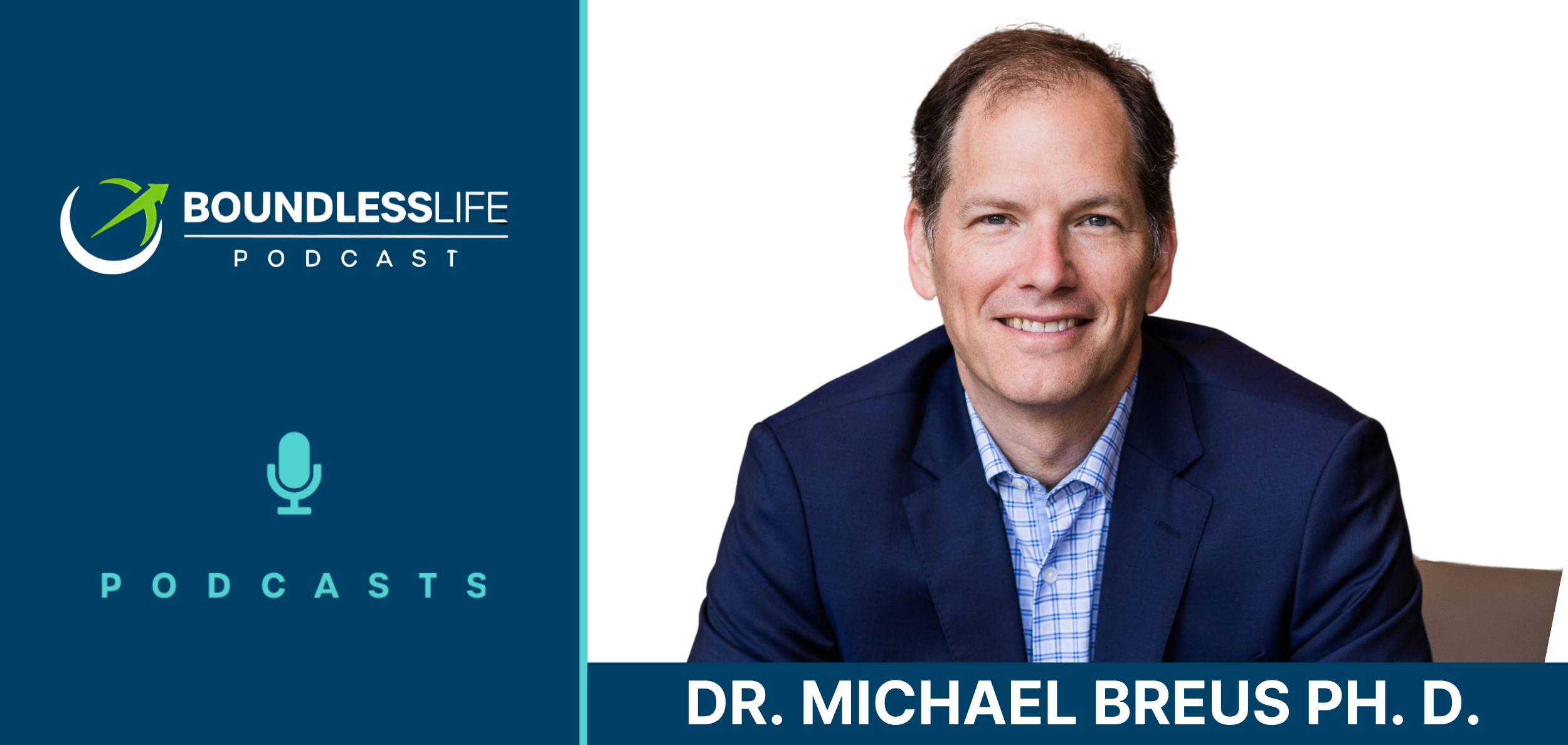
Home » Podcast » How To COOL Your Body For Better Sleep, INCREDIBLE Travel Sleep Tips & Orion Vs. Eight Sleep With Dr. Michael Breus

How To COOL Your Body For Better Sleep, INCREDIBLE Travel Sleep Tips & Orion Vs. Eight Sleep With Dr. Michael Breus

Listen on:

Reading time: 5 minutes

What I Discuss with Dr. Michael Breus:

  • Dr. Breus's rare status as one of only 168 board-certified sleep diplomats, his expertise on sleep, and his bestselling sleep books…01:46
  • How your core body temperature controls when you fall asleep, why cooling and warming strategies matter, and how simple choices can dramatically improve your sleep…04:33
  • The way alcohol, stress, hormones, room temperature, and heavy bedding disrupt your body’s natural cooling cycle, and the simple adjustments that can instantly make sleep more comfortable and restorative…10:26
  • Why small temperature tweaks can help your body stay in the right zone for deeper, uninterrupted sleep…14:51
  • How warming before bed can trigger better melatonin release, how new cooling mattress toppers actually work, and what to look for in low-EMF sleep tech that truly supports your body’s natural temperature rhythms…21:37
  • Orion’s smart cooling technology and personalized temperature tracking that keep your body in its ideal thermal zone all night for deeper, more consistent sleep…29:13
  • Orion’s gentle warming wake-up feature, its ability to personalize each side of the bed, and its comfortable, affordable design that fits any mattress…38:34
  • Dr. Breus's go-to travel sleep strategies, from picking the right airplane seat and hotel room to packing a few key tools that keep him well-rested on the road…42:50
  • More of his clever hotel and travel sleep hacks, from blackout tricks to pillow fixes, all the simple things he actually uses to sleep well on the road…48:51
 Visit : bengreenfieldlife.com/orionsleep and use code – GREENFIELD15 to save 15% off

In this fascinating episode, I sit down for another conversation with renowned sleep expert Michael J. Breus, Ph.D., to explore the science of temperature regulation and its massive impact on sleep quality. You'll get to dive into innovative technologies like thermoregulatory mattress toppers, discuss hacks for staying cool at night, and share practical sleep travel tips for anyone looking to optimize rest on the road. From how your core body temperature syncs with your circadian rhythm, to personalized sleep solutions and essential hotel room tricks, this episode is packed with actionable advice and the latest insights to help you wake up refreshed.

Michael J. Breus, Ph.D., is a clinical psychologist and both a Diplomate of the American Board of Sleep Medicine and a Fellow of the American Academy of Sleep Medicine. He is one of only 168 psychologists worldwide to have passed the Sleep Medicine Specialty Board without attending medical school. Dr. Breus was recently named the “Top Sleep Specialist in California” by Reader’s Digest and one of the “10 Most Influential People in Sleep.” Dr. Breus is on the clinical advisory board of The Dr. Oz Show and has been on the show over 40 times.  

Dr. Breus pens a monthly column in WebMD, “Sleep Matters,” and writes regularly for WebMD, The Huffington Post, and Psychology Today. He is also the author of The Sleep Doctor's Diet Plan and Beauty Sleep.

Dr. Breus is the author of four books, with his newest being Sleep, Drink, Breathe. This book provides an easy-to-follow three-week program to teach you how these three simple biobehaviors are the foundation for wellness.

For additional insights on the topic of sleep, you can check out our other show together here:

Please Scroll Down for the Sponsors, Resources, and Transcript

Episode Sponsors: 

Just Thrive: For a limited time, you can save 20% off a 90-day bottle of Just Thrive Probiotic and Just Calm at justthrivehealth.com/ben with promo code: BEN. That’s like getting a month for FREE—take control today with Just Thrive!

The Medicin: Immune Intel AHCC is a clinically studied shiitake mushroom extract that enhances immune cell communication through a patented fermentation process, creating highly bioavailable alpha-glucans. Backed by 30+ human studies and used in over 1,000 clinics worldwide, AHCC supports immune function for everyday wellness and chronic health challenges—learn more at TheMedicin.com and use code BEN for 10% off.

Organifi Shilajit Gummies: Harness the ancient power of pure Himalayan shilajit anytime you want with these convenient and tasty gummies. Get them now for 20% off at organifi.com/Ben.

LVLUP Health: I trust and recommend LVLUP Health for your peptide needs as they third-party test every single batch of their peptides to ensure you’re getting exactly what you pay for and the results you’re after! Head over to lvluphealth.com/BGL and use code BEN15 for a special discount on their game-changing range of products.

Timeline: Give your cells new life with high-performance products powered by Mitopure, Timeline's powerful ingredient that unlocks a precise dose of the rare Urolithin A molecule and promotes healthy aging. Go to shop.timeline.com/BEN and use code BEN to get 20% off your order.

Other podcast with Dr. Michael Breus

Resources from this episode: 


Upcoming Events: 

Do you have questions, thoughts, or feedback for Dr. Michael Breus or me? Leave your comments below, and one of us will reply!
Ben Greenfield [00:00:00]: My name is Ben Greenfield and on this episode of the Boundless Life podcast.

Michael Breus [00:00:04]: The goal was how do we figure out a way to keep people at what we call a thermoregulatory set point or what's the right temperature that your body needs to go to stay at and move through in order to have a good night's sleep. And so the good news is is that we're able to mimic that in just about anybody.

Ben Greenfield [00:00:24]: Welcome to the Boundless Life with me, your host, Ben Greenfield. I'm a personal trainer, exercise physiolog and nutritionist. And I'm passionate about helping you discover unparalleled levels of health, fitness, longevity and beyond.

Ben Greenfield [00:00:45]: All right, just finished talking with Dr. Michael Bruce. We discuss crazy cool new technologies to cool and warm your body during sleep. His sleep travel tips are off the hook. Incredible. I was taking notes like crazy. If you watch the video version, the yellow post its are flying. All the shownotes are going to [email protected] Sleep better for today's episode.

Ben Greenfield [00:01:06]: Enjoy. I have a two time, maybe three time my memory, maybe I need to sleep more. My memory doesn't serve me on this one, but my guest is at least a two time. He's a clinical psychologist and has a diplomat of the American Board of Sleep Medicine. I don't even know what that is, but it sounds official. He's a fellow of the American Academy of Sleep Medicine. His name is Michael Bruce. Michael was even kind enough to let me feature some of his work in chronobiology in my book Boundless.

Ben Greenfield [00:01:35]: But he also has books like the Sleep Doctor's Diet Plan and Beauty Sleep and recently released Sleep Drink Breathe. Wellness is too complicated. I was actually just with Michael in la. He has a wealth of knowledge on all things sleep and we have a special topic today. But Mike, welcome to the show.

Michael Breus [00:01:57]: Thanks for having me. Ben. I do think it's time number three. I think that I think I am a third time champ on the Ben Greenfield show, which by the way I enjoy and I listen to frequently and I definitely am excited to be here. The diplomat part, just for your own edification, that means that I took the medical boards without going to medical school and passed. I'm one of 168 people in the world who've ever done it as a diplomate. Now to be clear, all MDs who take the medical boards are diplomates as well. I'm just a PhD.

Michael Breus [00:02:29]: So I did. I had a little bit of a different route to take, but I've been practicing for 26 years. And so I do a lot of work based on my clinical experience, my read of the literature, and of course, you know, going to the edges and seeing if we can figure out how to help people sleep better.

Ben Greenfield [00:02:43]: Well, totally inside baseball probably. And there's like 0.1% of people who are going to be interested in this. But if you want to be a diplomat, do you have to have a PhD or could just like any hamburger flipper who's a smart cookie, take it and get the diplomat?

Michael Breus [00:03:00]: Great question. So it was a rogue board when I took it 26 years ago. So they were looking for people to take it. So you had to qualify, you had to have a healthcare type of degree. So you could be a DO, you could be an MD, you could be a PhD, you could be an RN, like a nurse or a chiropractor. And they were looking for people to take the boards. And good news for me, they closed the the way for people to do this. And so literally there's only 168 of us who've ever done it.

Michael Breus [00:03:26]: I'm sorry. I could definitely help you out if you wanted to take the test, but I'm not sure that they'd give you the diplomat over it.

Ben Greenfield [00:03:33]: Okay. Yeah, I'm not just going to go take the test for giggles. Don't get the diplomat. I'm not going to do it. So obviously, like I mentioned your wealth of knowledge on sleep, there's so many things we could talk about. I know you could talk about sleep for like 10 hours or more, probably a lot more. But I want to talk about temperature today. There's all these mattress coolers and cooling weighted blankets and the whole temperature piece of sleep is interesting.

Michael Breus [00:04:04]: It is.

Ben Greenfield [00:04:04]: But just from your perspective, because you're a really good teacher, how do you explain to people the importance of staying cool during sleep, even as the physiological part of it?

Michael Breus [00:04:17]: Yep, absolutely. Let's go to physiology first, because I always like to for people to know what's going on behind the scenes, meaning what's going on in their body to make them be able to fall asleep. So you're 100% spot on in picking temperature as a great kind of jumping off point when it comes to sleep. Most people don't realize it, but sleep follows your core body temperature cycle. What I mean by that is as your body cools down, you have a tendency to fall asleep. As your body heats up, you, your body has a tendency to wake up. This has been going on for thousands and thousands of years since the dawn of time since the dawn of human existence. And not just in humans, by the way.

Michael Breus [00:04:57]: We see this in most animal models as well. But sleep does follow the core body temperature cycle. So as an example, one of the things that we have a tendency to see happen is towards the evening time, let's say around 10, 10:30 at night, your core body temperature begins to slowly rise, rise, rise. It hits a peak of right around like 98.6, 98.8, so kind of your highest point of the day, unless obviously you're doing exercise or you're in a sauna where you're artificially raising your core body temperature, which we'll talk about in a minute and why that can be helpful for sleep. You hit this high point. Once you hit that high point, your core body temperature immediately begins to drop. That drop is actually a signal for your brain to release melatonin. So if your body doesn't drop temperature, your, your brain ain't got no melatonin.

Michael Breus [00:05:49]: And melatonin is what tells your brain it's bedtime. I want to be super duper clear. Melatonin is not like Ambien. Melatonin doesn't make you fall asleep. Melatonin is a circadian pacemaker, meaning it tells your body, hey, your sleep rhythm. Now is when we should start to see that what actually makes your body feel sleepy is something called adenosine. So if you remember, aden wave cell eats a piece of glucose, something comes out the back end when you one of those things is called adenosine. Adenosine works its way through your system, goes to a very specific receptor area in your brain, and as adenosine accumulates, you get sleepier and sleepier and sleepier.

Michael Breus [00:06:28]: So what's interesting is your body, you know, I've got to tell you, I'm so amazed by the human body on so many different levels because it, it does so many cool things. But one of the things it does is just about the time when you've got enough adenosine to really make you feel tired and is exactly when your melatonin kicks in via this temperature degradation to be able to allow you to fall asleep successfully. However, if anything screws this up, you can have very various typical times falling asleep from a temperature related issue. And by the way, you might have no idea that it's even temperature related. Let me give you a couple of examples. One example is working out at night. So look, I've got plenty of people out there from a chronotype standpoint, or what I call a wolf or A night owl. And let's be fair, they hate mornings.

Michael Breus [00:07:16]: They're not going to work out in the morning time. It's certainly not for, for them in terms of the best time of day for them to do something like this. But yet, hey, this is the only time I've got to work out. So I'm going to work out, you know, after work, before dinner, that kind of thing. And they artificially raise their core body temperature and now this can be problematic from exercise related raise in core body temperature because it takes a while for your body to cool down. Now you could artificially cool your body down by taking a cool shower or a cold plunge or something like that. However, if you do that too close to bedtime, it's super alerting, right? Like I don't know about you, but if I get into a cold plunge, like boom, I'm up. There ain't no going to bed for Michael after that.

Ben Greenfield [00:07:58]: Yeah. And if I didn't, by the way, how long would it take the body to cool if I did an evening exercise session?

Michael Breus [00:08:04]: So we'd like to say, of course it's going to depend upon how in shape you are. Gender as an example, women during their menstrual cycle, this can vary, but as a general guideline I'd say somewhere between 90 and 120 minutes is probably the timing when you would be starting to really see that cooling. But, but if you really wanted it, it's four hours. Like to, if you want to look at the data, it's really four hours where you start to see that eventual coolness kind of hit. And once again we're looking for a drop. And now here's where it gets interesting is there is data looking at a warm bath before bed, which you might think, hey, he just said we shouldn't exercise before bed. Why is he recommending a warm bath before bed? Because of the artificial nature of increasing the temperature so quickly and it being external. Right.

Michael Breus [00:08:50]: So this is external temperature that's basically coming in versus internal temperature that you are creating by using your muscles and you know, absorbing glucose and things of that nature. So it's a little bit different. But there is data to show that if you warm the body before bed, then artificially it raises your core body temperature, then you get that drop and then you're in business. Now here's where it gets kind of weird, right? So we've got this sleep initiation. That's basically a temperature drop forcing melatonin into the system. Hopefully you've got enough adenosine, you Go nighty night. But doesn't always work that way, right? And so as an example, let's say that you drink alcohol, right? So a lot of people like to have a bourbon or a beer glass of wine with dinner, what have you. Many people don't realize it.

Michael Breus [00:09:35]: Even though alcohol makes you feel sleepy, it has a thermogenic effect. In fact, it makes you sweat.

Ben Greenfield [00:09:42]: Really? As you know, everybody talks about. Well, it causes this release of inhibitory neurotransmitters like gaba. Those wear off and you wake up. But it sounds to me like there's more going on than that.

Michael Breus [00:09:53]: Absolutely, bro. And so what happens is, like, I don't know about you, but if I go out drinking with my buddies, I wake up maybe an hour and a half in drenched in sweat, right? The alcohol sweats, as they're often called, right? And this is a well documented thermoregulatory effect that alcohol has. It actually increases your. Increases your core body temperature, which again, is not what we're looking for. So there are external things that can be done. We've named exercise and alcohol as two things that can disrupt this core body temperature cycle. Let me talk for a half a second about what the core body cycle looks like in normals, and then let's talk about what it looks like in people where there's something different potentially going on. So in normals, what we have a tendency to see is after your core body temperature starts to drop, it drops by about 210 of a degree Fahrenheit, right? Every 20 or so minutes.

Michael Breus [00:10:51]: It then kind of bottoms out around one o' clock in the morning where you're at your coolest. But then you might reach a temper. Let's say you're down to 97, you know, 0.2 or something along those lines. You're starting to get pretty cold. Your body's starting to get pretty cold. Your brain doesn't like that, right? You go much further. You end up in hypothermia land, and that ain't good. So your core body temperature actually increases.

Michael Breus [00:11:15]: At that point in time, your internal furnace, if you will, kicks in and starts to rise. So there's a very gentle sloping going down and then there's a gentle rise starting around 3 o' clock in the morning. And then, and as the sun comes up about three hours later, you start to wake up because your core body temperature is up. You're not producing melatonin. You open up your eyes, you get some sunlight, turns off that melatonin faucet. Life is great, right? Everything seems to work wonderfully. However, if you screwed it up by having a lot of stress right before bed, which causes cortisol release, which actually has a thermoregulatory effect, if you drink alcohol or you have exercise too close to bed, you end up with hot sheets, right? And that doesn't work well for anyone. Now, also any.

Michael Breus [00:11:59]: Any women that are listening, there's a thing called menopause. It happens like in their mid-50s. And that is where you have a hormonal dysregulation which causes a thermoregulatory effect, by the way, for guys out there. There's also something called andropause, where you can also get these hot flashes in the middle of the night or this up upregulation of thermoregulation. And that becomes problematic as well. But here's the thing, what a lot of people just do, Ben, is they say, hey, I'm just going to crank the AC in my bedroom down to like 65, 68 degrees, or open the windows, right?

Ben Greenfield [00:12:34]: If it's fall, for example, or winter, right.

Michael Breus [00:12:37]: Depending upon what part of the country you're in or what part of the world you're in, that can be refreshing. But it also can get pretty cold in the middle of the night. So one of the things that a lot of people don't realize that they do is, is they put on the AC and then they pile on the covers and they wear flannel pajamas and they do all these things that cause what we call a micro climate underneath the covers. And so a lot of people say to me, oh, Michael, it's no big deal. I can crank my AC down or I open up my windows and I get the fresh air and it's nice and cool and it's no problem. But why do I still wake up at night and what's going on there? And what's happened is they've got comforter on top of comforter, they've got their pajamas, and all of these layers make it somewhat difficult for the body to really get any of that coolness and thermoregulate. Now, of course, you get some of it through your face, in your head, which is where you have a tendency to lose a lot of heat. But one of the things I talk about with people all the time is getting your feet out from under the covers.

Michael Breus [00:13:37]: And so I don't know if you've ever experienced this, Ben, but I've had this happen to me where it's the middle of the night, I'm hot as hell. And I just take my foot and put it outside the covers, and then instantly I get cooled down and I feel a whole lot better. Have you ever had that experience?

Ben Greenfield [00:13:52]: I have. And then I don't know if I heard this from you or somewhere else. I came across a recommendation to wear socks in. In. In a way. I think the way it was explained was that it paradoxically cools the body based on these special. Have a long name, arteriovenous something or other.

Michael Breus [00:14:13]: Yep.

Ben Greenfield [00:14:14]: The capillaries in the feet. So what is it? Do you put the feet out from underneath the covers, or do you wear socks? Or do both work?

Michael Breus [00:14:21]: It's all going to depend upon you and your level of ability to thermoregulate. So I'm glad you brought this up. So it feels kind of counterintuitive. Like he just said, bullets pull your feet out from under the covers. Right. And then Ben was just talking about wearing socks. So there is absolutely three different studies to show that if we heat just the feet before bed, it actually causes a cooling response. So what does that mean? So here's what ends up happening is you have to actually open up blood vessels by the bottom of your feet.

Michael Breus [00:14:51]: The thing that's so interesting about feet is they're a little bit like hands in that there's no hair on them. Right. And so when you don't have hair on them, they're not insulated, which means it's far easier to dissipate heat, which is one of the reasons why, if you're hot in the middle of the night, you stick your foot out. But if I'm honest with you, it's kind of too late at that point. Right. You're already woken up, you're already pretty uncomfortable. The goal would be to avoid ever actually waking up. There's a couple of things, though, that we want to kind of double tap on.

Michael Breus [00:15:19]: This whole sock idea would be one where you actually have socks on, and then right as you're falling asleep, you kick them off. Right. And then be able to sleep without socks on. And then your body has a little bit better way to thermoregulate. Once again, not to make this even more complicated, but menopausal women or women who have a period, you're going to see very different thermoregulatory processes occurring based on where they are in their menstrual cycle or where they are in their menopause journey. But as a general guideline, we want the feet to be a little bit warm before bed, and then once you're Asleep. We want them to be able to dissipate that heat and allow your body to cool down. This microclimate, though, is weird because it's very hard to influence the microclimate.

Michael Breus [00:16:04]: Now, I had a recommendation which I still give, by the way, all the time to people. And here's what I tell them to do. I say, look, if you're waking up with hot flashes or something is going on weird for you, here's one way that you can test to see if actually thermoregulation is kind of your jam and what's going on for you is go to the get two bottles of plastic bottles of water, stick them in the freezer, right? Freeze them completely, then take them and drop them into tube socks, like those old athletic socks. Because you know they're going to. Because what I'm going to have you do is put them in your and put them on either side of your hip. And when you put them on either side of your hip, it's like your own little personal air conditioning system that seems to work. And if you sleep well with that, then we're getting somewhere. Then we have an idea set that says, hey, this is somebody who is going to require some level of up and down in terms of their thermoregulation.

Michael Breus [00:16:56]: For whatever reason their body is not doing it appropriately. It could be alcohol, could be exercise, could be stress, could be menstrual cycle, what have you. That's where some of these interesting new cooling technologies have come from, these thermoregulatory cooling technologies where you can actually cool or heat somebody from underneath them, underneath the sheet versus piling covers on top and then on that, trying to make your climate one of coolness.

Ben Greenfield [00:17:23]: I give it about T/3 weeks before someone starts plastic tubes for sleep.com and start selling some tube sock plastic bottle contraction. I actually want to talk about some of these cooling technologies momentarily. But one thing I was wondering because I've tried this sometimes and it seems to work, but you might know the answer. I've been wanting to ask you this, actually. I have some of these like, you know, infrared mats that produce heat, sometimes red light. I keep one underneath my bed and occasionally I will pull that out and you know, before dinner or whatever, put it at 150 degrees. You know, the room's nice and cool. I get in bed and sometimes I'll lay on that thing and read, you know, on heat and read for like, you know, 15, 20 minutes before bed.

Ben Greenfield [00:18:11]: And I feel like it kind of makes me sleepy, like, like lulls me into a better sleep state. And then I turn it off and shove the mat under the bed and go to sleep. Is there something to be said for almost like a sandwich where you go like, warm to cold to warm?

Michael Breus [00:18:26]: Absolutely, brother. Basically what you're doing is you're bypassing the bath before bed and you're just. Right. And you're just passively heating your body before bed, which is causing this artificial rays, which then causes the drop. And then you're basically signaling your brain to release melatonin. That's where that feeling is coming from. That sleepy feeling is kind of coming from. So you're already actually doing it with the.

Michael Breus [00:18:48]: Is it a PEMF mat or is it a just a regular heating bed?

Ben Greenfield [00:18:52]: The one I've been using is that company. They were actually at that event we were at in LA therosage.

Michael Breus [00:18:57]: Oh, huh.

Ben Greenfield [00:18:58]: Yeah, yeah, yeah. It's just their mat. It's got red light and PEMF and heat, and it feels good. You know, especially if my wife's gone and I'm in bed at night, it's almost like my alternative to snuggling with her, just lay the mat underneath my body. So.

Michael Breus [00:19:10]: And not only that, if you've worked out that day, you could also be helping out, flush out some inflammation and things of that nature that could be valuable for you, depending upon, you know, what your workout looked out for the day.

Ben Greenfield [00:19:23]: Yeah. And when we were at that event, there was a bed, and I know you're involved with this company, so you could probably fill us in. And it had like one of these thermoregulatory. I don't know what you call, like a topper on top of the bed. And I think people are probably familiar with the concept of something like eight sleep as probably the closest thing to something like that. What are your thoughts on these? What do you call them? Mattress toppers?

Michael Breus [00:19:49]: Yep. So that's exactly what we call them mattress toppers or thermoregulatory mattress toppers. So, number one, I think it's a great idea. I think this is finally a. In the bedroom that I like. Generally speaking, I like less tech in the bedroom when. When possible. But this makes a lot of sense because the way that it utilizes water and heating and cooling water, I think is.

Michael Breus [00:20:14]: Can be quite helpful. And so the basics of any of these types of devices is quite simple. There's a topper, maybe it's 2 or 3 inches of some type of foam. There's a tube that goes through the foam, and either warm water or cool water. Is pumped through the tube, which then comes from underneath your body. Right. Which is also helpful because, by the way, most people have got fat in the front of their body. Right.

Michael Breus [00:20:40]: And so that adipose tissue is very insulatory, whereas when you have it coming across the back, you can actually feel the warmth or feel the cool a lot better. And so that's one factor that I really like, generally speaking about these types of devices. But I'll be honest with you, some of the devices aren't. They're very, I guess, dumb devices at times where it's just you push a button, you make it cold, and then you hope for the best. That, I think, is while initially probably helpful, kind of like the water bottle idea, what it doesn't do is it doesn't follow the curve that your body actually naturally wants to set, which is what's called an ultradian temperature curve. And so what we want to do is we want to have smarter and smarter devices that can actually follow those curves and understand what kind of situation you might be in to begin with. So I'm part of a company where we actually look at some of those things. The range also is something that I think is important for people to think about, is you want to have a device that can get you to the warmer places and the cooler places that are still healthy for the body.

Michael Breus [00:21:49]: As it stands right now, some of the devices on the marketplace. And by the way, there are several different devices, and I'm not saying one over the other, but all of them have a tendency to use the technology. Some of them don't go as warm or don't go as cold, and you probably want to have a little bit more range than a lot of them have.

Ben Greenfield [00:22:07]: Yeah, the one. The ones that I know of, by the way, are bedjet, which is like an air conditioning system for the bed. I don't think there's a warming feature on it.

Michael Breus [00:22:16]: Bedjet, if memory serves, is basically it's blowing air from beneath your bed.

Ben Greenfield [00:22:21]: Yeah.

Michael Breus [00:22:21]: Across your feet. Right.

Ben Greenfield [00:22:23]: Yeah, exactly. And then there's Chilipad and then eight sleeve. You know, I don't know that much about eight sleep. Besides, I've kind of resisted using it because I've talked to some people who've had building biologists come through their home, and it kind of tests a higher EMF in the topper, which could be a potential concern. The bedjet, I don't think it actually has the ability to do warming or much control for variation during the night. And then chilipat, I think they kind of had a decent product, but it just. I mean, my apologies to the people at chilipat. It just broke all the time.

Ben Greenfield [00:23:01]: So there's one. I was. I was looking at this one at this conference that we were at. You know, it turns out you're involved with these people, this Orion. I want to talk, if you can, fill me in on about some of the things built into that, I guess the big one, the elephant in the room that I just said emf. Do you know if they've addressed that in that topper?

Michael Breus [00:23:21]: So they have addressed that, and we have some of the lowest EMF frequencies out there. And that was part of the goal, was to be able to address that. And look, I mean, let's. Let's do a quick double tap on EMF in general. How does it affect sleep? What are we kind of thoughts there? So, number one, very few people have got good technology to measure EMF and to measure whether or not an individual is sensitive to EMF. You know, I've been practicing for 26 years, and I may have had a half a dozen people who have been EMF sensitive. By the way, that doesn't mean that. That's only the number I had in my practice.

Michael Breus [00:24:00]: That's the number that were so EMF sensitive that they came to me and they're like, michael, what can we do? Do I need grounding sheets? Do I need to, you know, have a Faraday cage in my room? There's special paint you can actually paint on your walls that can help you with EMFs.

Ben Greenfield [00:24:16]: Right, but none of that matters if you're sleeping on something that's producing emf.

Michael Breus [00:24:20]: Exactly. That becomes highly problematic. Right, so not just the electricity that's rolling through the walls, but if you're sleeping on a device that has that, that becomes problematic. So, absolutely. That's one of the things that Orion has addressed in terms of understanding, like, what's going on for people. Because, look, we. The last thing that anybody wants to do is add something that could be potentially unhealthy. Right.

Ben Greenfield [00:24:44]: And I know you're not an engineer, but do you know how they. How they fix that or how they address that?

Michael Breus [00:24:49]: So I'm pretty sure they grounded the device. I'm not 100% sure, but I'm pretty sure they grounded the device itself. So that way, any EMFs go through the ground and out.

Ben Greenfield [00:24:59]: Okay, interesting. Okay, so the EMF component could be taken care of. And then what else do you look at on a mattress topper like this? Because I know you talked about, like, the way the body kind of changes throughout the night.

Michael Breus [00:25:13]: So one of the things that I was interested in was really starting to understand, like, how do people's core body temperatures change over the course of the evening? And by the way, lots of people change in different ways. As an example, your core body temperature and my core body temperature, even though we're both, you know, Caucasian males, could be wildly different based on our age, our fitness level.

Ben Greenfield [00:25:35]: Yeah. How much chili we had before bed, which really affects that microclimate, for sure.

Michael Breus [00:25:40]: Affects the microclimate. I think that's called the Dutch oven. I'm not sure, but that's a whole nother story we can get into. But yeah. So, you know, one of the things I really wanted to learn was how does that work? And it turns out that it's not as consistent as one might think. And so what can happen is, is all kinds of different variables can cause awakenings. Now, what is an awakening? And do we care? Well, we do, because it's like a little mini alarm clock that's going off. And what happens is our body goes from deeper stages of sleep when it gets warm, to lighter stages of sleep, and then actually awakenings.

Michael Breus [00:26:13]: Right. And so when people wake up with the night sweats, as it were, they are very uncomfortable. Their heart is usually beating quite quickly. They are drenched in sweat. And the goal was to avoid as much of that. That particular scenario is possible. Now, where do we see that scenario? We see it a lot in menopausal women. We see it in women in general.

Michael Breus [00:26:35]: We see it in men also. So the goal was, how do we figure out a way to keep people at what we call a thermoregulatory set point, or what's the right temperature that your body needs to go to stay at and move through in order to have a good night's sleep? And so the good news is that we're able to mimic that in just about anybody. So what happens is there's a patch that comes with the product itself. Now, this is unique to the Orion product. I don't know if anybody can see that, but this is a patch, by the way.

Ben Greenfield [00:27:08]: Orion is from the O R I O N O N. Actually, you know what I can do? So the show notes I'll [email protected] Sleep Better. It's BenGreenfieldLife.com SleepBetter and I'll put a link to this Orion stuff, maybe some pictures of it so you can see what we're talking about. Okay, so this patch.

Michael Breus [00:27:28]: So the patch is interesting. As you can see here, there's a sensor beneath it. And for one night, what you do is you put it underneath your arm and you sleep with it there. And when you wake up in the morning, you take your iPhone or whatever phone and you put it on the patch and it will instantly give you an assessment of how many times you woke up based on temperature irregularities. So there's not the guesswork. Like a lot of people say, well, hell, I wake up in the morning in the middle of the night and I'm sweating. I want to fix that. I'm just going to crank it down and see what happens.

Michael Breus [00:28:02]: That becomes problematic. And here's why. If all you did was make your body colder, your body will react to that with heat, right? So think about it, right? The body reacts. So if all I do is sit outside in the snow, what does my body try to do? It tries to generate heat internally so I don't go hypothermic and die. So you have to be. There's a balance that has to be played. And so you have to know where somebody is to start with their temperature, where you think they need to go, and then how to get them there safely and effectively. So when you wake up in the morning after having used this patch, we can then download these data into the product and create a profile for you specifically.

Michael Breus [00:28:43]: And I think that's really where the rubber meets the road on thermoregulatory devices, because historically it was more like the, the, the plastic bottle, water bottle kind of, you know, thing where we just jam you down and make you as cold as possible and hope for the best when there really is a secondary effect here, you cannot just cool the body and keep cooling it and think that the body's just going to get colder and colder, because it's not.

Ben Greenfield [00:29:07]: This is fascinating. So, so could. So if I wear that wearable, is it going to detect just when I wake up? Or could it even detect how my temperature correlates to my sleep cycles, like non rem, rem, light sleep, et cetera, and kind of like adjusts my temperature on the Orion while I'm asleep to optimize my sleep stages.

Michael Breus [00:29:30]: So that will be phase two of the product. You are jumping ahead, which you always do, brother. You're always thinking in the future. But that's the goal is to eventually make this dynamic, right? And so it understands what stage of sleep you're in. It then can self adjust. We're going to need to collect a good bit of data to do that, but we're on our way and we're excited to have that opportunity, but this is really a science backed company so we're really looking at the science as hard as we possibly can. I mean, look, to be fair, all of those other companies, the Chili's and the Eights, they're awesome. They've done a fantastic job of educating the public and I think they've done some wonderful things.

Michael Breus [00:30:11]: We have a slightly different approach. We feel that we're out there to help as many people as we possibly can and we're looking forward to doing it.

Ben Greenfield [00:30:19]: So this, this like personalized comfort that based on your personalized temperature, based on your data, maybe your data would change. Does the device itself do any measurements besides the wearable? You know, in the future, as you.

Michael Breus [00:30:32]: Continue to use it in the future? It will. It doesn't currently, but it will. So we're moving all in that direction for basically we're turning it into a super smart device. It's already getting smarter with this data, that patch that we have. And the thing is that you have to actually attach something to the skin in order to get a fairly decent core body temperature reading. You can't just be lying on top of something and kind of hope for the best. So we have to use some of those data. So it might be a patch where you wear the patch, let's say once a week for four or five weeks.

Michael Breus [00:31:07]: That then creates, you know, the profile for you type of thing and then we can get back to you on it. But we're excited to explore it for sure and we think we've got some real learnings in there.

Ben Greenfield [00:31:16]: Yeah, I generally get up sometime between 5 and 5:30am But I don't really set an alarm. I just wake naturally. Occasionally that backfires. Right. And maybe I'm short on sleep. I open my eyes at 6am and all of a sudden I'm 30 minutes plus behind the eight ball. And part of that is I just don't like the way I feel from a jarring alarm clock. With something like this, could I theoretically say, well, I want to wake sometime between 5 and 5:30, just start to gradually warm at that time.

Ben Greenfield [00:31:45]: Almost like a body warming alarm clock.

Michael Breus [00:31:47]: Exactly. That is actually one of the feature sets that's coming next to be able to naturally wake people up because alarms suck. And if I'm honest with you, most people hit the snooze button, which by the way is the single worst invention in all of sleep. Like the average snooze is seven to nine minutes long and your Body physically can't get into a deep stage of sleep at that point in time. But we could easily slowly sunrise you to wake you up and you'd have a much better awakening. You wouldn't wake up feeling logy or groggy because you'd be waking up out of a lighter stage of sleep, which we could eventually put you in by raising your core body temperature. Absolutely.

Ben Greenfield [00:32:26]: Okay, and then what about my wife? Let's say we get this. We have a California king. I put it on. I plan on getting one, by the way. And I put it on our mattress. And she's got a different profile than me. Perfect.

Michael Breus [00:32:39]: It's easily personalizable per side. As an example, we could heat her up while we cooled you down, if that's. If that made more sense for her. So as an example, if she was waking up because of getting colder, which we do see in, for example, women who are iron related anemic, we do see that they have a tendency to be very chilly in the middle of the night. And so heat actually can be helpful for them. So absolutely, we would be able to do that. Or we could have you both cooling at different cooling rates, again, based on your profile and what works for your body.

Ben Greenfield [00:33:12]: Okay, now let's say that somebody gets this. Now I'm assuming like we're recording this in. We're not recording this. It's November of 2025. Is it available to actually purchase yet?

Michael Breus [00:33:24]: It is. You can pre order it now and people will be getting them within the next couple of weeks. So we're, we're hoping to hit for the holidays, you know, give the gift of good sleep.

Ben Greenfield [00:33:34]: Yeah, could be kind of fun. I saw it at the, I saw it at the event. It's kind of like a small. It's actually pretty tasteful. You know, it's like this, not like a. Some off a spaceship. It's like a little kind of wooden device next to the bed, two tubes coming out of it. And then the surface is pretty comfortable to lie on.

Michael Breus [00:33:49]: And that was the goal. Some of the manufacturers out there have actually created mattresses and entire sleep systems with type of technology involved. If I'm honest with you, it's too tough to do that. There are so many different body types and so many people who like different kinds of mattresses. The inventory on something like that would be insane. So having this overlay, or what we call a topper for the mattress that you already like works really well. We do have it at kind of a medium firm, which is so that way you don't sink into it. So as an example, if we made it too soft, you could feel the wire and we didn't want anything like that happening.

Michael Breus [00:34:23]: So you can't feel the wire. It's just kind of like an extra. Like you're lying on top of a little mini duvet, if you will. It's got a nice kind of comfort feel to it. Also, we did. We decided not to make it look like a computer. A lot of the ones that are out there look like a tower computer. You know, they're black and, you know, they're kind of.

Michael Breus [00:34:40]: They're kind of different looking. Ours is more of a. Has kind of a Scandinavian feel to it. It's got creams, it's got a wood cap. It's actually a decent looking piece of furniture.

Ben Greenfield [00:34:50]: And not that I want to keep, you know, tapping h sleep on the shoulder, but the other thing people talk about is that it's kind of expensive. Yeah, more expensive. Less expensive. Like, what's the comparison?

Michael Breus [00:35:03]: Sure. So our goal was to be significantly less expensive. And so we come in about a third less than some of the other products that are out there. We're falling to the $2,200 range with a subscription fee. Most of the other ones, you're looking at 3,500 to $4,000 plus subscription fee. And our goal is to get in as many people's beds as possible. So our goal is, I mean, we can make plenty of money at that rate and do a lot of good and help a lot of people.

Ben Greenfield [00:35:32]: Yeah. I joke to people. I'll pay $20 for a good night of sleep. So for me it'd be 100 and some days. This would pay for itself, right?

Michael Breus [00:35:38]: Exactly. It's kind of remarkable.

Ben Greenfield [00:35:40]: I have to count the days I'm traveling, which kind of sucks. You know, you get your perfect sleep set up at home and then you travel and it's very difficult to replicate.

Michael Breus [00:35:48]: I'm glad you brought that up because we're working on a travel version as well.

Ben Greenfield [00:35:53]: Oh, no way.

Michael Breus [00:35:53]: Yes. Way better. It's going to be awesome.

Ben Greenfield [00:35:57]: That would be incredible. Wow. Yeah, you could probably do. Because I know there's some hotels. I was just staying at the proper hotel actually, when I saw you. And I was down in la and they have wellness suites now, water filters and circadian friendly lighting and access to a recovery lounge and some other parameters. And they have the eight sleep actually in those rooms. You guys could probably partner with hotels and wellness brands as well.

Michael Breus [00:36:22]: I think that's definitely on the roadmap, we wanted to make sure that we got the science right and got the product, you know, working and doing all the things that we wanted to. And I think next step is to start looking at some of those, some of those places. I've done a tremendous amount of work in the hospitality world because sleep is basically, you know, hospitality is basically selling sleep, at least on some level. So I've worked with a lot of really wonderful places. Six Senses Hotels comes to mind. Post Ranch Inn comes to mind. Crowne Plaza. So there's a lot of people out there who've got some great programs.

Michael Breus [00:36:54]: Equinox has got a new interesting program that they're touting for better sleep. So I think you're right. I think this would be a great type of product to get involved in some of those types of environments for people as well.

Ben Greenfield [00:37:06]: And let's say you're just in a plain Jane hotel room. Let's say you, Michael, you're traveling, you don't have access to any of this fancy shit. Maybe you have a few choice things that you travel with. I'm sure people are wondering, what does the sleep doctor do when you're out of your perfectly optimized home environment?

Michael Breus [00:37:23]: You bet. Okay, so this is one of my favorite topics. And so first of all, I look at. On, I look up for my plane. I look for seats based on a website called seatguru.com this is a. This is a seating guide on airplanes that tells you where it's best to sleep on an airplane. It's got a red light, yellow light, green light map on it.

Ben Greenfield [00:37:43]: Is this based on, like how loud the overheads are or so it's based.

Michael Breus [00:37:46]: On a couple things. It's based on where in the fuselage you are. It's based on noise levels. It's also depending upon your height because you're a significantly taller than I am. So which seats are going to be able to fit these people. But I start out with SeatGuru.com and I. And it's. What's cool is you just put in your flight number and it brings up the fuselage of the plane that you're flying on because it can be different.

Michael Breus [00:38:07]: And then it tells you where on the flight, especially if you're doing an overnight or you've got a, you know, six and a half to eight and a half hour flight. That's one place to start. The second thing that I do is when I go to the hotel, the very first thing that I do is I walk up to the, to the counter And I ask them a question. I say, hey, how did you sleep last night? Before I get into all of it, and 99% of the time the person there is like, oh, I slept terribly. And so I give them a little piece of sleep advice, right? And I say, hey, you're on the night shift. There's a couple things that you can consider doing. Don't over caffeinate, you know, do this, do that. And then I turn to them and I say, by the way, can you please give me the quietest room in the hotel? Almost instantly I get, I get the upgrade to the quietest room in the hotel.

Ben Greenfield [00:38:55]: Yeah, but probably like far from the elevators, not below the gym.

Michael Breus [00:38:58]: Exactly, exactly. It's usually a corner room. So I only have one neighborhood, Right. I don't have neighbors on either side. It's usually a little bit higher than the street noise, so you don't hear cars going by, but not underneath the gym or the penthouse or whatever. Also, they don't necessarily put name next to the peewee hockey team that happens to be, you know, there for their convention or, you know, their tournament. But the thing is, is when you make your reservations, generally speaking, you're at a call center, you're not actually at the property. And so when you get to the property, the best thing that you can do is make friends with the person at the front desk because they know the property and they know it well.

Michael Breus [00:39:36]: And if you want to get a really good night's sleep, that's definitely one of the things that can be helpful. So once I enter into the room, the first thing I do is I go over to the alarm clock and I. And I take a look at it because usually some idiot has said 4:30 in the morning because they've got some freaking flight. And I don't want to wake up at 4, 4:30 in the morning. So I either unplug it completely or I make sure that the alarm is off. And then I also bring with me my own eye mask and my own earplugs because if I'm honest with you, I like. You travel a ton. And so I actually sleep with the bathroom light on with the door cracked.

Michael Breus [00:40:13]: Because sometimes when I wake up to pee, I'm not really sure what the room looks like. You know, I've been in multiple rooms that week, so I'll wear an eye shade to make sure that I've got some really good darkness going on and some earplugs as well. Because there's always weird sounds in hotels that you're not used to, by the way, there are a couple of different products out there from an earplug standpoint that are kind of interesting. I personally use a product called earplanes. This is a silicon version that kind of looks like a funnel and it goes right in the ear. It works really, really well. I have no affiliation with them whatsoever, but I like their product. There's one now that I saw called Oslo.

Ben Greenfield [00:40:51]: Yeah, I got those a couple months ago. They're incredible. They block noise. They last 10 hours. They have an accelerometer in them that detects when you fall asleep or stop moving. And it'll automatically shift from whatever, say, audiobook or podcast that you've been listening to before sleep, if that's your thing, to whatever relaxing sleep sounds are built into the earbuds. They're pretty cool.

Michael Breus [00:41:13]: Yeah. So the guys that did that, they were formerly at Bose because Bose had these beforehand and they couldn't get the batteries right. And these three engineers peeled off, started this company, and it's awesome. So I travel with my Oslos because that can be helpful. Also, that's helpful for sleeping on an airplane, by the way. So is my eye mask. Can be helpful for sleeping on an airplane. Then after I've got that, I always.

Michael Breus [00:41:35]: This is going to sound ridiculous, but I do it. I bring a chip clip with me, like the kind that goes on the bag of potato chips, and I walk over to the window and I pull the curtains closed and I clip the curtains because invariably there's sunlight comes streaming through and I catches me in the eye. And I want.

Ben Greenfield [00:41:54]: Most hotels. Yeah, I use the closet hanger. That proper hotel I was talking about, they've caught on. They got blackout curtains in the wellness suites. But, yeah, same thing. Same thing with all the blinky lights, just the alarm clock. I unplug other stuff you can unplug. I actually do have the electrical tape.

Ben Greenfield [00:42:12]: I rarely have to use it, but sometimes there's just something super bright and I'll cover it up with the electrical tape. But the only other thing that. The only thing that I do differently than you with the bathroom thing is if I'm traveling with my wife, I always have just a cheapo red light headlamp from Amazon. And I just put that on to get her on the room at night. And then when I'm by myself, I actually pack an extra stainless steel water bottle and I keep it next to the bed. And I kid you not, I know it sounds gross, but I just roll over, let my dick hang off the bed, pee, and Roll over, go back to bed. I actually sleep way better. I know it sounds totally gross.

Ben Greenfield [00:42:52]: Don't drink out of the water bottle in the morning. But it actually kind of works.

Michael Breus [00:42:57]: Yeah. So I don't go that far because I usually try to relieve myself before I go to bed. And I haven't historically, historically had to use it a lot, but I hear where you're coming from. And also I've also been known to bring like these little plug in night lights that you can just pop one into the, into the water closet where the toilet is. So that way you can go in. The key though is not to turn on the lights because then you tell your brain it's morning and it stops producing melatonin.

Ben Greenfield [00:43:23]: Exactly. Yeah. Especially the bright hotel lights Block blue light and von charge. They both sell motion activated red light squares. And that's what I have in my master bathroom at home. And it'll just auto detect when I walk in and turn on.

Michael Breus [00:43:39]: Yeah, and those are perfect for travel and for home use. I recommend them constantly. And those are the ones I like because they're motion detected, so they're not on all the time. It makes life a lot easier. But I got a couple of more things about hotel that I want to tell people. So also, when I'm down at the front desk, I do not ask for the king size bed ever. I always ask for a room with either two queens or two full beds. Let me explain why the king beds, number one, they're the most expensive bed in the property.

Michael Breus [00:44:12]: And what ends up happening is everybody wants one, they sleep in the middle of it, and it looks like a fricking taco by the time most people get to it. So just from a surface area standpoint, if you're sleeping on a king, I would rather you get two queens or two full beds because number one, they're replaced less often, but they're used less often. And so what ends up happening is you get better support. And that becomes highly important when you're traveling like you and I are. And we're not getting to go to our favorite bed at night with our, you know, our pillow between our knees and all of that other stuff. And so ask for, don't ask for the king size bed. Honestly, I, I know it sounds like you want to, but especially if you're traveling alone, there's absolutely no need. Get a firmer bed.

Michael Breus [00:44:57]: Your back will be thrilled. And then another thing along those lines. Now this is my favorite hack of all hacks that I'm letting you know about. Is I go into the bathroom and there's usually three types of towels in the bathroom. There's a washcloth, there's a bath towel, but then there's kind of an intermediary hand towel. I take the intermediary hand towel and I lie it out on the desk and then I roll it up long ways and I put it inside my pillow. Inside across the horizon of the pillow. And it gives me added neck support.

Michael Breus [00:45:30]: So that way. Because here's the thing is when you're buying pillows for a hotel, you buy them overstuffed because they last longer, but they're not good for your neck. And you can really get your neck jammed up by having the wrong pillow. By the way, if I'm traveling for more than three days, I usually bring my own pillow. I know that sounds ridiculous, but I do it and it works really, really well. Again, less than three days and I put this thing across the horizon and that works out quite well for me. But more than three days, I'm probably bringing my own pillow along with my eye shades and my earplugs.

Ben Greenfield [00:46:03]: I actually have a few notes. I know some of you will listen to a podcast. I was like, how do I implement? Well, all I do, just to give you guys an example of how I manage things like this, because I talk to super smart people like Michael every week after my call with Michael, all I'm going to do is go to Google Calendar. I'm going to go to my next flight, and under the notes section or the comments section, under that next flight, I'm just going to write, check seat guru, ask about a queen size bed, remember the towel trick and ask for the quiet room. And that way it's automatic. I don't have to worry about this. It's just ready for my next trip to jog my memory. So in case you guys want to know, my tip for keeping up with people like Michael, well, the Orion thing is also super interesting.

Ben Greenfield [00:46:50]: That was originally what I wanted to talk to you about. But these other tips are incredible. Also, Michael, of course. For those of you who want to listen to my other shows with Dr. Michael Bruce, you can go to BenGreenfieldLife.com Sleep Better BenGreenfieldLife.com SleepBetter I'll link to everything we talked about. The huge episode Michael and I did on chronobiology. You know, he mentioned the wolf. We take a deep dive into the wolf, dolphin, lion, the bear.

Ben Greenfield [00:47:19]: So take a listen to those. Check out his books too. What was, what was the OG the original book that got us connected in the first place.

Michael Breus [00:47:26]: Michael it was probably the Power of When W H E N, which is where I delineate out my whole chronotype idea set and what's kind of going on there. And it's really the greatest unlock you could possibly do because once you know your chronotype, I can teach you the best time of day to have sex, eat a cheeseburger, ask your boss for a raise, sleep, you name it.

Ben Greenfield [00:47:46]: Yeah, I'm kind of a Brian. I'm like a lion bear combo, but. Well, Michael, thank you so much for doing this, man. Your wealth of knowledge as usual.

Michael Breus [00:47:55]: Thank you. Ben. I always, always, always appreciate you and where you go with all of these topics. I love your energy for them them. I love your practicality for them and I love the. I love how you communicate them. So I want to thank you for doing such an amazing job with such complicated stuff all the time. It's.

Michael Breus [00:48:12]: It's really a superpower of yours. Thanks.

Ben Greenfield [00:48:14]: Thank you. That's awesome. Thanks. All right, folks, until next time, I'm Ben Greenfield along with Dr. Michael Bruce, signing out from the Boundless Life podcast. Have an incredible week.

Michael Breus [00:48:25]: Sweet dreams.

Ben Greenfield [00:48:26]: To discover even more tips, tricks, hacks and content to become the most complete boundless version of you, visit BenGreenfieldLife.com. In compliance with the FTC guidelines, please assume the following about links and posts on this site. Most of the links going to products are often affiliate links, of which I receive a small commission from sales of certain items. But the price is the same for you, and sometimes I even get to share a unique and somewhat significant discount with you. In some cases, I might also be an investor in a company I mention. I'm the founder, for example, of Kion llc, the makers of Kion branded supplements and products, which I talk about quite a bit. Regardless of the relationship, if I post or talk about an affiliate link to a product, it is indeed something I personally use, support and with full authenticity and transparency recommend. In good conscience, I personally vet each and every product that I talk about.

Ben Greenfield [00:49:28]: My first priority is providing valuable information and resources to you that help you positively optimize your mind, body and spirit. And I'll only ever link to products or resources, affiliate or otherwise, that fit within this purpose. So there's your fancy legal disclaimer.

Ben Greenfield

Ben Greenfield is a health consultant, speaker, and New York Times bestselling author of a wide variety of books.

What's Blocking You From Living Boundless?

Thoughts on How To COOL Your Body For Better Sleep, INCREDIBLE Travel Sleep Tips & Orion Vs. Eight Sleep With Dr. Michael Breus

Leave a Reply

Your email address will not be published. Required fields are marked *

Related Podcasts

Ben-Greenfield-Luke-Cook-2

Fireside Chat with Marvel’s Luke Cook: Cyclical Keto, Ketones, Cold Plunges, Nootropics, Peptides & Living Vital to the End

Listen on: Reading time: 2 min In this special live-recorded episode, actor Luke Cook—known for Chilling Adventures of Sabrina and...

Josh Clemente WP

The Weirdest, Most Shocking Things You Can Learn About Your Body From A Blood Glucose Monitor with Josh Clemente

Listen on: Reading time: 5 minutes What I Discuss with Josh Clemente: How his love of coffee began at SpaceX,...

Dylan Gemelli WP

Heart Hacks, Diet Myths Debunked & Straight Talk About Custom Nutrition with Dylan Gemelli

Listen on: Reading time: 5 minutes What I Discuss with Dylan: How factors like genetics, hormones, and microbiome diversity make...