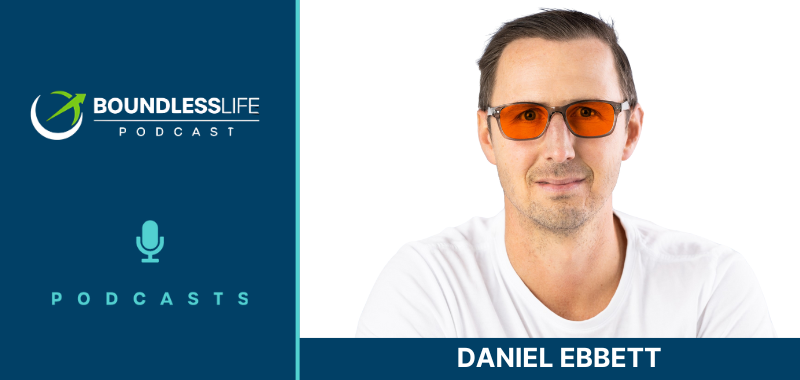
The Healthiest Way To Light Your Home For Optimizing Sleep & Energy (& How To Sleep Better When You TRAVEL!) With BlockBlueLight’s Daniel Ebbett

Affiliate Disclosure

Listen on:

Reading time: 6 min

What I Discuss with Daniel Ebbett:

Daniel Ebbett is a visionary leader in the field of blue light and its effects on human health. As the founder and CEO of BlockBlueLight (save 10% off here—auto-applied), a premier global brand for blue and artificial light-blocking products, he has made it his mission to promote and educate the public about the science behind modern phenomena such as digital eye strain and poor sleep, as well as the connection these have with screen overuse.

BlockBlueLight creates cutting-edge blue light glasses, red light therapy devices, and healthy lighting products to help people sleep better, feel better, and perform at their best. They serve a global community of health enthusiasts, biohackers, and anyone looking to optimize their light environment for better well-being.

Through his innovative product range, he champions eye health, sleep quality, and overall well-being. His journey to create BlockBlueLight began with a personal quest to fix his own health issues, including chronic insomnia, eye strain, and migraines, which were caused by his own overuse of electronic devices.

Determined to find a solution, Daniel conducted extensive research and discovered the impact of blue light on circadian rhythms, which can suppress melatonin secretion and cause sleep issues. He also learned about the dangers of chronic exposure to artificial light during the day, including eye strain, migraines, and even permanent eye damage.

Today, BlockBlueLight is recognized as one of the most trusted and respected international brands in the field of blocking blue light technology. With a passion for helping people live healthier lives, the company BlockBlueLight aims to make mitigating blue light a mainstream concern and empower individuals with the tools and knowledge they need to thrive in today's digital age.

💡 You can try BlockBlueLight's products for yourself and save 10% here (savings auto-apply when you use this link).

Please Scroll Down for the Sponsors, Resources, and Transcript

Episode Sponsors: 

Quantum Upgrade: Recent research has revealed that the Quantum Upgrade was able to increase ATP production by a jaw-dropping 20–25% in human cells. Unlock a 15-day free trial with the code BEN15 at quantumupgrade.io.

BIOptimizers Magnesium Breakthrough: The seven essential forms of magnesium included in this full-spectrum serving help you relax, unwind, and turn off your active brain after a long and stressful day so you can rest peacefully and wake up feeling refreshed, vibrant, and alert. Go to bioptimizers.com/ben and use code ben15 for 15% off any order.

Organifi Shilajit Gummies: Harness the ancient power of pure Himalayan shilajit anytime you want with these convenient and tasty gummies. Get them now for 20% off at organifi.com/Ben.

BON CHARGE: BON CHARGE is a holistic wellness brand with a wide range of products that naturally address the issues of modern life. Their products can help you sleep better, perform better, recover faster, balance hormones, reduce inflammation, and so much more. Go to boncharge.com/GREENFIELD and use the coupon code GREENFIELD to save 15%.

LeelaQ: Not only do LeelaQ’s products neutralize EMFs, increase ATP production, optimize HRV, and improve blood flow, but they've been third-party proven to do so in placebo-controlled double-blind studies. Visit leelaq.com and use code BEN10 for 10% off.

Resources from this episode: 

Ben Greenfield [00:00:00]: My name is Ben Greenfield, and on this episode of the Boundless Life podcast,

Daniel Ebbett [00:00:04]: glasses are great. They work. In my view, they're a bit of a band aid solution because why not improve the light of the source you're putting on these glasses to filter out junk light. Stop emitting junk light in the first place. And then the benefit is.

Ben Greenfield [00:00:20]: Welcome to the Boundless Life with me, your host, Ben Greenfield. I'm a personal trainer, exercise physiologist and nutritionist. And I'm passionate about helping you discover unparalleled levels of health, fitness, longevity, and beyond.

Ben Greenfield [00:00:41]: Hey. So in this episode, I interview this ninja on all things Circadian lighting. The guy actually designed all the light bulbs that I use in my house, but he knows way more than just light bulbs. His name's Daniel Ebbett from this cool company called Block Blue Light. All the show notes will [email protected] Blue Light Podcast. I had a blast learning a lot of things I didn't know actually about light. And he had some tricks up his sleeve that are new to me and that I'm going to implement. So enjoy this one.

Ben Greenfield [00:01:10]: There have been two videos just in the past few months alone that are kind of like an MTV crib style walkthrough of my so called biohacked home in Idaho. And one of the things that feature heavily in both those videos are these special light bulbs. Like the way that I create a circadian friendly environment in my home. I get so many questions about like, how do they even work? I mean, just in case you didn't see the video, you like the ones that are in most cans in the house. You flip the light switch on once, it goes daytime, you flip it on again, it goes like early evening twilight, you flip it on again and it just sucks all the blue light out of the bulb and switches to red. So I've been getting questions about that and other questions from people just in general about how we address circadian lighting in our home, preferably in a way that doesn't just require us to use a bunch of WI fi enabled light bulbs that increase emf, et cetera. So I decided to get an acquaintance of mine, a guy who I know is kind of a visionary leader in the field of blue light on the podcast. His name is Daniel Ebbett.

Ben Greenfield [00:02:24]: He's actually the founder and the CEO of Block Blue Light, which as the name implies, makes a bunch of blue and artificial light blocking products. And this is where I actually got my light bulbs from was from Block Blue Light. These full Spectrum bulbs. So, Daniel, welcome to the show.

Daniel Ebbett [00:02:44]: Hey, Ben. I'm excited to be here. Obviously, light has changed my life, so I'm excited to get into the details and share it with the audience.

Ben Greenfield [00:02:54]: Yeah, I. I guess I just want to jump right in, man, because I don't even fully understand it. You can probably describe the installation process and the technology better than I, but how does this actually work where you flip. Flip the light switch on once and it goes daytime, then again it goes twilight, then get to sleep? Like. Like, what's the technology behind that?

Daniel Ebbett [00:03:14]: Yeah, sure. I mean, I think. I think the best way to probably talk about this is to break down what an actual full spectrum bulb is, or what a real full spectrum bulb is versus a standard bulb. Right. So, I mean, a standard LED bulb starts with a pure blue LED chip around like 450 nanometers. And then what they do is they coat it in a real basic yellow phosphora, and it creates white light that we see. And when you measure that within a spectrometer, it's got a very unnatural spike in blue light and very little of the yellow, orange, and red light in it. So that's why they feel pretty cold, harsh, and fatiguing to be under for long periods.

Daniel Ebbett [00:03:56]: Essentially what they're doing is they're tricking your eyes into thinking they're seeing daylight. But biologically, your body knows it's not actually the real thing. Right?

Ben Greenfield [00:04:05]: Trust me, I know. Because the two areas of my home that I didn't put special lighting in were my garage because I just have like the long LED light strips in the garage and. And then my shop in the basement. And occasionally I flip those on at night and I'm like. It just feels like I'm getting blasted because I'm so used to the twilight or the evening lights. So, yeah, you notice it even more, the whole LED thing. If you switch everything out, then you have a couple LEDs left.

Daniel Ebbett [00:04:36]: Yeah, yeah, definitely. Once you kind of go to biologically appropriate lighting and then you get exposed to these unnatural sources, your body can really feel that. And so the real difference between what I've described there as a basic blue LED with a basic phosphorus to create an actual full spectrum bulb, we use what's called a multi phosphorus system. So instead of relying on a single layer to filter and create the light we see, we use kind of a multi advanced phosphor that will essentially convert the diodes output into the wider range of wavelengths. So that gives you coverage across the entire visible spectrum. So it's filling in the greens, the yellows, the oranges and reds that are normally missing in conventional lighting that we have in our homes.

Ben Greenfield [00:05:22]: Okay. And explain to me how you. Maybe you were just about to get into that. Sorry. How it interacts with the actual light switch.

Daniel Ebbett [00:05:30]: Yeah. So, I mean, that was one thing when we created this full spectrum bulb. Right. You don't want the same spectrum throughout the entire day. So, okay, we've created an alternate full spectrum with all the visible color, but we need it. The solar spectrum changes throughout the day and our body expects it to change as well. So when we created this bulb, we wanted the ability to be able to change the spectrum in the bulb, but we didn't want to introduce things like smart technology like WI fi and Bluetooth throughout the home, because ultimately we're trying to create a healthier lighting environment or a healthier environment in general..

Ben Greenfield [00:06:05]: And I know, by the way, it's not your job as a CEO to throw people under the bus, it's mine as the podcaster, but this would be like the super popular, like, Philips hue system or something like that, Right?

Daniel Ebbett [00:06:17]: That's it. Yeah. And so we wanted a way that we could kind of get the best of both worlds here. And so that's what we did. So incorporated in. So once you install the bulbs, it works off any light switch and essentially inside the brains of the bulb. When the bulb has got power and then it. And then you turn the power off and back on within three seconds, that instructs the bulb to change to the next spectrum.

Daniel Ebbett [00:06:44]: So pretty much that allows you to chop and change the modes you want by just using the light switch in your home.

Ben Greenfield [00:06:52]: And so I don't need to. If I were to buy these bulbs, I don't need to call my electrician and get the home rewired. As soon as I screw them into the existing cans in my home, all I have to do is just flip the light switch on and off and they'll automatically switch.

Daniel Ebbett [00:07:08]: That's it. That's the benefit. You don't have to buy a special switch or a special demo or anything to run them. They'll just run off your existing wire.

Ben Greenfield [00:07:16]: Yeah, that's one question I've been getting from a lot of people is do I have to have an electrician come over and change anything else? But no, you just screw them in. And I mean, I don't know if you have a good response to this question, Daniel. Mine is just fashion, I guess. I'm wearing them right now. Right. Like, I'm Wearing daytime anti glare glasses primarily because I'm staring at a backlit LED screen in front of my camera right now. However, why wouldn't people just like for maybe whatever 100 bucks just outfit the family with a, with a few pairs of blue light blocking glasses and just use those?

Daniel Ebbett [00:07:53]: I mean there's a use case for everything. And so my view is like glasses are great, they work in my view they're a bit of a band aid solution because why not improve the light at the source, right? Like you're putting on these glasses to filter out junk light. Why not stop emitting junk light in the first place? And, and then the benefit is everyone in the home benefits like to get buy in and nice families to go around and make sure all your kids and everyone puts on the glasses.

Ben Greenfield [00:08:21]: Yeah, exactly. Like my kids each have like three pair. They're just teenage boys and they, they don't wear them. I'm not going to force them to. And then if I throw a dinner party, it'd be nice if everybody in the home gets to benefit from circadian friendly lighting.

Daniel Ebbett [00:08:35]: Well, I don't know, if you have a dinner party you could hand out glasses on entry.

Ben Greenfield [00:08:38]: I don't know. Good icebreaker. The other thing is if you just wear blue light blocking glasses, from what I understand and correct me if I'm wrong, you still don't eliminate Flickr and emf.

Daniel Ebbett [00:08:54]: Right, Correct. I mean so because a lot of, there's a bit of a misconception that think people think, okay, blue light blocking glasses, I'm on screens, I need the glasses. Absolutely correct. In most circumstances, tv, computers, phones. But our biggest exposure is all the lights in our home. Right. Like you've got the sunset, everyone turns on like a whole host of lights throughout the home. So that's, that's really our biggest exposure to artificial light.

Daniel Ebbett [00:09:22]: Screens are a problem, but so is more of a problem is our overhead lighting in our home. So that's kind of why I think it's always should be a layered approach where glasses absolutely serve their purpose. If I'm on a screen at night or during the day, I should be using them. But how do I improve the entire environment? And also like there is some research around looking at the receptors in our skin are also activated under blue light. Melanops and receptors have been shown to exist in the skin which sort of say, you know, are having an influence on our circadian clock as well. So it's more of an argument.

Ben Greenfield [00:09:58]: Yeah, I'm glad you brought that up. A lot of people I have an article. Yeah, I'll put a link to it in the show notes, which [email protected] BlueLightPodcast but I have an article detailing what you were just describing, Daniel. It's called your skin is an eye and it's because of those photoreceptors and it's nowhere near what amount of circadian rhythm disruption like retinally directed blue light would cause. But there's still an effect there.

Daniel Ebbett [00:10:25]: That's it.

Ben Greenfield [00:10:26]: Yeah. And then regarding the EMF piece, I think it's pretty obvious that like you were saying something like a Philips hue or a smart lighting system, just based on the fact that unless I guess you've hardwired it all with Ethernet, it is going to kick off EMF just because of the WiFi component. That would I imagine be the most EMF. But then is there a difference if it's not a smart wired home, but just like the LED bulb versus say this full spectrum bulb, Any difference in the EMF between those two?

Daniel Ebbett [00:10:57]: Yeah, I mean this is an area I don't think people even realize that matters. But it's actually really, it's really important. And like so yeah, you've got smart bulbs, EMF from the WI Fi, Bluetooth, but in just general lighting has three major EMF components you need to worry about. So we've got dirty electricity, which is the big one. So the reason we've got dirty electricity in cheap mass made light bulbs is they use what's called like a switch mode power supply. So what this does, instead of delivering smooth power at like the 50, 60 Hz, the natural AC cycle of the wiring in your home, they sort of chop it up into very high frequencies. And this creates a lot of sharp voltage spikes back on that ride back on your home's wiring. So that radiates out a field from the bulb electrical noise into your environment.

Daniel Ebbett [00:11:47]: Not ideal. Right. The next one is electric fields. And so very similar inside bulbs you've got power supplies, drivers. They're not grounded. So they're not grounded. They emit out or shielded. They emit out a whole bunch of electric fields into the environment as well.

Daniel Ebbett [00:12:05]: So you could be sitting under, you know, close enough to a bulb and you're getting bathed in a high electric field as well. And the last one we've got is magnetic fields. And for a similar reason, a switch mode power supply is chopping the current on and off like a thousand times a second. So what you end up doing is pulsing magnetic fields sort of radiate into the wiring again. So that's kind of like you've got three big EMF problems and pretty much 95% of your, like conventional lighting.

Ben Greenfield [00:12:36]: Okay, so then three problems we have. Magnetic fields, electrical fields. What was the other one? Dirty electricity and dirty electricity. Okay, got it. Okay. So does the full spectrum bulb not have any of those three or lower amounts of all three of those?

Daniel Ebbett [00:12:54]: Yeah. So what we did is I talked about a switch mode power supply. This is pretty Much like all LEDs use this type of power supply. It's cutting up, it's cutting up the current as it comes in. We don't use them. We use what's called a constant current driver. So what this does is it essentially smooths out the current. It eliminates the dirty electricity.

Daniel Ebbett [00:13:13]: We, we put a shielding in the housing for the electric fields. And because the current's coming in at a steady direct current, it doesn't have all these magnetic fields that are associated with the, the chopping up of the electrical current. So you kind of. The result is in what I call like an electrically clean bulb. It's, you can put it above your head. You're not getting like these massive exposures to all these electrical, magnetic and dirty electricity fields coming off the bulb.

Ben Greenfield [00:13:41]: Okay. I would imagine people are wondering, does that affect the lifetime of the bulb? Like compared to, I don't know, a standard 100 or 150 watt LED, what do you sacrifice as far as lifetime of the BU bulb?

Daniel Ebbett [00:13:52]: The longevity of a bulb is created by using an LED or a light emitting diode. So you've still got all the longevity benefits. The only reason manufacturers use switch mode power supplies is for cost. It's cheap. They're cheap and nasty is what I like to say.

Ben Greenfield [00:14:08]: Okay. Yeah. How much is one full spectrum? Well, I don't know. People buy them as a package. Do you sell them standalone? I don't even know.

Daniel Ebbett [00:14:16]: We do because we sell all sorts of different fittings. Obviously. Can lights, bigger flood lights? Yeah, there's a lot of different.

Ben Greenfield [00:14:21]: Okay. But just like a standard, like all the ones you know, actually they're, they're more of the floodlight version of my office, but most of the house is the bulb. How much is just like a standard bulb?

Daniel Ebbett [00:14:31]: It's sort of ranging from around 20 to $30 for a bulb.

Ben Greenfield [00:14:35]: Okay. Okay, got it. Yeah. Well, I remember Brian Hoyer, building biologist, when he first came to me with the proposal for lighting. I was like this, this seems spendy, but I've got I think over 100 cans in the full house. And I was doing them all at once. And I had to kind of step back for a second, remind myself, okay, this is an investment in my health and this is how I'm going to light my home for the rest of all time. So I better make the right decision.

Ben Greenfield [00:15:02]: Speaking of the Flickr, did you total rabbit hole here. You mentioned phones. Obviously, we look at them. Did you know the new. Starting with the new iPhone 17, they have a pulse width modulation setting and you can go in and set it so that the phone is now basically flicker free.

Daniel Ebbett [00:15:25]: Well, I was not aware of that.

Ben Greenfield [00:15:26]: But yeah, they just added it.

Daniel Ebbett [00:15:28]: Okay. Because I was aware that pretty much iPhones and most led sources are using pulse with modulation, which is causing, you know, high amounts of flicker rate off the screens.

Ben Greenfield [00:15:39]: I'll put a link in the show notes for those of you who want to look at it for the iPhone 17, but it's just like you go into settings. I think it's settings, general accessories, something around in there under display, and then there's a pulse width modulation. And you kind of like, I believe you deactivate it or lower it. And they warn you this may affect screen performance if you're in a dimly lit situation. My take on it is if you're in a dimly lit situation, you should probably be sleeping. Anyways. So anyways, yeah, I'll find the instructions and put them in the show [email protected] Blue Light podcast another question, and hopefully this isn't a curveball for you, Daniel, but I'm seeing this more and more these days. Even Andrew Huberman, I think, has talked about.

Ben Greenfield [00:16:28]: He's probably the most popular guy that's talked about it. The idea of having your lights be lower, like even like below eye level in some cases to reduce something like sympathetic activation based on the actual location of the lighting relative to your eyes. Are you familiar with this idea?

Daniel Ebbett [00:16:47]: I'm very familiar with it and I think it's actually a really clever strategy because there's actually some pretty solid science behind it. So our circadian system doesn't just respond to the intensity and spectrum of light. It also responds to the angle of the incoming light. And how this works is the special specialized cells in our eyes could be IPRGCs, which are the main detectors of our circadian light. These cells are the most dense in the lower half of our retina. So when you've got light coming from above, it's hitting the lower part of your retina and obviously it's activating More of those detect those cells to detect sort of daylight signals. But when you've got light coming from below, like a fire or table on a lamp, that's primarily hitting your upper right now, now there's far fewer of the IPRGCs, so you get a much weaker circadian signal. So the, so the brain is essentially interpreting that it's more capable of being evening or nighttime kind of lighting.

Daniel Ebbett [00:17:47]: And so that's kind of like evolution is hardwired us this way. Right. For millions of years we've had only source of light is bright, overhead was from the sun. And so then always like night lighting was coming from firelight was from below. So like I think it's a really solid strategy. And like in terms of like the, the how the eye is created in terms of where the cells are and how it's, how it's interpreting light, it's, it's completely aligns to angle of light as well.

Ben Greenfield [00:18:15]: Yeah, I've been aware of it for about six months. The concept. And, and so in my office I have two standalone bulbs that I can just. If I'm working my office in the evening, I can put both those on and those are below eye level on the floor or near the floor of the office. I can adjust the angle of those. There's like a standard lampstand that I have the bulb plugged into. I'll admit I haven't gone through every room of our house and adjusted it so I could just have like floor lighting at night. But have you seen people implementing any creative strategies when it comes to considering this concept?

Daniel Ebbett [00:18:52]: My view is it is relatively simple to implement. So you know, if you've got your overhead lighting, you have like what you've got where you can change the modes using that in the early evening, you've got a nice warm amber light. Have your dinner, relax, hang out with family. Once you're finished, you've cleaned up and you're really wanting to wind down for the evening, turn all your overhead lights off, just have a couple of lamps on. Like a couple of lamps with red bulbs on where you might be just relaxing, reading a book and those like one to two hours before bed. And you. It's. It's not that hard to actually just strategically place a couple of lamps in your, in your lounge, living room or bedroom where you, where you hang out in those last sort of hours of the evening.

Daniel Ebbett [00:19:33]: And you don't need the overhead lights on. Like we, we don't need that bright stimulus anymore.

Ben Greenfield [00:19:38]: So I don't know if I Got these from you. You can tell me if you sell them. I honestly, I don't remember where I got them, but I have these motion activated red lights and they stick to the wall. They're like these little square things. So I've got one in the bathroom and three in my pantry. And the reason I have those is if I get up to pee at night, that just automatically detects my motion and flips on red light. And then in the pantry when I get up in the morning, I actually find that I do better as far as daytime energy if I keep myself in kind of like sunset mode for about the first half hour or so of the day. So I put on blue light blocking glasses when I first get up.

Ben Greenfield [00:20:23]: I only use the block blue light, full spectrum in night mode. And then in the pantry, I don't even turn on any lights. I just open the cupboard, the sensors detect it, and I get red light so I can take my morning supplements and stuff. Do you guys have something like that, A block blue light, or did I get these somewhere else?

Daniel Ebbett [00:20:40]: Those sounds like our ones. Yeah. So we've got the. Yeah. Essentially we activate by motion. Perfect bathrooms in the night. Exactly where you're using them, hallways to just find your way back to the bedroom, stuff like that.

Ben Greenfield [00:20:50]: Yeah, yeah. They're the ones you just, like, stick to the wall, Right?

Daniel Ebbett [00:20:53]: That's it. Yeah.

Ben Greenfield [00:20:54]: Yeah. Okay.

Daniel Ebbett [00:20:55]: All right.

Ben Greenfield [00:20:55]: Those did come from you. Okay, good to know. What else do you guys have that's interesting besides the full spectrum bulb and motion activated red lights? When it comes to kind of outfitting somebody's home or even like, portable solutions for a hotel that you think are big wins? Yeah.

Daniel Ebbett [00:21:12]: I mean, so, like, our goal is, as we've developed our business over the last 10 years, is to really look at how one uses light in their home, how they interact with light, whether they're traveling in a hotel, whether at home, and trying to create an alternative solution? Right. So what that's led to now is I think we've probably got like 40 different types of light fittings. We have sort of, you know, like a portable lamp that you can wrap up and take traveling motion lights. We've got book lights where you can sort of clip them onto a book to read. We've got strip lights even. So you can put strip lighting in your kitchen, for example.

Ben Greenfield [00:21:48]: I actually use the strip lighting to light my pool house. In my old home. I had like this structure. It's like a big cold plunge next to a hot tub, and that was lined with the light Strips.

Daniel Ebbett [00:21:59]: Yeah. Nice. Yeah. So, so similar idea. We're just trying to look at all the ways people were using lighting and create a more circadian friendly version of it. So, and that's kind of our goal is just we could come into one person's home and be able to change out 95% of the lights that they're using today with an alternative, healthier solution.

Ben Greenfield [00:22:20]: Okay, so let's say Daniel the light expert is going to travel. You're going to go on a trip. And let's make this a little bit more complicated. No checked bags, okay? This is carry on only. You know, you're going to go to a hotel for like, I don't know, six days or whatever that has crappy lighting. What is going into your bag from kind of like your essentials travel kit that's going to allow you to be as circadian friendly as possible, but not like, you know, have 12 light bulbs in your, you know, check baggage.

Daniel Ebbett [00:22:51]: Well, literally that's what I used to do, right? Check like 12 light bulbs in my baggage. And it wasn't practical, right, because it was like you'd end up at a hotel room. You go, I've got the wrong fittings or all right, they've got these settled bulbs. And I was like, this is, this is not practical. But so, I mean, in today's world, I keep it real simple. I, I, I pack with me what we call our multimode lamp. It has a red, an orange and an amber mode portable USB C charged. So I charge it up, can go into my carry on bag with me.

Daniel Ebbett [00:23:22]: So that's my bedside lamp. And then I've got exactly what you said, one of those motion activated red lights straight into the bathroom. And then I've got a book light with me so I can read my, that's my. And then the last thing I've got is a blackout sleep mask. Sorry to last two things, a blackout sleep mask. Because I can't always trust that the hotel curtains are going to be blackout. I need to create an actual blackout environment while I sleep. And then a roll of black electrical tape to tape up all the LEDs that are still blinding in the room at night.

Ben Greenfield [00:23:54]: I do the black electrical tape thing. So I'm on board with that. And that's super simple. Just like the first night before you go to bed in your hotel room or Airbnb, flip off all the lights and look for anything that looks like a blinking alien spaceship and try and cover it up if you can. And then the rest of my kit's a lot more basic than yours, even though I might have to go spend some money on your website after this. To upgrade. I do a cheapo $20 red light headlamp from Amazon, and that's pretty much how I navigate around my hotel room at night, how I read at night, et cetera. And then I grab a few curtains or a few hangers from the closet of the hotel room and use those to make the curtains, actual blackout curtains.

Ben Greenfield [00:24:39]: So I don't travel with the curtains either. I do travel with the sleep mask and I do travel with the blue light blocking glasses. So I'm even more stripped down than you. But I also don't own a lighting. company

Daniel Ebbett [00:24:49]: I mean, you've got a pretty solid strategy there. I think we could just improve it with a couple of more advanced portable lights for you, I think.

Ben Greenfield [00:24:59]: Okay. We talked briefly about the pulse width modulation on the new iPhone 17. We obviously use screens, TVs, computer monitors. We discuss blue light blocking glasses as being one of the potential ways to address that. Do you mess around at all with like phone settings software like say Iris or Flux on your laptop or computer monitor, or do anything to the actual hardware component of the screens using software or any other tools?

Daniel Ebbett [00:25:30]: Yeah, so, I mean, for how I tackle screens, primarily my computer monitors, I use Iris tech I have on there. Sometimes it's Flux.

Ben Greenfield [00:25:40]: Yeah. For those who didn't catch that, by the way. Iris. Iris. I interviewed their lead engineer like years and years ago. So I'll link to it in the show notes, but that's what I use. So keep going if you get a chance, explain what you do with Iris to people. Daniel?

Daniel Ebbett [00:25:55]: Yeah, so I mean, I set up Iris, actually. So during the daytime I'm setting it up to remove the big blue lights. 450 nanometer spike that's coming off my screen, bring it down to a more balanced level. So that makes my screen look a bit, you know, orange, like a warmer color. So that's really, really good for the daytime. It's, it's helping. You know, there's a good number of studies looking at the impact of high energy visible blue light, you know, causing reactive oxygen species in our retinal cells, leading to oxidative stress, you know, potential long term eye damage. So I'm really wanting to make sure that I'm not getting overexposed at such a short distance to a screen.

Daniel Ebbett [00:26:33]: So, you know, Iris does a really good job at allowing you to manipulate the color temperature, but also the brightness. And then it also doesn't Because a lot of the time when you start to manipulate these things, you can increase the flicker. I know Iris has done a really good job at how. How they're actually interacting into the. Into the hardware of the screen where it's not increasing the flicker on it. So that's why I really like what they've done versus the alternative saying, which is like flux or F lux, which simply is just manipulating the color temperature but not really helping with the flicker when you're starting to change the brightness.

Ben Greenfield [00:27:09]: I'm very similar with Iris. I decrease the color temperature, take some of the blue light out of the screen. I have it set to automatically switch to night mode feature. And that's just based on time, which was really makes the screens read. Those are. Those are really the biggies as far as that technology though. Like that software can go much deeper than that. It'll even adjust the, I think like the font style on the screen for eye friendliness if you're doing a lot of reading on the screen.

Ben Greenfield [00:27:41]: I mean, I probably use like 25% of the features on Iris.

Daniel Ebbett [00:27:45]: Yeah. One thing I would say in my research is when I started to look at this around and this is more around the nighttime use and the use of this software. So a screen has got what's called LED back, backlight bleed. So even if I'm sitting there trying to eliminate all blue light, which is what I'm trying to do at night, there is. There is still an element of the backlights on these things. It can. Even though I've manipulated the color temperature, there's a bit of bleed that comes through. So I, I'm still a strong proponent of if I'm on a screen at night, I'm not relying on the software.

Daniel Ebbett [00:28:19]: I'm relying on proper, you know, science back blue light glasses that are going to block all of the blue and most of the green portion up to 550 nanometers. So I'm not. Not having any way my melatonin at all suppressed in the evening. So it's kind of like. It's a really good daytime solution. I think the software. But I kind of want that assurances that I'm. I've got lenses on my eyes that I know are eliminating all the wavelengths of light that I shouldn't be exposed to at.

Ben Greenfield [00:28:47]: Yeah. The only technology I know of that eliminates the backlit problem with the screens is daylight computers. They have a tablet. I think they plan to expand in other categories. But it's a special technology like harvest light from the environment that you're in to light the screen. And honestly I use it like a Kindle. It's got, you know, anything in the Android app store you can install on it. But I pretty much have, Well, I have YouTube and Kindle on it, right.

Ben Greenfield [00:29:15]: So primarily if I'm traveling, I can read my books on it. I can watch YouTube videos, like if I'm in bed, for example.

Daniel Ebbett [00:29:22]: It's a great technology using the Ink style screen. It'd be great to see them evolve that into a more form factor where I can actually use it as a computer and stuff because I've got one as well.

Ben Greenfield [00:29:33]: I'm like, dude, just freaking sell the technology to Apple and let them. That's it. Yeah, yeah, because I'm not going to get all new device, even if they do make a tablet or, I'm sorry, a laptop and a phone. I'm just too knee deep in Apple to switch, I think at this point. But it's a great technology, it's a great idea. So if anybody from Apple listens to the podcast, contact Daylight Computers and buy their technology or whatever and start using it in some of your devices. Daniel, I'm new to the podcasting game, so, you know, my apologies I didn't ask this question earlier for you and for our audience, but how'd you get into this in the first place? Like, where'd your interest in light come from?

Daniel Ebbett [00:30:14]: Yeah, I mean, this is interesting. Obviously I didn't start out as an engineer or a lighting designer. I mean, I came into this from a health angle. So back in 2015, I was in a pretty bad place. I was dealing with severe insomnia, constant fatigue, severe migraines. I was doing all the things right, optimizing my diet, training, trying supplements, nothing, moving the needle. And so that's when I kind of, I started to dig deeper. I came across the concept of circadian biology from the wonderful Jack Cruz.

Ben Greenfield [00:30:46]: No way. That's so identical story. I knew nothing of circadian biology, didn't learn anything in pre med and master studies, anything. And I was like a Jack Cruz, like cover to cover blog reader for a solid three years. They're the hardest blog posts ever. It would take like an hour to get through one. And back then AI summaries didn't exist. But yeah, continue your story.

Ben Greenfield [00:31:14]: I just think it's funny we both found this through Jack Cruz.

Daniel Ebbett [00:31:16]: Yeah, so exactly what you said, deep diving in these crazy blogs, right? But what sparked my interest was like, no one's talking about this, right? And I'm like, I've done all the things I've been to, all the doctors, they're telling me it's in my head, nothing's wrong, and all that sort of stuff. And so I just got fascinated by Jack's work, right? Understanding how light controls our sleep, hormones, you know, our energy, everything. And I was sort of like, whoa, it's, you know, the missing piece isn't food or exercise here. It's like my light environment. It's like the modern way I'm living, I'm working, I'm training, is just all in this like artificially lit environment. So I started experimenting. This is in 2015, UVEX glasses from Amazon. That was my first trying the concept of blocking blue light at night.

Daniel Ebbett [00:32:04]: And that was the first thing that actually moved the needle for me. And I was like, well, this is crazy. And within a couple of months of applying these concepts, insomnia, gone, migraines, gone back into a full sweat of health. And for me it was so life changing. I was like, I can't be the only person, right, like, going through this. Like, so 2016, I'm like, let's, let's start a company. And we just started selling glasses. I think back then.

Daniel Ebbett [00:32:29]: Like, I don't even think the name blue light blocking glasses existed back then.

Ben Greenfield [00:32:34]: Was Dave Ashley selling them back then? Because I think he called my junk light glasses. I think we call them.

Daniel Ebbett [00:32:39]: When he launched them, the main ones was me, me selling them in Australia, New Zealand and a bit into the US and we had Swanick sleep as well. We were like the only guys in the space. So we've been around like veterans for 10 years. Started with the glasses for us. But, you know, that's when I realized something else. And I was like, I've alluded to before. I was like, glasses are the only part of the solution here. I was like, yeah, they're powerful, but they're also a band aid.

Daniel Ebbett [00:33:02]: I was like, we're just putting them on to block out all this junk life. So, like, how do we actually flip this around and create better light at the source? Because, like, you don't just want to manage the symptoms, you want to solve the problem at its root, right? So that's kind of where the business evolved. I began working on lighting. I spent, you know, I came from, you know, creating glasses to let's work out how to create lighting. But that's why I was like, okay, now we need to look at this. We have to go deeper. It's not the spectrum. We've got to look at Flickr We've got to look at EMFs.

Daniel Ebbett [00:33:34]: We've got to look at creating a light that supports human biology rather than fights against it.

Ben Greenfield [00:33:39]: Yeah, yeah.

Daniel Ebbett [00:33:40]: So from. So for me, it was like. Like it was a light bulb moment, essentially. You know, no pun intended, but, like, the company wasn't created around, you know, a lab or a boardroom. It was, you know, it was born out of necessity, experimentation, and a lived experience. Right. And so that's, you know, that's why today, I think people resonate with that, where it's like, we're here to create solution, you know, solutions for people and understand the problems that people have in the modern day.

Ben Greenfield [00:34:10]: Yeah, well, you've done a good job so far with a few of the curveballs that I've thrown you. So I'm just going to keep on going. Because when you're talking about your early involvement with blue light blocking glasses, James Swanik, who's a friend of mine, I actually recently debated him about alcohol. But before that, he started the Swanee's blue light blockers. Back in the day, we had Gunnar, we got Raw, now we got TrueDark. A lot of brands out there. But this documentary just came across my radar. I don't know how long it's been out.

Daniel Ebbett [00:34:44]: I think I've seen the same one. Just literally two days ago. It's going to be the same one.

Ben Greenfield [00:34:48]: Oh, yeah, I thought like five days ago. It's basically. The documentary is basically saying that blue light blocking glasses are a myth. Every study that's demonstrated that they somehow combat melatonin suppression or improve sleep quality is faults and poorly controlled environments, and that they're a total waste of money and basically the equivalent of snake oil. Correct. And again, not to put you on the spot, but I'm curious if you just saw it, do you have any initial thoughts on it or anything?

Daniel Ebbett [00:35:17]: Yep, I do. So, I mean, so interestingly, I felt like, first of all, the documentary contradicted itself because it did actually say, yes, there are studies that prove that blue light suppresses melatonin. It then went on to say that, oh, yeah. But there's no studies that really show that melatonin is the key driver of sleep. Which I was like, okay, so you're trying to make a. There's a link here. You've made a link to say, yes, we can. There are studies that show melatonin suppression, but we're not.

Daniel Ebbett [00:35:44]: But the link between actually, like, melatonin and sleep is kind of hazy. And I was sort of like, well, melatonin is Much more than a sleep hormone, Right. It's a powerful antioxidant in the body. Of course. Why would you want to suppress that is my kind of, my rebuttal to it. Regardless of, let's just take sleep out of the picture here. If I'm really wanting to optimize my hormone levels, of course I want like optimal levels of melatonin. The next thing I looked at in that study and I thought was quite of this, this documentary is they keep referencing like meta analysis saying essentially that you know, blue light glasses are junk, they don't work.

Daniel Ebbett [00:36:19]: There's no kind of solid research on it. But when you actually dive into each of these studies, which I've done a little bit and I was, you've got to actually. The devil's in the detail, right? Because blue eyed glasses, you can't just say is that they're all the same. I like using the analogy of a water filter, right. So if I, if I did a study, I bought a cheap 10 water filter and I did some studies and passed water through it and then you know, all the contaminants were still in the water and I made the conclusion that water filters don't work. Right. So I kind of look, I did a study. It's double blind, zero controlled and water filters don't work.

Daniel Ebbett [00:36:53]: Well, it's the same with glasses. It's like what, what were the lenses like what, what frequencies were they blocking? And then when you actually dive deeper it's like ah, they're just using like these cheap clear lens ones.

Ben Greenfield [00:37:04]: Yeah. Did it, did I buy these next to the gum at the Walmart checkout?

Daniel Ebbett [00:37:09]: That's it, right? I'm like, well they're not, they're not aligning to the, the, the academic literature on like what wavelengths you actually need to block and filter to make them work. So yeah, I agree with the study. The glasses, the blue light glasses you used are junk and don't work. And that's the thing because in today's industry it's like 95% of them are junk like because they've flooded the industry, right? They're everywhere. Like, and there are, you know, there's a handful of good companies around the world and you've mentioned some just before that do look at the science and do create the right lenses to block and filter the right frequencies. So kind of agree. Yep, your research is correct. But don't, don't put everything, don't put all these different glasses under the umbrella of blue light glasses when they're all so different from each other.

Ben Greenfield [00:37:56]: I'll link to the documentary for those of you who have 45 minutes to [email protected] bluelightpodcast but another thing I noticed. I don't know if you picked up on this, Daniel. I looked at all the studies cited. They were all, at least all the ones I could find, an analysis of the impact of screens. None of them took into consideration a lot of what we've been talking about. Overhead lighting.

Daniel Ebbett [00:38:20]: Yeah, yeah. Because I just don't think they're like, again, they've just, they've just cherry picked ones on screens and said, well, that we're just going to group that under the umbrella of all blue light sources and make conclusions off that. So that's why I think again, it's like the devil's in the detail. Right? You can't just generalize things.

Ben Greenfield [00:38:39]: Yeah, yeah. Okay. A few subtle nuances here. Timing. I'm still trying to figure this out. You kind of sort of hinted at some of the times to switch, but explain to people almost from a generic. Well, I want two standpoints. One, if people have the block blue light bulbs and they just had to go and get these full spectrum bulbs in their home, what your recommended times are for when you go daytime and when you go twilight and when you go bedtime and then let's say somebody's like, screw that, I'm not going to buy a bunch of bulbs.

Ben Greenfield [00:39:11]: I'm lazy. I only have a ladder to replace my bulbs. If someone is in that boat, when do you recommend they just switch off all the lighting in their home and switch to a headlamp or some nice red lamps or something like that?

Daniel Ebbett [00:39:26]: Yeah. Cool. I mean, so solar spectrum changes based on the seasons as well. Right. So there's no hard set rule.

Ben Greenfield [00:39:33]: Yeah. Well, we'll base it around if you can then base it around sunset and sunrise.

Daniel Ebbett [00:39:37]: Yeah, correct. So I mean, so if you're getting up before sunrise, you should, you should be still using the night mode. Right. Because we're trying essentially the idea with the, the lighting is you should try to mimic the solar spectrum. Right. So if you're getting up before sunrise, there's no blue light in the environment. So you shouldn't be starting to create blue light in your environment. Once the sun starts to rise.

Daniel Ebbett [00:39:58]: I like to use what's our mixed mode or our low blue mode. And, and the reason for this is it's, it's a lower blue spectrum and that's kind of simulating the same natural spectrum of the sun. Which has got less blue around sunrise, but it's starting to bring blue into the environment. So that mode is really good for, like, early morning after the sun has risen, and then late afternoon when we're getting around sunset, when you're getting more reds into the environment and less blues, then the full spectrum mode should be on for the bulk of the day. Sort of once you get sort of closer to solar noon, so maybe around 11am right through to like 3pm, you can run the full spectrum mode. And then once you come into the nighttime, you're running the night mode. Now your question around like, okay, no one has the bulbs. They just want the cheap solution.

Daniel Ebbett [00:40:52]: When should I start turning off all this stimulating light in my environment? And that's really just around sunset. Right. So once the sun is set, you should really have no exposure to any blue light at night. So that's. If I was rocking the headlamp, that's when I'd be turning that on.

Ben Greenfield [00:41:10]: Yeah. And if you can, by the way, if you don't have fancy light bulbs, like we're talking about when the sun has risen, first of all, have as many curtains open and stuff as you can. So you have to use as few lights as possible earlier in the morning. But when the sun has risen, you could flip on some of the lighting in the home. But this is what I do, like if I'm at a hotel or whatever, just as few of the lights as possible.

Daniel Ebbett [00:41:35]: And I think there's an interesting part we probably haven't touched on because you said open the curtain is windows and real full spectrum line infrared light. Right. So infrared light is an interesting part which we haven't touched on. And that is a interesting question we get from people which go, hold on a minute, you're calling these full spectrum. But in the solar spectrum, we've got infrared light. So do your bulbs emit infrared light? And the answer is no, they don't. But we do have, like, what we have, like, as an ultimate solution to that, because first of all, it's like natural light coming through the windows. Great.

Daniel Ebbett [00:42:13]: But it also filters out most of your infrared spectrum. So if you put a spectrometer next to a window, you'll see that very little infrared. If you then open the window, a lot of infrared coming in.

Ben Greenfield [00:42:25]: As demonstrated, by the way, in the YouTube video I do with Brian Hoyer. So if you want to see a building biologist demonstrate what Daniel just described with an actual light meter, the difference between the amount of infrared you get through a window versus when you Step outside. I'll put that video in the show. Notes.

Daniel Ebbett [00:42:41]: Infrared makes, you know, is making up like about 40% of the natural sunlight spectrum. So it's important, it's important to our biology. You know, it's helping with mitochondria, it's helping with energy production, circulation, cellular repair. So, you know, in the ideal indoor lighting solution, we want to have infrared light presence with the full spectrum. The challenge is it's not that simple. LEDs are semiconductors, they don't like heat. So modern lighting is built on not emitting meaningful amounts of heat. So if you try to put, say, the wavelength of 800-1000nm into a light bulb, it's going to overheat, it's going to have a long, a really short lifespan, it's going to be very unstable.

Daniel Ebbett [00:43:24]: I have seen some companies trying to do it. They've marketed like, I've got a full spectrum bulb and it's got infrared in it, right? And the reality of that is when you actually test it with a spectrometer, the infrared output is so low compared to the visible spectrum output. It's basically. So it's like, yes, there, you can say it's there for marketing, but it's not making a biological difference. But it is. But so what I recommend is a bit of a layered approach here. So think about your indoor environment and layers. So you want to start with high quality full spectrum lights to cover the visual and circadian needs, like for daytime.

Daniel Ebbett [00:43:57]: So these bulbs, you know, like our ones are very balanced, got lots of blue light in them, and they're doing the circadian stimulus for your circadian rhythm, your hormone regulation, your neurotransmitter regulation. Now you need to complement that with a true source of infrared because that's what's lacking in them. And the simplest and most accessible option to that is an incandescent bulb. They naturally emit a very large amount of infrared, but they're not the ideal solution for daytime by themselves because they're very low in blue and green light. They don't actually create enough circadian stimulus that we need for daytime. So what I like is you in a room, you'll have primarily say, our full spectrum bowls, but then you might have one or two incandescents in the environment and they're there purely to create the missing infrared spectrum. And so ultimately you're kind of then getting like a really good balanced solar spectrum in your home and it's kind of like you're getting the best of both worlds rather than Relying on a single imperfect source, essentially.

Ben Greenfield [00:45:03]: Yeah. And for those of you who just heard that and you're like yet another type of bulb I need in a different room. If you're lazy like me and you want to half ass it, here's what we did. We did the whole house with the full spectrum bulbs. But then in our great room, like the main room of the house where we spend the most time in eating, socializing, family devotions, reading, whatever, we have two chandelier style fixtures with a whole bunch of incandescents in them. So we chose one room of the house where you're just going to make it as full spectrum as possible. And yeah, it's not like if I wanted to be a perfect little lighting boy, I would put incandescents in every room. But we kind of chose to do it like in the room where it makes the most sense, where people are kind of hanging out the most.

Daniel Ebbett [00:45:53]: Yeah, cool. And then like another option is like people were light fittings and all that is you could say in your work environment by your desk, just run a small infrastructure infrared panel as well to start to bring the infrared spectrums into, into the environment as well.

Ben Greenfield [00:46:08]: What do you mean? What do you mean a small infrared panel?

Daniel Ebbett [00:46:11]: So like a, I mean red light therapy panel, but just run that, but just turn the infrared spectrum on. So turn the red off because it's way too bright and blinding. But if I'm on my desk in my office here, I've got full spectrum running here. I might just put a small little like a tabletop on my desk.

Daniel Ebbett [00:46:27]: Turn all the red, turn all the.

Daniel Ebbett [00:46:29]: Red frequencies off because they're too bright and it's just pushing out like a good amount of blend of the infrared spectrum into the environment.

Ben Greenfield [00:46:35]: Okay, you know what, Brian Hoyer, I think he was thinking ahead of this for me and he gave me a lamp and it's kind of like meant it's actually a full spectrum lamp and it puts off a little bit of heat. He gave it to me and I sometimes, I'll admit, I forget to turn it on. So I technically have that in my office. It's a good reminder for me to use it more because it's easy to forget that. Just like you mentioned, even though you have these bulbs that adjust for circadian rhythmicity, if you want to mimic sunlight as much as possible.

Daniel Ebbett [00:47:05]: And that's the thing. Another point to stress here is like these are great hacks for the indoor lifestyle, but nothing replaces the sun, even.

Ben Greenfield [00:47:14]: On a cloudy day.

Daniel Ebbett [00:47:15]: That's it Exactly. Yeah.

Ben Greenfield [00:47:17]: Yeah. And of course, another thing to think about as far as breaking the rules of everything that we just talked about, you can use the knowledge that you've learned over the past little bit to adjust your circadian rhythm. And what I mean by that is if I have been, let's say, time zones behind the Pacific time zone that I'm currently in. And so I arrive home and my preferred wake time is 5am, but I'm kind of groggy when I wake up because my body's been trained during travel for the past seven days or whatever to wake up at 8:00am Pacific Time because I was in a different time zone. What I can do is actually use the brighter overhead lights or blue lights, or not wear blue light blocking glasses earlier in the day to kind of shift that circadian rhythm backwards. And another thing that I would do in a situation for example like that is there are other so called timekeepers. So I would shift my meal time a little bit earlier, I would shift my exercise session a little bit earlier, I would shift my light exposure a little bit earlier. If I had the ability to have one of those sleeping pads that introduce warmth, I would do the warmth a little bit earlier.

Ben Greenfield [00:48:34]: So basically what you're doing is taking advantage of all these little timekeepers to shift your circadian biology. And it's a similar thing at night. Whatever. If you're having issues and you're not getting sleepy till midnight, you may want to even consider starting to implement some of the light mitigating practices earlier in the evening. So you're kind of shifting that circadian rhythm backwards in that type of situation. So it is kind of fun to play with light and it is super effective. Like once you understand how to adjust your light, your temperature, your food intake and your movement, like your exercise session timing to adjust your circadian rhythm is great for frequent travelers or people who experience jet lag.

Daniel Ebbett [00:49:19]: Yeah, I mean, I recently traveled all the way from New Zealand to London for the Health Optimization Summit. Now that was like 33 hours of travel or something crazy like that. And I can't remember the name, but I need to find the app. I had an app that literally told me, or literally all the things you talked about when I need to get the light exposure, when I should be having my meals so I could adjust to the time zone I was going into whilst I'm traveling.

Ben Greenfield [00:49:46]: So the app does not just do light, it'll do like when to exercise, when to move, temperature, everything.

Daniel Ebbett [00:49:50]: Yeah, it was not temperature, it was exercise and meals and Light. Yeah.

Ben Greenfield [00:49:56]: And those are the most powerful.

Daniel Ebbett [00:49:58]: And because like without that I was always like, you'd always be like trying to work. Okay, what's the time there? And like it's actually really complicated to try and work it out yourself. But you just want this thing to literally give you alerts like, okay, you need to put your blue light blocking glasses on now, you need to eat now sort of thing. And like it just makes travel kind of easier.

Ben Greenfield [00:50:15]: Okay, so these, these are the things you're doing even before you leave.

Daniel Ebbett [00:50:18]: That's it? Yeah, before. Because like in a scenario like that I want to get, get off the plane and hit the ground running in the, in the place I'm at. Right. Versus like taking two days to recover.

Ben Greenfield [00:50:30]: That's where my laziness shines through once again. That's a one thing I don't do. And maybe it's because of how often I travel. I'm rarely like saying, hey family, let's go, let's go. We're going to eat at 5pm tonight instead of 7 because dad's traveling again and we're going to adjust all the lighting in the home and dad's working out two hours later today. So boys, adjust your schedule so you can hang with me in the gym. I actually, this is going to sound horrible for a lot of people who think I'm just like the perfect little biohacker or whatever, but I ignore all the advice to wait to sleep on the plane. And as soon as I get on any national flight, my number one objective is avoid much movie consumption at all, skip the meal or have them serve it to me all at once.

Ben Greenfield [00:51:16]: So I get out of the way super quick, pop a sleep supplement. Usually for me it's high dose melatonin combined with a Valium, about 10 MB of Valium. Sleep the entire flight, wake up when I get to where I'm going, and if it's daytime, take 150 milligrams of modafinil. And I realize that's not like the perfect, healthiest protocol, but just for the acute bout of traveling, like lighting, food, movement and temperature aside, I sleep like nuts on the plane and then take a cognitive stimulant that I rarely if ever take unless I'm traveling internationally. Modafinil. That's the way that I do it. I realize that might not be for everybody, but that's my approach.

Daniel Ebbett [00:52:00]: I mean travel is not optimal in itself to start with. Right. And I think hacks like that to just increase the amount of sleep is the most important thing regardless of time zones. And that is like if you can sleep on as much as possible on a long haul travel. Like that's the game changer right there.

Ben Greenfield [00:52:15]: Yeah. If I'm arriving at my final destination at let's say like 10pm And I know I'm going to be going right to bed and it's let's say like an eight hour flight to London, I will still sleep for the entire flight, get up, take the Uber, the car to the hotel, get ready for bed and fall asleep again. I didn't like my theory is just like bake as much sleep as possible while you're getting to or returning from like a long haul travel destination.

Daniel Ebbett [00:52:41]: Yeah, we're aligned there.

Ben Greenfield [00:52:44]: Yeah. Well this is pretty fascinating. Obviously Block Blue Light is kind of like a shopping mall for a lot of this stuff. I don't even have it in front of me, but I know we have discount codes and I'll put those in the show notes BenGreenfieldLife.com block blue light one open loop Daniel, is if you do recall the name of that app you were using and you email it to me, I'll put that in the show notes for people and everything else Daniel and I talk about like the lighting, video, other podcasts I've done about this stuff. Maybe we'll even link to a few old school Jack Cruz posts just to give people some good bedtime reading. And Daniel, I've been wanting to pick your brain on these light bulbs for a while, so thanks for letting me ask all the stupid questions.

Daniel Ebbett [00:53:29]: No worries. And thanks Ben. Enjoyed the chat.

Ben Greenfield [00:53:33]: Yeah. All right folks, well thanks for listening and again shown us [email protected] Blue Light Podcast until next time, I'm Ben Greenfield with Daniel Ebbett from Block Blue Light signing out. Have an incredible week to discover even.

Ben Greenfield [00:53:47]: More tips, tricks, hacks and content to become the most complete, boundless version of you, visit BenGreenfieldLife.com in compliance with the FTC guidelines. Please assume the following about links and posts on this site. Most of the links going to products are often affiliate links, of which I receive a small commission from sales of certain items. But the price is the same for you and sometimes I even and get to share a unique and somewhat significant discount with you. In some cases, I might also be an investor in a company I mention. I'm the founder, for example of Kion llc, the makers of Kion branded supplements and products, which I talk about quite a bit. Regardless of the relationship, if I post or talk about an affiliate link to a product. It is indeed something I personally use, support, and with full authenticity and transparency recommend.

Ben Greenfield [00:54:43]: In good conscience, I personally vet each and every product that I talk about. My first priority is providing valuable information and resources to you that help you positively optimize your mind, body and spirit. And I'll only ever link to products or resources, affiliate or otherwise, that fit within this purpose. So there's your fancy legal disclaimer.

Upcoming Events: 

Do you have questions, thoughts, or feedback for Daniel Ebbett or me? Leave your comments below, and one of us will reply!

Ask Ben a Podcast Question

Leave a Reply

Your email address will not be published. Required fields are marked *