
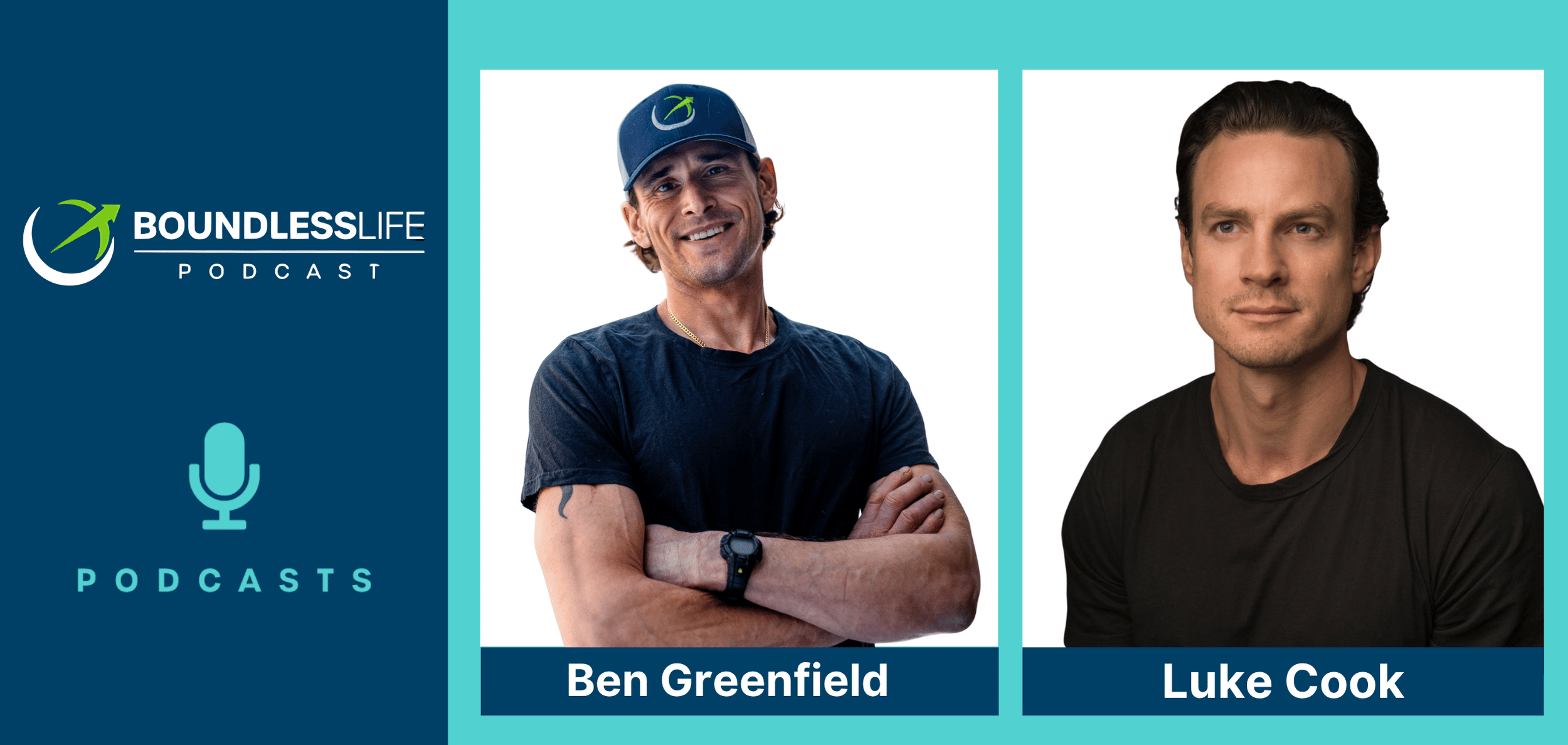
A Fascinating Fireside Chat with Actor Luke Cook: Cyclical Keto, Ketones, Cold Plunges, Nootropics, Peptides & Living VITAL to the End!

Affiliate Disclosure

Listen on:

Reading time: 7 minutes

What I Discuss with Luke Cook:

  • Everything from daily habits to deep dives into ketones, sleep hacks, and nootropics (in a live conversation recorded in LA during my Boundless book tour)…02:09
  • My journey from a strict keto diet to a more balanced cyclical low-carb approach, staying in fat-burning mode during the day and using evening carbs to boost recovery, sleep, and energy for the next morning…03:21
  • How I use drinkable ketones as a secret weapon for clean energy, focus, and endurance, without relying on coffee or heavy meals…07:56
  • How I weave movement into every part of my day, and why something as simple as walking can supercharge focus, creativity, and even relationships…10:27
  • The truth about fasted workouts, and how a simple morning routine of coffee, movement, and cold therapy can give your metabolism a powerful boost…13:26
  • Whether adding butter to coffee really changes the game, how caffeine actually impacts fat burning, and why the so-called “fat-burning zone” might not be what you think…15:50
  • Why I’ve stayed committed to cold plunging, what the science really says about its effects on men and women, and how short, smart exposure can build resilience without the downsides people fear…22:27
  • How my training has evolved from extreme intensity to a smarter, more “boundless” and sustainable routine built around strength, movement, and resilience…31:02
  • How I actually prepare people to get camera-ready, the surprising tools that make the biggest difference, and the hidden side of Hollywood physiques most people never talk about…36:43
  • The boundaries I set around work, family, and recovery, including daily rituals, buffer days, and midday reboots, that help me stay fully present at home without the burnout…40:35
  • The nootropics and smart blends I use for sharper focus, longer energy, and staying clear-headed (even on low sleep)…45:56
  • How my T-shirt would say “Die Happy” because the real goal isn’t chasing 150 years, but living with health, vitality, and purpose right up to the very end…48:41

In this fascinating episode that was recorded live, you’ll get to experience what happens when an actor and a wellness expert sit down together for a raw, unfiltered conversation about living well. I teamed up with Luke Cook—who played Lucifer in Chilling Adventures of Sabrina and appeared in Guardians of the Galaxy Vol. 2—for a special event to celebrate my book launch, “A Boundless Evening,” hosted at HUME Los Angeles, a private wellness club in Venice Beach.

We kicked things off with a deep dive into the rhythms of daily life—what I eat in the morning, how I train when I travel, and why I save carbs for the evening. You’ll hear about the thinking behind my cyclical keto approach and how it helps me stay sharp, sleep better, and still enjoy family dinners without compromising health. It’s not about chasing perfection—it’s about finding the sweet spot between science, practicality, and joy.

You’ll also get to discover the simple ways I build movement into everyday life. From treadmill desks to kettlebells and pull-up bars, my environment is designed for motion, not stagnation. We talk about the real science behind fasted training—not as a magic fat-loss hack, but as a sustainable practice that helps me feel better, think clearer, and train consistently.

Then, Luke and I dive headfirst into some of the biggest trends in biohacking—cold plunges, nootropics, and stress adaptation. Luke brings the curiosity, and I unpack what actually works versus what’s hype. We talk about the power of small, controlled stressors—cold, heat, movement—as tools to build resilience, along with the mental side of performance: my favorite nootropics, adaptogens, and caffeine rituals for focus and creativity.

By the end of the fireside chat, the conversation gets deeper—into purpose, family, and what it really means to build a fulfilling, healthy life. I share my philosophy on healthspan over lifespan, how I stay present with my family while chasing big goals, and why my personal motto has become “Die Happy.”

If you’ve ever wanted an honest, laughter-filled look at the human side of health and biohacking, this one’s for you.

https://youtu.be/fYVvDNL2Y-4

Please Scroll Down for the Sponsors, Resources, and Transcript

Episode Sponsors: 

Pique: Pique Teas are where plants and science intersect to produce teas and supplements of unrivaled efficacy, purity, and convenience. Go to Piquelife.com/Ben to get 20% off for life, plus a free starter kit with a rechargeable frother and glass beaker to elevate your ritual.

Sunlighten: Discover the ultimate efficiency in wellness with the Sunlighten Solo System, a compact, portable far infrared sauna designed to detoxify, reduce stress, improve sleep, and enhance heart health—all while fitting seamlessly into your daily routine. Save $600 or more today and start biohacking your mind, body, and spirit at get.sunlighten.com/ben.

Hiya: Give your kids the full-body nourishment they need to grow into healthy adults. I’ve secured a special deal with Hiya on their best-selling children's vitamin—get 50% off your first order today! To claim this deal, you must go to hiyahealth.com/BEN (it is not available on their regular website).

Qualia: Qualia Stem Cell combines 15 science-backed ingredients to support stem cell proliferation, migration, and differentiation, so you can heal and repair with a youthfulness that DEFIES your age. Visit qualialife.com/boundless and use code BOUNDLESS for 15% off your order.

Organifi Shilajit Gummies: Harness the ancient power of pure Himalayan shilajit anytime you want with these convenient and tasty gummies. Get them now for 20% off at organifi.com/Ben.
Resources from this episode: 

Ben Greenfield [00:00:00]: My name is Ben Greenfield and on this episode of the Boundless Life podcast.

Ben Greenfield [00:00:05]: If you eat and then work out, or you eat after you work out, as long as we're talking about the same number of calories by the end of whatever that two or three hour timeframe is, it doesn't really matter. I think the main reason to work out fasted is.

Ben Greenfield [00:00:19]: Welcome to the Boundless Life with me, your host, Ben Greenfield. I'm a personal trainer, exercise physiologist and nutritionist. And I'm passionate about helping you discover unparalleled levels of health, fitness, longevity and beyond. So about two months ago I kicked off my Boundless book tour in la and as a part of the big book launch, I hosted a fascinating, funny and wildly entertaining and educating fireside chat at a wellness club called Hume with my friend Luke Cook. You might know him from Sabrina Co Guardians of the Galaxy and his new series Good Cop, Bad Cop on Amazon Prime. He's also a hilarious Instagram follow. So Luke Cook and I sat down in front of a live audience and what followed was this unplanned wide ranging conversation where he asked me everything from what I eat for breakfast to my.

Ben Greenfield [00:01:16]: Thoughts on ketones, movement, cold plunges, peptides.

Ben Greenfield [00:01:19]: Sleep hacks, nootropics, family routines, and I think you'll really enjoy the mix of practical takeaways. Raw open discussion why my life T shirt might just read Die happy. So without further ado, here's my fireside chat with Luke Cook recorded live in LA during the Boundless upgraded tour. For all the show notes for this one, go to BenGreenfieldLife.com BoundlessFirechat BenGreenfieldLife.com BoundLessFirechat Enjoy.

Ben Greenfield [00:01:51]: Luke and I have not planned this out at all. No, no, he's just gonna ask me questions. Yeah, I'm gonna reply to questions from you guys. So I have no clue what exactly he has up his sleeve.

Luke Cook [00:02:03]: Yeah, yeah. Well, firstly, what did you have for breakfast?

Ben Greenfield [00:02:09]: I travel with little oatmeal packets called Meal one Oatmeal. Okay.

Luke Cook [00:02:13]: What's special about it?

Ben Greenfield [00:02:14]: I interviewed this guy named Michael Chernow. He's like an entrepreneur. He has a whole brand called Creatures of Habit and they make these 30 gram of protein oatmeal packets. And my jam is I'll just like wander into a Starbucks, get a half cup of hot water and a spoon and I don't pay for it because I tell them that I am making oatmeal and I forgot to get water and a spoon and they just Assume that I bought the oatmeal at Starbucks and then I mix up my oatmeal and. Same thing when I'm at a hotel, go downstairs, buy the coffee, grab the hot water. So. And it has nothing to do with, like, macros, timing of carbs, anything like that. Like, at home, I actually don't eat a lot of carbs till the end of the day.

Ben Greenfield [00:02:57]: When I travel, I just throw one of those packets. Like superfood oatmeal, basically.

Luke Cook [00:03:01]: Got it.

Ben Greenfield [00:03:01]: Yeah.

Luke Cook [00:03:02]: But generally you've been through the whole gamut. You've been vegan, vegetarian, you're kind of carnivore ish for a time, keto ish for a time.

Ben Greenfield [00:03:11]: Two out of four. I don't know about the vegan vegetarian. Like, very brief stints.

Luke Cook [00:03:15]: All right.

Ben Greenfield [00:03:15]: Yeah. Like day long stints. Yeah.

Luke Cook [00:03:20]: There may have been a day where he was vegan.

Ben Greenfield [00:03:22]: Try to juice fast once. That lasted about a day and a half. So, yeah, I have tried a lot of different diets.

Luke Cook [00:03:28]: And where are you now?

Ben Greenfield [00:03:32]: Probably the diet that I got most into back in the day, like back when I used to race Ironman, keto started to become a thing. Anybody tried that? Like, keto low carb, generally. It's an interesting idea based on the fact that when you have really high levels of ketones, they're a preferred fuel for the liver and the heart and the diaphragm and the brain. You can go for long periods of time without eating if you structure the diet right. And it. It actually was almost like a hack for endurance training because you could just go for really long periods of time and endurance, like Ironman, you're not burning a ton of carbs, like a crossfitter. So that diet was something I stuck to for like a solid seven years. The problem with.

Ben Greenfield [00:04:17]: With a traditional ketogenic diet, which is like very low carbohydrate, it's like 30 to 50 grams in some cases, is that there's just not enough carbs for things like thyroid, testosterone, the glycans in your joints. So long term, you start to see some issues, which I started to see. So now I would say if we were gonna like, give a super cool scientific name to my diet, it's like a cyclic keto diet. Besides the oatmeal. When I travel, and what that means is I eat pretty much almost no carbs, no sugar the entire day to keep the body in kind of a state of fat utilization. Then the very end of the day, I'll have carbohydrates that Works out well for a few reasons. First of all, if you're having dinner at night, like we do as a family back home, or when I'm out and about, it's kind of like the most wide ranging meal of the day. As far as maybe you're out at a restaurant or you're eating with family.

Ben Greenfield [00:05:17]: There's a lot of different foods on the table, like, you know, my wife sourdough bread, or you're out of the steakhouse and they've got the cracker basket or whatever. So it works out well if you've saved your carbohydrate, your sugar allotment for the end of the day. Carbs help your body to produce serotonin, which can also help with melatonin, which can also help with sleep. So I wear this continuous glucose monitor. And I can tell you one of the most common reasons for me and a lot of people to wake up like 1 or 2 or 3am besides drinking too much alcohol at dinner, which would be another reason this happens. Let's say you're not doing that. You go hypoglycemic, especially people who are like excessively restricting calories or carbohydrates. So having the carbohydrates at night also gives you a better night of sleep.

Ben Greenfield [00:06:01]: And then I don't like to work out with food in my stomach, so I do a fasted morning workout. And by having all my carbs at night, I've kind of stocked up the muscle glycogen and the liver glycogen levels. And my body's kind of ready to go in the morning. So you kind of get to have your cake and eat it too. Literally and figuratively, because you're going the entire day, kind of turning yourself into a fat burning machine at night you have some carbs, you go to bed, you rinse, wash and repeat. And that diet works really well.

Luke Cook [00:06:27]: So it's kind of cyclical throughout a day rather than throughout a week like yourself.

Ben Greenfield [00:06:31]: Cyclical throughout a day. Got it. Yep. Less active people will sometimes do something similar, but they'll just like have a bunch of carbs once a week to kind of keep a message going to the thyroid that it doesn't need to down regulate metabolism. I'm just so freaking active. Like I can't go a whole week being ketogenic now. You can almost cheat your way into the same state as anybody. Try like these drinkable ketones like ketone IQ or ketone 8 or any of these liquid jet fuel tasting shots.

Ben Greenfield [00:07:02]: They don't taste great. But those are kind of a cool advancements in science because they allow you to drink your way into a state that your body would normally achieve through long term carbohydrate restriction or even fasting. You don't get some of the metabolic benefits of carb restriction, but you can feel a lot of the energy and the endurance and the appetite satiation that ketones or ketosis can give you just by drinking yourself into that state.

Luke Cook [00:07:30]: And when would you use ketones? In the afternoon, after lunch, little pick me up instead of a second coffee.

Ben Greenfield [00:07:36]: Or you do it then. I like to use them anytime I'm planning on not eating a lot of food or I want the option to not eat a lot of food before getting on an airplane. That's perfect because airplanes, you know, you're sedentary most of the time. The foods news flash, not all that great on airplanes. And so you have one of these before you get on a flight. And the cool thing is it keeps the appetite satiated, just like a little liquid shot. But ketones are also anti inflammatory, so it helps you to battle some of the inflammation that you might experience during airline travel. Another example would be before a fasted morning workout because ketones do kind of like keep you still in a fasting like state, but give you some energy for something like that.

Ben Greenfield [00:08:21]: And then like sometimes like on a trip like this to la, I'm here, you know, nine days doing a lot of podcasts and meetups and things like that. And I don't do as well cognitively with a belly full of food. So I've already had two shots of ketones today.

Luke Cook [00:08:36]: Did you notice that actually when you eat a big meal and then you go on a podcast or you go and meet people.

Ben Greenfield [00:08:41]: Horrible.

Luke Cook [00:08:41]: Yeah. What do you think that is?

Ben Greenfield [00:08:43]: Yeah. Oh, it's, it's, it's the blood shifting to your gut away from your brain. Yeah, yeah, got it. Yeah. You got to strike a balance. If you're hypoglycemic, then you're kind of foggy. But the cool thing is if you're hypoglycemic, you can still feel pretty functional. On ketones.

Luke Cook [00:08:59]: You mentioned how much you move. Can you give us an idea of a general day how much you move? Like, what's the go. What's that?

Ben Greenfield [00:09:08]: It kind of depends on how you define movement. I mostly sit when I'm being interviewed or sit to eat or sit on an airplane, I guess in a car too. I'm pretty active. I have a treadmill workstation. I got a kettlebell on the floor of the office, I got pull up bars all over the house. I'm moving. Like my goal, and I think this is a pretty reasonable idea, is to structure my work day so that hitting the gym at the beginning or the end of the middle of the day is an option, not a necessity. Because I've just kept myself moving all day long.

Ben Greenfield [00:09:39]: Everything from like a treadmill at the workstation to weight scattered around the house to, you know, we, we live out in the sticks in Idaho. And I could take the four wheeler or the bicycle down to the mailbox a quarter mile down, but I'll instead like jog down to the mailbox and walk back with the mail. So I just kind of structure the entire day to be moving. So average day, I'll usually get about 18 to 20,000 steps. And I still do workout most days. And what that looks like is typically I've got three or four days of the week that I do strength training and then another couple days of the week where I do cardio training. So yeah, so I move a lot.

Luke Cook [00:10:12]: That's a lot.

Ben Greenfield [00:10:12]: Yeah, I move a lot. I mean, I typically on an average day, for not talking about like sitting a lot and doing podcasts and things like this, and trying to have the empty stomach, I'm usually eating like 4 to 5,000 calories a day just to not lose weight.

Luke Cook [00:10:27]: Yeah. Wow, that's amazing. And then do you find that walking and working on a treadmill, so you're at a desk, you're at a desk, that's a high desk and you're walking. Do you find that's good for thinking? Do you find that kind of moves the blood around the brain?

Ben Greenfield [00:10:42]: I think walking is an incredible hack for cognitive function. I mean, I'm not making that up. Walking actually increases vascular endothelial growth factor and brain derived neurotrophic factor. So even like back to like Greek philosophers who would teach their students, they would often engage in basically the equivalent of what would be called a walking university, where you do a lot of the lectures while strolling. I think it's great for kids as well, just because they're so fidgety to be able to move as much as possible in the classroom. But yeah, I mean, you stay way more focused even during a podcast. Now I do a better podcast when I'm walking than when I'm just like sitting there starting to fidget. My ADD starts to kick in.

Ben Greenfield [00:11:28]: Moving actually helps a lot.

Luke Cook [00:11:29]: Yeah, totally. I've often thought that men should walk because we're better side to side than we are face to face. Have you ever heard about that?

Ben Greenfield [00:11:37]: Yeah, yeah. I've heard the same thing about conflict resolution amongst couples. Like if you got an argument, like go on a walk together.

Luke Cook [00:11:43]: Yep.

Ben Greenfield [00:11:43]: So you're kind of staring off in the horizon rather than like giving demon eyes to each other face to face. Unless you're on mdma, then that just fixes everything. Just sit there, sit there and stare at each other.

Luke Cook [00:11:53]: That fixes literally everything. There's nothing that doesn't fix. What about that morning workout that you do fasted? Is there a metabolic advantage or you just enjoy working out fasted? You'd prefer to not have anything in the system.

Ben Greenfield [00:12:06]: There's a lot of people in the fitness industry who would tell you there's a metabolic advantage from a fat loss standpoint to working out fasted. There's no actual research to back that up, really. Like if you eat and then work out or you eat after you work out. As long as we're talking about the same number of calories by the end of whatever that two or three hour time frame is, it doesn't really matter. I think the main reason to work out fasted is there's a little bit less blood flow to the gut, more blood flow to the brain and the muscles. And for a guy like me who just gets princess gut if I exercise with a stomach full of food, it's just easier digestively. But you won't burn more fat or cut or lean up better if you're doing your main workout fast, at least based on research. Now, some of you who have read my book might know there's a section in the fat loss chapter where I talk about as kind of like a cutting strategy to wake up in a fasted state and to consume something that will increase fatty acid oxidation.

Ben Greenfield [00:13:12]: That's typically like green tea or coffee, not like an orange mocha frappuccino, but like just like black coffee. And then you go and do like 20, 30 minutes of something aerobic, like take the dog for a walk or ride your bike or go for a swim or do a yoga class or whatever. And then the third part of that is finishing with about two to three minutes of cold therapy. So you're almost like shifting some of the white adipose tissue into metabolically active brown fat and amping up the metabolism just a little bit more when you get out of the cold. I'll do that with like everything from like a celebrity getting ready for a movie role to, you know, an executive who wants to lose 30 pounds. And it works pretty well. There's just no research on that strategy. I think one of the reasons it works is people can just do it consistently.

Ben Greenfield [00:14:04]: Like, not a lot of people are going to go do like a fasted, you know, hard hour long crossfit session or hard weight training session in the gym on a consistent basis. But most people just want to lose some fat. They'll get up, have a cup of coffee, go for a walk, come back, take a cold shower, and maybe hit the gym later on.

Luke Cook [00:14:21]: Let's talk about the rules of that because my, my ears perked up. I want to know all about that. What are the rules about the coffee can have. It's got to be black, green tea, got to be black. That's got to be, you know, no milk or anything.

Ben Greenfield [00:14:34]: What takes you out of a fasted state.

Luke Cook [00:14:35]: So that's it. It's a fasted state. So it could be butter in the coffee if you did that kind of thing.

Ben Greenfield [00:14:42]: So calories are calories, right? I mean, if you have butter in your coffee, your body typically has to burn mostly those calories before it's going to tap into its own fat. Now, from a cognitive standpoint, putting butter in the coffee, there's different parts of coffee, like cowaol and capestol that will cross the blood brain barrier if they're mobilized with fats. And that's why coffee kind of seems to hit your brain better if you blend it with MCT oil or butter or something like that. But I mean, you can easily have a 300 calorie cup of coffee, and that's 300 calories you gotta burn before you start to burn your own fat. That being said, like, there are other little things that really aren't gonna, they're gonna be like a speed bump from a fasting standpoint, like a little bit of creamer or a touch of sugar or something like that. It's not that big of a deal.

Luke Cook [00:15:28]: That first piece of exercise, it should be generally not too high intensity, about 20 to 30 minutes. Like a walk is perfect.

Ben Greenfield [00:15:37]: Not. Well, it shouldn't be super high intensity because there's science that says that doing low intensity is better than high intensity. As a matter of fact, you hear. Does everybody hear about like zone two fat burning zone, aerobic conversational zone burns more fat. It does. Like, my formal background is exercise physiology. And so one of the things that I did in the lab for like six years is people would come into the lab and they put on this massive like gas mask Device, which you know now has been replaced by devices you can just, like, have in your own home. Like there's one called the Lumen that does this.

Ben Greenfield [00:16:11]: It's just like a little tiny device that you breathe into. But the reason people would put this mask on was you'd measure inspired oxygen and expired carbon dioxide, and you'd be able to approximate how much fat somebody's burning, how many carbohydrates somebody's burning, and what their overall metabolic rate is. And of course, what the ratio of fat to carbohydrates being burnt is. And that ratio of fats to carbohydrates. You guys are all gonna be super smart cookies when you leave today. It's called the respiratory quotient, the rq. And if you're working out at a really low intensity, your RQ is lower. And a lower RQ means you're burning more fat than you are carbs, but at the same time, you're also burning a lot fewer calories.

Ben Greenfield [00:16:52]: Right. So if you're burning like 70% fat, but you're burning 100 calories every 30 minutes, you're still going to burn more fat. If you're burning 50% fat, but you're burning 500 calories every 30 minutes because you're working out harder. So there's not a huge amount of magic behind, like, the whole, like, fat burning zone, low intensity thing from that standpoint. The reason I think it works is it's just like super simple for people to do. Like, I don't have a lot of people who I've coached who resist the idea of getting up, having a cup of coffee and like taking the dog for a walk, or literally, like walking around the neighborhood while they're checking their emails and coming back and taking a cold shower. So it's just doable for people and.

Luke Cook [00:17:34]: The caffeine before it. Does that kind of boost the fat burning process?

Ben Greenfield [00:17:37]: Yeah, yeah. Caffeine boosts fat oxidation. Again, like, that doesn't mean if you wake up and you have a cup of coffee, you're just going to like melt fat off your body. If you get any of these, you know, thermal burners, you can get a gnc. Those are actually going to work to any significant extent, but it's just a little bit of an edge. Especially if you're doing exercise afterwards. It's usually exercise with caffeine, where you see more fat oxidation than just caffeine all by itself.

Luke Cook [00:18:03]: Got it. You've remained bullish on the cold plunge. It kind of came into fashion, then went out of fashion as fast as it came up.

Ben Greenfield [00:18:10]: Yeah.

Luke Cook [00:18:11]: But you've remained somewhat bullish on it. I'd love to hear your thoughts on why you think it's fantastic and why.

Ben Greenfield [00:18:18]: You should be doing it. Yeah. Well, it is interesting because Wim Hof, I think, was largely responsible for championing a lot of the benefit. Does anybody hear cold plunge, by the way? Yeah. Okay, so a lot of you are masochists. Good audience here. And even before he came to the scene or a lot of the science came out, I was just accidentally cold plunging because I raced triathlon for 15 years. You just had to swim come hell or high water.

Ben Greenfield [00:18:44]: Like you'd be swinging your arms in your Speedo, getting ready to jump into the YMCA pool. That was, you know, like 69 degrees when there's a 45 degree draft coming in the door In Idaho in the winter, you'd have to go out and do open water swimming in October to get ready for Hawaii Ironman. And the only body of water outside your house in October in the inland Northwest is like, you know, 45 degrees. So I was doing it accidentally before I learned about all the metabolic benefits. And then it got pretty popular. And now kind of like you said, Luke, there's some people starting to say, I don't do it. It's super stressful for the body. It causes excess cortisol and stresses you out.

Ben Greenfield [00:19:25]: And then your body goes into starvation or famine mode because it thinks it's constantly running from a lion. So it produces a bunch of cortisol and you get bloating and fat retention. The devil's in the details a lot when it comes to the things that you see in the news or you hear some, you know, some Instagrammer influencer saying versus what's actually the case. So let's take women, for example. Has anybody heard that this new thing going around like women should cold plunge because it's bad for women? Yeah. Yeah. So it's interesting because they've actually done comparative studies of men versus women in cold plunging. And by the way, the argument is pretty much exactly what I just said, that it causes like, sympathetic nervous system response, fight and flight, cortisol, vasoconstriction, and that that's even more pronounced in women, which is kind of true, because if.

Ben Greenfield [00:20:22]: If a mammal has higher levels of estrogen and progesterone in the system and that's combined with cold, there's a greater degree of vasoconstriction and a higher cortisol response when that happens. Now, if you look at actual comparative studies on men versus women in cold exposure, there was one with like 60 men and 60 women where they did that. And they tracked metabolic factors related to fat loss and metabolism. Things like adiponectin, insulin, lectin, blood glucose, all the things that you'd expect to be kind of out of whack if cold was an issue. Well, the women did have a different response to the cold. They had different levels of all these metabolites that I just mentioned, but all of them were more favorable than what the men got. So the only thing that study showed was that women actually had a better metabolic adaptation to cold than men did. They did another study where they looked at the actual cortisol response in women to cold.

Ben Greenfield [00:21:29]: And lo and behold, just like all the, you know, the influencers are saying there was a big cortisol spike for four weeks. There was a 12 week study after the four week mark, all of a sudden this stress resilience mechanism kicked in and women began having a lower cortisol curve during the day and a lower cortisol response to the cold. Meaning that the cold did what? Cold is one of the things cold is supposed to do, like increase stress resilience, improve your ability to be able to move blood around the body, improve your ability to be able to respond to cortisol. So, yeah, like, there's a chance that for the first few weeks it might be a little stressful. And then if you do it continuously, it becomes beneficial from a stress management standpoint. And then if you look at the studies on women with higher levels of estrogen, progesterone, which would occur during, during the luteal phase of your cycle, there is a bigger vasoconstrictive and cortisol response to cold when you're in that period. But there's no link between that and anything like more fat gain or adrenal fatigue or any of this. Like, I'm convinced that, like the people who say that women shouldn't cold plunge are mostly people who don't like to cold plunge and they want some other people along for the ride with them.

Ben Greenfield [00:22:47]: If you are in menopause or postmenopausal and you have lower levels of estrogen, you would actually operate a little bit similarly to a man when it comes to a cold plunge. You just have less vasoconstriction. So there is one factor though, and that's that women in general, there are definite exceptions to this rule, have lower muscle mass than men, and muscle is thermogenic. Like muscle helps you heat up. So women might have a different temperature or time in the cold tub compared to a man in order to get the benefits. Like, maybe not as cold or as long. But the general rule is, if you get out of the cold plunge and you feel cold and refreshed and energized, that's great. If you get out and you're shivering for, like, an hour, you definitely went too, too long.

Ben Greenfield [00:23:34]: And if you even look at. You know another thing that people say about cold plunging, that if you do it after workout. Has anybody seen this? Like, if you do it after a workout, it's not good. Cold can suppress the body's own inflammatory response, meaning that if your body doesn't get to mount its own inflammatory response because you shove that down with cold, or you even shoved it down with a whole bunch of antioxidants like vitamin C or vitamin E or something like that, because the body can't mount its own inflammatory response, you don't see as many benefits for things like mitochondrial proliferation or satellite cell generation for new muscle. That is true, but even the studies that show that to be true are using, like, 10 to 20 minutes of cold. And there's just not a lot of people. I don't know about you, Luke, but, like, I just. I don't go.

Ben Greenfield [00:24:28]: I don't have the time to go sit in a cold plunge for 10 to 20 minutes. Yeah. And a lot of people aren't doing that, like, even here. Like, you know, people are in there for two or three minutes and they're out. My sweet spot is like two to three minutes. So, yeah, the devil's in the details. Yeah. If you do cold too long and too hard, it's a problem.

Ben Greenfield [00:24:46]: If you're a woman, it's really not as big of an issue as, you know, a lot of people are saying. And cold does put you into fight or flight. Right. It's a hormetic stressor. And this is kind of interesting because there's so many hormetic stressors out there. It's like, if you look at life, we were born, and as soon as we're born, we're all of a sudden just having to battle entropy and gravity and, you know, toxins and poisons. And one of the ways that we put our bodies into a state where they're resilient enough to handle all the stress stressors of daily living is paradoxically, to stress our bodies, right. To have mild elements of discomfort spread throughout the day.

Ben Greenfield [00:25:27]: And so that can be cold, which causes the acute fight or flight response. But Then when you get out, your body becomes more resilient to stress, heat, same thing. If you stayed in there for two hours, you'd get some kind of electrical abnormality and you get dehydrated. I mean, in many cases, if you work out, your muscles look like World War II after a workout, depending on how you're training. And that's poisonous, that's toxic, it's hard for your body. Even a lot of the diets, the very myopic diets, where you eliminate lectin and gluten and oxalates and phytates, every last plant defense molecule known to humankind, when you eliminate all of those stressors, whether they're dietary stressors or thermal stressors or gravity stressors, like weight or cardiovascular stressors, sure. Like your body is less stressed, but as a result of your body not having to deal with any of those discomforts, it becomes less able to deal with the discomfort of aging. So yeah, I mean, inducing cellular resilience in small to moderate amounts, like having little hormetic stressors spread throughout the day, including dietary diversity, is a pretty good health span lifespan strategy.

Luke Cook [00:26:38]: In regards to your own exercise. How often are you going to balls to the wall? High intensity and how often are you keeping it? You know, 120, 100, 140. Heart rate slow and low weights, like heavy weights. And how often are you going high intensity intervals, like how often are you mixing?

Ben Greenfield [00:26:55]: Oh, I was like a total masochist for like at least a couple of decades. Like, you know, starting off with bodybuilding and then Ironman triathlon and then Spartan racing and everything was just like, you know, what, lactic acid out the eyeballs, which, you know. Pavel, what's your book called? The Quick and the Dead. Yeah, about how. Yeah, yeah, yeah. Basically the idea. Pavel's written some fantastic literature on this about how like when the body's just like constantly having to metabolize lactic acid and you're constantly just like burning tons of carbohydrates because you're exercising at such a high intensity for such a long period of time, that's actually stressful to the body. Another researcher, James O', Keefe, has shown that once you exceed about 70 minutes of high intensity exercise each week, you start to see arterial stiffness, atherosclerosis, plaque formation.

Ben Greenfield [00:27:44]: So, you know, even though I exercised pretty hard for a long time since I hung up the hat on professional obstacle course racing, now it is kind of like you said, it's a lot of super slow stuff or quick and Snappy stuff. It's very, very, very seldomly do I ever like go hard for longer than about 60 seconds. Like as far as like high intensity interval training. I don't go on long runs. I rarely do like long bike rides or long swims. Most of my cardio is walking so I'm basically lifting heavy typically just for me as a time hack, like circuit style training, walking a lot and throwing, throwing some power moves in here and there. So.

Luke Cook [00:28:26]: Got it. I do intimately work out throughout a day. Is that why you've got bars around the house and tuna bars and.

Ben Greenfield [00:28:32]: Yep, all throughout the day my sons do the same thing. My sons are 17. Like if you walk into our house on any random day, it's like every half hour you'll like hear something clunking around or somebody doing burpees or somebody doing pull ups. Because we just like stop every half hour and do do something. Just move. Yeah, well, I mean, you know, it's like, you know, back to the discomfort thing. Like we live in a blessed post industrial era where we are now having to like build fences and run from lions and you know, go up and down ladders, painting and you know, hauling rocks around. Unless we're a farmer or construction worker or something like that.

Ben Greenfield [00:29:00]: So we have to like fabricate these boxes that we go and pick up stuff and set it down in order to keep our bodies able to fight the entropy. And you have to be mindful of doing that or else it is very easy to just sit around and for lack of a better term get soft mentally and physically.

Luke Cook [00:29:23]: In regards to, you have trained multiple celebrities to get ready for, you know, camera ready. Zac Efron being one of them. Just one. Just one.

Ben Greenfield [00:29:31]: Just for the record, I didn't train Luke for his Adonis like body for the Good Cop, Bad cop show.

Luke Cook [00:29:39]: No, he didn't.

Ben Greenfield [00:29:40]: But I look forward to maybe vicariously traded tips here and there.

Luke Cook [00:29:44]: But what do you do to get somebody? I mean Zac Efron, he's probably already in shape before you start working with him, but. And I guess that's ideal. What would you do if you were taking a CEO who is looking to get in the best shape of their life? Tips like the one that you said earlier where you wake up in the morning, have some coffee, go for a walk. Can you give us a few more of those?

Ben Greenfield [00:30:06]: Yeah. I think similar to how we live in this fantastic post industrial era where we can live very cushy lifestyles, we also live in an era in which the same type of self quantification that would have cost tens of thousands of dollars, the Princeton Longevity Institute or whatever a couple decade, decades ago is now pretty achievable like in the comfort of our own homes or at a Quest Diagnostics or LabCorp down the street. So if I'm working with somebody, I start with a very data driven approach, especially from like a nutrition and supplementation standpoint. Meaning specifically a basic blood test, a micronutrients test. I use one right now called the metabolomics, a gut test, like a three day stool tests look at parasites, yeast and fungus and bacterial balance, urinary hormone tests, food allergy tests and a DNA test. So you can make really good progress if you can sit down with that and say, okay, I need vitamin D, I need a higher omega count, I need a higher protein intake, I'm deficient in these three minerals. And that can plug up a lot of holes from a nutrition standpoint. And you can also find out, hey, these are the foods that I shouldn't eat.

Ben Greenfield [00:31:20]: These are the foods that genetically or biochemically I'm more adapted to. And I think getting that baseline can move the dial a lot more quickly than just like shooting in the dark. If you were going to shoot in the dark. Some semblance of a low carb Mediterranean style diet works for a lot of people. Not like unlimited breadsticks and seed oil salads. That's not Olive Garden is not a Mediterranean diet. But it works for a lot of people. So that's one consistency is another one.

Ben Greenfield [00:31:54]: Now a lot of like you know this Luke. A lot of actors and actresses can have a little bit more time at their disposal to train, especially if they're being expected to train until the shooting gets hard and heavy. And I mean, and I literally have some people who are just like working out in their trailers. They have the perfect push up bar, they have the door frame suspension, straps and they're doing like mini workouts in between shoots. But the idea of having a plan where you're very, very consistent and you never get to the point where you've missed so many workouts, you got to pile a bunch into a weekend, that's another big factor. And that just comes down to scheduling and calendaring. You do see in Hollywood especially there's a lot more used to of things like hormones, peptides, steroids, like a lot of the bodies that you see. Like there's some better living through science going on as well, often to a pretty big standpoint.

Ben Greenfield [00:32:49]: I mean anything from like growth hormone precursor peptides to pylon mass to testosterone stints to even deca in some cases. Like, I won't lie, that's a part of it as well.

Luke Cook [00:33:01]: Well, when you've got everything at your disposal, you should use it, right?

Ben Greenfield [00:33:05]: If, if, if you've got like three months and you're supposed to put on whatever, something that would technically be impossible, like 18 pounds a month, like, you're only going to do that with drugs.

Luke Cook [00:33:13]: Yes.

Ben Greenfield [00:33:14]: Yeah.

Luke Cook [00:33:14]: Yes. In regards to just general life and general living, I think so. I'll speak for myself personally. Getting off the phone and staying present with your family is something that I think a lot of us struggle with. Just in general screen time. Any tips and hacks for that to remain present?

Ben Greenfield [00:33:32]: Yeah, don't remain present is kind of like one of, one of the ways that I pull it off. Meaning, like I have deep work periods where if, like, and this sounds really bad, but like, if I'm deep in a riding phase and my headphones are in and my son comes up to me and tells me he just won the state lacrosse championships, I'll be like, huh? Because I do have these deep work periods where I am focused 100%. And then the way that I do it is I bookend the day. I paint myself into a corner of having the time to be present when I know I can be fully present. So a couple examples of what that looks like is anytime I go on a trip, like a trip like this, where I'm gone more than a week, there's always a buffer day. When I get back, that buffer day has no work. That's just like peer focused time with the family. That means I build my business more slowly.

Ben Greenfield [00:34:30]: I don't make as much money because, you know, that's multiple days per year that are just like total day off. But having that built in, if you travel a lot is one good strategy. 7am every morning, no matter what, you know, I typically get up pretty early. I'm up around 4:35am at the latest. So I've already put some work in, I've already put some time in. I've done my own routine. But 7am we have a morning family huddle. If my sons are gone, it's just me and my wife.

Ben Greenfield [00:34:56]: If my wife's gone, it's me and my sons. But we have 20 minutes carved out where we get up, we talk about our day, we meditate together, we pray together, we read the Bible together, we talk about what the plans are and who's gonna have the car and where. And I found up until the point that we started doing that about 10 years ago, that it's pretty easy, especially if you live with the spouse or loved one or family member. So just like get started with the day and before you know it, everybody's just like scattered to the four corners of the wind. You might see each other at random points throughout the day and then at dinner time. So having that carved out morning routine, and everybody who has heard me say this and implemented it has reported that life just improves automatically because you have this touch point with the family early in the day, same thing, 7pm, no matter what, I am in the kitchen, gathered around the dinner table with the family, starting the evening routine. And when that evening routine starts, it's just pure family time for the next two, two and a half hours. You know, songs and games and chatting and talking about the day and cooking together and cleaning together.

Ben Greenfield [00:36:01]: And by having those bookends, like, I know my whole family will think something's up and dad must be sick or his leg's broken out in the office because he's not in here in the living room at 7am and same thing, 7pm I can't be on a zoom. Like it's just not gonna happen because my whole family is in there waiting for me. So, you know, it's very similar to like author Cal Newport's book Deep Work. Like when you're gonna work, go hard, like, don't, pardon the expression, dick around. Like put the work in like a horse with blinders. But then when it's time for family, like, you're 100% with the family. So I'm either like 100% present or basically when it comes to family, pretty much like 100% non present.

Luke Cook [00:36:41]: Yeah. So do you make a firm boundary with your work where you're like seven o', clock, that's it. Don't over schedule out anything around that time.

Ben Greenfield [00:36:49]: Yep. My firm boundaries are that buffer day when I get back, the 7am slot, the 7pm slot. And then for me personally, because I get up so early, that means typically most nights I'm sleeping six to six and a half hours. And that's technically not enough sleep for somebody who's as active as me and who really wants to be as healthy as possible. So I also have from 2 to 3pm Just like total blank spot in my schedule. Like you can't schedule anything. No calls, no zooms, no work. And that's my time to just like go meditate, slip away, read a book, just lay back, just do nothing for about an hour.

Ben Greenfield [00:37:24]: And that's kind of like my middle of the day that allows me to hit the reboot button. And it's nice too cause I don't get to that evening family dinner exhausted or grumpy. I can just like charge through and then be with the family until bedtime at 9:30 or 10. So I do have that, that other like me boundary right in the middle of the day to hit the reboot.

Luke Cook [00:37:43]: Button and you find that energizing. Like what is it that you do during that time? Does, do you come out of it? Do you come out of it raring to go or.

Ben Greenfield [00:37:51]: No, you come out of like a little bit groggy until you jump in the cold plunge. So yeah, seriously. So one of the things that's kind of like part of my job is I'm always testing out like the hyperbaric chambers and the light sound machines and all these different meditation devices. And I'm not going to get in bed at night with my wife and have like a bunch of wires attached to my head. So it kind of doubles up as the time for me to try out a lot of the parasympathetic things I'm supposed to be trying anyways. But yeah, like anytime you like stop in the middle of the day, the adrenaline and the cortisol wears off. You do have to jump start the system. And I'm kind of not kidding.

Ben Greenfield [00:38:24]: Like, like cold is one of the ways that I do that. And then I'll typically do some, some kind of like energetic compound like you guys have like those update energy drinks. I have a mini fridge full of those at home and typically I'll slam one of those and get back to work.

Luke Cook [00:38:37]: And what about focus? Like if you, when you are in that zone, when you're focused, you do you like to supplement with anything other than caffeine or nicotine, anything like that that makes you, helps you with focus.

Ben Greenfield [00:38:48]: There's all sorts of fantastic compounds out there. I bet.

Luke Cook [00:38:51]: I know you've got some great stuff.

Ben Greenfield [00:38:53]: You know, like, you know, back in, back in like the old school biohacking days, I mean people had all these kind of things like piracetam and new PEPT and you know, high doses of choline, all sorts of stuff you'd order from only sold for human research chemical websites and you kind of put your own stacks together. Some of that stuff does work. Like I would say probably the most powerful would be like go to like, you know, you can get R. Modafinil from an Indian pharmacy and that stuff will just like Keep you going for like 12 to 16 hours nonstop. Focus. That would be like one of the few pharmaceutical agents that you still kind of have to go out of your way to get. But now there's so many really, really well done done for you blends that work really well. A few that, that I've looked at.

Ben Greenfield [00:39:41]: I've seen the formulas, I've talked to the, to the formulators. I know they're good stuff. Qualia. They have a really good one called Qualia Mind. There is on it, on it has Alpha Brain. There's another company called Wukio W u k I Y o that's probably one of my favorites for like 12 solid hours of like really good energy, even on low sleep. They have a product called Apex. They have another one called Bliss that even has like a microdose of psilocybin in it that you can like stack with the Apex one.

Ben Greenfield [00:40:15]: I don't know how they do that legally, but they do so get it while the getting's good. So those are a few examples of blends. Another company is Nootopia. They're kind of cool. You go to their website, you fill out a quiz and then they customize things like Brain Flow and Upgrade and Extreme Focus. And these different blends that they have based on what it appears like your neurotransmitter imbalances are or your dominances are based on their quiz. A lot of these done for you. Nootropic blends actually work and a lot of them work better than a cup of coffee.

Ben Greenfield [00:40:53]: Not that an old school cup of coffee doesn't do the trick. I don't drink a lot of coffee at home. I might have one or two cups of coffee a week at home. When I travel, I have two or three cups of coffee a day because like my schedule's just all over the place. When I travel, I don't get that morning nap in a lot of times I have late night dinner. So I kind of like save my caffeine for when I know it's gonna hit me the hardest. Then when I get home, I just switch to like decaf or little morning mushroom blends. And then when I travel, I hit the coffee again.

Luke Cook [00:41:21]: Brian Johnson has Don't die on a T shirt. What would you put on your. What would you put on your T shirt?

Ben Greenfield [00:41:29]: Die happy. I'm not one of the Extreme Life Extension guys. I think it's kind of silly actually to hypothesize that we're gonna live to 150 or 160 or 180 years old. That someone living right now is gonna live that long, when the longest livid person on record right now is, I think, 117, something like that. And to climb claim that through, like, some hyperbaric chambers and, you know, injecting a few peptides and taking some AKG and rapamycin, you're gonna like, push that by 30 or 40 or 50 years, I think, is a little bit ridiculous. Especially when you consider that even if you could do that, you're gonna be spending a lot of the years that you get, like, huddled up, cold and hungry and libido less inside a hyperbaric chamber, like, trying to live a longer time. So it almost becomes this relentless effort of grasping at straws when at the end of the day, you're still gonna be just, like, ugly and wrinkled and osteopenic and sarcopenic. You're still gonna be old, and you're gonna die old.

Ben Greenfield [00:42:34]: So I think it's a better goal just to live as healthy as possible, as close as possible to the day that you die. I would love to just kick the can after a day of snowboarding in the mountains, have a heart attack while making love to my wife. I told her that once. She said that would be really awkward. So maybe not. Yeah, she's going to have to push me off of her and call the ambulance. But, yeah, I think the idea is being vital into old age is a pretty good goal and not deceiving yourself that, yeah, you are going to feel old, you are going to have aches and pains, like, your body's not going to work like you want. That just happens.

Ben Greenfield [00:43:11]: That's life. Yeah. And you can certainly fight entropy to a certain extent, but we're all going to get old and die. And I think the main thing is to be as vital as possible, as close as possible to the day that you die. And then also just to understand your life's purpose, to identify your life's purpose, and to make as much impact as possible with the time that you do have on this on planet? And part of that is like keeping this vessel, keeping this body in good enough shape to be able to be impactful. So a lot of people be like, well, why would you, you know, inject peptides and go take a nap inside of a hyperbaric chamber and do the cryotherapy? And part of it is I want to be more vital, more productive, more impactful. And if I can do that until I'm 80 or 90 instead of till I'm 60, then that's fantastic.

Ben Greenfield [00:43:56]: To discover even more tips, tricks, hacks and content to become the most complete, boundless version of you, visit BenGreenfieldLife.com.

Ben Greenfield [00:44:13]: In.

Ben Greenfield [00:44:13]: Compliance with the FTC guidelines, please assume the following about links and posts on this site. Most of the links going to products are often affiliate links, of which I receive a small commission from sales of certain items. But the price is the same for you, and sometimes I even get to share a unique and somewhat significant discount with you. In some cases, I might also be an investor in a company I mention. I'm the founder, for example, of Kion llc, the makers of Kion branded supplements and products, which I talk about quite a bit. Regardless of the relationship, if I post or talk about an affiliate link to a product, it is indeed something I personally use, support and with full authenticity and transparency recommend. In good conscience, I personally vet each and every product that I talk about. My first priority is providing valuable information and resources to you that help you positively optimize your mind, body and spirit.

Ben Greenfield [00:45:06]: And I'll only ever link to products or resources, affiliate or otherwise, that fit within this purpose. So there's your fancy legal disclaimer.

Upcoming Events: 

Do you have questions, thoughts, or feedback for Luke Cook or me? Leave your comments below, and one of us will reply!

Ask Ben a Podcast Question

Leave a Reply

Your email address will not be published. Required fields are marked *