
Home » Podcast » Could This Be The World’s Most POWERFUL Self-Quantification Device?! (& Is It Even *Safe* Or *Accurate*?) With WHOOP’s Will Ahmed

Could This Be The World’s Most POWERFUL Self-Quantification Device?! (& Is It Even *Safe* Or *Accurate*?) With WHOOP’s Will Ahmed

Listen on:

Reading time: 8 minutes

What I Discuss with Will Ahmed:

In this fascinating episode with Will Ahmed, founder of WHOOP (you can click here to get 1 month free on your membership), you’ll get to discover how his company is redefining health tracking through continuous 24/7 physiological monitoring, actionable coaching, and innovations like ECG readings and noninvasive blood pressure insights. We dive into the new WHOOP 5.0 and WHOOP MG hardware, how the technology detects atrial fibrillation, and why comfort and versatility matter as much as sensor accuracy for long-term use. You’ll also hear about WHOOP’s groundbreaking partnership with OpenAI, which integrates ChatGPT to analyze user data alongside supplements, nutrition, and even blood tests, plus their new “Healthspan Score,” developed with the Buck Institute for Research on Aging, which quantifies physiological age across nine validated metrics like sleep, strain, and fitness. Along the way, we tackle controversies around sleep-stage detection, heart rate variability trends, EMF and Bluetooth exposure, and how WHOOP’s mission to optimize healthspan and performance is pushing the limits of what a wearable can achieve.

Will Ahmed is the founder and CEO of WHOOP, which has developed next-generation wearable technology for optimizing human performance and health. WHOOP members include professional athletes, Fortune 500 CEOs, fitness enthusiasts, military personnel, frontline workers, and a broad range of people looking to improve their performance.

Ahmed is a member of the Board of Fellows of Harvard Medical School, where he provides counsel to the dean and faculty on topics related to the strength and health of the institution. Ahmed was named to the 2021 Sports Business Journal “40 Under 40” list, as well as the 2020 Fortune “40 Under 40” Healthcare list, and was previously named to the Forbes “30 Under 30” and the Boston Business Journal’s “40 Under 40.” Ahmed founded WHOOP as a student at Harvard College, where he captained the Men’s Varsity Squash Team and graduated with an A.B. in government.

WHOOP, the human performance company, offers a wearable health and fitness coach to help people achieve their goals. The WHOOP membership provides best-in-class wearable technology, actionable feedback, and recommendations across recovery, sleep, training, and health. WHOOP serves professional athletes, Fortune 500 CEOs, executives, fitness enthusiasts, military personnel, frontline workers, and anyone looking to improve their performance. Professional athletes on WHOOP include Cristiano Ronaldo, Patrick Mahomes, Rory McIlroy, Aryna Sabalenka, and Michael Phelps. Studies show WHOOP can positively change behavior, increase sleep, and improve physiological biomarkers. Founded in 2012, WHOOP is based in Boston, Massachusetts, USA.

If you’re interested in wearables, physiological tracking, and the future of health optimization, you won’t want to miss this episode.

Discount Codes:

🏋️ You can click here to get 1 month of WHOOP for free (membership only).
  

My WHOOP Data

Please Scroll Down for the Sponsors, Resources, and Transcript

Episode Sponsors: 

LVLUP Health: I trust and recommend LVLUP Health for your peptide needs as they third-party test every single batch of their peptides to ensure you’re getting exactly what you pay for and the results you’re after! Head over to lvluphealth.com/BGL and use code BEN15 for a special discount on their game-changing range of products.

Ketone-IQ: Ketone-IQ delivers science-backed performance fuel that increases power output by 19%, reduces fatigue by 10%, and naturally boosts erythropoietin (EPO) production for better oxygen delivery—trusted by elite athletes like Jon Jones and Olympic champions. Save 30% on your subscription, plus get a free gift with your second shipment at Ketone.com/BENG.

Quantum Upgrade: Recent research has revealed that the Quantum Upgrade was able to increase ATP production by a jaw-dropping 20–25% in human cells. Unlock a 15-day free trial with the code BEN15 at quantumupgrade.io.

MASA Chips: Introducing the best guilt-free snack on the market: classic, seed oil-free tortilla chips with only 3 natural ingredients. Go to masachips.com/greenfield and get 25% off your first order!

Timeline Nutrition: Give your cells new life with high-performance products powered by Mitopure, Timeline's powerful ingredient that unlocks a precise dose of the rare urolithin A molecule and promotes healthy aging. Go to shop.timeline.com/BEN and use code BEN to get 20% off your order.

Resources from this episode:


Upcoming Events: 

Do you have questions, thoughts, or feedback for Will Ahmed or me? Leave your comments below, and one of us will reply!


Ben Greenfield [00:00:00]: A lot of people ask me what I've been using to self-quantify. Today I tell you in a podcast with the CEO and founder of the technology that I've been using and it is tricked out. I can get like health span, super accurate sleep data. The list of features that we dive into go on and on as well as some shocking things that they found from their big data about sleep, HRV, training, recovery. Gonna dig this one. Will Ahmed of WHOOP. Here we go. I haven't interviewed my guest on Today's show since 2017 and since he makes technology I figured, I don't know, like eight years, shit happens, right Will?

Will Ahmed [00:00:46]: That's right.

Ben Greenfield [00:00:47]: Yeah, yeah, yeah. So figured it was a high time for catch up with the CEO and founder of a company called WHOOP. And I actually did interview Will Ahmed back in 2017. When did you guys launch, Will, do you remember?

Will Ahmed [00:01:06]: We launched to consumers in 2017. So okay, yeah, you were, you were, you know, on the very front end of things. Now mind you, back then we, you know, had thousands of people, not, not millions of people on WHOOP.

Ben Greenfield [00:01:20]: Yeah, yeah. And that was actually a reason that I want to interview was because, you know, stuff has come a long ways as far as what you can measure, you know, from a wrist, from a finger, whatever. And I recently got my hands, I guess it was like eight weeks ago on your new WHOOP and I have been geeking out on it hardcore. As a matter of fact, it's what I'm using now extensively for or self quantification. Besides the blood glucose patch, it's my new jam. So anyways, for people living under a rock, Will, who may not have actually heard of WHOOP before, how do you describe and differentiate it from another wearable?

Will Ahmed [00:02:09]: Well, our mission at WHOOP is to improve human performance and, and health span. We really want to help individuals live longer and better. We develop wearable technology that you can see on my wrist that you're wearing, that I'm wearing, millions of others are wearing that continuously measures a lot of physiological information about your body and then pairs with an app that gives you 24/7 coaching on that data. And people value our measurements around strain and recovery and sleep. And we've got health monitors that alert you if things are out of range. We've got now ECG functionality on our latest technology so you can detect AFib. We were one of the first wearables to come out with blood pressure insights which allows you to understand your blood pressure on a daily basis without a cuff. And so it's Really, I would say the most comprehensive health platform and wearable system out there.

Ben Greenfield [00:03:14]: I want to dig into some of that stuff because honestly, I think like step count and sleep, even though I do want to talk a little bit about sleep later on, it's old news to people. But the ECG thing, for example, I mean, this is something I think a lot of people are concerned about. It'd be cool if they could figure out what's going on with their ticker from a wearable. And I know you guys don't claim to be a medical company, you're not diagnosing cardiovascular disease. However, how's that work? What's the ECG thing?

Will Ahmed [00:03:45]: So we recently just came out with the WHOOP 5.0 and the WHOOP MG. The WHOOP MG is our medical grade technology and you can take an ECG reading directly from your wrist. So for those of you who are able to see this, you can just put your finger on the side of the sensor that does a full circuit of your body and is able to capture an ECG and you'll get a formal ECG report that you can then share with a doctor. And it'll also tell you whether or not you have AFib. And so for people who have AFib, which is about 2 to 3% of the population, this is an amazing way to keep track of whether or not you're in an AFib state. And, and it's a really important thing to be able to share with a doctor in a non invasive way. There's many situations where people might feel like something's wrong with them, but they don't have access to an ECG machine. And ECGs are expensive and they're in a hospital environment.

Will Ahmed [00:04:46]: So the fact that we can now do this in a pretty non invasive form factor anytime you want is a big deal.

Ben Greenfield [00:04:53]: What's AFib? Which would mean for the average person, how do you describe that?

Will Ahmed [00:05:00]: Atrial Fibrillation

Will Ahmed [00:05:02]: It's essentially when your heart has an arrhythmia and it'll sort of beat out of place. And this is something that can increase the likelihood with which someone's going to have a stroke or another cardiovascular event. And interestingly, for those of you familiar with heart rate variability actually will show up in having an abnormally high heart rate variability. So normally you think of a higher heart rate variability is good, but what happens is someone who might have a heart rate variability of, you know, 40 or 50 ms. One day wakes up and they have like a heart rate variability of 200 and they might think that's a good thing, but they're like.

Ben Greenfield [00:05:45]: Yes, I've finally recovered, I'm finally beating all my friends.

Will Ahmed [00:05:49]: It's actually, it's actually a sign of AFib. And so now, so now we can help detect that and, and get you the attention you need.

Ben Greenfield [00:05:57]: Have you guys had anybody who's actually, as far as like any information you're able to share, like tested, found AFib and then went to the doctor and found more serious issues?

Will Ahmed [00:06:07]: Yeah, absolutely. It's, it's very common now because just the size of our member base is so large and the number of people who now have the new MG technology, but we have people detecting they have AFib every day through WHOOP.

Ben Greenfield [00:06:21]: Yeah. Okay, so, so the MG, is that like a different wearable than the 5.0? Like do you need to buy different hardware or is that more of the software?

Will Ahmed [00:06:32]: It's both, but the, the 5.0 and the MG are different hardware platforms, they're similar size, they Both have a 14 day battery life. The product is probably 30 to 40% smaller than when we last spoke, but it's about 10% smaller than our last generation of hardware. And the MG product is now able to do both ECG monitoring for AFib as well as blood pressure insights, which is another big innovation. So we spent the last three years working on how we can non-invasively measure blood pressure from the wrist.

Ben Greenfield [00:07:13]: Blood pressure piece is huge by the way. I actually did an interview, I think it was like three months ago with a company, they, they changed their name, now they're called Hilo and it was, it was like a blood pressure wearable. And then like a few weeks later I found out that you guys were doing it.

Will Ahmed [00:07:32]: Yeah. And look, it's, it's very hard to do. There's a reason that many of the biggest technology companies in the world still haven't done it, but we spent years working on this. And now a WHOOP member can do a cuff calibration and then from WHOOP every day thereafter get a daily estimate of their blood pressure. And this is not a medical feature, it's designed as a wellness feature. So similar to how you might use heart rate to understand exercise or you might use pulse-ox to understand whether you're healthy or not, we're using blood pressure insights as a way to help people understand how their blood pressure is evolving based on exercise or nutrition or sleep. And we've just seen that awareness around blood pressure has been super valuable for people. I had a woman in my office, a couple months ago who saw that she had a really low blood pressure on WHOOP and it turned out that she was dehydrated.

Will Ahmed [00:08:36]: So she starts drinking more water. All of a sudden her blood pressure is right back into the normal range. I've heard people talk about how their diet spikes their blood pressure and someone's eating too much salt and all of a sudden their blood pressure is high. And, and so the ability to measure this every day I think is creating a real self awareness for people and that's a lot.

Ben Greenfield [00:08:56]: Just real quick. So with the food piece, can I track food in the WHOOP and then see how that correlates to something like BP?

Will Ahmed [00:09:03]: It's something we're working on. We also have an AI inside the app now in partnership with OpenAI where we have the latest models from OpenAI and we use ChatGPT5 inside the app. And so essentially you can query all of your data and have a full blown conversation about it. But part of that is the ability to tell WHOOP things and have WHOOP remember them. So now you can, you know, I just, for example, recently told WHOOP my entire supplement stack and so now it's looking at my data and it also knows my supplements. And so those are things that are going to be playing off each other.

Ben Greenfield [00:09:44]: So real quick, so could I do that? This is a great idea. I didn't know this. Could I do that? And let's say I start taking, I don't know, like Urolithin A or something like that. I could say, okay, today I started taking Urolithin A and then it would theoretically look at variables, say HRV, sleep, body temp, et cetera. And it could potentially say, hey, since you started taking this new supplement, assuming you haven't changed anything else, this is what's happening with your data.

Will Ahmed [00:10:12]: Yeah, absolutely. I mean, we're building out the ability to ingest all of these different forms of health data. The, the newest example of that's going to be blood tests. So you're going to be able to upload all of your past blood tests into WHOOP and then on a go forwards basis, you're going to be able to take blood tests. And that data will also now be under the WHOOP umbrella and under the AI. And so if you ask questions about why you might not be sleeping well, or why you have headaches in the afternoon, or, you know, why your energy levels feel low, or, you know, fill in the blank question, it'll the answer will now be through the lens of all of this. Information.

Ben Greenfield [00:10:52]: Okay, so I have like a metric crap ton of blood data for the past 10 plus years on Dropbox. Like, is it agnostic? Do I need to have somebody from WHOOP come to my house or go to a LabCorp or could I just take all my existing data and upload it all?

Will Ahmed [00:11:08]: All your existing data and upload could be as simple as you taking pictures of each page. Or if you have them as PDFs, you can just upload them as PDFs and then it'll chart all of it over time so you'll have it all in one place. And then if you ever want to ask WHOOP, hey, what was my testosterone level in the summer of 2017 or something, like, they'll just pull it like that.

Ben Greenfield [00:11:29]: This is gonna be incredible. Well, for the consumer, but also you guys are going to be able to get a lot of big data on, I don't know, like what happens to a guy's HRV if he starts on testosterone replacement therapy or something like that.

Will Ahmed [00:11:40]: Yeah, totally. I mean there's going to be amazing, amazing correlations and learnings at a population level that will then inform back to our members. A big theme of WHOOP in general is as the, as the data gets bigger, using the data to then improve the experience of the population. And you know, you should benefit from the fact that there's 10,000 other people on WHOOP that look very similar to you and you want to be the best version of that 10,000. Right. And so here are some learnings from those folks of people who exercise as much as you and sleep as much as you, and eat like you and you know, so on and so forth.

Ben Greenfield [00:12:20]: So could I reverse engineer it? Could I say, like, give me the data on like the top 1,000 WHOOP users who are 40 to 45 year old males getting sleep scores of like 90% plus. What are their protocols? Like, can the data go both ways?

Will Ahmed [00:12:36]: Yeah, absolutely. I mean there's some, depending on how narrow you make that, there's probably some privacy triggers. So like you couldn't say, you know, describe the top person or something, but it'll be able to give you analysis at a population level. So, you know, if you wanted to understand 40 to 45 year olds, that's probably a query you can run.

Ben Greenfield [00:12:57]: Yeah, back to the blood pressure piece. Real quick clarification on the cuff thing, does this mean I could go to, I don't know, like CVS where they have the little blood pressure monitor that you stick your arm into or use A home cuff. I take a reading and that's the initial calibration. And then after that WHOOP will basically like approximate my blood pressure.

Will Ahmed [00:13:19]: Exactly. You do a calibration once and then every day thereafter you receive an estimate.

Ben Greenfield [00:13:26]: That other company I interviewed Hilo they said they recalibrate every month. Is there a recalibration with the, with the WHOOP?

Will Ahmed [00:13:35]: At any point you can re-upload your calibration. So at any, you know, it could be once a month. It could be as often as you take a reading.

Ben Greenfield [00:13:45]: Yeah. Are you thinking about CGMs at all? I mean, obviously I wear that. It's one of the things that WHOOP doesn't do is collect blood data. From what I understand, nobody's cracked the code on doing that with, you know, infrared or anything of that nature on the wrist. But could you. Or do you pull in CGM data or have a way of doing that?

Will Ahmed [00:14:06]: It's something we're absolutely looking at. One step, of course, is just being able to ingest that data and then have that be part of the population of data similar to what we were just talking about. Another is to be able to actually do the monitoring ourselves non invasively. Yeah, the first step's a lot easier, so that's probably something we'll do near term. The latter step is a big research project that no one's cracked, but it's certainly something we're looking at.

Ben Greenfield [00:14:36]: Yeah. Beyond ECG and blood pressure, I want to know a few of the other new things that you're measuring or new algorithms that you're using, but I also wanted to ask you about. I mean, this sounds dumb, but this is one of the main reasons that, that I switched to using the WHOOP extensively is the freaking battery life. Like, it's like 10 to 14 days on average before I need to charge this thing. And that was one of. I mean, I like a lot of the rings and they're good and they seem to give me good data, but the charging is like. I mean, if you're syncing it frequently, it's every three to four days. You gotta take it off and set it on.

Ben Greenfield [00:15:13]: How'd you guys figure that out with the, with the battery life?

Will Ahmed [00:15:17]: Well, you know, the last time we spoke was eight years ago. So there's been a lot of innovation over that period from, from the team and a lot of iteration. I think one thing that we're very intentional about is what WHOOP does and what WHOOP doesn't do. So just the fact that it doesn't have a have a screen on it is one leverage point that we have to be better at health data and to be better at battery life. And I think we went from probably having like an 18 hour battery life to two or three days to four to five days. And now we made a big leap or it's close to 14 days or actually more than 14 days for some people, depending on how you use the product. So that's a big breakthrough and we're seeing people absolutely loving the battery life. And of course you can still charge the product without ever taking it off.

Ben Greenfield [00:16:13]: I actually did charge it yesterday because the last day I wanted was for, I was thinking what if Will asked me something during the call and it's dead. So I charged it yesterday, but I charged it just while I was walking around. You just flip the charger on and you don't have to actually take it off. So you still, I mean I'm assuming it's still collecting data while it's charging, right?

Will Ahmed [00:16:32]: Yeah, of course. The idea is that you get continuous data, you never take it off, you wear it 24/7.

Ben Greenfield [00:16:38]: Yeah. What else have you rolled out as far as new algorithms or things you can measure with it?

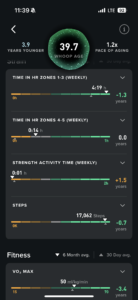
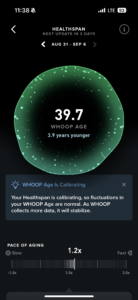
Will Ahmed [00:16:46]: Well, one of probably our members favorite features that we've rolled out is this health span score. So health span with WHOOP age is our way of quantifying your chronological age versus your physiological age. Essentially how old are you really based on your habits and your physiology. And we validated this and developed this with the Buck Institute of Longevity which is really the leading longevity institute in the country. A guy named Dr. Eric Verdin, the CEO there is really an expert on longevity. He's a member of our advisory board, scientific advisory board. And the health span analysis looks at nine different metrics and we can, we can actually talk about them because I think your audience will find this interesting.

Ben Greenfield [00:17:40]: Yeah, I'm actually really interested what you're feeding into it.

Will Ahmed [00:17:43]: Because we did a lot of, we did a lot of physiological research around what the metrics should be. Essentially we looked at all-cause mortality and we looked at what are the key variables that most impact all cause mortality. And we came up with three categories. We came up with sleep, strain and fitness. Now within sleep hours of sleep. So that's the total duration of sleep that you're getting. And sleep consistency. Sleep consistency we could talk more about.

Will Ahmed [00:18:15]: But that's the idea of going to bed and waking up at a very similar time.

Ben Greenfield [00:18:20]: Yeah, the opposite of so called social jet lag where you might have consistent Sleep times Monday through Friday, throw that off on a Saturday and Sunday, return back. Something as simple as that from the research I've seen, is enough to make a dent in lifespan from a sleep consistency standpoint.

Will Ahmed [00:18:36]: Sleep consistency has a massive impact on all cause mortality and your overall longevity. So we made that actually one of our top metrics. And then within strain, which is an umbrella for things related to exercise and activity, we have time and heart rate, zones one to three, time and heart rate, zones four and five. So that's essentially how much general activity do you get and also how intense is your activity? We have strength training time, which, as you know, strength training is a massive, massive indicator of how long someone's going to live in their overall health. And then we also have steps, which is a good proxy for, you know, your overall movement, activity level. I see you taking some steps right now, so you're well on your way.

Ben Greenfield [00:19:28]: Yeah. Will, well, real quick, does WHOOP auto detect for me, whether It's a strength versus zone 1 to 3 cardio versus zone 4 to 5 cardio, or do I manually input that?

Will Ahmed [00:19:41]: Well, it depends. You can do both. Actually, if you've just been on WHOOP recently, like you just started using it, it might take a minute for it to get to know you. So, you know, what you think of as box fitness, someone else thinks of as functional fitness, someone else thinks of CrossFit. Okay, you're gonna have to label that relative to what, how you want it WHOOP to know it. Right. But over time, as you start adding some of these activities, WHOOP will start detecting them and classifying them on its own. And it may even ask you along the way, hey, did you just do, you know, box fitness or fill in the blank?

Ben Greenfield [00:20:21]: Yeah, yeah.

Will Ahmed [00:20:23]: So within fitness, we've got VO2 max. So essentially, how much oxygen can your body consume? Resting heart rate, which is at rest, how low does your heart rate get? Lower is better. And lean body mass. So that's looking at the overall nine metrics that are affecting the WHOOP health span.

Ben Greenfield [00:20:48]: Okay, so a few things kind of related to my question about manually inputting strength versus cardio lean body mass. Is that something that I check on, let's say like a DXA or a body scan or a withings, and then I manually input that and that will go into my health span score.

Will Ahmed [00:21:07]: Exactly. And if you have a certain type of scale, it'll automatically upload to WHOOP. So if you have a Withings Scale or if you have a certain scale and that connects to Apple Health kit. Then the Apple health kit will send it to WHOOP. So there's some ways for it to be pretty automatic. But you can also at any point jump on a scale at your gym. And if it does lean body mass, you can then input that into WHOOP manually.

Ben Greenfield [00:21:30]: Okay. Yeah. When I ran an exercise phys lab years ago, to get VO2 max, you had to go in and put the mask on and do indirect calorimetry and basically run until you're falling off the back of the treadmill. Now, I have a Carol bike in my office, and that will do an approximation of VO2 max. How are you guys tackling VO2? Same thing manually input, or are you approximating it based on movement or activity levels or heart rate?

Will Ahmed [00:21:56]: Well, we did a massive study where we had a ton of people come in and do four formal VO2 max tests. And then from that we developed an algorithm using machine learning to approximate VO2max based on someone's entirety of their WHOOP data. And the VO2max measurement will change over time on WHOOP, and it'll be an estimate that keeps changing. If you've ever done a lab test, you can manually update your VO2 max on WHOOP and the day that you did it. And then on a go forwards basis, it'll be benchmarking off of that, off of that update. But our, our analysis shows that our estimate is within about 1 of, of someone's actual VO2 max. So if you had a reading of, of 50 on WHOOP, it would be between 49 and 51.

Ben Greenfield [00:22:52]: Yeah, that's pretty good. And I'm assuming by adaptation, let's say, you know, because VO2 max, for example, part of the function of it is weight. You know, that's in the, in the numerator. If someone loses weight, I'm assuming it would re estimate the VO2 max based on a lower kilogram.

Will Ahmed [00:23:09]: Exactly. It's, it's looking at your weight, it's looking at your exercise consumption. There's even some interesting variables around your heart rate that are driving the algorithm.

Ben Greenfield [00:23:22]: Yeah, okay, so the sleep thing. And honestly this kind of applies to the exercise too. You're no doubt aware of the Goldilocks zone. It's like you see an increase in all cause mortality once. Besides the occasional pro athlete, for example, sleep exceeds about nine hours a night. You also see the Goldilocks zone with exercise. Right. Once you're pushing much higher than 75 minutes per week.

Ben Greenfield [00:23:49]: Zone 5 plus, there's increased risk for say, arterial stiffness or cardiovascular disease. Do you guys factor in kind of like the more is not better when it comes to things like sleep or intense cardio. On the healthspan.

Will Ahmed [00:24:02]: Yeah. One thing that's cool about the way the score is visualized is it shows you orange, gray, green at different little intervals. So if you're. And also for your age and for your sex. So if you're a man who's 45 years old or you're a woman who's 65 years old, your bars and what your numbers actually mean relative to your score will be different. But one theme is, like, for sleep, for hours of sleep, for example, you're exactly right. Where if someone is getting, I think it's over nine hours of sleep on WHOOP, it actually starts to. To hurt your age, not help your age.

Will Ahmed [00:24:48]: Because there's a lot of evidence that people who are getting 9, 10, 11 hours of sleep actually may have some chronic issue that's the reason that they're getting that much sleep. And so.

Ben Greenfield [00:25:00]: Or even things like lack of purpose in life or relationships. Like, there's a lot of variables.

Will Ahmed [00:25:04]: Yeah. So it becomes actually a negative signal.

Ben Greenfield [00:25:06]: Yeah, yeah. With the healthspan score, let's say I get it. I measure it. I haven't messed around with this function too much. I remember checking it a couple weeks ago. I'm 43, let's say, gives me an output of 46 for biological age. Does it just give me that output, or will it say, and here's why, like, you need to worry, like, your sleep's good, cardio is good, you need to work on, say, like, VO2 max, and, I don't know, resting heart rate or something like that.

Will Ahmed [00:25:38]: Yeah, I mean, it's almost worth, like, pulling yours up. But, you know, you can see this on my screen, where it's got this big orb that shows you, like, how healthy it is, and I'm, like, 5.7 years younger.

Ben Greenfield [00:25:52]: Wait, did you just say you're 30? Does that say you're 30?

Will Ahmed [00:25:55]: Yeah, I'm 30.15.

Ben Greenfield [00:25:57]: You're not 30 chronologically, are you?

Will Ahmed [00:25:59]: Well, I'm 35, about to be 36.

Ben Greenfield [00:26:02]: Okay, so that's. That's good. You're, like, five years younger biologically.

Will Ahmed [00:26:05]: Yeah, almost six years younger. So I feel good about that. My pace of aging, that's something that changes every week. And so your age is based on your last six months of data, and your pace of aging is showing you how you're trending every week. So you want to have a pace of aging that is very low. But that's like a leading indicator essentially of how you're doing. So that'll give you a sense of like, okay, over the past week, were my actions and my behaviors and my physiology leading me in the right direction or not? So it's cool to have that like immediate feedback loop. And then for every metric you can actually see, you know, orange versus green.

Will Ahmed [00:26:49]: To what degree is a number helping or hurting? And it'll quantify everyone. So right now my sleep consistency is actually hurting my age. It's plus point two years. And that's in part because sleep consistency is affected by travel and part because I've got a six month old at home. So you know, so that's like a harder one for me. Whereas, okay, things like my strength training time, that's subtracting 1.6 years from my overall age. So that's really good. Or steps is subtracting 0.4 years.

Will Ahmed [00:27:21]: So you can go through each, each metric and see which ones you're doing best on and which ones you need to work on.

Ben Greenfield [00:27:28]: Yeah, that's incredible. It should factor in like number of times you've lifted a six month old. The video, by the way, for those of you who are listening to the audio, Will just held up his phone and showed some cool screenshots. You can see the [email protected]/WHOOP5. Obviously a lot of pretty cool rollouts. And actually I get questions from people a lot about like, why is the HRV different from device to device? And a few questions about sleep. I want to ask you those, but before I do, I don't know if you told me this. I found out through somebody, actually.

Ben Greenfield [00:28:05]: I think it was a guy talking about how he was rolling in Jiu-Jitsu and he had like a special pair of shorts that he could put because obviously you don't want to have some on your wrist. He could put the WHOOP into. And then I went to your website and you have like a clothing line that's not just like advertisement. Like it's actually designed to, to, to use with the WHOOP.

Will Ahmed [00:28:28]: Yeah, that's right. So we developed something called Anywear technology. And, and the idea is that you can put WHOOP in all these different locations on your body so that if you are doing an exercise where wearing it on your wrist is uncomfortable or prohibitive, you can still get the data. I mean Jiu-Jitsu is a perfect example. But I mean we work with professional athletes in every major sport, you know, someone like Patrick Mahomes is wearing a WHOOP during an arm. In an arm sleeve during every NFL game because he couldn't wear it on his wrist.

Ben Greenfield [00:29:08]: Right.

Will Ahmed [00:29:09]: Professional tennis players, you know, because the US Open is going on right now, a lot of them will wear it in. In their boxers or their underwear because they don't want to have it on their wrist while they're playing tennis. You can. You can really look at a lot of different sports, and you. You might realize, okay, is the wrist optimal or not?

Ben Greenfield [00:29:27]: And so, well, I'm. I'm like a cheapskate. Like, what is the difference between that and me just getting, like, a good sweat band on Amazon that's got, like, good elasticity and sliding it into that. Like, is there an actual, like, port that the. That the WHOOP slides into or something?

Will Ahmed [00:29:44]: Well, for your. For your visual audience, I'll show it here. You know, take WHOOP off. And it's mostly material, right?

Ben Greenfield [00:29:50]: Yeah.

Will Ahmed [00:29:50]: And I can take apart this band.

Ben Greenfield [00:29:52]: Yeah.

Will Ahmed [00:29:53]: And then all of a sudden, I've just got this little sensor, which is about the size of my thumb. And this little sensor can go into different sleeves that we've developed within our apparel. And we've validated that the apparel keeps the sensor on your skin properly, such that you still get the same accuracy of data.

Ben Greenfield [00:30:13]: Do you need. Do you need skin contact? Like, can there be a lining of fabric between the WHOOP and your skin or.

Will Ahmed [00:30:20]: No, the sensor has to be directly touching your skin, and it really needs to be secure, which is why we developed this ourselves versus, you know, bring your own apparel. You need it to be in a secure location. Now, some people also use our armband, so we have a bicep band, and you can wear WHOOP up on your upper arm. Funny enough, a lot of golfers do that. So you might see, like, Scotty Scheffler, Rory McElroy, or Justin Thomas. They've got this band up on their upper arm, that's WHOOP. And they're wearing it on their bicep.

Ben Greenfield [00:30:56]: Yeah, yeah. You remember, I think your older WHOOP was bigger, wasn't it?

Will Ahmed [00:31:00]: Much bigger.

Ben Greenfield [00:31:01]: Yeah. Yeah. Because I. I think. Actually, I think this came up on the Joe Rogan podcast. He asked me why I wasn't wearing one, and I said that my arms are kind of, like, tucked under my legs when I'm sleeping, and it feels like I just have, like, a giant chunky object down against my skin. I sleep with it now on my wrist. It doesn't Bother me.

Ben Greenfield [00:31:18]: But for people who are annoyed by things on their wrists when they're sleeping, do you have, like, a line of clothing that works for sleep?

Will Ahmed [00:31:26]: Yeah, we have actually a whole underwear collection. You can wear WHOOP. Now in our women's bras. We've got men's boxers, we've got women's underwear. So we actually have a whole collection of undergarments that people find comfortable wearing it at night.

Ben Greenfield [00:31:44]: Okay, this is pretty cool. All right, so I got to ask you some of the tricky questions now. So we're going to put the nerd propeller hats on sleep. There's, like, a ton of ongoing debate about the accuracy of sleep tracking in wearables. And there's, for example, some research I've seen saying they overestimate deep sleep stages. I know you guys are looking at consistency as well. Have you ever tested WHOOP against, what's it called, Plasmography? Like a professional sleep lab measurement?

Will Ahmed [00:32:21]: Yeah, PSG machines. That's how we developed the score in the first place, is against the gold standard sleep monitoring. And, and I, I have to look at our latest results, but I think it's like 96% sleep wake accuracy. Like, the accuracy numbers have gotten really, really high. And, you know, WHOOP is best in market at these things, so it's not surprising that, that the numbers are really good. I think there's. There's a little bit of variability amongst devices on these things or a lot of variability, and there's different reasons for that.

Ben Greenfield [00:33:03]: Have you ever tested, like, putting it in the underwear versus wearing it on the wrist for sleep?

Will Ahmed [00:33:08]: Yeah, we have. And the objective is for those readings to be very similar. So one of the things that we did when we put the sensor on your, you know, your upper arm versus your wrist versus your waist versus around your torso is, is to have the data be the same. And that was a really hard thing to do just to say it, but that's something we've, we've spent a lot of research and development on.

Ben Greenfield [00:33:37]: How does it compare, as you said, 96%. Not that I want you to just, like, start throwing people under the bus, but, you know, like, there's toppers or like eight sleep and then there's rings, of course, probably your biggest competitor. Do you know how those sleep scores match up to WHOOP?

Will Ahmed [00:33:56]: Yeah, I think that, like, overall, again, I believe that WHOOP is best in class at sleep. I think there's products that are good enough and there's products that, you know, objectively can't really measure sleep. And, and I would say some of the call it up and coming companies are actually better at sleep than you'd expect. And some of the big established players, you know, some obvious names are actually like really bad at it. And, and some of that becomes a, you know, a resource prioritization. Like, remember we talked about the fact that WHOOP doesn't have a screen being one of the reasons we collect more health data and we have a better battery life? Well, some of the products that do have screens, for example, are really bad at sleep monitoring. And it's in part because they don't have the throughput, so to speak, to accurately measure it.

Ben Greenfield [00:34:59]: Okay, back to the GPT question. You know, I asked about the mattress topper and obviously a lot of them, the primary reasons for cooling. Is there a way for me to mess around? Let's say I wanted to mess around for like the next month with whatever, 65, 64, 63, you know, and 60 degrees Fahrenheit in a sleep environment, Would that be a matter of me telling GPT and WHOOP, here's what I'm sleeping at, and then start to direct patterns? Or is there some other way to detect sleep environment temperature with the WHOOP besides just manually inputting?

Will Ahmed [00:35:33]: Well, we have a, what's called the WHOOP journal. And that allows you to input, I don't know, probably at this point over a hundred different behaviors and lifestyle decisions so...

Ben Greenfield [00:35:45]: That's the one that pops up like it pops up in the morning asking you about the previous day, right?

Will Ahmed [00:35:52]: Yeah. And so you can input things about alcohol consumption, hydration, did you take certain supplements? Did you spend time with an infant, you know, or parent an infant? Did you, did you, were you hydrated? Did you do cold plunge? Did you do sauna, steam? Like a really wide range of things that you can input about your lifestyle. And what a lot of people use that feature for is to your point, to try to sort of ab test something about their body. You know, if I, if I take magnesium before bed, does that help me sleep better? If I take melatonin before bed, does that help me sleep better? If I am well hydrated, you know, how does that improve my resting heart rate? There's a lot of sort of evidence like that. And, and what WHOOP does is it allows you to input these things and then under, you know, measure the result of them.

Ben Greenfield [00:36:48]: Yeah, I imagine you've got better things to do than just sit in front of a computer pouring over the big data you guys have collected. But from your users or from...

Will Ahmed [00:36:57]: We have a massive team that does that.

Ben Greenfield [00:36:59]: Yeah, it's just Will in his mom's basement.

Will Ahmed [00:37:06]: It's really a fascinating lens into physiology and we're able to make discoveries now that have never been made before.

Ben Greenfield [00:37:16]: Yeah, that's what I wanted to ask you though. Like, have you found out anything that's just like super shocking or head-turning about sleep in yourself or in the users?

Will Ahmed [00:37:25]: Well, we actually just published a big paper on 4 million nights of sleep that was around exercise. You'll appreciate this, but the amount of exercise, the intensity of exercise and the time of exercise that you do before sleep has a huge impact on your sleep. And if you exercise within four hours of going to bed, it'll disrupt your sleep. And every hour as you get closer to exercising before sleep, it more profoundly disrupts your sleep. And then the intensity of the exercise matters too. So if you do rigorous activity within 4 hours, 3 hours, 2 hours, 1 hour, each one of those is going to make it more impactful and negatively so on your sleep. And so it does raise the question of whether people should exercise within four hours of bed.

Ben Greenfield [00:38:19]: Yeah. Which is not surprising based on body temperature and endorphins and possibly even a later post workout feeding. But then where my mind goes is, okay, so now let's say that's what my life dictates. My schedule dictates that the best time of day to exercise is when I can actually do it. I could then say, okay, so I'm going to take glycine, a supplement that appears to be able to lower blood temperature or body temperature a little bit. I'm going to do like a lukewarm shape, shower before bed, turn down the temperature. How many, half a dozen factors could I use to potentially still get in my 8pm exercise session and get good sleep?

Will Ahmed [00:39:04]: I think that's right. I mean again, this goes back to manage what you measure. And so if you measure all these different things, you can start to quantify for yourself how to improve your sleep despite that disadvantage. And it may also make sense, try to go to bed later, ironically, if you have to exercise in the evening, but then try to wake up later. And so you try to shift your sleep schedule if you're always going to be exercising at that period.

Ben Greenfield [00:39:32]: Right? Yeah, yeah. I think some of the biggest ones would be like take an adaptogen, get the body cold afterwards, use some glycine and pay attention to your post workout meal and maybe prioritize pre workout and a quick, quick post workout snack. But I guess based on big Data we'll be able to find out eventually. So heart rate variability, this is another one. I mean, I know you've probably heard this almost close to the time that you launched. Varies widely between devices. And so many people get confused about the algorithms. And why am I 40 on this device and 60 on this device? How do you tackle that? Like, how do you explain to somebody sitting next to you on an airplane, you know, what is it about the reason that the heart rate variability can vary so widely?

Will Ahmed [00:40:17]: Well, the first thing to understand about heart rate variable, just big picture for your audience, heart rate variability is the amount of time between successive beats of the heart. So if your heart's beating at 60 beats per minute, it's not beating every second. It might be beating at 1.2 seconds and then 0.8 seconds and then 0.6 seconds and then 1.4 seconds. And it turns out that variability in the time of beats of your heart is actually a good thing. And it's because it's this lens into your autonomic nervous system, which consists of sympathetic and parasympathetic activity. And you want for sympathetic activity for there to be parasympathetic response. And that's a sign that your body is well adapted and rested and governing its environment.

Ben Greenfield [00:41:05]: Right. Yeah. The pacemaker cells of your heart are responding with good precision to your nervous system.

Will Ahmed [00:41:11]: Well said. And. And so, WHOOP. Measures heart rate variability 24/7. And we also measure it super accurately. So the first thing, first big question for any wearable device is can it actually measure heart rate variability? Because heart rate variability is measured in milliseconds, some products aren't actually sampling at a high enough rate to even measure it accurately. Right, right. And so one of the things that WHOOP has always done is sample at the highest rate possible relative to other products on the market.

Will Ahmed [00:41:44]: That alone has helped us be more accurate heart variability. The second thing is, okay, when you measure heart rate variability for a recovery score, for example, what measurement are you using? Are you taking an average of someone's heart rate variability over a long period of time, over all of sleep, or is it a different measurement? What we discovered is the most useful measurement of heart rate variability to predict recovery was actually during slow wave sleep. And what we look at is the last five minutes of slow wave sleep every single night. And that also creates what we call a control, because heart rate variability is so noisy. And right now, my heart rate variability is different than it would be in 10 minutes from now, depending on what we're talking about and what I'm thinking about and how much I'm moving so on and so forth. Because it's such a noisy statistic. It's very sensitive. Right.

Will Ahmed [00:42:42]: Because your body's sensitive and it's measuring a sensitive thing. It's really important that you take it in a control and you're able to then compare it under similar circumstances. Now why slow wave sleep? Slow wave sleep is when your body is producing 95% of its human growth hormone. You know, people think they get stronger in the gym. You're actually breaking your muscles down in the gym that then need to be repaired. A lot of that happens during slow wave sleep. Right.

Ben Greenfield [00:43:13]: Unless you got your hands on Deca.

Will Ahmed [00:43:15]: Right, well, we can, we can get, we can get into that. And so, and so slow wave sleep is this, you know, very powerful restorative period for your body. And it happens in stages over the course of the night. And we look at the last period of slow wave sleep, and that's when we use the heart rate variability calculation for recovery. Now, another product that's measuring or claiming to measure heart rate variability, probably, first of all, there's a question mark of how accurately it's being measured. And then there's a question mark on when are they actually showing you the reading of it and is that the right time? So, for example, if they were taking an average over a long period of time, that might actually not be that reflective of how recovered you are. WHOOP, for example, has a stress score where we're looking at heart rate variability in real time every minute of the day to show you how heart rate variability is indicating stress levels. And again, that's a different reading than if it were for recovery.

Ben Greenfield [00:44:21]: Yep, so if somebody is seeing their stress levels, I'm actually asking this because I have client who will sometimes see like eight to nine hours of elevated stress levels during the average workday. Just knowing what you know and what you've seen, does that typically come down to HRV or are there other things that somebody like that should be looking into? Or let's say that it actually does come down to HRV. HRV really is low stress. Strain is high during the day. What do you typically tell somebody like that to do or to look into?

Will Ahmed [00:45:03]: Well, if that's every day at work and it's not, they don't have a very active job. I do think they probably want to start identifying mechanisms to manage their stress better and we can spend a little bit of time talking about that. The other piece that I would look at is their resting heart rate during that period. So the way WHOOP is looking at stress is a combination of heart rate variability relative to your baseline and resting heart rate relative to your baseline. It's really critical to talk about these things relative to baselines because that's the way you can actually give someone a personalized analysis of it.

Ben Greenfield [00:45:44]: When you say relative to baseline, by the way, you mean the five minute slow wave sleep measurement.

Will Ahmed [00:45:49]: Well, what I really mean is relative to your averages of that metric, okay, over the course of the day, you probably have some average heart rate variability, and during activities, you have some average heart rate variability. And then, you know, during sleep, you have, you know, different averages of heart rate variability depending on whether it's slow wave sleep or your overall sleep. And what I'm saying is it's really important to compare individuals to themselves, not to a population. You can compare to a population if you want to talk about fitness or longevity or whatnot, but in the context of what does it mean for you? You want to look at it versus yourself. Said differently; If I told you, hey, my HRV last night was 70, how recovered am I? You could never answer that question without knowing what my baseline HRV is. If my baseline HRV is 50, and all of a sudden I'm 70 today, odds are my body's really restored. However, Michael Phelps's baseline is, you know, 175 HRV, and today he's 70.

Will Ahmed [00:46:58]: He's super run down. So all I'm saying is you can't just look at the absolute number. You have to look at it relative to someone's baseline.

Ben Greenfield [00:47:05]: Yeah, yeah. Similar to blood glucose. You know, I tell people, well, you might have an average of 100, but that might be totally normal for you. And as a matter of fact, with low carb keto people, that is more normal just because the liver mobilizes more glycogen to raise blood glucose. A little paradoxical, but it happens. And I tell them I pay more attention to if it's been 100 for two weeks and all of a sudden you're seeing 110, 115, that's what you pay attention to more often, along with how often it's spiking up and down during the day and how quickly returns to baseline after a meal. So what you're saying is pay a lot of attention to trends, especially a decreased trend in HRV. And I covered this research years ago and bring it up occasionally on podcasts.

Ben Greenfield [00:47:49]: The shocking accuracy at being able to predict injury and illness before you realize it's happening. I think this even happened a little bit during COVID although it was related to body temperature, I believe. Like, you could actually use a wearable to predict an illness or even a musculoskeletal injury that could occur if you push through that trending low HRV.

Will Ahmed [00:48:14]: Yeah, there's going to be some very powerful research published soon on. On physiological data and injuries. We had a pretty powerful study we actually did a long time ago now with Major League Baseball, where we were able to show that athletes with a lower recovery had a higher chance of a muscular strain injury. So, you know, when you normalize for injuries that otherwise might have been from contact, you know, we can't. We're not gonna be able to predict that you, you know, you broke your leg because someone fell on it. But when you were able to look at the physiological data alongside muscle strains, there were some pretty interesting correlations there with low recovery and a higher likelihood for injury.

Ben Greenfield [00:49:05]: Yeah. And obviously some subtle nuances, like, from an exercise periodization standpoint, you do want to intentionally overreach at times and then super compensate and recover. And you can use HRV to do that. Say, okay, I've dug myself into a hole intentionally, or my coach has, and now I'm going to super compensate.

Will Ahmed [00:49:23]: Yep, exactly.

Ben Greenfield [00:49:25]: One last question about HRV. Similar to my question about sleep. Have you found anything kind of like abnormally shocking or surprising about things that either increase or decrease HRV that you didn't expect?

Will Ahmed [00:49:37]: Well, your question actually made me think of something slightly different, which is we did a really fascinating study on pregnancy, and essentially we enrolled about 2,000 pregnant women, and they offered to have their data shared for research purposes. And we were able to look at their heart rate variabilities over the course of pregnancy. What we saw was this steady decline of heart rate variability over the course of a woman's pregnancy, leading up to seven weeks right before delivery, and then seven weeks before, all of a sudden, the HRV started spiking. If you look at it on a graph, it looks like a V where it's steadily declining, declining, declining. And then all of a sudden, it shoots up. And the, you know, the anecdotal explanation for that is it's a woman preparing her body for what is like, an enormous athletic feat, so to speak. Right. Like, giving birth is the ultimate human performance, so to speak.

Will Ahmed [00:50:43]: And what's also powerful, though, about this phenomenon is it's predictive. It doesn't just happen at the 33rd week. So when we looked at the 2000 pregnancies 10% of them were early deliveries, so they didn't go to 40 weeks. And so we were able to observe this seven week phenomenon even for people who delivered at the 36th week. So at the 36th week, at the 29th week, we saw the inflection. And so it's become a very powerful piece of our pregnancy. Coaching on WHOOP, where we graph women's heart rate variabilities and we give them a sense for whether or not they are trending to a normal delivery or whether there might be signs of an early delivery.

Ben Greenfield [00:51:32]: Yeah. That has implications for the husband about how to time their paternity leave. Yeah, super valuable lot. Lots of implications. Wow, it's fascinating.

Will Ahmed [00:51:42]: That was kind of an unexpected learning, right. From large data. And again, heart rate variability being this fascinating indicator.

Ben Greenfield [00:51:51]: Yeah, yeah, I know. I only have you for so much time, so I want to make sure I cover another. This is probably like the last tricky question that I get. The EMF piece right. No doubt. You know, lots of people are concerned about Bluetooth radiation, EMFs, magnetic fields, what's on their body. And even just this morning I had a client tell me, hey, what about the WHOOP? I told him I was interviewing you and I told him I'd ask you like if somebody has some friend who's a building biologist with a fancy meter and they wave the magic wand over the person's wrist and they tell them, hey, look, this is putting out radiation on your body, what's your response to that?

Will Ahmed [00:52:32]: Well, Bluetooth low energy, which WHOOP uses, has a remarkably low signal relative to WI fi and cell service. So unless you're in an environment in your entire life with no WI Fi or cell service, that's a much bigger issue for you than wearing a WHOOP. And if you want to minimize Bluetooth transfer, like during the night, for example, you could, you know, have your phone on airplane mode and in a different room or something, and then it's not going to be sending data.

Ben Greenfield [00:53:06]: Oh, so if my phone's in airplane mode, which it is anyways, when I'm sleeping, the WHOOP detects that. And it's not going to just be trying all night to send data.

Will Ahmed [00:53:14]: Well, it's not going to be able to send data through.

Ben Greenfield [00:53:16]: Yeah. Okay. And then regarding the, like the EMF piece relative to a phone, I tried to look it up before the call. The best that I could find is the phone puts out about two to three times the amount that's with WI Fi and Bluetooth disabled than the WHOOP does. When the WHOOP is transmitting to your phone. So the way I think about this is if you're going to complain about it, like, you should probably also just have your phone off all the time. And the signal itself is still like. If you were to say that the WHOOP, at least from, from what I found, puts out like two times more radiation than some comparable device, we are still talking about levels of radiation that are far below the safety limit for, I think, what's called, what is it like, I think specific absorption radiation, SAR or something like that.

Ben Greenfield [00:54:15]: So we're still talking about low values because. Good stuff. I live in a stupid home, Everything's hardwired. I'm pretty careful about what I put on my body. And from all the data I've seen, I'm not concerned.

Will Ahmed [00:54:27]: Yeah, well, I think, I think you summarized it well. And for someone who's really concerned with it, I would just point to other sort of situations in their life. I mean, that individual wouldn't be able to walk down the sidewalk without having more exposure than what a WHOOP would put out.

Ben Greenfield [00:54:43]: And obviously it's kind of paradoxical, but you could wear the WHOOP and test it. I mean, I don't know how you test it without it on to compare the differences, but maybe at least test it with airplane mode on your phone on for a while and then off for a while and see if what it's emitting when your phone is in airplane mode on is somehow affecting your HRV or sleep or something like that.

Will Ahmed [00:55:06]: Well, one thing I'd add too, which is interesting, is WHOOP stores up to 30 days of data. So if you've got a WHOOP which has a two week battery life, and then you have the battery pack with you, which also has another two weeks of battery on it, you can essentially go on a backpacking trip for a month without having any connectivity. And you'd have a month of data just sitting on your WHOOP for the next time that you come within range of your phone. So it's always storing data too, which is powerful.

Ben Greenfield [00:55:37]: Yeah, it's a good point. Two last questions for you, Will. Any little secret projects in the Batman lab that you guys are working on that you haven't mentioned yet, that might be something you could allude to or that could be rolled out in the future?

Will Ahmed [00:55:55]: Well, I'd point you to Advanced labs, which is a wait list that we've now developed in the WHOOP lab or in the WHOOP app. Excuse me. And that is growing remarkably fast. We've got over 350,000 people just in the US signed up for our wait list for advanced labs and that's going to allow you to do blood testing. And then we're going to have more and more data points as well where you're going to be able to add all of the essentially health metrics that you might be collecting elsewhere. And I think that's for people. That's going to be a big deal. Like you just said, you've got a decade of blood tests.

Will Ahmed [00:56:33]: They're probably on printout somewhere, not super well organized. And you'll be able to upload all of that and have it under the same umbrella as all your physiological data.

Ben Greenfield [00:56:44]: Yeah, I think, I think I saw that pop up and signed up for like two weeks ago. Can people pay for this with health insurance HSA? I mean, I know it's like the, the wearable itself is pretty inexpensive and then you pay for subscription. But how does it work as far as any insider tips for getting some kind of a savings from a health insurance or HSA standpoint?

Will Ahmed [00:57:10]: Yeah. Just to be clear, on the, on the business model, the hardware is entirely included in the membership and there's three different membership tiers. So you can pay anywhere from 15 to $30 a month for it on an annualized basis and depending on what features you want. And then you can also use HSA FSA to cover an annual membership.

Ben Greenfield [00:57:35]: Yeah, which is, I don't know, rough math. Annual membership, like was like $350, $400.

Will Ahmed [00:57:41]: That's the highest tier, is $360 and then you've got one.

Ben Greenfield [00:57:46]: So if I'm able to put away, last time I checked, we're like 6k into my HSA. I can easily cover all that. Okay, cool. I am going to. I don't even know what it is, but I think even since 2017 we've had some kind of a discount code for WHOOP that I haven't put out there for a while. But I will hunt it down and find it and put it in the show notes, which should knock a few more bucks off for you. That's going to be at BenGreenfieldLife.com/WHOOP5 like w h o o p the number five will. It's kind of been fun like after not talking for a while and then getting my hands on the new technology a couple of months ago to reconnect and start to experiment with this thing again. And honestly I'm. I'm having a lot of fun with it/feel like I haven't even begun to tap into all the all the things it can do.

Will Ahmed [00:58:35]: Well, I'm excited for you to get up and running on it and especially see your healthspan score. I bet you're a lot younger than your age. And look, it's been...

Ben Greenfield [00:58:47]: I keep glancing around for my phone. It's out of reach. I'm going to check, you know, what I'll do for people listening because I know you're all curious now. I'll check it after the call and upload a screenshot to the show notes.

Will Ahmed [00:58:59]: Yeah, I'm sure it's great. And yeah, look, it's been awesome to see your growth over the last eight years too. And big fan of your voice in the health and performance space.

Ben Greenfield [00:59:11]: Cool. Thanks man. Will Ahmed, Everybody, from WHOOP. BenGreenfieldLife.com/WHOOP5 for the juicy show notes. And Will, thanks so much for for doing this.

Will Ahmed [00:59:20]: Awesome. Thank you, Ben.

Ben Greenfield [00:59:22]: All right, folks, thanks for listening. Hit subscribe, leave a ranking, leave a review. If you got a little extra time, it means way more than you might think. Thank you so much.

Ben Greenfield

Ben Greenfield is a health consultant, speaker, and New York Times bestselling author of a wide variety of books.

What's Blocking You From Living Boundless?

Thoughts on Could This Be The World’s Most POWERFUL Self-Quantification Device?! (& Is It Even *Safe* Or *Accurate*?) With WHOOP’s Will Ahmed

2 Responses

  1. For all the fancy stuff and $ubscription$, it is shocking to me that WHOOP can’t turn off transmissions. They are selling to a health-conscious audience, a portion of which is EMF-conscious, yet are unable to solve the EMF transmitting problem.
    Will: “Well, it’s not going to be able to send data through.” -> ie: WHOOP is too stupid to know, and will continue trying to send all night.
    I know Ben needs to be cordial, but the primary concern is that no one ‘wears’ a phone 24×7, the WHOOP is effectively grounded to you.
    Sad

  2. Ben,

    You are like 45 right so yo are really 39.7! Cool. I am 80 and my Whoop age is 64.2. I am more grateful than I was before now.

    Also am using “Ask Ben” in your Life Network App. Curious if it learns from what I tell it and how often is new information like from this podcast uploaded?

Leave a Reply

Your email address will not be published. Required fields are marked *

Related Podcasts

Kyal Van Der Leest YT

The Coolest, Craziest Oral Peptides (& Where To Get Them), Boosting Testosterone Without Drugs & More With LIFE Network Expert Kyal Van Der Leest

Listen on: Reading Time: 8 minutes What I Discuss with Kyal Van Der Leest Kyal’s quick reference guide for understanding...

RAW 12 NSDR podcast WP

Ben’s #1 “Sleep Simulation” Tactic: The Art & Technology of Non-Sleep Deep Rest (NSDR) – LIFE Network: RAW Podcast #12

Listen on: Reading time: 4 minutes What I Discuss in this RAW episode: How chronic slight sleep deprivation can quickly...

Dr. Khanh Nguyen on Regenerative Medicine

The Surprising Science Of Injecting Young Blood, Salmon Sperm & Stem Cells Into Your Face (And Other Places) With Dr. Khanh Nguyen

Listen on: Reading time: 7 minutes What I Discuss with Dr. Khanh Nguyen: The distinction between therapeutic plasma exchange (TPE)...